

Ramadan arrives with the same promise every year: a month whose fasting and standing can erase what came before it. The Prophet (ﷺ) said: “Whoever fasts Ramadan out of faith and seeking reward, his previous sins are forgiven” (Al-Bukhari and Muslim). But a fast can be physically complete and spiritually empty, and a month can pass with all its hunger and none of its harvest. The difference is rarely the big, obvious invalidators; it is the small mistakes, repeated daily, that quietly drain the month.
This guide names the mistakes that matter most, in order: the mistakes of the heart that corrupt the fast from within, the eating and drinking errors people get wrong in both directions, the sins of the tongue the Prophet (ﷺ) specifically warned fasting people about, the schedule failures that burn the month by day three, and the health errors that send worshippers to the couch when they should be in the masjid. Fixing even half of them transforms the month. For Ramadan 1448, expected to begin around February 8, 2027, there is still time to plan differently.
Mistakes of the Heart: Where Fasts Quietly Fail
Fasting without intention. The fast is an act of worship, and acts of worship live in the intention. The Prophet (ﷺ) said: “Whoever does not resolve to fast before dawn, there is no fast for him” (Abu Dawud, At-Tirmidhi). The intention is not a sentence to recite but a resolve in the heart, and anyone who plans to fast tomorrow has made it. Still, the Muslim who treats Ramadan as cultural habit, waking for suhoor because the family does, has left the foundation unlaid. Renew the resolve nightly; it takes three seconds. For the detailed rulings, see our guide on the intention for fasting in Ramadan.
Fasting to be seen. The person who fasts for compliments on their discipline or their weight loss has traded the reward of the Hereafter for applause. Riya’, showing off, does not invalidate the fast legally, but it poisons its acceptance. The cure is privacy: do not narrate your worship, and let your tiredness be a secret between you and your Lord.
Learn to read the Quran correctly — Start Learning Quran →Fasting as a diet. Ramadan often arrives wrapped in fitness goals, and losing weight is a fine side effect. But a month planned around a calorie target is a diet that happens to coincide with Ramadan. Let the meal plan serve the worship, never the reverse.
Eating and Drinking Mistakes
Punishing the forgetful eater. Someone eats mid-morning, forgets they are fasting, then remembers in horror. The ruling is mercy: “Whoever forgets while fasting and eats or drinks, let him complete his fast, for it is Allah who fed him and gave him drink” (Al-Bukhari and Muslim). The fast stands. No makeup, no sin. The mistake is not the forgetfulness; it is the person who stops fasting, or who swallows another bite after remembering.
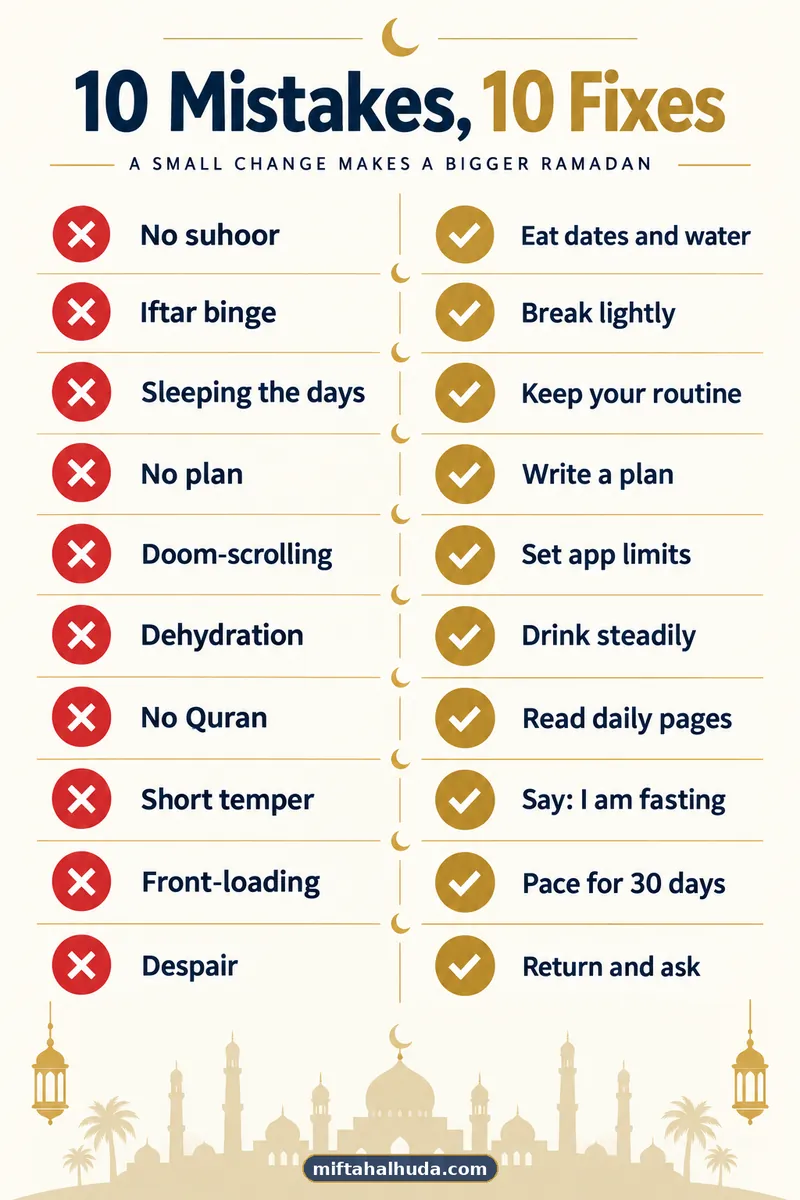
Skipping suhoor. “Take suhoor, for in suhoor there is blessing” (Al-Bukhari and Muslim). The pre-dawn meal is the month’s fuel and its most underrated act of worship. Even dates and water fulfill the sunnah. Skipping it buys an hour of sleep and sells a day of energy. See what to say and eat in our suhoor dua guide.
The iftar binge. A day of fasting followed by a table of fried food is the month’s most universal mistake: the stomach swells, the blood sugar crashes, and taraweeh becomes impossible. Break the fast lightly, as the Prophet (ﷺ) did, on dates and water, pray Maghrib, then eat the main meal calmly. Your night prayer depends on this single discipline. The words to open with are in our iftar dua guide.
Overcorrecting on gray areas. Some worshippers refuse to swallow their own saliva, avoid showering, and spit constantly, turning the fast into anxiety. None of these break the fast. Exaggerated scrupulousness is itself a mistake the scholars warned against; the religion is ease, and the devil is pleased when worship becomes misery.

Mistakes of the Tongue and Limbs
The Prophet (ﷺ) set the standard: “Fasting is a shield. So when one of you is fasting, let him not speak obscenely or act ignorantly. If someone insults him or fights him, let him say: I am fasting” (Al-Bukhari and Muslim). Then the warning that should hang in every kitchen and office in Ramadan: “Whoever does not leave false speech and acting upon it, Allah has no need of his leaving food and drink” (Al-Bukhari).
The Ramadan temper. Hunger shortens fuses, and “I am fasting” becomes a license to snap instead of a reason to restrain. The hadith reverses it: the fast is the argument for patience, and the fasting person’s answer to provocation is those two words, said to himself first.
Backbiting over iftar. Ramadan gatherings are the month’s warmth, and its most reliable sin. A fast protected from food all day and spent on people’s faults all evening arrives at the scales light. Guard the majlis: change the subject, excuse the absent, or sit with better company.
The entertainment fast. Fasting from halal food while binging content that hardens the heart is a contradiction the soul feels. Ramadan’s nights were made for the Quran; a screen diet is the cheapest, highest-yield upgrade of the month.
Schedule Mistakes That Burn the Month
No plan. The believer who enters Ramadan with no Quran target, no charity plan, and no nightly schedule finishes it with good intentions and vague regret. Write the plan in Sha’ban: a juz a day or a page a day, a fixed nightly prayer slot, a set charity amount. Our Ramadan preparation guide walks the full setup.
Sleeping the daylight away. Flipping day and night makes the fast easy and empty. The sleeping fast is technically valid, but it trades the month’s schools, work, and family witness, its intended friction, for unconsciousness. Rest, yes; hibernate, no.
Front-loading and collapse. The first three nights of heroic worship followed by twenty-six of exhaustion is the classic amateur arc. The most beloved deeds to Allah are the most consistent, even if small (Al-Bukhari and Muslim). Pace for thirty days, and peak in the last ten, not the first three.
Worship Mistakes
Fasting but abandoning the prayer. The five prayers are the pillar; the fast is the month’s specialty. A fasting person who skips Salah is guarding a branch and dropping the trunk. If Ramadan does nothing else for a lapsed worshipper, let it restore the five prayers on time; that alone is a life’s repair.
A taraweeh-only Ramadan. Some worshippers fast the days and fill the nights with taraweeh but leave the Quran unread, the dua unmade, and the charity ungiven. The month is a package: fasting, Quran, prayer, charity, and repentance. Our Ramadan Quran schedule and Ramadan duas collection cover two of its pillars; build all five.
Reading the Quran without stopping at its meaning. Speed khatmahs have their place, but a juz rattled through daily without a single verse landing is the recitation equivalent of the entertainment fast. Read most of the month at your sustainable pace, and give at least a few pages each day to slow reflection with a translation or tafsir.
Delaying repentance to the last ten nights. The last ten nights are the peak, not the starting gun. Whoever plans to “get serious” on the 20th has misunderstood the month; its forgiveness flows from day one, and the training arc exists precisely so the final ten find you ready. See the last ten nights plan for how the month builds toward them.
Health Mistakes
Dehydration. The headaches and brain fog of the first week are usually water, not hunger. Drink steadily from iftar to sleep, roughly eight to ten cups, rather than flooding at suhoor, where excess simply passes through. Limit evening caffeine, which dehydrates and steals the sleep the month already shortens.
Ignoring medical limits. The fast that endangers a sick body is not piety; Allah Himself excused the ill and the traveler. Diabetics, pregnant and breastfeeding women, and those on time-critical medication should consult a trustworthy doctor and a knowledgeable scholar before Ramadan, not after a collapse. The rules for missed fasts, fidyah, and exemptions exist precisely for them; our Ramadan fasting rules guide lays them out.
Training like it is not Ramadan. Athletes who keep peak-season intensity on empty tanks invite injury and burnout. Shift hard training to after iftar or before suhoor, cut volume, and let the month be maintenance, not progress.
Family and Social Mistakes
Fasting alone in a full house. Some worshippers pursue their own program so single-mindedly that the family experiences Ramadan as a month of their absence. The Prophet (ﷺ) woke his household to worship; the fast that makes a parent harsher, a spouse colder, or a father invisible has its priorities inverted. Pray together, eat together, and let the children catch the month from you.
Turning iftar into a competition. Lavish spread versus lavish spread wastes food in the one month whose whole curriculum is appetite. Cook enough, not for display; send the surplus to neighbors and workers while it is warm. A simple iftar shared with presence feeds more than a banquet eaten in distraction.
Abandoning the children from the masjid and the month. Kids who are banned from the prayer space or ignored through the month learn that Ramadan is for adults. Bring them, teach them, and give them their own small fasts and rewards. Our Ramadan for kids guide has age-by-age ideas.
Money and Charity Mistakes
Leaving zakat al-fitr to the last hour. Zakat al-fitr is due before the Eid prayer, and it is meant to reach the poor in time to feed them on Eid morning. Every year, payment platforms crash and families scramble on the last night. Set it in the final ten days and sleep easy. The amounts and rules are in our zakat al-fitr guide.
Giving only when it trends. Ramadan’s donation drives are a mercy, but charity that waits for a campaign or a camera misses the month’s quieter reward. The best giving of these nights is the scheduled, private, nightly amount that no one sees, guaranteed to catch Laylat al-Qadr among them.
Forgetting that fasting itself is a treasury. Feeding one fasting person their iftar earns a reward equal to their fast (At-Tirmidhi). The colleague, the taxi driver, the masjid’s cleaning staff: a box of dates and a juice is a deed most budgets can carry daily.
Technology Mistakes
Entering the month with an argument. The moon-sighting debate returns every year, and every year it costs someone their first night’s peace. Follow your community’s scholars, wish the other camp a blessed Ramadan, and let the calendar dispute die at the group-chat door.
Fatwa shopping. Asking the same question to five scholars until one permits what you wanted is not research; it is shopping. Choose one trustworthy local scholar or body, follow them, and spend the saved energy on worship.
Letting the phone break wudu of the heart. The group chats, the news scroll, the short-video reel: none of it breaks the fast, and all of it breaks the fast’s atmosphere. Set app limits for the month, keep the mushaf app on the first screen, and let the phone serve the season instead of stealing it.
The Biggest Mistake of All
After the broken resolutions and the lost tempers and the missed taraweehs, one mistake outranks every other: despair. The worshipper who decides by mid-Ramadan that the month is already ruined has believed Shaytan’s oldest lie. The doors are open until the crescent of Shawwal rises. A sincere return in the final week outweighs a sloppy first three; the last ten nights alone contain a night worth more than eighty-three years. Whatever the month has been so far, the next fast can be the one that is accepted, and the Lord who feeds the forgetful eater is the Lord who pardons the returning servant. Ask Him, and keep asking, with the words He taught through His Prophet (ﷺ) in our Laylat al-Qadr dua.

Mistakes Around Eid and After
Fasting the day of Eid. Fasting on the first of Shawwal is prohibited; the Prophet (ﷺ) named it a day of eating and celebration. The believer who “extends” Ramadan by fasting Eid disobeys in the name of piety.
Skipping the Eid sunnahs. Eating dates before the Eid al-Fitr prayer, taking the ghusl, wearing one’s best, and walking to the prayer by one route and returning by another are the Prophet’s (ﷺ) own Eid morning. The full checklist is in our Eid al-Fitr guide.
The Shawwal crash. The most common post-Ramadan mistake is treating the crescent as a finish line: the Quran closes, the masjid empties, and by week three nothing remains. The scholars named continuity the sign of acceptance, and Allah opened the gentlest of bridges: six days of Shawwal that carry the reward of a year’s fasting (Muslim). Keep one thread from the month unbroken, a daily page, a weekly fast, a guarded prayer, and start with the six fasts of Shawwal.
Mistakes in Seeking Laylat al-Qadr
Sleeping the odd nights after a month of effort. The believer who prayed twenty-nine nights and slept the 27th has slept through the most likely candidate. Rearrange the last ten days around the nights: nap, lighten the schedule, tell work and family now.
Chasing signs instead of worship. Every year someone asks whether last night’s calm, softness, or sunrise marked the night. The signs are recognized after the fact, not chased in it; the only reliable method is standing all ten.
Leaving after taraweeh. In the last ten nights the prayer after taraweeh, the qiyam, the qunoot, and the quiet hour before suhoor are the night’s marrow. Leaving at the imam’s last tasleem of taraweeh and driving home to sleep forfeits what the congregation stayed for.
Frequently Asked Questions About Ramadan Fasting Mistakes
1. Does eating or drinking forgetfully break the fast?
No. The Prophet (ﷺ) said the forgetful eater was fed by Allah and should complete the fast (Al-Bukhari and Muslim). The moment you remember, stop immediately, even removing food from your mouth. Deliberately continuing after remembering invalidates the fast.
2. Does brushing teeth or using miswak break the fast?
No. The miswak is a sunnah of the fasting person’s day. Toothpaste requires care to avoid swallowing, so many scholars prefer it before Fajr and after iftar, but swallowing nothing, nothing breaks the fast.
3. Does swallowing saliva or showering break the fast?
Neither breaks the fast. Swallowing one’s own saliva is unavoidable and permitted by consensus, and showering or swimming is allowed as long as no water is deliberately swallowed. Excessive worry about these is the scrupulousness the scholars discouraged.
4. What happens if I deliberately break my fast without excuse?
Deliberately eating or drinking during a Ramadan day without a valid excuse is a serious sin requiring sincere repentance and making up the day. If it involved intimacy, the expiation of kaffarah applies; the details are in our guide to kaffarah for breaking a Ramadan fast. Whatever happened, do not compound it by abandoning the rest of the month.
5. Do injections or eye drops break the fast?
Non-nutritive injections, vaccinations, and eye or ear drops do not break the fast according to the majority of contemporary scholars, including the Islamic Fiqh Academy. Nutritive IV drips that replace food and drink do break it.
6. Does anger or lying break the fast legally?
Sins like lying, backbiting, and losing one’s temper do not invalidate the fast legally, so no makeup day is owed, but they eat its reward, and the Prophet (ﷺ) warned that some fasting people get nothing from their fast but hunger. Guarding the tongue is part of the fast’s purpose.
7. Is my fast valid if I skip suhoor entirely?
Yes, valid but incomplete. Suhoor is a stressed sunnah with blessing in it, not a condition of validity. Fasting without it is permissible, harder on the body, and deprived of a prophetic practice that takes minutes to keep.
8. Can I taste food while cooking during Ramadan?
Scholars permit tasting with the tongue when genuinely needed for the cooking, provided nothing is swallowed. If you can rely on measures and recipes instead, that is safer; if you must taste, keep it to the tongue and spit it out.
9. I had a terrible first week. Is my Ramadan ruined?
No. The month’s forgiveness runs to its final night, and the last ten nights alone outweigh years of ordinary worship. Repent, reset the plan at whatever day you are on, and finish stronger than you started. The only ruined Ramadan is the one abandoned.
10. Does vomiting break the fast?
Unintentional vomiting does not break the fast; the Prophet (ﷺ) said: “Whoever is overcome by vomiting has no makeup upon him, and whoever makes himself vomit must make it up” (Abu Dawud, At-Tirmidhi). If you feel nauseous, do not fight to keep food down out of fear; let the body do what it needs and continue your fast.
Learn to read the Quran correctly
Start or improve your Quran reading with a certified teacher, one-to-one online.