

The Laylat al-Qadr dua is the most valuable sentence a Muslim can carry into the last ten nights of Ramadan. One night, hidden among them, is better than a thousand months, and the Prophet (ﷺ) taught his wife Aisha exactly what to say when she finds it.
This guide gives you that supplication with its Arabic text, transliteration, translation, and source, explains when to look for the Night of Decree, and gathers the other duas and deeds that fill the last ten nights. At Miftah Al-Huda Academy, we believe every worshipper deserves to understand the words they say to Allah.
What Is Laylat al-Qadr?
Laylat al-Qadr, the Night of Decree, is the night the Quran began to descend. Allah says about it:
“لَيْلَةُ الْقَدْرِ خَيْرٌ مِنْ أَلْفِ شَهْرٍ”
Learn to read the Quran correctly — Start Learning Quran →“Laylatul-qadri khayrun min alfi shahr.”
(The Night of Decree is better than a thousand months.) – Surah Al-Qadr, 97:3.
One night of worship worth more than a lifetime of ordinary nights. The angels descend in it, peace fills it until dawn, and Allah hides its exact date so that believers strive through all ten nights instead of relaxing after one.
The Dua the Prophet (ﷺ) Taught Aisha
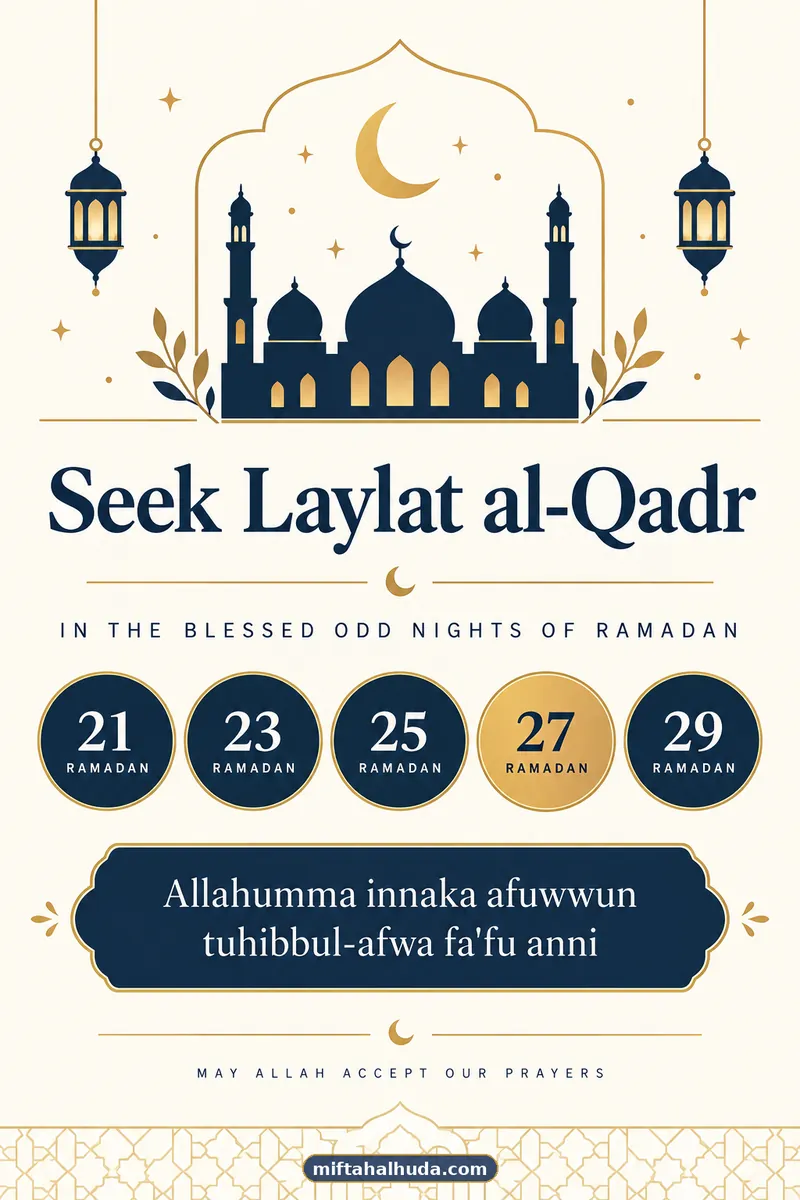
Aisha, may Allah be pleased with her, asked the question every Muslim asks: “O Messenger of Allah, if I know which night is Laylat al-Qadr, what should I say in it?” He answered: say:
“اللَّهُمَّ إِنَّكَ عَفُوٌّ تُحِبُّ الْعَفْوَ فَاعْفُ عَنِّي”
“Allahumma innaka ‘afuwwun tuhibbul-‘afwa fa’fu ‘anni.”
(O Allah, You are the Pardoner, You love to pardon, so pardon me.) – Recorded by al-Tirmidhi and Ibn Majah, graded sahih.
Short enough for a child to memorize, deep enough for a lifetime. The word ‘afw means more than forgiveness: it is the complete erasing of the sin and its traces, as if it never happened. On a night better than a thousand months, you are asking the One who loves to erase, to erase.
When to Seek Laylat al-Qadr
The Prophet (ﷺ) said: “Seek Laylat al-Qadr in the odd nights of the last ten nights” (agreed upon, recorded by al-Bukhari and Muslim): the 21st, 23rd, 25th, 27th, and 29th nights of Ramadan. The wise approach is to treat all ten as if each could be the night, increasing prayer, Quran, charity, and dua through them all.
The night begins at Maghrib, not after Isha, so the worshipper greets it from sunset. If you cannot pray long night prayers, protect your Isha and Fajr in congregation and fill what you can with dua; the Prophet (ﷺ) said that whoever prays Isha in congregation has taken a share of the night’s reward.
More Duas for the Last Ten Nights
Alongside Aisha’s supplication, carry these through the ten nights. The comprehensive Quranic dua:
“رَبَّنَا آتِنَا فِي الدُّنْيَا حَسَنَةً، وَفِي الْآخِرَةِ حَسَنَةً، وَقِنَا عَذَابَ النَّارِ”
“Rabbana atina fid-dunya hasanah, wa fil-akhirati hasanah, wa qina ‘adhaban-nar.”
(Our Lord, give us good in this world and good in the Hereafter, and protect us from the punishment of the Fire.) – Surah Al-Baqarah, 2:201.
And the dua the Prophet (ﷺ) told Mu’adh never to leave at the end of every prayer:
“اللَّهُمَّ أَعِنِّي عَلَى ذِكْرِكَ، وَشُكْرِكَ، وَحُسْنِ عِبَادَتِكَ”
“Allahumma a’inni ‘ala dhikrika, wa shukrika, wa husni ‘ibadatik.”
(O Allah, help me to remember You, to thank You, and to worship You well.) – Recorded by Abu Dawud, graded sahih.
The last ten nights often include Qunoot in the witr prayer; our guide to dua e Qunoot and its benefits explains it. Forgiveness is the theme of the season, so keep our collection of duas for forgiveness close as well.
How to Live the Last Ten Nights
The Prophet’s (ﷺ) example was total effort: he would tighten his belt, pray the night, and wake his family. In practice, that means guarding the five prayers, adding whatever night prayer you can sustain, reading the Quran with understanding, giving charity even in small amounts, and returning to the Laylat al-Qadr dua again and again. Some worshippers also observe i’tikaf, staying in the mosque for the ten days, following his Sunnah.
Understanding the Quran you hear in taraweeh multiplies the experience. Many of our students spend the year learning to read and understand the Quran online so that the next Ramadan sounds completely different to them.
Signs of Laylat al-Qadr
The Prophet (ﷺ) described some of its signs, and they come as gentle confirmations after the night, not as shortcuts to find it. It is a calm and mild night, neither hot nor cold (recorded by Ibn Khuzaymah, graded sahih), and its sunrise the next morning is bright and white, without strong rays (recorded by Muslim). The believers who feel unusual peace, focus, and sweetness in worship on a night may be tasting its nearness. These signs should never make anyone neglect the other nights; the certainty is in the striving, not the sighting.
Why the Laylat al-Qadr Dua Is About Forgiveness
Pause on what the Prophet (ﷺ) chose to teach Aisha (may Allah be pleased with her) for the greatest night of the year. She did not ask for a long supplication or a special ritual. She asked: if I know which night it is, what should I say? And the answer was a single plea: “Allahumma innaka ‘afuwwun tuhibbul-‘afwa fa’fu ‘anni – O Allah, You are Pardoning and You love pardon, so pardon me.” (At-Tirmidhi, sahih)
There is deep wisdom here. On a night worth more than eighty-three years of worship, the Prophet (ﷺ) did not point her first to wealth, health, or worldly success. He pointed her to the one thing that decides a person’s eternal outcome: Allah’s pardon. If a lifetime of worship is compressed into one night, then the best use of that night is to ask for what no amount of our own deeds can guarantee, which is forgiveness.
The name Allah chose in this dua is also precise. Al-‘Afuww is not only the Forgiver who covers sin; He is the One who erases it completely, as if it never stood in your record. You are not asking for a discount on your sins. You are asking for their removal. Learn the dua, say it with understanding, and let it carry your heart on those nights.

A Night Better Than a Thousand Months
Allah says: “The Night of Decree is better than a thousand months. The angels and the Spirit descend therein by permission of their Lord for every matter. Peace it is until the emergence of dawn.” (Surah Al-Qadr 97:3-5)
A thousand months is longer than eighty-three years, longer than most lifetimes of worship. The scholars explain that righteous deeds done on this night are recorded as better than a lifetime of deeds without it. That is why the Prophet (ﷺ) would tighten his belt in the last ten nights, stay awake through them, and wake his family, as Al-Bukhari and Muslim report from Aisha (may Allah be pleased with her).
Notice also the last description: peace, until dawn. A night of salam. The believer who spends it in prayer, Quran and dua is not performing an exhausting ordeal; he is sitting inside the most peaceful hours of the year. Go into the night expecting tranquility, and you will taste it.
What to Ask Allah on Laylat al-Qadr
Start with the taught dua, repeat it often, and then open your heart. The night is called the Night of Decree (Qadr) because the year’s decrees are assigned in it, so asking on this night is asking at the moment of writing. There is nothing too big to request and nothing too small.
- Ask for yourself: forgiveness, steadfastness on the deen, a good ending, healing, provision with barakah.
- Ask for your parents, living or deceased, and your children and family.
- Ask for the ummah: relief for the oppressed, guidance for those far from Allah, unity of the hearts.
- Ask for Jannah by name, and for refuge from the Fire. The Prophet (ﷺ) said: “Whoever asks Allah for Jannah three times, Jannah says: O Allah, admit him to Jannah.” (At-Tirmidhi, hasan)
Keep a written list in your pocket or on your phone during the last ten nights. When the dua flows easily, keep going; when your mind tires, return to the list and to the taught dua. The Ramadan duas collection has a full section for these nights.

I’tikaf and the Last Ten Nights
The Prophet’s (ﷺ) own method for catching Laylat al-Qadr was i’tikaf: staying in the masjid devoted to worship for the last ten days. Aisha (may Allah be pleased with her) reported that he performed i’tikaf in the last ten nights of Ramadan until Allah took him, and his wives continued it after him. (Al-Bukhari and Muslim)
I’tikaf means cutting off the noise. No shopping, no visiting, no scrolling, only worship in the house of Allah. If you can take even two or three days off for it, you will understand why he (ﷺ) never left it. If full i’tikaf is not possible this year, imitate its spirit at home: set fixed night hours with the phone in another room, pray what you can, read Quran, and sit with your dua list. Women can make i’tikaf in the masjid where arrangements exist, and everyone can guard the nights of worship at home.
If You Believe You Caught the Night
You may feel it: a strange calm, tears that come easily, a night that does not feel long. If a night of the last ten seems to you to be Laylat al-Qadr, do not spend the morning debating whether it was. Do two things instead:
- Thank Allah for letting you witness it, and ask Him to accept what you did. Acceptance is the goal, not the feeling.
- Do not let the next night drop. The companions did not treat one strong night as permission to relax. The command was to seek it in all ten, and the one who worships them all is guaranteed to have caught it.
And when Ramadan ends, the question is not whether you found the night, but what the night left in you. A forgiven person walks out of Ramadan lighter than he entered it. That is the sign that matters.
Teaching Your Children About Laylat al-Qadr
Children understand more than we assume when we speak to them with love. Tell them plainly: there is a night hidden in the last ten nights of Ramadan that is better than a thousand months, and Allah hid it so that we would try hard in all of them. Turn the search into a family adventure rather than a lecture:
- Let them stay up a little later on the odd nights with their own small worship: two rak’ahs, a page of Quran, the Laylat al-Qadr dua learned by heart.
- Teach them the short dua “Allahumma innaka ‘afuwwun…” as their personal treasure. It is brief, and children memorize it in one evening.
- Make a simple chart of the last ten nights and mark each night they joined in worship.
- Keep the mood peaceful. They are learning that worship is sweetness, not obligation.
Our guide on teaching Quran to kids at home has more age-specific ideas, and the Ramadan for kids guide builds the whole month around them.
Why Did Allah Hide Laylat al-Qadr?
The Prophet (ﷺ) was shown the exact night and then made to forget it, as the hadith of the two men disputing in the mosque describes (Al-Bukhari). He commented: perhaps it is better for you. And it is. Hiding the night inside the last ten is mercy disguised as mystery.
If the night were known, most of the ummah would worship one night and sleep through nine. Hidden, it pulls believers into ten nights of prayer, Quran and dua. A person who sincerely seeks it every odd night has, without doubt, caught it. The concealment is also a filter: the ones who truly want Allah do not need a marked calendar to stand at night. Seek it in the last ten, especially the odd nights, and you cannot miss it.
A Simple Plan for Each of the Last Ten Nights
The last ten nights exhaust people who enter them without a plan. Here is a structure many worshippers find sustainable, adjustable to your work and health:
- After Maghrib: break your fast calmly, pray, and sleep a short while if you can. The companions called this qaylulah, and it carries the night.
- Isha and taraweeh: pray with the imam until he finishes; the Prophet (ﷺ) said whoever stands with the imam until he leaves, it is recorded as a whole night. (At-Tirmidhi, sahih)
- A home session: an hour of Quran, two rak’ahs of tahajjud, then your dua list with the taught dua repeated through it.
- Suhoor with istighfar: end the night as Allah described His righteous servants, seeking forgiveness before dawn (Surah Adh-Dhariyat 51:18).
Guard the plan on the odd nights especially, and accept that some nights will go better than others. Consistency across ten imperfect nights beats one perfect night followed by collapse.
Making Dua When You Cannot Pray
Women experiencing their monthly cycle sometimes feel locked out of the last ten nights because salah and fasting pause. The doors of Laylat al-Qadr are not among the things that pause. Dua, dhikr, istighfar, charity, listening to Quran, and serving the worshippers all remain fully open, and the taught dua of the night is for every tongue.
The scholars state clearly that a woman in this state may make every supplication, send salawat on the Prophet (ﷺ), remember Allah, and even hold a translation of the Quran to read its meanings according to many scholars. The night rewards the seeker, and Allah does not turn away a servant He Himself excused from prayer. Plan those nights around dua and dhikr, and your share of the night is intact.
Live 1-to-1 classesLearn it properly, with a real teacherCertified teachers · Flexible times · Free trial classStart Learning Quran →Charity and Laylat al-Qadr
Do not limit the night to prayer and dua alone. Ibn Abbas (may Allah be pleased with him) described the Prophet (ﷺ) as the most generous of people, and most generous of all in Ramadan. (Al-Bukhari and Muslim) A deed of charity on Laylat al-Qadr carries the night’s multiplication, which is why so many Muslims schedule their sadaqah across the last ten nights to guarantee catching it.
Feed a fasting family, sponsor an iftar, support students of the Quran, or give quietly to someone who will never know your name. Pair every night of prayer with an act of giving, however small, and you will have filled the season with the two deeds Ramadan loves most.
Frequently Asked Questions About the Laylat al-Qadr Dua
1. What is the best dua for Laylat al-Qadr?
The dua the Prophet (ﷺ) taught Aisha: “Allahumma innaka ‘afuwwun tuhibbul-‘afwa fa’fu ‘anni” (O Allah, You are the Pardoner, You love to pardon, so pardon me). It is short, authentic, and asks for the exact gift that night was made for.
2. Which night is Laylat al-Qadr exactly?
Allah hid the exact night so believers would strive through all ten. It is in the odd nights of the last ten, the 21st, 23rd, 25th, 27th, or 29th, with the 27th often mentioned in reports. Treat every one of the ten as if it could be the night.
3. Does the night start at Maghrib or after Isha?
The Islamic night begins at Maghrib. Laylat al-Qadr enters at sunset, so begin your worship and supplication from the iftar of the odd nights rather than waiting for late-night prayers.
4. Can I make dua in my own language on Laylat al-Qadr?
Yes. Allah hears every language. Learn Aisha’s dua in Arabic with its meaning, and then open your heart in whatever words come naturally: your needs, your family, your repentance, and your hopes are all welcome.
5. Can women who are not praying still make dua in the last ten nights?
Yes. Dua, dhikr, istighfar, and charity are open to everyone in every state. A woman who is not praying can still fill the nights with supplication and remembrance, including the Laylat al-Qadr dua, and she loses nothing of the night’s mercy.
For the month’s full supplication collection, from the intention at suhoor to the iftar duas, read our complete guide to authentic Ramadan duas and the Ramadan fasting rules guide.
6. Can Laylat al-Qadr fall on an even night?
Yes. The strongest emphasis is on the odd nights of the last ten, but authentic hadiths also describe seeking it in the last ten without restriction, and scholars note it has fallen on even nights in some years. Worshipping all ten nights is the only guaranteed way to catch it.
7. Is it enough to pray only on the 27th night?
The 27th is the night many scholars considered most likely, but singling out only that night risks missing the night entirely, since its date moves within the last ten. The Prophet (ﷺ) and his companions sought it through all ten nights, and that is the safe and rewarded path.
8. What should I do if I am working night shifts during the last ten nights?
Make your work break your prayer time: pray what you can, keep your tongue busy with the taught dua and istighfar through the shift, give your charity, and guard your days off for longer worship. Allah rewards the seeking according to your capacity, and He does not waste the intention of the one who would stand if he could.
9. Can I hold a dua list or phone while making dua on Laylat al-Qadr?
Yes. There is no requirement that dua be from memory. Reading your needs from a list or phone keeps the heart focused through a long night, and many scholars recommend preparing the list in advance exactly for this reason.
10. Do the signs of Laylat al-Qadr appear before or after the night?
The reported signs, such as a calm, mild night and a sunrise with white, rayless light, are mostly known afterward, as the hadith of the sun rising without rays describes its morning. (Muslim) The practical lesson is to seek the night through worship rather than through watching the sky.
Keep reading
Learn to read the Quran correctly
Start or improve your Quran reading with a certified teacher, one-to-one online.
2 Responses