

Ramadan duas are the heartbeat of the holy month. Fasting purifies the body, but it is supplication that fills the fast with life: the quiet moments at suhoor, the seconds before iftar, and the long nights of the last ten days were all made for turning to Allah.
This guide gathers the authentic Ramadan duas every Muslim needs, from the intention before dawn to the special supplication of Laylat al-Qadr, each with its Arabic text, transliteration, translation, and source. At Miftah Al-Huda Academy, we teach Muslims to understand what they recite, so every dua comes from the heart with full presence.
Why Dua Matters So Much in Ramadan
Ramadan is the season of answered supplication. The Prophet (ﷺ) said:
“إِذَا جَاءَ رَمَضَانُ فُتِّحَتْ أَبْوَابُ الْجَنَّةِ، وَغُلِّقَتْ أَبْوَابُ النَّارِ، وَصُفِّدَتِ الشَّيَاطِينُ”
Learn your deen with a qualified teacher — Explore Fiqh Classes →“Idha jaa’a Ramadanu futtihat abwabul-jannah, wa ghulliqat abwabun-nar, wa suffidatish-shayateen.”
(When Ramadan comes, the gates of Paradise are opened, the gates of the Fire are closed, and the devils are chained.) – Agreed upon, recorded by al-Bukhari and Muslim.
He ﷺ also told us that three people are never turned away: “the just ruler, the fasting person until he breaks his fast, and the supplication of the oppressed” (recorded by al-Tirmidhi). Every fasting Muslim, every single day of the month, carries a supplication that Allah does not reject. That is why the minutes before iftar are precious: eat a date, drink some water, but first, raise your hands.
Dua for Starting the Fast (The Intention)
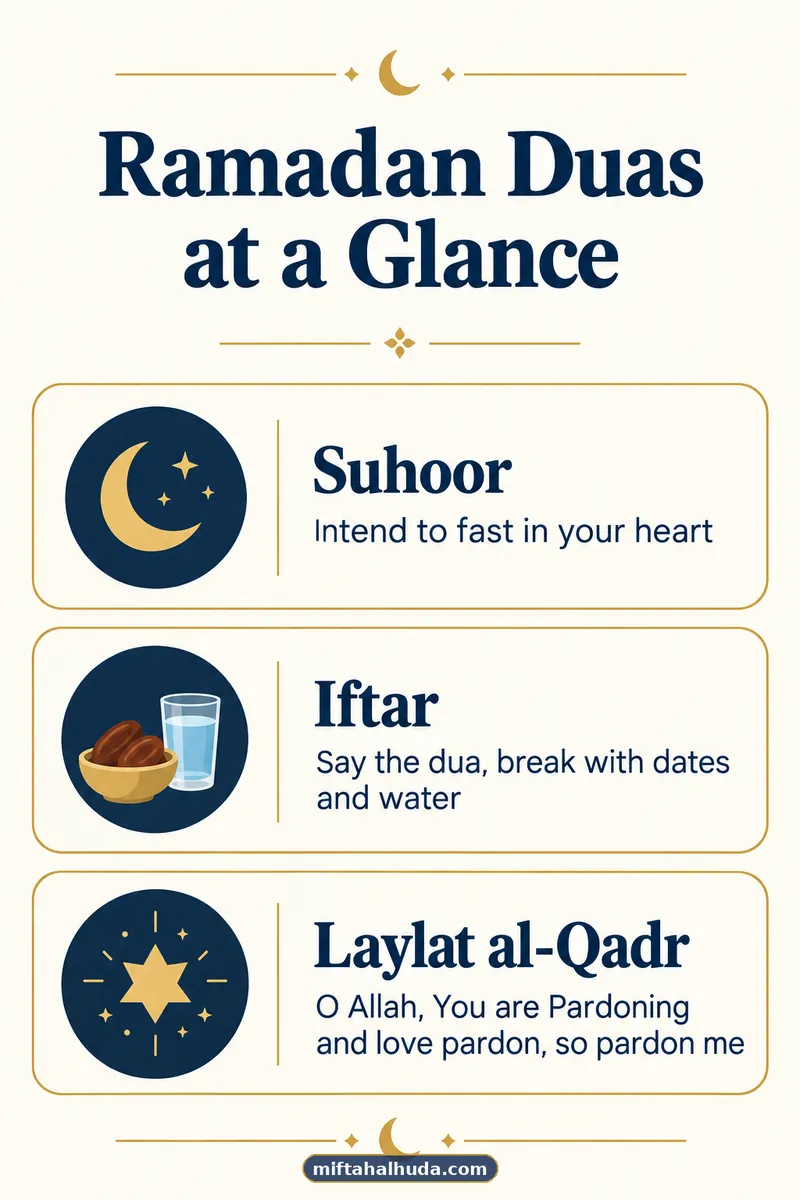
Many Muslims search for a specific dua for fasting to say before beginning the day’s fast. It helps to know what the scholars actually teach: the intention (niyyah) is an act of the heart, not a sentence to pronounce. No particular verbal formula for starting the fast is established from the Prophet (ﷺ). Simply resolving in your heart, before dawn, that you will fast this day of Ramadan is the complete and valid intention.
Many people like to say words such as “Allahumma inni nawaytu an asuma Ramadan” (O Allah, I intend to fast Ramadan). There is no harm in saying them as a reminder to yourself, but they are not a required formula, and the fast is valid without them. Waking for suhoor is itself one of the clearest signs of intention.
For a full explanation of the intention and its rulings, see our guide on the intention for fasting in Ramadan.
Suhoor Duas: Starting the Day With Barakah
Suhoor is not just a meal; it is a Sunnah filled with blessing. The Prophet (ﷺ) said:
“تَسَحَّرُوا فَإِنَّ فِي السَّحُورِ بَرَكَةً”
“Tasahharu fa inna fis-suhuri barakah.”
(Take suhoor, for indeed in suhoor there is blessing.) – Agreed upon, recorded by al-Bukhari and Muslim.
There is no single prescribed dua reported specifically for the suhoor table, so begin with Bismillah, eat with gratitude, and use these quiet pre-dawn moments for personal supplication. The last part of the night, when suhoor is eaten, is exactly the time Allah descends to the lowest heaven and asks who is calling upon Him. Ask for a day of accepted fasting, ease in worship, and forgiveness.
Iftar Duas: Dua for Breaking the Fast
The moment of breaking the fast is the most famous supplication time of the month. These are the authentically reported iftar duas:
1. The dua reported from the Prophet (ﷺ) after breaking his fast:
“ذَهَبَ الظَّمَأُ، وَابْتَلَّتِ الْعُرُوقُ، وَثَبَتَ الْأَجْرُ إِنْ شَاءَ اللَّهُ”
“Dhahabadh-dhama’u, wabtallatil-‘uruqu, wa thabatal-ajru in sha Allah.”
(The thirst is gone, the veins are refreshed, and the reward is confirmed, if Allah wills.) – Recorded by Abu Dawud, graded hasan.
2. The well-known iftar supplication:
“اللَّهُمَّ لَكَ صُمْتُ، وَعَلَى رِزْقِكَ أَفْطَرْتُ”
“Allahumma laka sumtu, wa ‘ala rizqika aftartu.”
(O Allah, for You I have fasted, and with Your provision I break my fast.) – Recorded by Abu Dawud. Scholars note that its chain is not strong, but its meaning is sound and it is widely recited across the Muslim world.
After these short words, make your own personal dua before the meal. Ask for your family, your health, your studies, your guidance, and the acceptance of your fast, because this is the hour when the fasting person’s supplication is not turned away.
Dua When You Break Your Fast at Someone’s Home
If you are hosted for iftar, the Sunnah gives you a beautiful way to thank your hosts:
“أَفْطَرَ عِنْدَكُمُ الصَّائِمُونَ، وَأَكَلَ طَعَامَكُمُ الْأَبْرَارُ، وَصَلَّتْ عَلَيْكُمُ الْمَلَائِكَةُ”
“Aftara ‘indakumus-sa’imun, wa akala ta’amakumul-abrar, wa sallat ‘alaykumul-mala’ikah.”
(May the fasting break their fast with you, may the righteous eat your food, and may the angels pray for you.) – Recorded by Abu Dawud.
The Dua of Laylat al-Qadr
The greatest night of the year hides in the last ten nights of Ramadan, and the Mother of the Believers asked the exact question every one of us would ask. Aisha (may Allah be pleased with her) said: I asked, “O Messenger of Allah, if I know which night is Laylat al-Qadr, what should I say in it?” He said: say:
“اللَّهُمَّ إِنَّكَ عَفُوٌّ تُحِبُّ الْعَفْوَ فَاعْفُ عَنِّي”
“Allahumma innaka ‘afuwwun tuhibbul-‘afwa fa’fu ‘anni.”
(O Allah, You are the Pardoner, You love to pardon, so pardon me.) – Recorded by al-Tirmidhi, graded sahih.
Repeat it through the odd nights of the last ten, in sujood, after prayers, and while breaking your fast. For a complete look at the rulings of the month, see our complete guide to Ramadan fasting rules.
Quranic Duas to Carry Through the Month
Ramadan is the month of the Quran, so fill your supplications with its own words. These two short Quranic duas are easy to memorize and cover everything a believer needs:
1. The most comprehensive short dua in the Quran:
“رَبَّنَا آتِنَا فِي الدُّنْيَا حَسَنَةً، وَفِي الْآخِرَةِ حَسَنَةً، وَقِنَا عَذَابَ النَّارِ”
“Rabbana atina fid-dunya hasanah, wa fil-akhirati hasanah, wa qina ‘adhaban-nar.”
(Our Lord, give us good in this world and good in the Hereafter, and protect us from the punishment of the Fire.) – Surah Al-Baqarah, 2:201.
2. The dua of Musa for ease in his task:
Live 1-to-1 classesLearn it properly, with a real teacherCertified teachers · Flexible times · Free trial classExplore Fiqh Classes →“رَبِّ اشْرَحْ لِي صَدْرِي، وَيَسِّرْ لِي أَمْرِي”
“Rabbish-rahli sadri, wa yassirli amri.”
(My Lord, expand for me my chest and ease for me my task.) – Surah Ta-Ha, 20:25-26.
Many of our students learn these supplications as part of learning to read the Quran online with a certified teacher, verse by verse, until the words come alive in their prayers.
Making the Most of Every Dua in Ramadan
A few habits turn these supplications from words on a page into a living routine. Keep a short written list of your personal needs and read through it at iftar. Learn one dua per week rather than all of them at once, and say each one slowly, understanding the meaning as you speak. If you miss the Arabic, supplicate in your own language; Allah hears every tongue. And if you break your fast incorrectly or miss days, do not let it push you away from dua; our guides on kaffarah for broken fasts and fidyah for missed fasts explain how to set things right, and Allah’s door stays open.
Looking for duas for other occasions? Our guides to the travelling dua and duas for forgiveness follow the same format, with Arabic text, transliteration, and sources.
A Simple Daily Dua Routine for Ramadan
Structure helps sincerity. Many families find it easy to anchor their supplications to the natural stations of the fasting day:
- At suhoor: Bismillah, gratitude for the meal, and a personal dua for an accepted fast, in the blessed last part of the night.
- After each prayer: the Quranic duas above, especially Rabbana atina, until they become second nature.
- In the last hour before iftar: your personal list, unhurried, with full hope in Allah’s answer.
- At iftar: Dhahabadh-dhama’u after the first dates, then your own words.
- In the last ten nights: the Laylat al-Qadr dua on every odd night, in sujood and before sleep.
Small, steady, and understood beats long, rushed, and forgotten. One new dua a week is enough to transform your month.
The Best Times for Dua in Ramadan
Ramadan stacks several answered-dua windows into a single month, and knowing them turns the month from a blur into a strategy:
- While fasting. The Prophet (ﷺ) said the fasting person’s dua is not turned away, so do not wait for iftar to start asking. Your whole day is a dua window.
- At the moment of breaking the fast. This is the named, promised moment, covered in detail in our iftar dua guide.
- In the last third of the night. Suhoor time overlaps with the descent of divine mercy, when Allah asks who is calling upon Him. The suhoor dua guide shows how to fill that hour.
- In sujood. “The closest a servant is to his Lord is while he is prostrating, so make much dua.” (Muslim) Add long sujood to your taraweeh and night prayers.
- Between the adhan and the iqamah, a daily window that most people scroll through.
- The last ten nights, seeking Laylat al-Qadr, with the dua the Prophet (ﷺ) taught Aisha (may Allah be pleased with her). Our Laylat al-Qadr dua guide covers it fully.
- Fridays. Ramadan Fridays combine the hour of acceptance on Friday with the fasting person’s dua.
Mark these on your daily routine before Ramadan begins, and you will never wonder when to ask.

Duas for Forgiveness in Ramadan
Ramadan is the month of mercy, and its middle ten days are described in the reports as days of maghfirah, forgiveness. Beyond the daily adhkar, these supplications deserve a permanent place in your Ramadan:
أَسْتَغْفِرُ اللهَ الْعَظِيمَ الَّذِي لَا إِلَٰهَ إِلَّا هُوَ الْحَيُّ الْقَيُّومُ وَأَتُوبُ إِلَيْهِ
“Astaghfirullahal-‘Adhim alladhi la ilaha illa Huwal-Hayyul-Qayyumu wa atubu ilayh – I seek the forgiveness of Allah the Magnificent, besides Whom there is no god, the Ever-Living, the Sustainer, and I repent to Him.” (Abu Dawud and At-Tirmidhi)
رَبَّنَا ظَلَمْنَا أَنفُسَنَا وَإِن لَّمْ تَغْفِرْ لَنَا وَتَرْحَمْنَا لَنَكُونَنَّ مِنَ الْخَاسِرِينَ
“Rabbana zalamna anfusana wa in lam taghfir lana wa tarhamna lanakunanna minal-khasirin – Our Lord, we have wronged ourselves, and if You do not forgive us and have mercy upon us, we will surely be among the losers.” (Surah Al-A’raf 7:23)
And do not forget the master supplication of forgiveness, Sayyid al-Istighfar, which the Prophet (ﷺ) attached to Paradise for the one who says it in the morning or evening with certainty and dies that day or night. If you do not know it yet, learning it is one of the best preparations you can make in Rajab and Sha’ban, as our Ramadan preparation checklist suggests.
Duas for Your Parents, Children and Family
Family duas carry a special door in Ramadan. The Quran itself gives you the words:
رَبِّ ارْحَمْهُمَا كَمَا رَبَّيَانِي صَغِيرًا
“Rabbi irhamhuma kama rabbayani saghira – My Lord, have mercy upon them as they brought me up when I was small.” (Surah Al-Isra 17:24)
رَبَّنَا هَبْ لَنَا مِنْ أَزْوَاجِنَا وَذُرِّيَّاتِنَا قُرَّةَ أَعْيُنٍ وَاجْعَلْنَا لِلْمُتَّقِينَ إِمَامًا
“Rabbana hab lana min azwajina wa dhurriyyatina qurrata a’yuniw waj’alna lil-muttaqina imama – Our Lord, grant us from among our spouses and offspring comfort to our eyes and make us leaders for the righteous.” (Surah Al-Furqan 25:74)
Say the first for your parents at every iftar. Say the second for your children when you look at them across the suhoor table. These are Quranic words with Ramadan moments, and they settle into the heart of a household faster than any lecture.
Teaching Ramadan Duas to Children
Children learn dua by watching it, then by joining it. A few principles that work in Muslim homes every Ramadan:
- One dua per week. Short, memorized with its meaning, said out loud at iftar. Four duas per Ramadan is a real curriculum.
- Meaning before perfection. A child who knows what “Allahumma innaka ‘afuwwun” asks for will say it with presence; one who only parrots sounds will drop it by Shawwal.
- Let them lead. Take turns at the iftar table so each child says the dua for everyone. Pride in leading worship is a powerful teacher.
- Connect dua to Quran. Children who are learning to read the Quran meet these supplications inside it, and the two reinforce each other. Our article on teaching Quran to kids at home has age-by-age routines, and the Ramadan for kids guide plans the whole month around them.

Common Dua Mistakes to Avoid in Ramadan
- Limiting dua to a memorized list while the heart stays silent. The memorized words are the door, not the destination. After the sunnah duas, speak to Allah in your own words about your own life.
- Rushing. The Prophet (ﷺ) said: “Your Lord is Generous and Shy; when His servant raises his hands to Him, He is shy to return them empty.” (Abu Dawud, sahih) Raised hands deserve a pause.
- Asking only for the dunya. The balanced dua of the Quran asks for good in this world and the Hereafter. Keep both in every session.
- Abandoning dua when the answer delays. The Prophet (ﷺ) said the servant is answered as long as he does not say “I asked and was not answered.” (Muslim) Ramadan’s thirty days are an exercise in patient certainty.
- Sticking only to Arabic when it blocks the heart. The established supplications are said in Arabic, and personal dua is valid in any language you cry in.
How to Build Your Personal Ramadan Dua List
Before Ramadan starts, sit with a pen and write three short lists. First, your needs: forgiveness, guidance, health, provision, the problems that keep you up at night. Second, your people: parents, spouse, children, teachers, friends, and the sick and oppressed of the ummah. Third, your akhirah: Jannah by name, refuge from the Fire, a good ending, the company of the Prophet (ﷺ).
Keep the list where you will actually use it: folded in your pocket, saved on your phone, stuck inside the kitchen cabinet you open at iftar time. Then give each window of the day its share: the morning adhkar after Fajr, your personal list before Maghrib, the Quranic duas in sujood at night. By the second week the list will be memorized, and by the last ten nights your tongue will run ahead of it. That is what a prepared Ramadan feels like, and it starts now, in the months before, with guides like our Rajab preparation article and the preparation checklist above.
Duas for the Ummah in Ramadan
No Ramadan dua list is complete without the ummah. The Prophet (ﷺ) said: “The supplication of a Muslim for his brother in his absence is answered; an angel is appointed over his head, and every time he prays for his brother with good, the appointed angel says: Ameen, and for you the same.” (Muslim) Dua for others multiplies back to you.
Remember in your Ramadan duas the oppressed in every land, the sick, the imprisoned unjustly, new Muslims finding their way, and those who do not yet know Allah. Remember the people of Gaza and every place of hardship by name if you know their names. And remember your own community: the imam who leads your taraweeh, the teachers of your children, the neighbor who fasts alone. A dua made for someone who will never know is among the purest worship of the month.
Keeping Dua Alive After Ramadan
The test of a Ramadan dua habit is Shawwal. The servant of the Most Merciful does not stop calling on his Lord because the month ended; the same Lord who answered in Ramadan answers in every month. Keep one small thread unbroken: the morning and evening adhkar, or the dua before sleep, or one personal request you refuse to drop. A thread is enough to keep the connection warm until the next season, and the seasons come quickly: Rajab, Sha’ban, then Ramadan again, by Allah’s permission. Our Rajab preparation guide explains how the righteous used those months to stay ready.
Frequently Asked Questions About Ramadan Duas
1. Is there a specific dua to say when starting the fast in Ramadan?
No specific verbal dua for starting the fast is established from the Prophet (ﷺ). The intention is made in the heart before dawn, and eating suhoor is itself a sign of that intention. Words like “Allahumma inni nawaytu an asuma Ramadan” are commonly said as a personal reminder, but they are not a required formula.
2. When is dua accepted while fasting?
The strongest time is at the moment of breaking the fast, because the Prophet (ﷺ) taught that the fasting person’s supplication is not rejected until he breaks his fast. The last third of the night, the time of suhoor, and the hours of Laylat al-Qadr are also among the most hopeful times in the month.
3. Can I make dua in English or my own language?
Yes. Allah understands every language and every heart. The transmitted duas are best learned in their original Arabic with their meanings understood, but your personal supplications, your hopes, fears, and requests, can be made in whatever language flows from you most sincerely.
4. What is the best dua for Laylat al-Qadr?
The dua the Prophet (ﷺ) himself taught Aisha for that night: “Allahumma innaka ‘afuwwun tuhibbul-‘afwa fa’fu ‘anni” (O Allah, You are the Pardoner, You love to pardon, so pardon me). Repeat it often through the last ten nights.
5. Do I say the iftar dua before or after eating?
The reported practice is to break the fast first, usually with dates or water, and then say “Dhahabadh-dhama’u wabtallatil-‘uruqu wa thabatal-ajru in sha Allah” (the thirst is gone…). Personal supplication fits naturally at this same moment, before or during the meal.
6. How many duas should I memorize for Ramadan?
Start with the essential five covered in this guide: the dua of breaking the fast, the dua of Laylat al-Qadr, one Quranic dua such as Rabbana atina, a dua for your parents, and a short istighfar formula. Master these with their meanings, then add more each week. Five duas said with presence outweigh fifty recited without a heart.
Keep reading
Learn your deen with a qualified teacher
Live one-to-one Fiqh classes that explain the rulings clearly and practically.
5 Responses