
You open a translated Quran at night, mouth the Arabic under your breath, and stop halfway through a word because you genuinely don’t know if you said it right. Maybe you tried reading along with a YouTube reciter. Maybe you asked a friend who “sort of” knows Tajweed.
Either way, nobody corrected you, and that silence is exactly why so many adults quietly give up on Quran reading before they ever really start.
A Noorani Qaida online beginner course exists for this precise moment, the one where you know the letters exist but nobody has shown you how your mouth is supposed to shape them.
Most people’s first attempt at fixing this involves an app, a free PDF, or a group class where twenty other students are reciting at once.
None of these give you what actually moves the needle: a teacher listening to your voice specifically and telling you the second your Ain sounds like a regular A.
Apps can’t hear you. Group classes can’t slow down for you. A free PDF has no opinion about your pronunciation at all.
This guide walks through what a Noorani Qaida online beginner course actually covers, why the early weeks feel harder for adults than for children, and what a structured program with real teacher correction looks like from lesson one through to an Ijazah. By the end, you’ll know exactly what to look for before you commit your evenings to it.
Noorani Qaida The Fundamentals of the Arabic Language
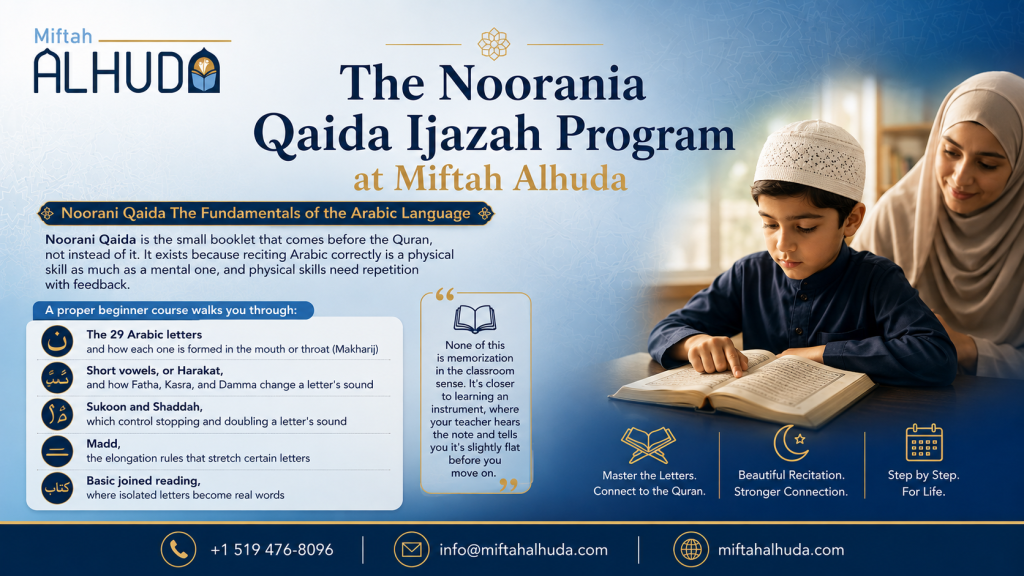
Noorani Qaida is the small booklet that comes before the Quran, not instead of it. It exists because reciting Arabic correctly is a physical skill as much as a mental one, and physical skills need repetition with feedback.
A proper beginner course walks you through:
- The 29 Arabic letters and how each one is formed in the mouth or throat (Makharij)
- Short vowels, or Harakat, and how Fatha, Kasra, and Damma change a letter’s sound
- Sukoon and Shaddah, which control stopping and doubling a letter’s sound
- Madd, the elongation rules that stretch certain letters
- Basic joined reading, where isolated letters become real words
None of this is memorization in the classroom sense. It’s closer to learning an instrument, where your teacher hears the note and tells you it’s slightly flat before you move on.
Why Non-Native Speakers Struggle With Sounds Arabic Doesn’t Share?
If English or another Western language is your first language, a handful of Arabic sounds simply don’t exist in your mouth’s muscle memory yet. Ain (ع), Ha (ح), Kha (خ), and Ghain (غ) are the usual culprits, and self-teaching almost never fixes them because you can’t hear your own mistake the way a trained ear can.
This is where most people’s first attempt quietly stalls. They can read the shapes of the letters just fine, but their recitation still sounds approximate, and there’s nobody around to say exactly
A few things tend to separate students who push through from students who stop:
- Getting live correction in the same session as the mistake, not days later
- Practicing with a teacher who has actually taught non-Arabic speakers before
- Repeating short drills instead of rushing to the next page
- Recording sessions or notes to track which sounds keep slipping
Adults also carry something kids don’t: self-consciousness. Sitting in a group class and mispronouncing a letter in front of strangers is enough to make many adults avoid practicing altogether. One-on-one online sessions remove that pressure entirely.
Inside a Noorani Qaida Online Beginner Course, Lesson by Lesson
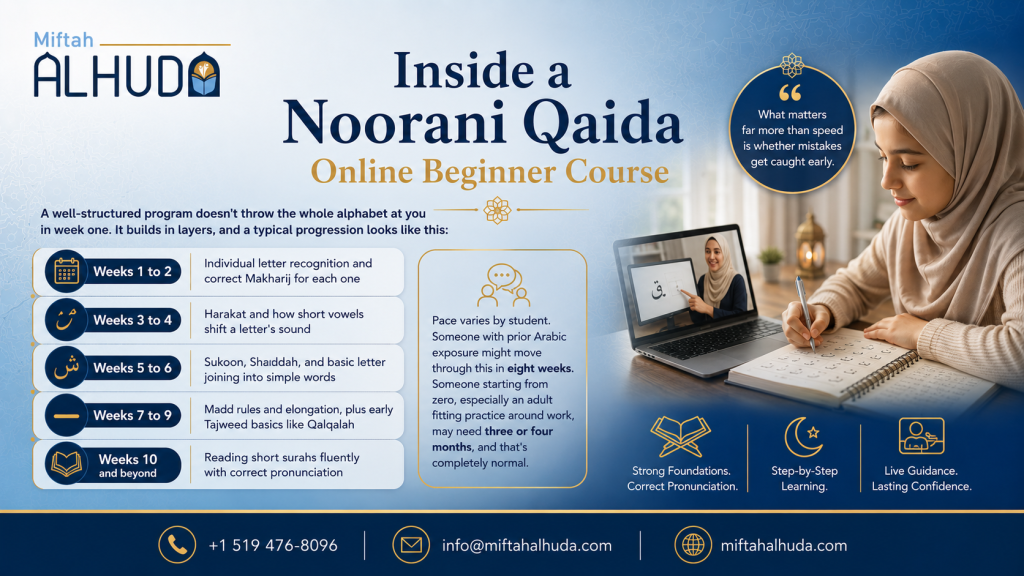
A well-structured program doesn’t throw the whole alphabet at you in week one. It builds in layers, and a typical progression looks like this:
- Weeks 1 to 2: Individual letter recognition and correct Makharij for each one
- Weeks 3 to 4: Harakat and how short vowels shift a letter’s sound
- Weeks 5 to 6: Sukoon, Shaddah, and basic letter joining into simple words
- Weeks 7 to 9: Madd rules and elongation, plus early Tajweed basics like Qalqalah
- Weeks 10 and beyond: Reading short surahs fluently with correct pronunciation
Pace varies by student. Someone with prior Arabic exposure might move through this in eight weeks. Someone starting from zero, especially an adult fitting practice around work, may need three or four months, and that’s completely normal.
What matters far more than speed is whether mistakes get caught early. A letter mispronounced for six weeks becomes a habit. A letter corrected in week one never becomes one.
The Weight Behind Getting the Recitation Right
There’s a reason this isn’t treated as a casual skill to pick up whenever. The Prophet Muhammad ﷺ said, as narrated by Uthman ibn Affan, that the best among the believers are those who learn the Quran and teach it (Sahih al-Bukhari 5027). Correct recitation isn’t a side detail in that hadith. It’s the foundation the learning and teaching both rest on.
Allah also instructs in the Quran, “Or add to it, and recite the Qur’an with measured recitation” (Surah Al-Muzzammil, 73:4). Tarteel, the measured and deliberate recitation described in that verse, is precisely what Noorani Qaida trains a student to do before they ever open the Mushaf itself.
Learning Noorani Qaida properly isn’t about ticking a box before “real” Quran study begins. It carries its own reward, its own patience, and for many adult students, its own quiet return to a relationship with the Quran that started shakily and slowly becomes steady.
The Noorania Qaida Ijazah Program at Miftah Alhuda
Miftah Alhuda’s Noorania Qaida Ijazah program is built to take non-native Arabic speakers from Bismillah all the way to a certified Ijazah, an authorized chain of transmission (Sanad) tracing back through qualified teachers.
The program includes:
- One-on-one live sessions with certified male and female tutors who are fluent in English
- Focused Makharij and Harakat training built specifically for non-native pronunciation gaps
- Advanced Tajweed rules including Qalqalah, Ikhfa, Idgham, Iqlab, and Madd
- Classes available around the clock, so scheduling works across US, UK, and European time zones
- A 100% money-back guarantee and a free trial class before you commit
Students don’t need any prior Arabic background to start. Whether the goal is simply reciting with confidence or eventually becoming a certified Quran teacher yourself, the same structured path applies from your first session onward.
Start your Noorani Qaida online beginner course with a certified tutor today.
Not ready to commit? Book a free trial session first.
Contact Us
WhatsApp: +1 519 476-8096
E-Mail: in**@**********da.com
Facebook: https://www.facebook.com/MiftahAlhudaOfficial
Instagram: https://www.instagram.com/miftahalhudaa
Youtube: https://www.youtube.com/@MiftahAl-huda
Tiktok: https://www.tiktok.com/@miftahalhuda00“.
Frequently Asked Questions
Is Noorani Qaida suitable for adults, or is it only for kids?
It’s designed for both. Adults with zero Arabic background often benefit more from it than kids do, since they can understand the rules being explained rather than just repeating sounds.
How long does a Noorani Qaida online beginner course usually take?
Most students finish in 8 to 12 weeks with regular practice. Adults with some prior Arabic exposure sometimes move faster, while complete beginners may take three to four months.
Do I need to know Arabic before starting?
No. The entire point of the course is to build that foundation from zero, including letter shapes, sounds, and basic reading.
What’s the difference between Noorani Qaida and Tajweed?
Noorani Qaida teaches you to read the letters and basic rules correctly. Tajweed builds on that foundation with more advanced rules for fluent, accurate Quran recitation.
Can I get an Ijazah after completing Noorani Qaida?
Yes, through a structured program like the Noorania Qaida Ijazah program, which continues past basic reading into certification with an authentic Sanad.
Are online one-on-one classes actually effective compared to in-person ones?
For pronunciation correction specifically, one-on-one online sessions often work better, since the teacher hears only your voice and can correct mistakes the moment they happen.
Where Your Recitation Actually Begins
Nobody starts out pronouncing Ain correctly on the first try, and no serious teacher expects you to. What separates someone who’s reciting confidently a year from now from someone still avoiding it is simply whether they had a teacher who caught the small mistakes early enough for them to matter.
The letters on the page haven’t changed in over a thousand years. What’s changed is that a corrected, one-on-one Noorani Qaida online beginner course is now available from wherever you’re sitting tonight. The only real question left is which lesson you’re going to start with.