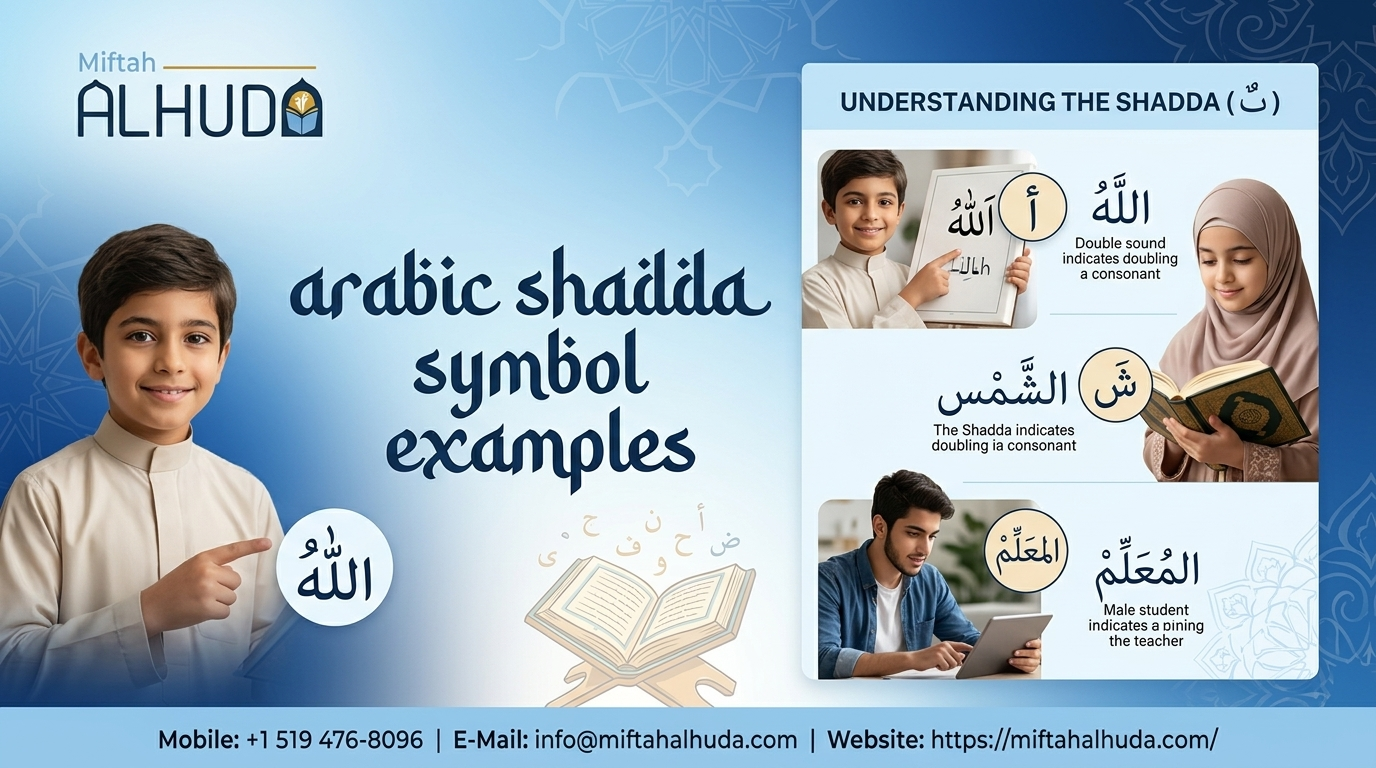
Have you ever looked at an Arabic word and wondered about the little “w”-shaped mark above a letter? That tiny symbol is called the shadda, and it can significantly alter how a word sounds and its meaning. If you’re searching for clear Arabic shadda symbol examples, you’ve come to the right place.
Today, with Miftah Al-Huda Academy, we’ll explain it in simple terms with plenty of real examples, so you can finally stop guessing and start reading with confidence.
Think of the shadda as the Arabic equivalent of doubling a letter in English. When you see the word “bookkeeper,” the double k’s indicate that you hold the sound a bit longer. The shadda performs the same function but achieves it with a single, elegant mark.
What Exactly Is the Arabic Shadda Symbol?
The shadda (ّ ) stands out as a crucial diacritical mark in the Arabic writing system. Its primary function is to indicate that a consonant is doubled or “geminated,” meaning you should pronounce the letter for a longer duration or with added emphasis.
A Brief Overview of Arabic Diacritics
Arabic letters typically represent consonants on their own. Short vowels and other pronunciation aids are depicted by small marks placed above or below the letters, known as harakat or tashkeel. The shadda is part of this group but is unique because it doesn’t add a vowel; instead, it intensifies a consonant.
The Role of Shadda in Context
Without the presence of the shadda, many Arabic words would appear and sound almost identical. This tiny mark distinguishes between a slight tap and a pronounced double knock. As you train yourself to recognize it, reading becomes more fluid, and your pronunciation starts to sound more authentic.
Why the Shadda Matters for Meaning?
This isn’t merely a pronunciation quirk; it’s often what distinguishes two entirely unrelated words. Consider words that change meaning with and without the shadda:
- عَلَم (alam) means “flag,” while عَلَّم (allam) means “he taught.”
- جَمَل (jamal) means “camel,” while جَمّل (jammal) means “he beautified.”
Notice how a single small mark alters the entire meaning? Mastering the shadda isn’t just an optional refinement; it’s a fundamental necessity for accurate reading and speaking in Arabic.
How to Recognize the Shadda Symbol Instantly?
The shadda resembles a small handwritten “w” or a sideways number three positioned on top of a letter. Once you familiarize yourself with a few examples, recognizing its shape becomes second nature.
Visual Shape and Placement Rules
The shadda is always positioned directly above the letter it affects, and it is never found below a letter.
There are no exceptions to this rule. Whether the letter is at the start, middle, or end of a word, the shadda is always placed on top.
Combining with Other Marks
Occasionally, the shadda is used alongside a short vowel mark. In such instances, the vowel is placed directly above the shadda. For instance, when a shadda is combined with a fatha (representing a short “a” sound), it appears as though a small diagonal line rests atop the shadda.(َّ )
Arabic Shadda Symbol Examples in Everyday Words
Let’s delve into some clear Arabic shadda symbol examples you can start using right away.
Simple Everyday Examples
- مُعَلِّم (mu‘allim) – teacher: Look at the double “l” sound. The letter ل carries a shadda. You hold the “l” longer: mu-‘al-lim.
- قِطّ (qiṭṭ) – cat: The ط has a shadda. You say “qitt” with a strong double “t” sound at the end.
- شَدّة (shadda) – the shadda itself: The letter د has a shadda → stretch the “d” sound: shad-da.
- سُكّر (sukkar) – sugar: The letter ك has a shadda → strong double “k” sound: suk-kar.
- دُكّان (dukkān) – shop: The letter ك has a shadda → hold the “k” longer: duk-kān.
- فَنّ (fann) – art: The letter ن has a shadda → stretch the “n” sound: fan-n.
- ظَنّ (ẓann) – thought / opinion: The letter ن has a shadda → hold the “n” longer: ẓan-n.
- كلّ (kull) – all / every: The ل is doubled.
Religious and Classical Examples
A prominent illustration of the use of diacritical marks in Arabic is the word “الله” (Allah). The second ل is accompanied by a shadda, which necessitates that native speakers articulate it as “Al-lah,” distinctly elongating the “l” sound. In the absence of the shadda, the pronunciation would seem incomplete.
Another example:
- رَبّ (Rabb) – Lord The ب carries a shadda. You pronounce a strong double “b.”
Here, the ب is marked by a shadda, resulting in a pronounced and forceful double “b” sound.
These examples highlight how the shadda actively influences everyday speech, illustrating its persistence in oral language even when the written mark is sometimes left out.
Shadda Combined with Other Diacritics
The shadda often doesn’t stand alone; it frequently appears alongside a short vowel mark such as fatha, kasra, or damma.
- دَقَّ (daqqa) The letter ق has a shadda + fatha → hold the “q” then add a short “a”: daq-qa.
- شَكَّ (shakka) The letter ك has a shadda + fatha → stretch the “k” and add “a”: shak-ka.
- مُحَمَّد (Muḥammad) The letter م has a shadda + fatha → long “m” + short “a”: Mu-ḥam-mad.
- تَجَارّ (tajarr) The letter ر has a shadda → strong double “r” sound (often with sukoon or vowel depending on the form).
- صَبَّار (ṣabbār) The letter ب has a shadda + fatha → stretch the “b” and add “a”: ṣab-bār.
Common Mistakes Learners Make with the Shadda
1. Ignoring It Completely
Some people treat the shadda as optional decoration, skipping the doubling and wondering why native speakers appear perplexed. Don’t do that. The mark is there for a reason.
2. Misplacing the Stress
Another common mistake is placing the stress on the wrong syllable. The shadda itself often carries the main stress of the word; when you double the consonant, give it a little extra energy.
How to Practice the Shadda Like a Native?
Practice is essential; information fades rapidly.
- Listening Drill: Find small audio samples from the Quran or children’s stories. Pause after each word that has a shadda and repeat three times. Your ear will begin to expect the prolonged sound.
- Writing Drill: In a notebook, write ten common words with a shadda. Say each one aloud while you write. Muscle memory and auditory memory operate together in this manner.
- Shadda in several Arabic scripts and fonts: In lovely traditional calligraphy, the shadda is frequently drawn with delicate curves. In modern digital fonts, it appears cleaner and more geometric, but the purpose remains unchanged. Whether you’re reading a handwritten note or a smartphone message, the significance of the mark remains constant.
Quick Reference Table of Popular Shadda Words
Here are a few high-frequency words you will meet again and again:
- أُمّ (umm) – mother
- جَدّ (jadd) – grandfather
- عَمّ (ʿamm) – paternal uncle
- حَجّ (ḥajj) – pilgrimage
- سِرّ (sirr) – secret
- حَرّ (ḥarr) – heat / hot
- بَرّ (barr) – land / piety
- طِبّ (ṭibb) – medicine
- مُرّ (murr) – bitter
- تَمّ (tamm) – complete / finished
Keep this little list nearby when you practice.
Conclusion
The Arabic shadda may appear little, yet it carries a powerful punch. Once you understand what it does, how it looks, and how to pronounce the doubled sound, a whole new layer of Arabic becomes accessible. You begin to read more precisely, speak effectively, and understand native speakers better. The next time you see that little “w” perched on top of a letter, smile because you know precisely what it wants you to do. Continue practicing with the Arabic shadda symbol examples we covered, and you’ll be handling doubled consonants like a pro in no time.
calling all students who want to master Arabic!
Tired of getting confused by diacritical marks? Still mixing up the shadda, fatha, kasra, and damma? At Miftah Al-Huda Academy, we teach the shadda and every other diacritic professionally and easily, using practical, everyday examples until they become second nature. No confusion, no rote memorization, just real understanding.
Book your Arabic course with us today, and feel the difference for yourself!
start your free trial today and feel the difference for yourself!
Contact Us
- WhatsApp: +1 519 476-8096
- E-Mail: in**@**********da.com
- Facebook: https://www.facebook.com/MiftahAlhudaOfficial
- Instagram: https://www.instagram.com/miftahalhudaa
- Youtube: https://www.youtube.com/@MiftahAl-huda
- Tiktok: https://www.tiktok.com/@miftahalhuda00
Frequently Asked Questions
Does every doubled consonant in Arabic need a written shadda?
Yes, in fully vowelled texts such as the Quran or children’s books. In daily modern writing, the shadda is frequently dropped, but the pronunciation doubles the sound.
Is the shadda the same as the English double letter?
Very similar in effect. The key distinction is that Arabic employs one symbol rather than writing the letter twice.
Where can I find clear Arabic shadda symbol examples to practice with?
You can find good arabic shadda symbol examples in vocalized texts like the Quran, children’s Arabic reading books, or dedicated language-learning resources words like رَبّ (rabb), حُبّ (hubb), and مُدَرِّس (mudarris) are especially useful starting points since they show the shadda paired with different vowel marks.
Why do some fonts make the shadda hard to see?
Certain contemporary fonts reduce diacritics. If readability is a problem, use a clearer Arabic font made specifically for learners.