
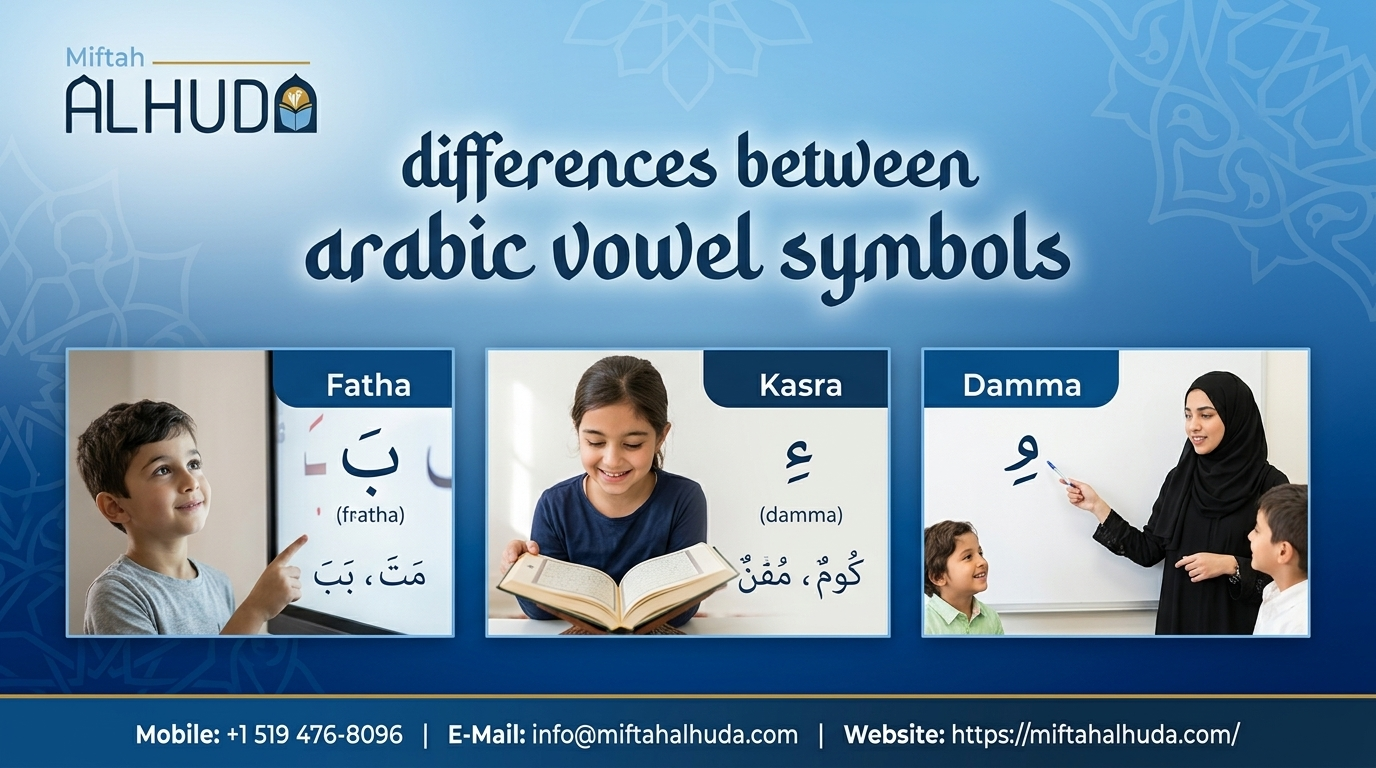
Recognizing the consonant letters of Arabic isn’t enough to learn to read it correctly. Harakat, a system of vowel marks, is frequently used in Arabic pronunciation to lead readers to the correct short-vowel sounds, pronunciation patterns, grammatical endings, and meanings.
For those new to Arabic, the small marks placed above or below the letters might be puzzling at first. What distinguishes a fatha, kasra, and damma from each other? How does a sukoon contrast with a vowel? What role does a shadda play? And why can altering just one small symbol entirely change the pronunciation of an Arabic word?
Understanding the differences between Arabic vowel symbols significantly enhances learners’ capabilities in reading Arabic, interpreting the Quran, refining Tajweed, and communicating with heightened precision.
In this guide, Miftah Al-Huda Academy will explore the key Arabic vowel symbols, compare their sounds, explain their placement, and demonstrate how they affect pronunciation.
What Are Arabic Vowel Symbols?
Arabic vowel symbols, known as harakat, are marks placed above or below letters to indicate pronunciation. Whereas English uses separate letters like a, e, i, o, and u to denote vowels, Arabic often uses these diacritical marks with consonants to indicate short vowel sounds.
For instance:
- بَ = ba
- بِ = bi
- بُ = bu
In all three examples, the Arabic letter ب stays consistent; it’s the vowel mark that alters the pronunciation. Grasping this concept is fundamental for beginners learning to read Arabic.
Why Are Arabic Vowel Symbols Important?
Arabic vowel marks are very crucial for beginners, as unvowelled Arabic can be difficult to speak correctly without prior knowledge of the language.
Consider the differences between:
- كَتَبَ
and a word written without vowel marks:
- كتب
The first provides direct pronunciation guidance, while the second relies on the reader’s context or previous understanding.
For students of the Quran, precise recognition of vowels holds paramount importance, as errors in pronunciation can alter the intended meaning or contravene established rules of recitation.
For instance:
the word , عَلِمَ (ʿalima) means “he knew,” while عُلِّمَ (ʿullima) means “he was taught.” The changes in harakat and shadda alter both the pronunciation and meaning of the word.
The Three Main Short Arabic Vowels
The three essential short vowels in Arabic are:
- Fatha ـَ
- Kasra ـِ
- Damma ـُ
These vowel marks are the cornerstone of Arabic pronunciation.
1. Fatha: ـَ
The fatha is a small diagonal stroke placed above a consonant.
For instance: بَ
It typically yields a short “a” sound:
- بَ = ba
Additional examples include:
- مَ = ma
- لَ = la
- تَ = ta
- كَ = ka
Fatha is among the most common vowel marks in Arabic.
2. Kasra: ـِ
Kasra is depicted as a small diagonal stroke beneath a consonant.
For instance: بِ
It generates a short “i” sound:
- بِ = bi
Other examples are:
- مِ = mi
- لِ = li
- تِ = ti
- كِ = ki
A simple way to remember kasra is its position below the letter.
3. Damma: ـُ
The damma looks like a small comma or rounded mark above the consonant.
For instance: بُ
It provides a short “u” sound:
- بُ = bu
Further examples include:
- مُ = mu
- لُ = lu
- تُ = tu
- كُ = ku
Together, fatha, kasra, and damma form the foundational short-vowel sounds in Arabic.
Fatha vs. Kasra vs. Damma
When we directly compare these symbols, we can better understand their differences.
| Arabic Symbol | Name | Position | Approximate Sound | Example | Word Example |
| ـَ | Fatha | Above | Short “a” | بَ = ba | كَتَبَ = kataba |
| ـِ | Kasra | Below | Short “i” | بِ = bi | كِتَاب = kitab |
| ـُ | Damma | Above | Short “u” | بُ = bu | كُتُب = kutub |
Understanding the unique sound produced by each mark and the placement of the symbol is crucial. A learner who can quickly recognize these three signs has already acquired a fundamental skill in reading Arabic.
What Is Sukoon in Arabic?
Sukoon (ـْ) signifies a consonant without a short vowel after it.
For instance, in مَنْ, the نْ is pronounced without an added vowel sound.
Sukoon vs. Short Vowels
Unlike fatha, kasra, and damma, which add short vowel sounds, sukoon signifies the lack of a short vowel.
- Fatha → adds an “a” sound: ذَهَبَ = dhahaba
- Kasra → adds an “i” sound: جَمِيل = jamil
- Damma → adds a “u” sound: رُسُل = rusul
- Sukoon → indicates no short vowel: يَفْهَم = yafham
What Is Shadda in Arabic?
The shadda (ـّ) is a diacritical mark that signifies the doubling or intensified pronunciation of a consonant within a word. For instance , in مُدَرِّس (mudarris), the رّ has a shadda, creating a doubled r sound.
Additionally, shadda combines with short vowels:
- بَّ becomes bba
- بِّ becomes bbi
- بُّ becomes bbu
Here, the shadda intensifies the consonant , while the vowel mark determines its sound.
Tanween: The Double Vowel Symbols
Tanween refers to the doubled vowel marks that often add a “n” sound to the end of a word. There are three forms: fathatan (ـً), kasratan (ـٍ), and dammatan (ـٌ).
For Instance:
- كِتَابًا = kitāban → “an”
- كِتَابٍ = kitābin → “in”
- كِتَابٌ = kitābun → “un”
Tanween is especially important in Arabic grammar and Quranic reading, as it can indicate indefiniteness and grammatical case endings.
Long Vowels vs. Short Vowels in Arabic
Short vowels are uttered briefly, but long vowels are retained for a longer duration .
| Type | Arabic | Sound | Example |
| Short Fatha | بَ | ba | بَتَرَ = batara |
| Long Fatha | بَا | bā | بَاب = bāb |
| Short Kasra | بِ | bi | بِنت = bint |
| Long Kasra | بِي | bī | كَبِير = kabīr |
| Short Damma | بُ | bu | كُتُب = kutub |
| Long Damma | بُو | bū | نُور = nūr |
Arabic Vowel Symbols in Quran Reading
Arabic vowel marks play a crucial role in accurate Quranic recitation by guiding pronunciation and maintaining the correct meaning. Learners should gradually become proficient in recognizing fatha, kasra, damma, sukoon, shadda, tanween, long vowels, and other recitation symbols.
For instance, in the phrase الْحَمْدُ لِلَّهِ from Surah Al-Fatihah, these harakat ensure the words are pronounced correctly.
Miftah Al-Huda Academy simplifies and makes accessible the study of these symbols, guiding students step by step to enhance their Quran reading skills with confidence.
Differences Between Arabic Vowel Symbols for Beginners
Memorizing all the Arabic pronunciation rules at once can be daunting for beginners. It’s more effective to establish a foundation gradually.
- Start with these four symbols:
بَ — بُ — بِ — بْ
- Read them repeatedly:
ba — bu — bi — b
As these become second nature, introduce tanween and shadda into your practice.
- Then practice combinations:
بَّ — بِّ — بُّ
and:
بًا — بٍ — بٌ
This step-by-step progression helps learners recognize patterns without depending on slow mental translation.
4 Common Mistakes When Learning Arabic Vowels
Several mistakes appear frequently among new Arabic learners.
1. Confusion between Fatha and Kasra:
Owing to their simplicity as mere strokes, beginners may sometimes neglect whether the diacritical mark is placed above or below the letter. It is essential for learners to recall that Fatha is situated above, whereas Kasra is located below.
2. The addition of a vowel following a Sukoon:
When a consonant is marked with a sukoon, it should not be followed by an additional short vowel. For instance, in the word مِنْ, the نْ should not be altered to na, ni, or nu.
3. Neglecting Shadda:
Omitting the shadda can significantly alter the rhythm and pronunciation of an Arabic word. Learners must actively pay attention to the indication of doubled consonants during reading.
4. Prolonging short vowels:
A further prevalent issue is the unwarranted extension of short vowels. Mastery over the distinction between short and long vowels is essential and can be cultivated through consistent practice and attentive listening exercises.
Conclusion
In conclusion, gaining a comprehensive understanding of the differences between Arabic vowel symbols is an essential step for anyone seeking to read the Quran and the Arabic language with accuracy and fluency. Vowel markers such as fatha, kasra, damma, sukoon, shadda, and tanween each serve distinct functions. Awareness of these differences facilitates precise pronunciation and enriches one’s comprehension of word meanings.
Through consistent practice, attentive listening, and expert guidance from a knowledgeable instructor, the challenge of distinguishing among Arabic vowel symbols can be transformed into a natural skill that enhances both the quality of one’s recitation and the depth of understanding of Arabic texts and this is exactly the kind of guidance you’ll find at Miftah Al-Huda Academy, where experienced instructors walk you through every step with patience and care.
Ready to master Arabic vowel symbols with confidence? Book your free trial class with Miftah Al-Huda Academy today and take the first step toward clear, accurate Quran reading!
Contact Us
- WhatsApp: +1 519 476-8096
- E-Mail: in**@**********da.com
- Facebook: https://www.facebook.com/MiftahAlhudaOfficial
- Instagram: https://www.instagram.com/miftahalhudaa
- Youtube: https://www.youtube.com/@MiftahAl-huda
- Tiktok: https://www.tiktok.com/@miftahalhuda00
Frequently Asked Questions
1. Can Arabic words be written without vowel symbols?
Indeed, it is feasible. The majority of commonplace Arabic texts are composed without the inclusion of short-vowel markers. Proficient readers generally rely on vocabulary, grammar, and contextual cues to infer the correct pronunciation.
2. Which Arabic vowel should beginners learn first?
Beginners are advised to initiate their studies with the three fundamental short vowels: fatha, kasra, and damma. Once these are mastered, learners can advance to more complex elements such as sukoon, shadda, and tanween.
3. Do Arabic vowel marks always appear in modern Arabic books?
Vowel marks are not uniformly applied across all Arabic literature. While materials
intended for education, children’s books, dictionaries, Quranic texts, and instructional resources for learners frequently employ full vowelization, many other publications often exclude most short vowels.
4. Can the differences between Arabic vowel symbols change a word’s meaning?
Absolutely. In particular contexts, altering a vowel can modify a word’s pronunciation, grammatical role, or meaning. Therefore, recognizing the nuances among Arabic vowel symbols is crucial, particularly in formal and Quranic Arabic contexts.
5. How long does it take to recognize Arabic vowel symbols automatically?
The duration required for automatic recognition of Arabic vowel symbols varies among individuals. Generally, brief but regular practice sessions tend to be more effective than sporadic prolonged study periods. Engaging in reading aloud coupled with feedback on pronunciation can enhance the speed of recognition development.