
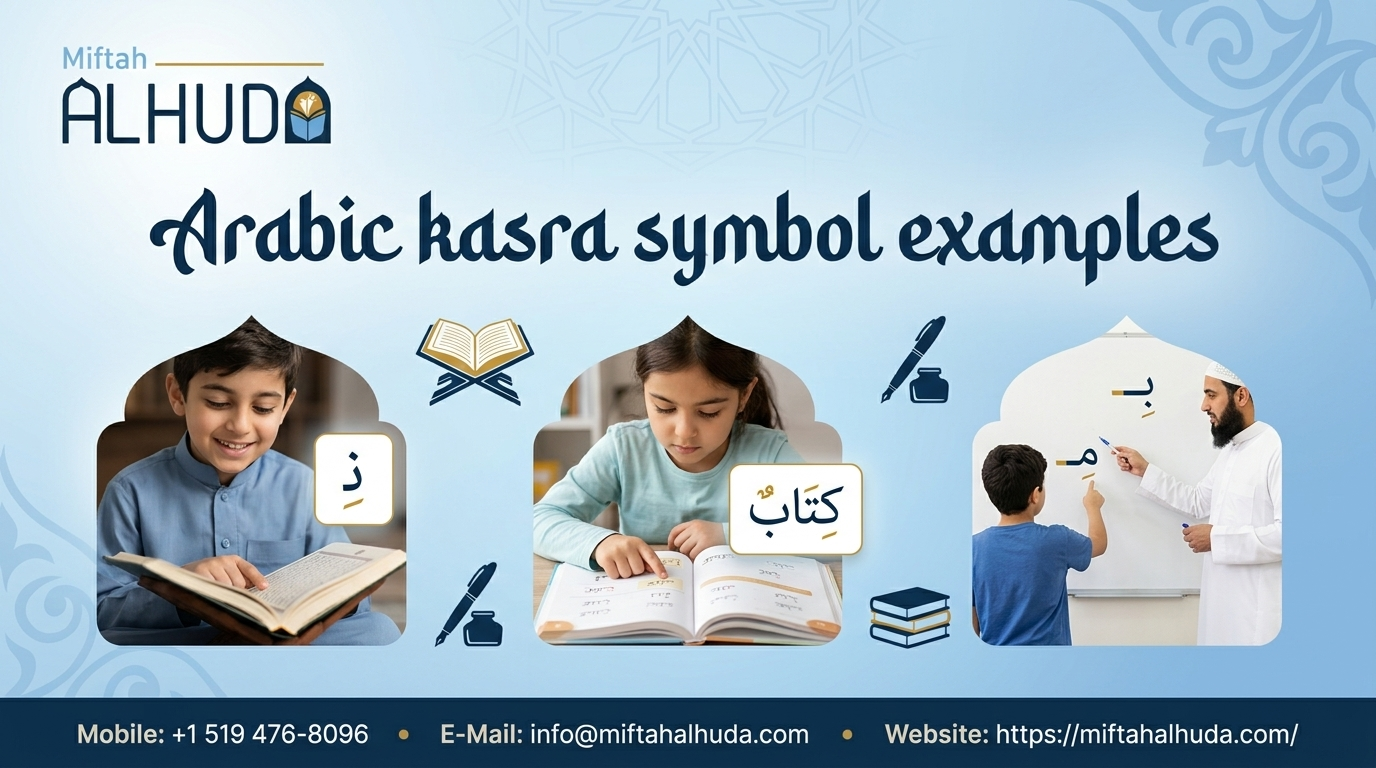
If you’ve ever looked at a page of Arabic text and observed tiny marks floating above and below the letters, you’ve already encountered diacritics, and the kasra is one of the most essential. It’s small and easy to miss, but it completely alters the way a word sounds. Consider it like a condiment in cooking: without it, the dish isn’t the same.
In this article, we’ll explain what the kasra is, how it works, and show you lots of Arabic kasra symbol examples so you can start recognizing and using it with ease. And, if you’d rather have someone direct you through it step by step than figure it out on your own, Miftah Al-Huda Academy is here to help you master Arabic reading and tajweed with confidence and clarity.
What Is the Arabic Kasra Symbol?
The Arabic kasra symbol (ـِ) is a short vowel mark that appears underneath an Arabic letter. It makes a short “i” sound, equivalent to the “i” in the English word “sit,” but the Arabic pronunciation is often cleaner and shorter.
Example
- بِ = bi
- كِ = ki
- مِ = mi
Without the kasra, these letters would only signify consonants.
How Does the Kasra Sound?
Kasra pronounces the letter with a short “i” vowel.
| Arabic | Pronunciation | Similar English Sound |
| بِ | bi | bit |
| تِ | ti | tip |
| دِ | di | did |
| نِ | ni | knit |
Remember that the vowel is short and not extended.
Where Is the Kasra Written?
Kasra, unlike Fatha (ـَ) and Damma (ـُ), is always written below the letter.
Comparison
| Vowel | Symbol | Sound |
| Fatha | ـَ | a |
| Damma | ـُ | u |
| Kasra | ـِ | i |
Why Is Kasra Important?
Arabic relies significantly on vowel symbols to ensure proper pronunciation.
- Kasra helps readers:
- Pronounce words accurately.
- distinguish between related terms.
- Read the Quran correctly.
- Improve Arabic fluency.
- Avoid pronunciation mistakes.
For beginner learners, learning kasra is one of the quickest ways to boost reading confidence.
Arabic Kasra Symbol Examples
Here are some easy Arabic kasra symbol examples to help you practice.
| Arabic | Transliteration | Meaning |
| مِنْ | min | from |
| كِتاب | kitāb | book |
| إِمام | imām | leader |
| سِراج | sirāj | lamp |
| رِزْق | rizq | provision |
| نِعْمَة | ni’mah | blessing |
| حِكْمَة | hikmah | wisdom |
| بِسْم | bism | in the name |
| مِفْتاح | miftāḥ | key |
Read each word loudly numerous times until the short “i” sound comes naturally.
Kasra in the Arabic Alphabet
Every Arabic letter can take a kasra.
Here are examples:
| Letter | With Kasra | English Pronunciation |
| ا | إِ | i |
| ب | بِ | bi |
| ت | تِ | ti |
| ث | ثِ | thi |
| ج | جِ | ji |
| ح | حِ | ḥi |
| خ | خِ | khi |
| د | دِ | di |
| ذ | ذِ | dhi |
| ر | رِ | ri |
| ز | زِ | zi |
| س | سِ | si |
| ش | شِ | shi |
| ص | صِ | ṣi |
| ض | ضِ | ḍi |
| ط | طِ | ṭi |
| ظ | ظِ | ẓi |
| ع | عِ | ʿi |
| غ | غِ | ghi |
| ف | فِ | fi |
| ق | قِ | qi |
| ك | كِ | ki |
| ل | لِ | li |
| م | مِ | mi |
| ن | نِ | ni |
| هـ | هِ | hi |
| و | وِ | wi |
| ي | يِ | yi |
A few important pronunciation notes
- بِ = bi → like “bee”, but keep the vowel short.
- تِ = ti → a short ti sound.
- ثِ = thi → the th is like the sound in “think”, not “this.”
- جِ = ji → generally ji; pronunciation can vary by Arabic dialect.
- حِ = ḥi → a strong h produced deeper in the throat.
- خِ = khi → similar to the “kh” in Khan.
- شِ = shi → like “shi” in ship.
- صِ = ṣi, ضِ = ḍi, طِ = ṭi, ظِ = ẓi → these are emphatic Arabic sounds and don’t have exact English equivalents.
- عِ = ʿi → ʿayn, a distinctive Arabic throat sound with no exact English equivalent.
- غِ = ghi → a gargled/throaty sound, somewhat similar to the French r.
- قِ = qi → a deep q sound produced at the back of the mouth.
Kasra vs Fatha vs Damma
These three short vowels are the basis of Arabic pronunciation.
| Symbol | Sound | Example |
| ـَ | a | بَ (ba) |
| ـُ | u | بُ (bu) |
| ـِ | i | بِ (bi) |
Accurate Arabic reading requires the ability to identify these sounds.
Kasra and Long Vowels
Kasra makes a short “i” sound.
When followed by the letter ي (yaa’) without vowels, it creates a long “ee” sound.
Examples
- بِ = bi
- بِي = bee (bī)
More examples:
- فِي (fī) – in
- كَبِير (kabīr) – big
- صَغِير (ṣaghīr) – small
Learning to distinguish between short and long vowels significantly improves pronunciation.
Common Words That Use Kasra
Many everyday Arabic words contain kasra.
| Arabic | Transliteration | Meaning |
| بِنت | bint | girl |
| طِفل | ṭifl | child |
| سِتّ | sitt | lady |
| مِصر | Miṣr | Egypt |
| رِجال | rijāl | men |
| لِسان | lisān | tongue/language |
| حِمار | Himār | donkey |
These words are ideal for daily pronunciation practice.
Kasra in Quranic Arabic
The kasra symbol is extremely important in Quranic recitation since each vowel changes pronunciation.
For example:
- بِسْمِ
- رَبِّ
- الَّذِينَ
- إِلَى
Correct pronunciation preserves the intended reading and enables accurate recitation.
Common Mistakes Beginners Make
-
Stretching the Sound
Incorrect:
- bii
Correct:
- bi
Kasra is always a short vowel, unless it’s followed by a long one.
-
Confusing Kasra with Damma
Some learners pronounce:
بِ as bu
Remember:
- Kasra equals i, while Damma = u.
-
Ignoring the Vowel Marks
A lot of beginners focus just on consonants.
Reading each vowel mark carefully results in significantly faster progress.
Easy Practice Exercises
Read the following aloud:
- ذِكر → dhikr → remembrance
- سِلاح → si-LAAH → weapon
- شِفاء → shi-FAA → healing
- صِدق → sidq → honesty / truthfulness
- ضِرس → dirs → molar tooth
- ظِلّ → dhill → shade
- عِباد → i-BAAD → servants
- غِنى → ghi-NAA → richness / independence
- فِكر → fikr → thought
- قِراءة → qi-RAA-ah → reading
- كِرام → ki-RAAM → noble / generous people
- لِقاء → li-QAA → meeting
- مِرآة → mir-AH → mirror
- نِظام → ni-ZAAM → system
- هِداية → hi-DAA-yah → guidance
- وِفاق → wi-FAAQ → agreement / harmony
Repeat them multiple times, keeping the vowels short.
6 Tips for Mastering the Kasra with Miftah Al-Huda Academy
- Every day, spend 5-10 minutes practicing Kasra letters and simple words.
- To improve your pronunciation, listen to what your teacher says and repeat it.
- Compare Harakat: Learn to distinguish between بَ (ba), بِ (bi), and بُ (bu).
- Read gently at the start, then gradually increase your pace.
- Get feedback from your teacher to correct pronunciation mistakes early on.
- Consistent practice will let you recognize and pronounce Kasra naturally.
Miftah Al-Huda Academy offers guided practice and personalized feedback to help learners gain confidence in Arabic reading and pronunciation.
How to Remember the Kasra Symbol?
A simple memorization trick is to imagine the kasra dragging your voice slightly lower, exactly like the mark below the letter.
Kasra is pronounced as “ki,” or “mi” with a short “i” sound.
Many beginners benefit from this visual linkage, which helps them recall both the position and pronunciation.
Building Reading Confidence
Mastering Kasra is a critical step toward reading Arabic with confidence. Miftah Al-Huda Academy offers structured courses, guided reading, and customized feedback to help students practice Kasra, Fatha, and Damma. Regular practice makes recognizing short vowels easier, allowing students to read Arabic more accurately and naturally.
Conclusion
The Arabic kasra symbol (ـِ) is a crucial component of Arabic reading and pronunciation. Despite being small, it serves a significant role in assisting learners in correctly pronouncing words, distinguishing meanings, and confidently reading Arabic.
You will gradually increase your Arabic fluency by practicing the Arabic kasra symbol examples in this guide, reviewing the alphabet with kasra, and reading simple words on a daily basis.
With patience and constant practice, mastering kasra becomes a natural step toward reading Arabic accurately and confidently.
Start Your Arabic Reading Journey Today!
Ready to master Kasra and other Arabic vowel marks with confidence? Join Miftah Al-Huda Academy and learn with expert guidance, structured lessons, and personalized support. Try your first lesson with our free trial and discover how easy learning Arabic can be!
Contact Us
- WhatsApp: +1 519 476-8096
- E-Mail: in**@**********da.com
- Facebook: https://www.facebook.com/MiftahAlhudaOfficial
- Instagram: https://www.instagram.com/miftahalhudaa
- Youtube: https://www.youtube.com/@MiftahAl-huda
- Tiktok: https://www.tiktok.com/@miftahalhuda00
Frequently Asked Questions About the Arabic Kasra Symbol
1. Can Kasra appear on every Arabic letter?
Yes. Kasra can be placed beneath Arabic letters to produce the short “i” vowel sound.
2. How can beginners tell Kasra from other Arabic vowel marks?
Kasra is easy to identify because it appears as a small diagonal line underneath the letter, while Fatha and Damma appear above it.