
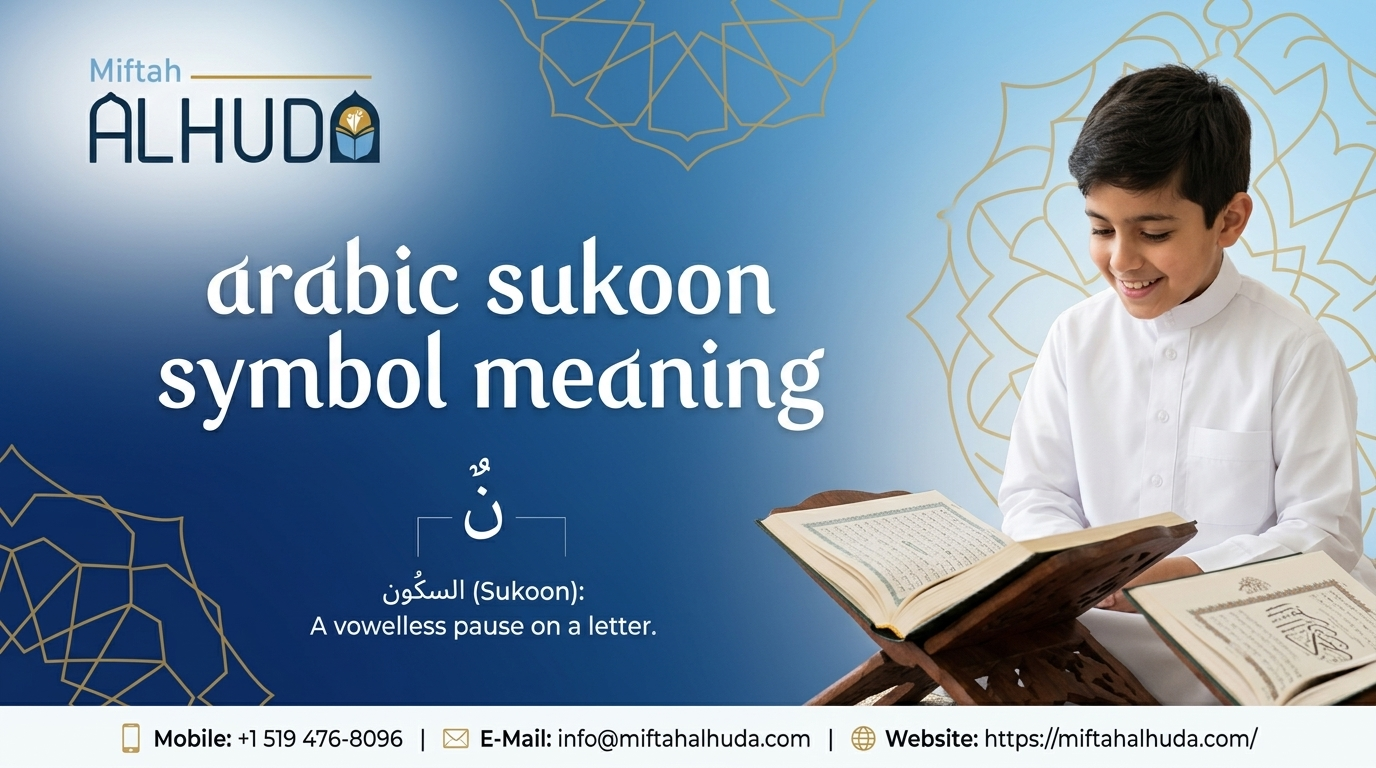
Arabic Sukoon Symbol Meaning and Usage Guide
The clarity of reading Arabic significantly improves when one learns to recognize the diacritical marks accompanying its letters. Among these, the Sukoon symbol (ـْ) plays a pivotal role by indicating that a consonant is articulated without the addition of a short vowel. Despite its seemingly straightforward appearance, the Sukoon can profoundly influence the rhythm, structure, and articulation of Arabic words. For beginners , Quran students, and anyone studying Arabic pronunciation, understanding the Arabic sukoon symbol meaning is an essential step toward reading words correctly and avoiding common pronunciation mistakes.
In this guide, we delve into the workings of Sukoon, methods for identifying it, and how it connects with Quranic reading and Tajweed, with guidance from Miftah Al-Huda Academy to help you develop greater accuracy and confidence in your Quran recitation.
What Is the Arabic Sukoon Symbol?
The Sukoon is an Arabic diacritical mark used to indicate that the consonant it accompanies does not have a short vowel sound. The symbol typically appears as a small circle, like this: ـْ.
For example
أَبْ
The letter ب has a Sukoon: بْ. This means the letter is pronounced without a short vowel sound such as ‘a’, ‘i’, or ‘u’. Instead, the consonant is pronounced without an accompanying short vowel.
To illustrate, consider these examples:
- بَ = ba
- بِ = bi
- بُ = bu
- بْ = b
This distinction is crucial for learning to read Arabic.
Arabic Sukoon Symbol Meaning in Simple Terms
In Arabic, short vowels are indicated by specific signs:
- Fatha ـَ → short a
- Kasra ـِ → short i
- Damma ـُ → short u
- Sukoon ـْ → no short vowel
Additionally, Sukoon (ـْ) indicates the absence of a short vowel. Sukoon can be understood as a marker that instructs us not to add a vowel after the consonant.
For example, when we see:
مِنْ
The ن has Sukoon, so it is pronounced as a consonant ending rather than na, ni, or nu.
What Does Sukoon Look Like in Arabic?
The Sukoon symbol looks like a small circle placed above Arabic letters such as: ـْ.
Here are several examples:
- بْ
- تْ
- مْ
- نْ
- لْ
- كْ
- قْ
While the visual appearance might differ slightly across various Arabic fonts and Quranic scripts, its grammatical and phonetic role stays consistent. It’s important to notice the presence or absence of Sukoon when reading Arabic, as altering a vowel can significantly impact both pronunciation and meaning.
How Is Sukoon Pronounced?
Sukoon itself lacks an independent sound. It instructs us on the proper pronunciation of a letter. Take the letter م, for example:
- مَ = ma
- مِ = mi
- مُ = mu
- مْ = m
In the last case, it doesn’t imply that we are producing a sound named “Sukoon.” Instead, it indicates that the m is uttered without any short vowel following it. This is one of the first concepts we should master when learning Arabic reading.
Sukoon and Consonants
Arabic is a language rich in consonants, and the Sukoon plays a crucial role in allowing consonants to be pronounced without short vowels.
Take for example the word: يَكْتُبُ
here, the letter ك is marked with a Sukoon (كْ), which leads us to pronounce the sequence as yak-tu-bu, avoiding the insertion of an unneeded vowel after k.
Beginners who aren’t familiar with the concept of Sukoon might instinctively add a vowel to every consonant, which can significantly alter the pronunciation of words.
Examples of Arabic Sukoon in Words
| Arabic Word | Letter with Sukoon | Pronunciation | Meaning |
| يَجْلِسُ | جْ | yaj-li-su | He sits |
| يَفْتَحُ | فْ | yaf-ta-hu | He opens |
| يَشْرَبُ | شْ | yash-ra-bu | He drinks |
| مَكْتَبٌ | كْ | mak-ta-bun | Office / desk |
| بَحْرٌ | حْ | baḥ-run | Sea |
| شَمْسٌ | مْ | sham-sun | Sun |
| نَهْرٌ | هْ | nah-run | River |
| صَبْرٌ | بْ | ṣab-run | Patience |
| فَجْرٌ | جْ | faj-run | Dawn |
| دَرْسٌ | رْ | dar-sun | Lesson |
Sukoon in Quranic Arabic
The Sukoon symbol holds significant importance when reading the Quran, as precise pronunciation is inherently linked to Tajweed. This small diacritical mark can affect how letters are connected, whether a sound is continued, and how specific pronunciation rules are applied. For those studying the Quran, the Sukoon appears frequently in words and is essential for understanding rules related to:
- Meem Sakinah
- Noon Sakinah
- Idgham
- Ikhfa
- Izhar
- Iqlab
- Qalqalah
Learning the Sukoon symbol should not be approached as a mere rote memorization task; it is an integral part of a comprehensive pronunciation system.
Sukoon and Noon Sakinah
One of the key aspects of Tajweed is Noon Sakinah. This refers to the letter ن with a Sukoon: نْ
For example: مِنْ
The presence of the Sukoon denotes that the Noon is pronounced without any short vowel sound. In the study of Tajweed, Noon Sakinah is subject to several important rules that vary based on the subsequent letter. These rules include Izhar, Idgham, Iqlab, and Ikhfa. Grasping the concept of Sukoon is crucial for advancing in the understanding of more advanced Tajweed.
Sukoon and Meem Sakinah
The concept of Meem Sakinah follows a similar rule. A Meem with Sukoon is represented like this: مْ.
For example: هُمْ
The م is sakin, indicating it lacks a short vowel sound. Meem Sakinah comes with specific Tajweed rules that apply when it is followed by particular Arabic letters. These rules consist of Ikhfa Shafawi, Idgham Shafawi, and Izhar Shafawi. A student who promptly identifies the Sukoon can also easily recognize Meem Sakinah.
What Is the Difference Between Sukoon and Short Vowels?
When we set the signs side by side, the difference becomes quite evident.
| Arabic Sign | Name | Basic Sound |
| ـَ | Fatha | a |
| ـِ | Kasra | i |
| ـُ | Damma | u |
| ـْ | Sukoon | no short vowel |
Look at the letter ل:
- لَ = la
- لِ = li
- لُ = lu
- لْ = l
The final form indicates that the consonant is not followed by any of the three basic short vowels.
Sukoon vs. Shadda
Beginners often confuse Sukoon and Shadda, but they serve quite different functions.
| Aspect | Sukoon (ـْ) | Shadda (ـّ) |
| Function | Indicates that a letter has no short vowel | Indicates that a consonant is doubled or strengthened in pronunciation |
| Symbol | ـْ | ـّ |
| Example | رَبْ (Sukoon on ب) | رَبِّ (Shadda on ب) |
| Effect on Pronunciation | A brief stop on the letter with no vowel sound | Strengthens and doubles the sound of the letter |
| Interchangeable? | Cannot be replaced with Shadda | Cannot be replaced with Sukoon |
Can a Letter Have Sukoon and Shadda Together?
In typical Arabic writing, the Shadda signifies a doubled consonant, where the first part is a consonant without a vowel, and the second part bears the vowel. As a result, there is usually no need to place a separate Sukoon mark alongside the Shadda. For learners, it’s crucial to understand that the Shadda inherently includes the concept of Shadda already containing the idea of a consonant closure followed by another instance of the same consonant.
Sukoon and Arabic Word Pronunciation
Sukoon can be compared to a minor traffic signal for pronunciation.
When a learner sees a Fatha, Kasra, or Damma, the consonant naturally transitions into a short vowel sound.
When the student notices Sukoon, the vowel does not follow.
For example:
- دَرَسَ
-
- can be broken down as: دَ – رَ – سَ
- Every consonant has a short vowel.
Now compare: يَدْرُسُ
- This can be understood as: يَ – دْ – رُ – سُ
- The دْ is different because the letter د has Sukoon.
Why Is Sukoon Important for Arabic Learners?
Understanding Sukoon aids in the development of several vital reading skills.
- More Accurate Pronunciation: Sukoon helps prevent the addition of unnecessary vowels in words, leading to more precise pronunciation.
- Better Word Recognition: By recognizing consonant and vowel patterns, decoding Arabic words becomes simpler.
- Enhanced Quran Reading Skills: Sukoon is crucial for accurate recitation, as Quranic Arabic heavily relies on diacritical marks.
- Simplified Tajweed Learning: Many Tajweed rules are based on identifying letters that are sakin, making Sukoon essential.
- Increased Reading Confidence: Instead of guessing pronunciations, learners can rely on written vowel marks for guidance.
Common Mistakes When Reading Sukoon
When first meeting Sukoon, many Arabic learners make predictable mistakes.
1. Adding a Vowel After a Sakin Letter
A common mistake is mispronouncing “بْ” as “ba, bi, or bu.”
The student should pronounce the consonant without adding a short vowel.
2. Ignoring Sukoon Completely
Some beginners focus just on Fatha, Kasra, and Damma, ignoring Sukoon. This can result in a wrong word structure.
3. Confusing Sukoon With Shadda
Because both markings influence consonant pronunciation, beginners may confuse them. We need to learn their visual forms and functions independently.
4. Reading Every Letter With Equal Vowel Length
Sukoon does not indicate a long vowel. It indicates the absence of a short vowel. We should avoid expanding it into an additional syllable.
5 Steps to Practice the Arabic Sukoon Symbol
The most effective method involves gradual practice.
Step 1: Practice Individual Letters
- Start by reading combinations like: بَ — بُ — بِ — بْ
- Continue with other letters:تَ — تُ — تِ — تْ
Step 2: Practice Two-Letter Combinations
Work on combinations such as:
- أَبْ
- مِنْ
- هَلْ
- قَدْ
Step 3: Practice Longer Words
Progress to words that include multiple vowel signs and Sukoon.
Step 4: Read Aloud
Reading aloud helps in identifying if any unintended vowels are being added.
Step 5: Practice With a Qualified Teacher
A teacher can pinpoint any pronunciation issues that might be hard to detect on your own, especially when working towards Quranic recitation. At Miftah Al-Huda Academy, our certified instructors offer personalized guidance to help you master these rules with confidence.
How Sukoon Connects With Tajweed?
Tajweed is more than just enhancing the beauty of the Arabic language. It is a systematic approach to ensuring Quranic letters and sounds are articulated accurately. The concept of Sukoon plays a vital role because many Tajweed rules hinge on whether a letter is sakin. For instance, when encountering نْ, it is understood as Noon Sakinah, while مْ indicates Meem Sakinah. This identification allows one to assess the subsequent letter and identify the applicable pronunciation rule. Thus, a solid grasp of Arabic vowel signs simplifies advanced Tajweed studies considerably.
Final Thoughts
The Arabic Sukoon symbol may appear as a small circle, but it plays a crucial role in Arabic reading. Grasping the Arabic Sukoon Symbol Meaning helps us identify when a consonant has no accompanying short vowel, enabling us to read Arabic words more accurately and confidently.
For beginners, recognizing the ـْ symbol is a key step toward independent Arabic reading. For those learning the Quran, its importance is heightened as it is closely linked to concepts such as Noon Sakinah, Meem Sakinah, and Tajweed rules.
Practicing with the Sukoon along with Fatha, Kasra, Damma, and Shadda can help create a stronger foundation for precise Arabic reading and Quranic recitation. The aim is not just to recognize the symbol visually but to understand its instruction for reading.
Turn Every Arabic Letter Into a Step Toward Better Quran Reading
Learning Arabic becomes easy with the right support. At Miftah Al-Huda Academy, we make Quran and Arabic learning simple, systematic, and accessible to learners of all levels. Instead of battling with Arabic letters and symbols on your own, learn step by step with supporting teachers who will help you gain confidence from the start.
Ready to begin? Book your Arabic course with Miftah Al-Huda Academy and take advantage of our Free Trial. Start learning Arabic with the right guidance and make every lesson a step closer to confident reading!
Contact Us
- WhatsApp: +1 519 476-8096
- E-Mail: in**@**********da.com
- Facebook: https://www.facebook.com/MiftahAlhudaOfficial
- Instagram: https://www.instagram.com/miftahalhudaa
- Youtube: https://www.youtube.com/@MiftahAl-huda
- Tiktok: https://www.tiktok.com/@miftahalhuda00
Frequently Asked Questions
1. Can Sukoon appear in the middle of an Arabic word?
Yes, Sukoon can appear in either the middle or the end of a word. It indicates that the letter it is associated with is pronounced without a short vowel.
2. Does every Arabic word contain a Sukoon symbol?
No, not every Arabic word includes a Sukoon symbol. Many words in unvowelled Arabic texts are written without it. Sukoon is more commonly used in fully vowelled texts, such as educational materials and the Quran, to help clarify pronunciation.
3. Can Sukoon change the meaning of an Arabic word?
Yes, altering or removing a vowel mark can sometimes change the pronunciation and meaning of a word. Therefore, it is important to recognize Sukoon correctly, especially when learning fully vowelled Arabic.
4. Is Sukoon difficult for children learning Arabic?
Not necessarily. Children can effectively learn Sukoon through simple letter combinations, repetition, visual exercises, and guided reading practices. Using short examples initially can help make the concept easier to grasp.
5. Why should beginners learn the Arabic Sukoon symbol meaning?
Understanding the Arabic sukoon symbol meaning helps beginners read Arabic words more accurately by avoiding unnecessary vowels, recognizing important pronunciation patterns, and building a solid foundation for Quranic reading and Tajweed.