
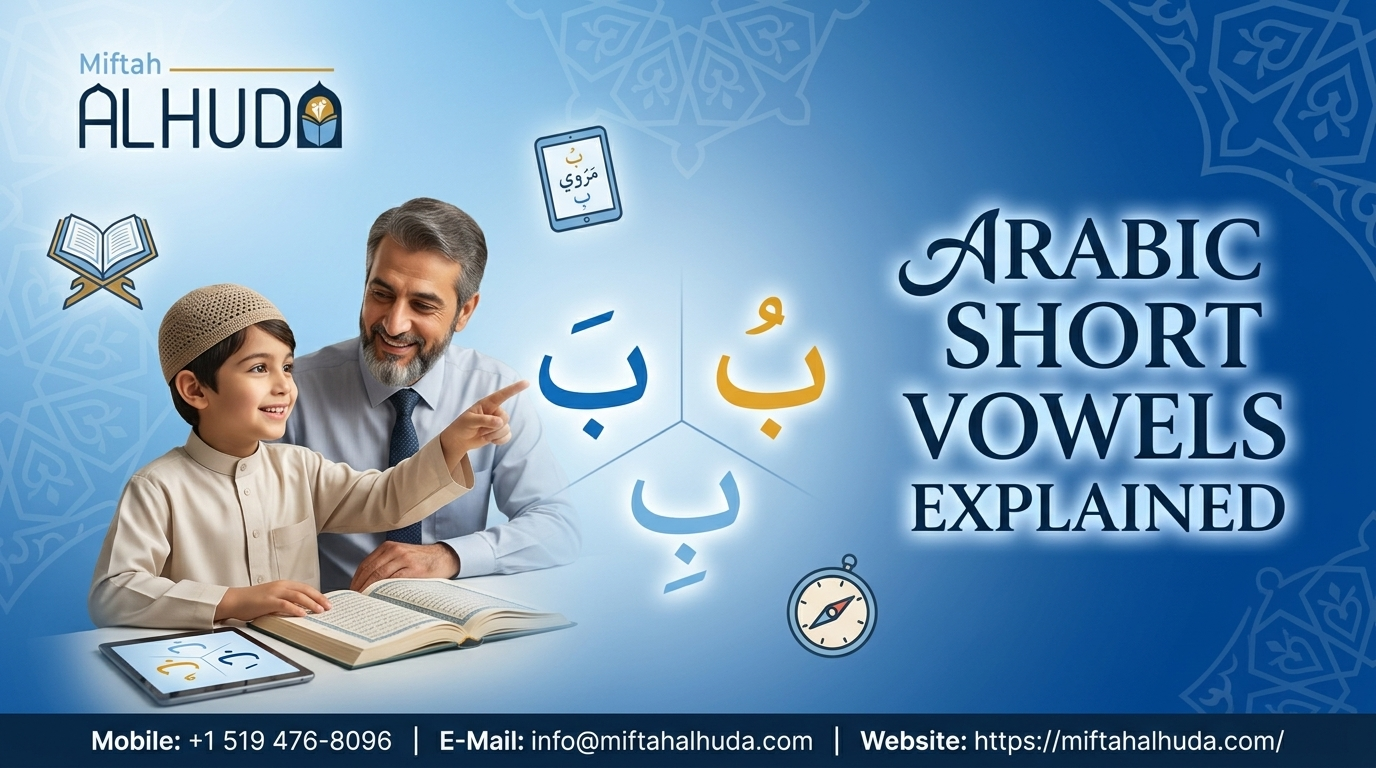
Arabic is an abjad, which means that its alphabet consists mainly of consonants. Consider consonants to be the skeleton of a word. They provide both structure and core meaning. But a skeleton requires flesh and blood to be alive, right? This is exactly what short vowels do.
They are the diacritical marks (Tashkeel or Harakat) that give life, sound, and specific meaning to those consonant skeletons.
In this comprehensive guide, we’re going to have Arabic short vowels explained in a way that covers everything you need to know. Miftah Al-Huda Academy will keep it simple, engaging, and completely natural. Are you ready to unlock the code? Let’s dive right in.
Why Are Short Vowels Important in Arabic?
You may be wondering, “Cannot I just guess the vowel sounds?” Sometimes you can, but usually not. In Arabic, altering a short vowel entirely alters the meaning of a word. For instance, the root letters k-t-b (ك ت ب) relate to writing. Add a *Fatha* to the first letter, and you get “kataba” (he wrote). Change it to a *Damma*, and it becomes “kutiba” (it was written). See the difference? Getting Arabic short vowels explained is about more than simply pronunciation; it is about mastering the fundamentals of Arabic communication.
The Big Three: Fatha, Kasra, and Damma
Let’s meet the show’s stars. The Arabic short vowel system is organized around three major marks. Once you get to know these three, reading Arabic will become far less intimidating.
What is a Fatha? (The “A” Sound)
The Fatha is a tiny diagonal dash that appears directly above a consonant. It illustrates the short “a” sound. If you’re familiar with English phonetics, imagine it as the crisp, short ‘a’ you hear in everyday conversation.
How to Pronounce Fatha Correctly?
- Think of the short, sharp ‘a’ sound in words like “cat” or “hat”.
- For example, the letter ب (Ba) with a Fatha becomes “Ba” (بَ).
- It’s quick and punchy and it doesn’t linger.
- Avoid making a long “aaa” sound; instead, keep it short!
What is a Kasra? (The “I” Sound)
Next up is the Kasra. This is a small diagonal dash that appears directly below a consonant. It makes a short “i” sound, which serves as the descending counterpart to the upward Fatha.
Mastering the Kasra Pronunciation
- Observe the short ‘i’ sound in English words such as “sit,” “pin,” and “bit.”
- The letter س (Sin) with a Kasra beneath (سِ) is pronounced as “Si.”
- It’s a bright, high-pitched sound that moves swiftly.
- A helpful approach is to smile slightly when you pronounce it; the shape of your mouth will automatically direct you to the correct pronunciation.
What is a Damma? (The “U” Sound)
Finally, we have the Damma. This little mark is like a tiny, curled comma or a little Arabic letter “Waw” (و) floating just above the consonant. It produces a brief “u” sound.
Tips for Perfecting the Damma Sound
Think of the short ‘u’ sound in English words like “put,” “book,” or “foot.”
- Adding a Damma to the letter م (Meem) creates “Mu” (مُ).
- Round your lips slightly, almost as if about to blow out a candle.
- Keep the sound quick and snappy; don’t let it drag on.
The Silent Partner: Sukoon
We cannot discuss vowels without mentioning their silent but immensely strong partner, the Sukoon.
Understanding the Role of Sukoon in Arabic
- The Sukoon, a little circle above a consonant (e.g., بْ), represents “stillness” or “rest.”
- It instructs you to cut off the vowel sound abruptly because there is no vowel after that consonant.
- Consider it like the brake pedal in a car: if Fatha, Kasra, and Damma are the gas pedals propelling the word forward, Sukoon puts it to a screeching halt.
- For example, the word “Qalb” (heart) is spelled as قَلْب. The Sukoon on the ل requires “lb” at the end, not “lub” or “lib.”
Shadda and Its Impact on Short Vowels
Now that you’ve mastered the fundamentals, let’s add a layer of complexity with the Shadda.
How Shadda Changes the Game?
- The Shadda resembles a little ‘w’ or a mustache placed above a letter, signifying that the consonant is doubled or accentuated.
- It is nearly always accompanied by a short vowel (Fatha, Kasra, or Damma), written above or below the Shadda itself.
- For example, ب with a Shadda and a Fatha (بَّ) is more than just “Ba”; you hold the ‘b’ sound slightly longer, making it “Bba.”
- It’s similar to the difference between the English words “holy” and “holly”; the Shadda adds weight, rhythm, and emphasis.
Common Mistakes Beginners Make with Arabic Short Vowels
Even the most committed learners make mistakes from time to time. Understanding these common mistakes will save you hours of frustration.
1. Mixing Up Fatha and Kasra
Because the Fatha is above the letter and the Kasra is below, it is remarkable how easily the brain switches them when reading quickly. This is particularly true for visual learners. Always pause and examine the dash’s position. Is it the roof Fatha or the floor Kasra?
2. Ignoring the Sukoon
Beginners frequently add a default vowel (typically a Fatha) at the end of each word, ignoring the Sukoon. This converts correct words into nonsense. Remember to respect the brake pedal! Allow the word to rest when the Sukoon tells you to.
Practical Tips for Mastering Arabic Short Vowels
So, how do we go from theory to practice? Here are some practical, human-tested tips for making these vowels second nature.
-
Listen and Repeat: The Golden Rule
Language is mostly an auditory experience. You cannot learn to ride a bicycle by reading an instruction book, nor can you acquire Arabic vowels by staring at a page. Listen to native speakers recite the passage in full *Tashkeel*. Pause, imitate their mouth movements, then repeat. Shadowing is your best friend in this situation.
-
Use Color-Coded Learning Materials
Our brains enjoy patterns and colors. Use highlighters or digital text editors to color-code the vowels. Turn all Fathas red, Kasras blue, Dammas green, and *Sukoon* black. This visual separation forms a strong mental map, making it much easier to distinguish and retain the sounds when you encounter them in nature.
Conclusion: Your Journey to Arabic Fluency Starts Here
Mastering a new language is a race, not a sprint, but learning Arabic short vowels explained is one of the most satisfying first stages. These little symbols are more than simply ornamentation; they are the heartbeat of Arabic language and meaning. By embracing the Fatha, Kasra, Damma, Sukoon, and Shadda, you empower yourself to read, speak, and comprehend Arabic with confidence and clarity. Continue to practice, keep curious, and remember that every expert started out as a beginner who refused to give up. You’ve got this!
Don’t just read about it, live it. Book your course with Miftah Al-Huda Academy today and get Arabic short vowels explained step by step by expert teachers, live and one-to-one.
Start your free trial and turn these vowels into real conversations. Your first class is on us. What are you waiting for?
Contact Us
- WhatsApp: +1 519 476-8096
- E-Mail: in**@**********da.com
- Facebook: https://www.facebook.com/MiftahAlhudaOfficial
- Instagram: https://www.instagram.com/miftahalhudaa
- Youtube: https://www.youtube.com/@MiftahAl-huda
- Tiktok: https://www.tiktok.com/@miftahalhuda00
Frequently Asked Questions
1. Do I always need to write short vowels in Arabic?
Short vowels are rarely used in common Arabic writing (such as newspapers, novels, or text messaging). Native readers rely on context to determine the proper vowels. However, they are always included in the Quran, children’s books, poetry, and beginner learning materials to avoid ambiguity.
2. How long does it take to master Arabic short vowels?
Most beginners can distinguish and pronounce short vowels after 2 to 4 weeks of steady, daily practice of 15-20 minutes. True mastery, in which you employ them automatically when speaking, may need several months of active listening and speaking practice.
3. Can short vowels change the meaning of an Arabic word?
Absolutely! This is one of the most interesting characteristics of Arabic. For example, “عَلِمَ” (‘alima) indicates “he knew,” while “عَلَّمَ” (‘allama) means “he taught.” The alteration in the short vowel (and the addition of a *Shadda*) fundamentally changes the definition.
-
What is the best app for practicing Arabic short vowels?
Apps like as “Kaleela,” “Drops,” and “Mango Languages” provide excellent interactive activities for *Tashkeel*. Additionally, YouTube channels like as “Arabic Pod 101” or “Imran Alawiye” offer excellent visual and audio breakdowns of short vowels for beginners.
5. When beginners search for “Arabic short vowels explained”, what is the fundamental difference between these short vowels and long vowels (Alif, Waw, Ya)?
The main difference is in duration and form. Short vowels are diacritical markings (dashes or dots) that make a rapid, one-beat sound. Long vowels are written with letters (Alif, Waw, and Ya) that stretch the vowel sound by two beats.