
Excited to take your Quran recitation to the next level? Today we’re diving into Idgham Shafawi in the simplest and most enjoyable way possible!
Let Miftah Al-Huda Academy be your friendly guide, holding your hand step by step through this beautiful rule.By the end of this article, you’ll not only understand Idgham Shafawi Basics but also feel confident spotting and applying it while reciting the Quran. Let’s make this fun and easy!
What Is Idgham Shafawi?
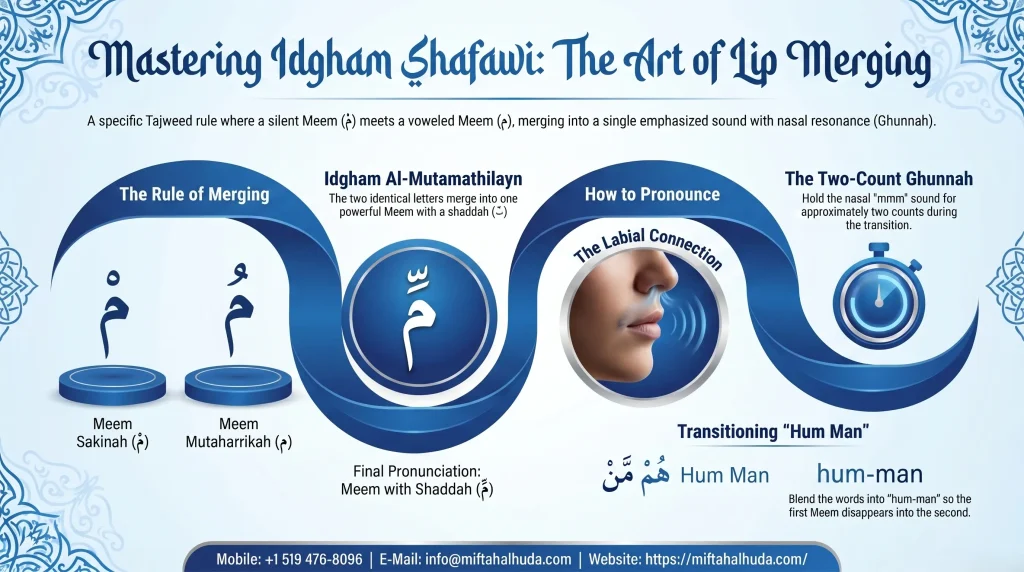
When a Meem Sakinah (مْ) is followed by another Meem (م) at the beginning of the next word, you merge them into one powerful Meem with a shaddah (ّ) and add a nice nasal sound called Ghunnah.
This is called Idgham of identical letters (Idgham Al-Mutamathilayn).
The Meaning Behind the Name
- The term “Idgham” refers to merging or assimilation.
- “Shafawi” is derived from “shafah,” which means lips. So, Idgham Shafawi Basics is essentially “lip merging” and occurs specifically with the letter Meem (م). Have you ever noticed how your lips come together when you say “mmm”? That’s the key!
When Does It Happen?
This rule in Idgham Shafawi Basics occurs exclusively when a Meem Sakinah (a Meem with sukoon) is followed by a Meem Mutaharrikah (a voweled Meem) .There are no other letters involved. It’s so specific!
How to Pronounce It Correctly?
To apply Idgham Shafawi Basics effectively, focus on the transition. Instead of saying ‘hum man’ separately, you blend it into something like “hum-man,” with the first Meem disappearing into the second and the “mmm” sound held for about two counts. It feels good once you have it.
Why “Shafawi” The Lip Connection ?
Anatomy of the Sound
Your lips are the stars here. Meem is a labial letter formed by bringing both lips together.
Feeling It in Your Mouth
Place your fingers on your lips while practicing. You’ll feel the vibration and closure.
10 Examples of Idgham Shafawi in the Qur’an
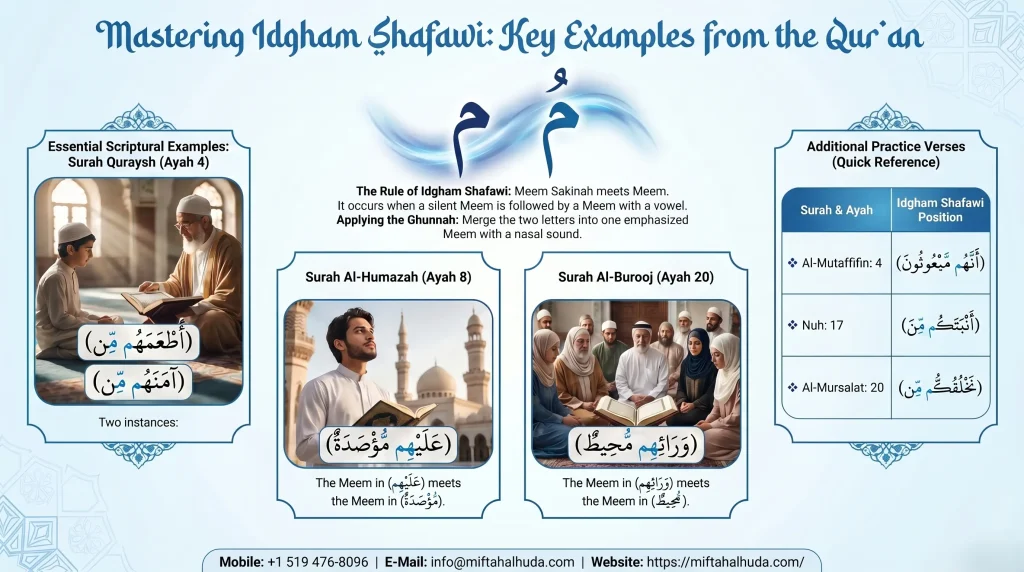
To better comprehension of Idgham Shafawi Basics, we examine the following clear examples:
| Verse | Surah & Ayah | Idgham Shafawi Position |
| ﴿الَّذِي أَطْعَمَهُم مِّن جُوعٍ وَآمَنَهُم مِّنْ خَوْفٍ﴾ | Quraysh: 4 | Meem Sakinah in (أَطْعَمَهُم) ,(آمَنَهُم) meets Meem in مِّن |
| ﴿إِنَّهَا عَلَيْهِم مُّؤْصَدَةٌ﴾ | Al-Humazah: 8 | Meem Sakinah in (عَلَيْهِم) meets Meem in (مُّؤْصَدَةٌ) |
| ﴿وَاللَّهُ مِن وَرَائِهِم مُّحِيطٌ﴾ | Al-Burooj: 20 | Meem Sakinah in (وَرَائِهِم) meets Meem in (مُّحِيطٌ) |
| ﴿أَلَا يَظُنُّ أُولَئِكَ أَنَّهُم مَّبْعُوثُونَ﴾ | Al-Mutaffifin: 4 | Meem Sakinah in (أَنَّهُم) meets Meem in (مَّبْعُوثُونَ) |
| ﴿أَلَمْ نَخْلُقكُّم مِّن مَّاء مَّهِينٍ﴾ | Al-Mursalat: 20 | Meem Sakinah in (نَخْلُقكُّم) meets Meem in (مِّن) |
| ﴿فَلَمْ يَجِدُوا لَهُم مِّن دُونِ اللَّهِ أَنصَاراً﴾ | Nuh: 25 | Meem Sakinah in(لَهُم) meets Meem in (مِّن) |
| ﴿أَنبَتَكُم مِّنَ الْأَرْضِ نَبَاتاً﴾ | Nuh: 17 | Meem Sakinah in (أَنبَتَكُم) meets Meem in (مِّن) |
| ﴿يُرْسِلِ السَّمَاء عَلَيْكُم مِّدْرَاراً﴾ | Nuh: 11 | Meem Sakinah in (عَلَيْكُم) meets Meem in (مِّدْرَاراً) |
| ﴿وَالَّذِينَ هُم مِّنْ عَذَابِ رَبِّهِم مُّشْفِقُونَ﴾ | Al-Ma’arij: 27 | Meem Sakinah in ( هُم) meets Meem in (مِّنْ)
Meem Sakinah in (رَبِّهِم) meets Meem in (مُّشْفِقُونَ)
|
| ﴿أَمْ تَسْأَلُهُمْ أَجْراً فَهُم مِّن مَّغْرَمٍ مُّثْقَلُونَ﴾ | Al-Qalam: 46 | Meem Sakinah in(فَهُم) meets Meem in (مِّن) |
12 Smart Tips to Master Idgham Shafawi
-
Train Your Lips, Not Just Your Voice
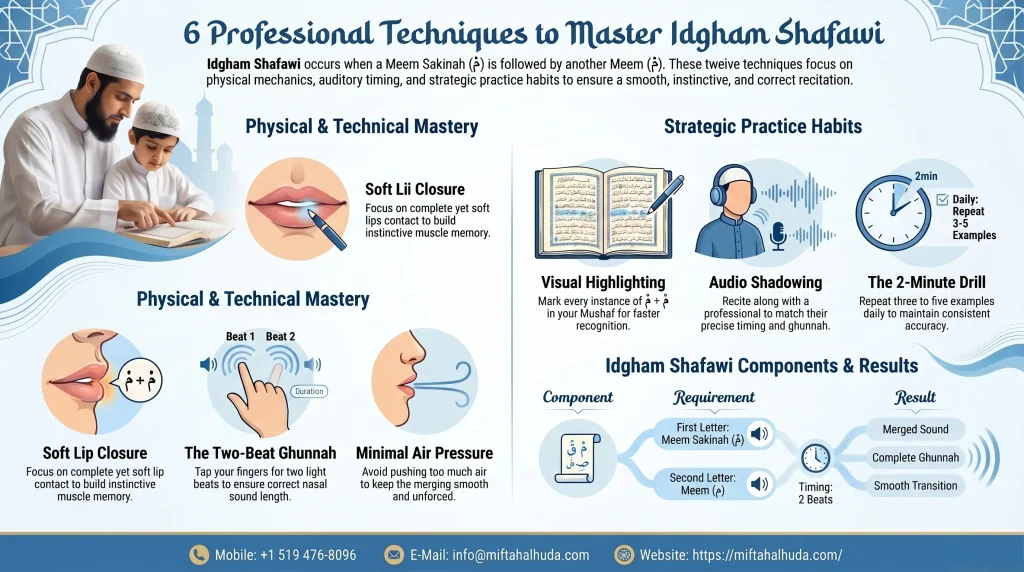
Focus on soft yet complete lip closure when combining the two Meems. This cultivates muscle memory and renders the sound instinctive.
-
Use the “Pause & Merge” Technique
During practice, pause slightly before the second Meem and then merge smoothly to ensure a clear transition.
-
Whisper Practice First
To isolate the ghunnah without straining your voice, recite softly or in a whisper.
-
Highlight While You Read
Mark every مْ + م in your Mushaf ,visual recognition accelerates correct application.
-
Count the Ghunnah with Your Fingers
Tap two light beats with your fingers to adjust the length of the nasal sound.
-
Practice Backward Linking
Begin with the second Meem and connect it back to the first .This improves smooth merging.
-
Record in Slow Motion Mode
Slow down your recitation recording and listen carefully to ensure that the merging is clean.
-
Switch Between Fast and Slow Recitation
Master it slowly, then accelerate. This ensures accuracy at any speed.
-
Shadow a Skilled Reciter
Play a recitation while reading along to ensure precise timing and ghunnah.
-
Focus on One Rule Per Session
To avoid confusion with other Tajweed rules, commit a short session to Idgham Shafawi Basics.
-
Use Minimal Air Pressure
Avoid pushing too much air; Idgham Shafawi should be smooth, not forced.
-
Create a Daily 2-Minute Drill
Every day, repeating 3-5 examples consistently.
Why Master Idgham Shafawi Basics?
- Achieves an effortless transition between words, ensuring that your Tarteel is flowing and continuous.
- The proper use of Ghunnah adds melodic beauty to your voice, promoting a deeper heart connection with the Revelation.
Teaching Idgham Shafawi to Kids or New Learners
Use games, mouth exercises, and plenty of repetitions. Make it visible with lip drawings or mirrors.
Give yourself a pat on the back for coming this far! Learning Tajweed requires patience, but each single step brings your recitation closer to perfection.
Level Up Your Recitation: The Idgham Shafawi Flow
Idgham Shafawi is one of the easiest yet most impactful rules for beginners. It’s all about blending two Meems into one smooth, nasal sound using your lips.
Keep practicing your exercises with Miftah Al-Huda Academy, and make sure to listen to Tajweed experts; that’s how we learn and grow. Soon, Idgham Shafawi Basics will feel completely natural, and your Quran recitation will shine brighter. Keep going, you’ve got this!”
“Elevate your soul and your recitation. Join Miftah Al-Huda Academy for a Free Trial session and experience how easy it is to apply the Idgham Shafawi Basics correctly. Book your spot now!”
Contact Us
- WhatsApp: +1 519 476-8096
- E-Mail: in**@**********da.com
- Facebook : https://surl.li/yqeyas
- Instagram:https://surl.li/smlfaq
- Youtube: https://surl.li/inbncd
- Tiktok:https://surl.li/ldzmww
Frequently Asked Questions About Idgham Shafawi Basics
1. Can Idgham Shafawi occur within the same word?
No, Idgham Shafawi usually occurs between two separate words, not within a single word.
2. Is Idgham Shafawi applied in both slow and fast recitation?
Yes, the rule must be followed consistently at all recitation speeds, including slow (Tarteel) and fast (Hadr).
3. Does Idgham Shafawi change the meaning of words?
No, it doesn’t affect the meaning, however inappropriate application may impair good pronunciation.
4. What is the core difference between Idgham Shafawi and Idgham in Noon Sakinah?
While both involve merging, Idgham Shafawi Basics only apply when Meem Sakinah meets another Meem. Unlike Noon Sakinah rules, this is the sole instance of Idgham for the letter Meem.
5. How long should the Ghunnah be held during this merger?
The Ghunnah is held on two counts (harakah). At Miftah Al-Huda Academy, we teach learners how to pace their verses precisely in order to keep the rhythmic flow.
6. Why is mastering this specific rule vital for beginners?
Because the letter Meem appears frequently in the Qur’an. Mastering this rule quickly increases the “fluidity” of your recitation, making it sound more professional and polished.