
You listen to someone Counting from 1 to 100 in Arabic and suddenly you lose track of things. One through ten was okay. The numbers move beyond ten into their teens. You hear some grammar term which makes no sense to you, and you start hitting pause and rewind button, again and again. It is here that most people lose interest in learning how to count in Arabic and decide to do it later.
There is one more point though. The fault lies not in you. All resources teach Arabic numerals as though they were verb forms, rules first and examples after.
And nobody even tells you that from one to ten and from twenty-one to ninety-nine there are two separate things that happen to have the same name. You learn the first ten numerals quite easily. And then comes the complicated numbers that play tricks on your mind.
I’m going to walk through it in the order your brain actually wants it. Ten building blocks first. Then the one rule that unlocks everything from 21 to 99. Then a full chart, the pronunciation traps, and a practice plan you can come back to whenever you need it.
Why Learn Counting in Arabic?
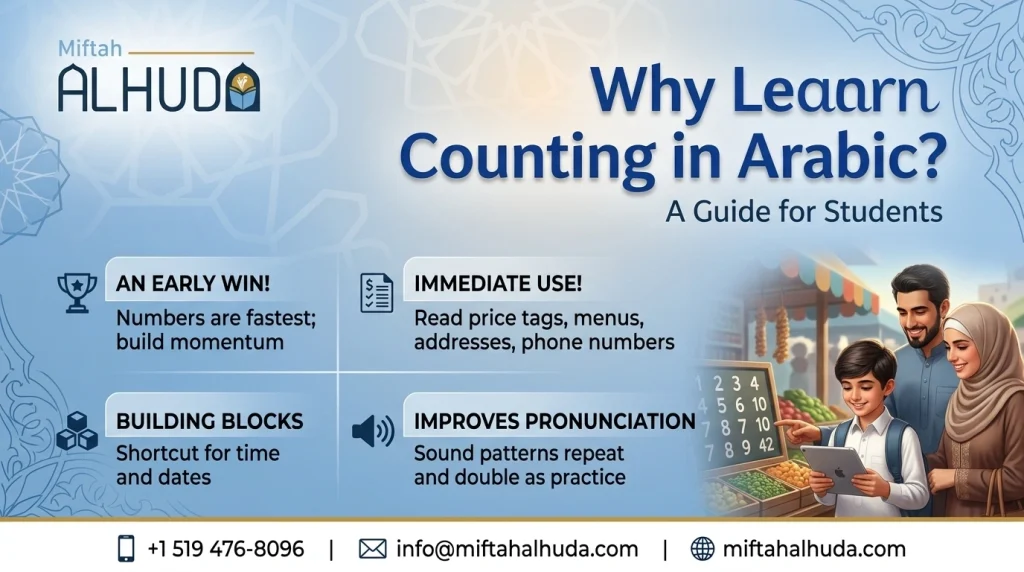
Numbers are one of the fastest wins you’ll get in a new language. Most vocabulary needs context before it feels useful. Numbers don’t. They show up immediately, in prices, addresses, phone numbers, ages.
You can read price tags and menus without guessing.
You can give someone your number or address without freezing up.
You build a mental shortcut you’ll reuse later for telling time and dates.
You get an early win, and that early win is what keeps people going.
Everyday Uses of Arabic Numbers
If you’re traveling, working with Arabic speakers, or just trying to go deeper in the language, numbers come up constantly. Markets, taxis, hotel bookings, someone asking how many siblings you have. It’s everywhere once you start listening for it.
Improving Speaking and Reading Skills
Numbers train your ear too, which surprised me a little when I first noticed it. The sound patterns repeat across the language, so once counting feels natural, you start catching those same sounds in completely unrelated words. It’s one of the only vocabularies sets that doubles as pronunciation practice.
Understanding the Arabic Number System
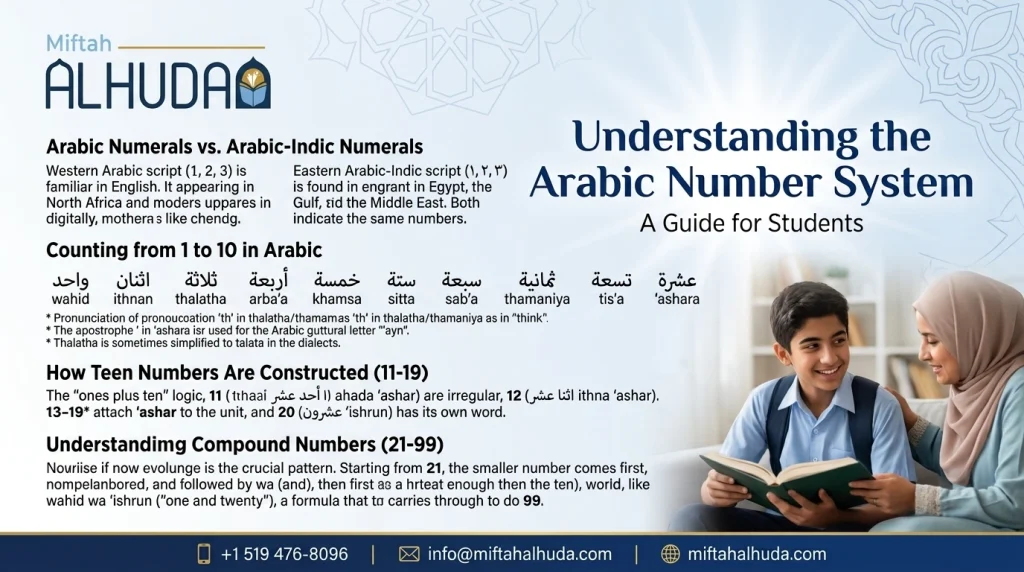
Arabic Numerals vs. Arabic-Indic Numerals: The numbers that you are familiar with, namely 1, 2, 3, are referred to as “Arabic numerals” in English. But these aren’t the numbers that appear in written or printed Arabic around much of the Arab world.
Numbers of Western Arabic script (1, 2, 3) appear in North Africa and almost everywhere digitally.
Numbers of Eastern Arabic-Indic script (١, ٢, ٣) will be found in Egypt, Gulf states, and most of the Middle East.
Both indicate the same numbers but vary in their symbols only.
How Numbers Are Formed in Arabic
From 11 onward, Arabic builds numbers by combining smaller units rather than handing you a brand-new word for each one. Once the formula clicks, you stop memorizing and start recognizing instead, which is a much better feeling.
Common Patterns in Arabic Counting
And here is what really matters above all else: starting from 21, the smaller number comes first, followed by wa (and), then the ten. “Twenty-one” is not “twenty-one” but rather wahid wa ‘ishrun, meaning “one and twenty.” Remember this well. It will take you through most numbers from 21 to 99.
Counting from 1 to 10 in Arabic
These ten words are the whole foundation. Every number above ten just reuses them.
| Number | Arabic | Transliteration |
| 1 | واحد | wahid |
| 2 | اثنان | ithnan |
| 3 | ثلاثة | thalatha |
| 4 | أربعة | arba’a |
| 5 | خمسة | khamsa |
| 6 | ستة | sitta |
| 7 | سبعة | sab’a |
| 8 | ثمانية | thamaniya |
| 9 | تسعة | tis’a |
| 10 | عشرة | ‘ashara |
A few pronunciation notes that’ll save you weeks of confusion later:
“The” in thalatha and thamaniya is pronounced as in “think,” not “this.”
This apostrophe at the beginning of a word, as in ‘ashara, is an indication of an Arabic guttural letter “‘ayn.” It doesn’t exist in English, and you may approximate it temporarily as your ear gets accustomed to it.
Thalatha is sometimes simplified to talata in some dialects, such as the Egyptian one.
Counting from 11 to 20 in Arabic
How Teen Numbers Are Constructed: Numbers 11 through 19 follow a “ones plus ten” logic, kind of like English but not built the same way. Eleven and twelve are irregular, just memorize those two outright. From 13 to 19, take the unit and attach ‘ashar.
| Number | Arabic | Transliteration |
| 11 | أحد عشر | ahada ‘ashar |
| 12 | اثنا عشر | ithna ‘ashar |
| 13 | ثلاثة عشر | thalathata ‘ashar |
| 14 | أربعة عشر | arba’ata ‘ashar |
| 15 | خمسة عشر | khamsata ‘ashar |
| 16 | ستة عشر | sittata ‘ashar |
| 17 | سبعة عشر | sab’ata ‘ashar |
| 18 | ثمانية عشر | thamaniyata ‘ashar |
| 19 | تسعة عشر | tis’ata ‘ashar |
| 20 | عشرون | ‘ishrun |
Notice 20 isn’t built from 2 and 10 the way 12 is. It gets its own word, ‘ishrun, with that “-un” ending you’ll keep seeing on every multiple of ten. That ending is basically a flag telling you “clean ten” every time you hear it.
Counting from 21 to 30 in Arabic
Understanding Compound Numbers: This is where it really shifts. From 21 on, Arabic stops building numbers the English way and flips the order entirely.
English says twenty-one. Ten’s place first, then one’s place.
In Arabic we say wahid wa ‘ishrun, literally “one and twenty.” One’s place first, then the ten.
| Number | Arabic | Transliteration |
| 21 | واحد وعشرون | wahid wa ‘ishrun |
| 22 | اثنان وعشرون | ithnan wa ‘ishrun |
| 23 | ثلاثة وعشرون | thalatha wa ‘ishrun |
| 24 | أربعة وعشرون | arba’a wa ‘ishrun |
| 25 | خمسة وعشرون | khamsa wa ‘ishrun |
| 26 | ستة وعشرون | sitta wa ‘ishrun |
| 27 | سبعة وعشرون | sab’a wa ‘ishrun |
| 28 | ثمانية وعشرون | thamaniya wa ‘ishrun |
| 29 | تسعة وعشرون | tis’a wa ‘ishrun |
| 30 | ثلاثون | thalathun |
Number Formation Rules: Once 21 clicks, the same formula carries you all the way to 99. New unit, keep “wa,” new ten. No irregular exceptions waiting to ambush you later in this range, which is unusual for a language this old, and honestly one of the more forgiving stretches in Arabic grammar.
Counting from 31 to 50 in Arabic
Recognizing Patterns: Thirty, forty, fifty; each one follows the same pattern ending in “-un” that you have just seen in the number twenty. Once the unit numbers are firmly grasped, then you need not learn any new words to construct numbers in this range.
| Number | Arabic | Transliteration |
| 31 | واحد وثلاثون | wahid wa thalathun |
| 35 | خمسة وثلاثون | khamsa wa thalathun |
| 40 | أربعون | arba’un |
| 42 | اثنان وأربعون | ithnan wa arba’un |
| 47 | سبعة وأربعون | sab’a wa arba’un |
| 50 | خمسون | khamsun |
Practice Examples: Try building these on your own before peeking at the chart: 33, 38, 44, 49. If you can put them together using unit-plus-wa-plus-ten, the pattern’s actually in your head now, not just on the page.
Counting from 51 to 99 in Arabic
Combining Tens and Ones: Same logic, no surprises, all the way through the sixties, seventies, eighties, and nineties.
| Number | Arabic | Transliteration |
| 53 | ثلاثة وخمسون | thalatha wa khamsun |
| 60 | ستون | sittun |
| 64 | أربعة وستون | arba’a wa sittun |
| 70 | سبعون | sab’un |
| 75 | خمسة وسبعون | khamsa wa sab’un |
| 80 | ثمانون | thamanun |
| 86 | ستة وثمانون | sitta wa thamanun |
| 90 | تسعون | tis’un |
| 97 | سبعة وتسعون | sab’a wa tis’un |
Common Pronunciation Mistakes
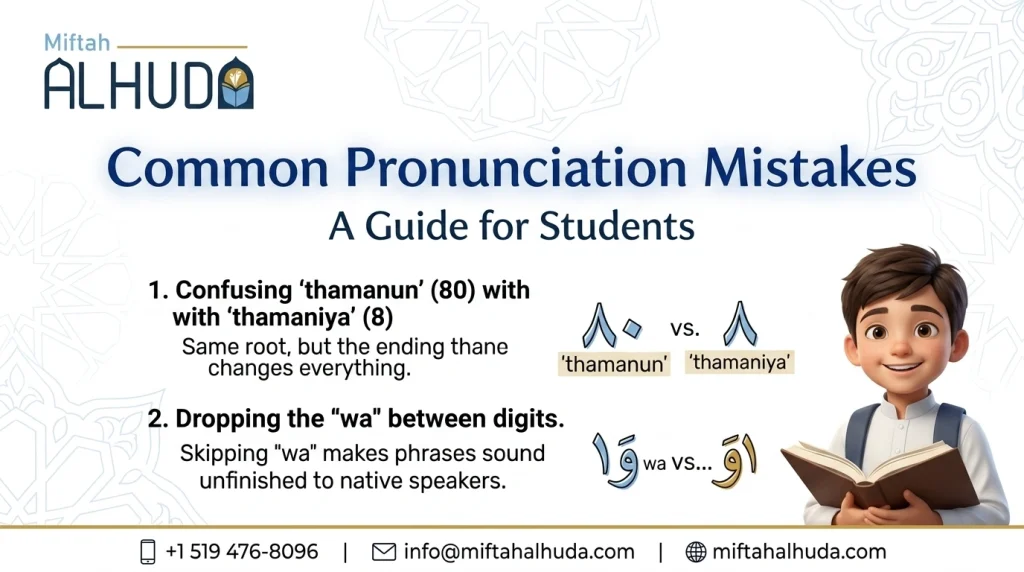
Two mix-ups trip people up here constantly.: Confusing thamanun (80) with thamaniya (8). Same root, but the ending changes everything.
Dropping the “wa” between the two digits. Every word might be correct, but skip that “wa” and it sounds unfinished to a native speaker.
Multiples of Ten in Arabic
Ten to Ninety: It helps to see all the tens together, separated from the compound numbers, since these are your anchor points for everything else.
| Number | Arabic | Transliteration |
| 10 | عشرة | ‘ashara |
| 20 | عشرون | ‘ishrun |
| 30 | ثلاثون | thalathun |
| 40 | أربعون | arba’un |
| 50 | خمسون | khamsun |
| 60 | ستون | sittun |
| 70 | سبعون | sab’un |
| 80 | ثمانون | thamanun |
| 90 | تسعون | tis’un |
Memorization Techniques
Every multiple of ten from 20 to 90 ends in “-un.” That one ending is doing most of the work for you. Learn the nine root sounds, tack on the ending, and the whole tens column is yours in one sitting.
How to Say 100 in Arabic?
One hundred is مائة, pronounced mi’ah or mia depending on dialect. The spelling trips learners up because it has a silent alef sitting in there that doesn’t change the pronunciation at all, a quirk that goes back to early Quranic-era spelling conventions.
Examples of Usage:
“One hundred dollars” becomes mi’at dolar.
“One hundred students” becomes mi’at talib.
You’ll also hear the casual spoken form mia in everyday conversation, outside of formal or written Arabic.
Arabic Numbers Chart from 1 to 100
Here’s the complete reference, grouped by tens so you can scan it fast.
| 1–10 | 11–20 | 21–30 |
| 1 wahid | 11 ahada ‘ashar | 21 wahid wa ‘ishrun |
| 2 ithnan | 12 ithna ‘ashar | 22 ithnan wa ‘ishrun |
| 3 thalatha | 13 thalathata ‘ashar | 23 thalatha wa ‘ishrun |
| 4 arba’a | 14 arba’ata ‘ashar | 24 arba’a wa ‘ishrun |
| 5 khamsa | 15 khamsata ‘ashar | 25 khamsa wa ‘ishrun |
| 6 sitta | 16 sittata ‘ashar | 26 sitta wa ‘ishrun |
| 7 sab’a | 17 sab’ata ‘ashar | 27 sab’a wa ‘ishrun |
| 8 thamaniya | 18 thamaniyata ‘ashar | 28 thamaniya wa ‘ishrun |
| 9 tis’a | 19 tis’ata ‘ashar | 29 tis’a wa ‘ishrun |
| 10 ‘ashara | 20 ‘ishrun | 30 thalathun |
| Tens | Word |
| 40 | arba’un |
| 50 | khamsun |
| 60 | sittun |
| 70 | sab’un |
| 80 | thamanun |
| 90 | tis’un |
| 100 | mi’ah |
For anything between the tens, the same formula from earlier applies: unit, then wa, then the ten.
How to Practice Counting from 1 to 100 in Arabic
Flashcards: Build a simple deck, Arabic script on one side, transliteration and meaning on the other. Shuffle it. Quiz yourself both directions, Arabic to English and back.
Counting Games: Count whatever’s around you in Arabic. Stairs. Dishes. Books on a shelf. It forces recall under a little pressure, and that sticks better than passive review ever does.
Worksheets and Tracing Activities: Teaching a child, or just someone who learns better by hand? Tracing the script while saying the number out loud locks in the visual and the sound together.
Audio and Video Practice: Transliteration only gets you so far. Arabic has sounds that don’t map cleanly onto English letters, full stop. Listen to a native speaker, repeat it back, and that’s really what fixes your accent. Reading alone won’t.
Common Challenges When Learning Arabic Numbers
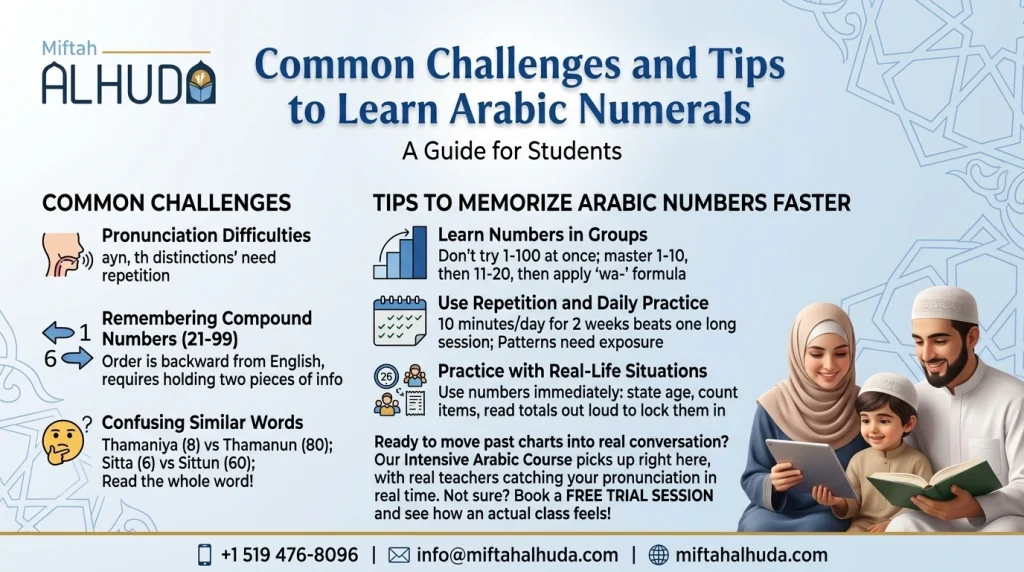
Pronunciation Difficulties: Sounds like ‘ayn, that throat sound marked by the apostrophe, and the “th” distinctions just don’t exist in English. This takes repetition, not a single clean explanation, so don’t expect it to click on the first try.
Remembering Compound Numbers: Numbers from 21 to 99 ask you to hold two pieces of information at once, the unit and the ten, in an order that’s backward from English. This is genuinely the hardest stretch for most learners. Slowing down here is normal, not a sign you’re behind.
Confusing Similar Words: Thamaniya (8) and thamanun (80) trip up almost everyone at first. So do sitta (6) and sittun (60). Reading the whole word instead of skimming the first syllable fixes this fast.
Tips to Memorize Arabic Numbers Faster
Learn Numbers in Groups: Don’t try to learn 1 to 100 in one sitting, you’ll burn out fast. Get 1 to 10 fully solid first. Then 11 to 20. Then apply the wa-formula to everything else. Each group leans on the one before it.
Use Repetition and Daily Practice: Ten minutes a day for two weeks beats one long weekend session every time. Numbers are pattern-based, and patterns need repeated exposure before they go automatic.
Practice with Real-Life Situations: Use them the second you learn them. State your age. Count your siblings. Read a receipt total out loud. Applied practice locks things in faster than drilling a list ever will.
Ready to move past charts and into real conversation? The Intensive Arabic Course at Miftah Alhuda picks up right at this stage, once you’ve got the basics down and need a real teacher catching your pronunciation in real time.
Not sure yet if it’s the right fit? Book a free trial session and see how an actual class feels before committing to anything.
Contact Us
WhatsApp: +1 519 476-8096
E-Mail: in**@**********da.com
Facebook: https://www.facebook.com/MiftahAlhudaOfficial
Instagram: https://www.instagram.com/miftahalhudaa
Youtube: https://www.youtube.com/@MiftahAl-huda
Tiktok: https://www.tiktok.com/@miftahalhuda00“.
Frequently Asked Questions About Counting from 1 to 100 in Arabic
How do you count from 1 to 100 in Arabic?
Start with 1 to 10, move into the teens, then apply “unit + wa + ten” for everything from 21 to 99. One hundred stands on its own as mi’ah.
What are the Arabic numbers from 1 to 20?
Wahid (1) through ‘ashara (10), then the teens, which combine a unit with ‘ashar, ending at ‘ishrun (20).
How do you say 50 in Arabic?
خمسون. Khamsun.
How do you say 100 in Arabic?
مائة, pronounced mi’ah, or mia if you’re hearing it in casual conversation.
Are Arabic numbers difficult to learn?
The first ten are easy. The real challenge is that reversed word order from 21 to 99, and most learners need a few weeks of repetition before it stops feeling backward.
What is the fastest way to memorize Arabic numbers?
Learn in small groups, starting with 1 to 10, then lean on the wa-formula instead of memorizing each compound number on its own. Short daily practice wins over the occasional marathon session.