
You open a flashcard app, see the word واحد next to the number 1, and close the app five minutes later more confused than when you started. That is usually where the Arabic counting system explained in textbooks falls apart for new learners. The numerals look unfamiliar, the words don’t match anything in English, and nobody tells you why the number “three” suddenly changes form depending on what you’re counting.
Most guides hand you a list of numbers and assume that’s enough. It isn’t. Memorizing واحد, اثنان, ثلاثة without understanding the logic behind Arabic numerals, the gender rules, or the difference between Eastern and Western Arabic digits means the information slips away within a week.
This guide builds the Arabic counting system from the ground up. You’ll get the numerals, the pronunciation, the grammar that actually explains why numbers behave the way they do, and the everyday situations where you’ll use all of it.
What the Arabic Counting System Includes?
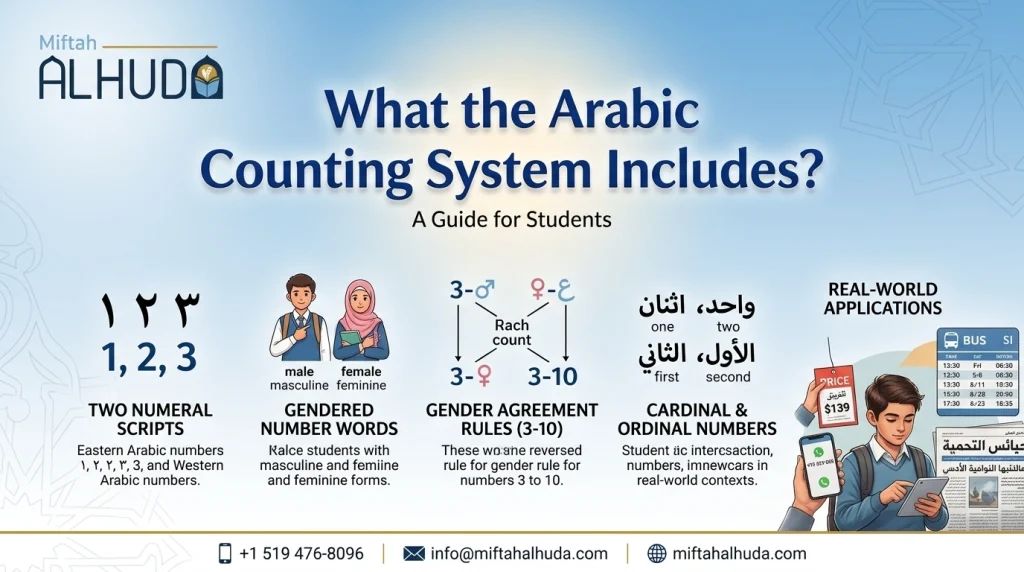
The Arabic counting system isn’t a single list of numbers. It includes:
Two separate numeral scripts (Eastern Arabic and Western Arabic).
Spoken number words that shift form based on gender.
A grammar rule that reverses gender agreement for numbers 3 through 10.
Cardinal numbers (one, two, three) and ordinal numbers (first, second, third).
Understanding the Arabic counting system helps with more than test scores. It shows up the moment you:
Read a price tag in Cairo or Dubai.
Tell someone your phone number.
Check a bus schedule or a street address.
Read dates on documents or invitations.
Follow along with Arabic news, signage, or children’s books.
A beginner who learns the rules instead of memorizing isolated numbers tends to retain the material far longer.
A Short History Behind Arabic Numerals
The numerals most of the world calls “Arabic numerals” (0, 1, 2, 3…) were developed in India and later refined and transmitted to Europe through Arab mathematicians during the Islamic Golden Age.
Scholars such as Al-Khwarizmi helped popularize this number system, which is why Europe associated the digits with the Arab world even though the origin was Indian. Arabic itself still uses two distinct numeral scripts today, and beginners often don’t realize this until they land in an Arabic-speaking country and see digits they don’t recognize on a price tag.
Eastern Arabic Numerals vs Western Arabic Numerals
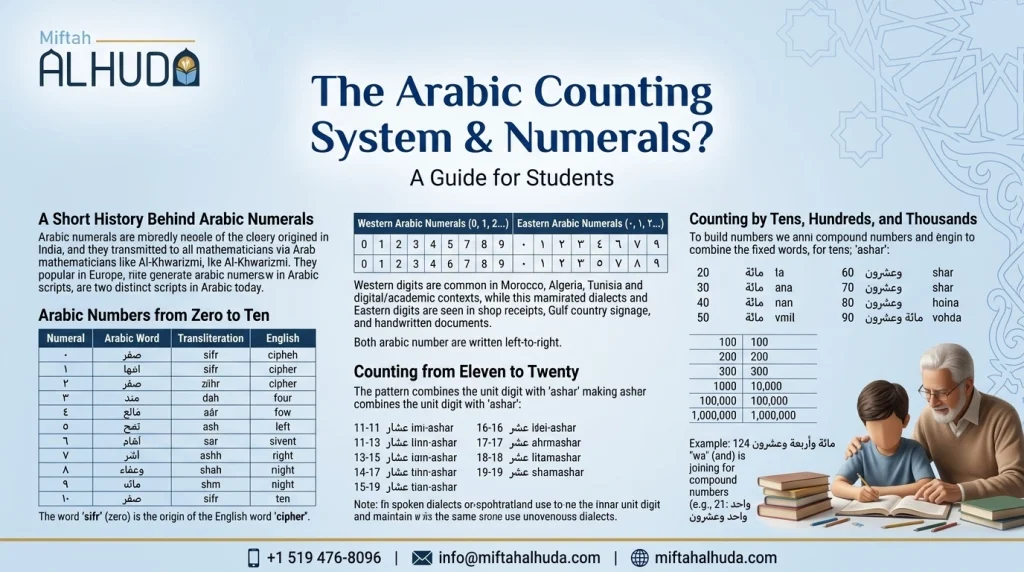
Here is a table that show the difference between Eastern and Western numbers:
| Western Arabic Numeral | Eastern Arabic Numeral |
| 0 | ٠ |
| 1 | ١ |
| 2 | ٢ |
| 3 | ٣ |
| 4 | ٤ |
| 5 | ٥ |
| 6 | ٦ |
| 7 | ٧ |
| 8 | ٨ |
| 9 | ٩ |
Western Arabic numerals are the same digits used in English (0-9), and they are common in Morocco, Algeria, Tunisia, and most digital and academic contexts across the Arab world. Eastern Arabic numerals are the script you’ll see on Egyptian shop receipts, Gulf country signage, and many handwritten documents.
Both systems are written left to right, even though Arabic script itself reads right to left. That detail alone confuses a lot of beginners the first time they see a multi-digit number sitting inside a right-to-left sentence.
Arabic Numbers from Zero to Ten
These are the building blocks. Every other number in the language is constructed from this list.
| Numeral | Arabic Word | Transliteration | English |
| ٠ | صفر | sifr | zero |
| ١ | واحد | wahid | one |
| ٢ | اثنان | ithnan | two |
| ٣ | ثلاثة | thalatha | three |
| ٤ | أربعة | arba’a | four |
| ٥ | خمسة | khamsa | five |
| ٦ | ستة | sitta | six |
| ٧ | سبعة | sab’a | seven |
| ٨ | ثمانية | thamaniya | eight |
| ٩ | تسعة | tis’a | nine |
| ١٠ | عشرة | ashara | ten |
Worth noting: the word “sifr,” meaning zero, is the actual root of the English word “cipher.” That single number word traveled from Arabic into European mathematics and stayed there.
Counting from Eleven to Twenty
The teens follow a pattern once you know zero to ten. Each number combines the unit digit with “ashar,” the Arabic word tied to “ten” in this position.
11: أحد عشر (ahada ashar)
12: اثنا عشر (ithna ashar)
13: ثلاثة عشر (thalathata ashar)
14: أربعة عشر (arba’ata ashar)
15: خمسة عشر (khamsata ashar)
16: ستة عشر (sittata ashar)
17: سبعة عشر (sab’ata ashar)
18: ثمانية عشر (thamaniyata ashar)
19: تسعة عشر (tis’ata ashar)
Spoken dialects often shorten these forms, so don’t be surprised if a teacher in conversation drops a syllable that Modern Standard Arabic keeps intact. That’s normal variation, not a mistake on either side.
Counting by Tens, Hundreds, and Thousands
Once you reach twenty, Arabic numbers stop changing shape as dramatically. The tens have their own fixed words:
20: عشرون (ishrun)
30: ثلاثون (thalathun)
40: أربعون (arba’un)
50: خمسون (khamsun)
60: ستون (sittun)
70: سبعون (sab’un)
80: ثمانون (thamanun)
90: تسعون (tis’un)
To build numbers like 21, 35, or 47, Arabic places the unit before the ten and joins them with “wa” (meaning “and”). So 21 becomes واحد وعشرون (wahid wa ishrun), read literally as “one and twenty.”
Hundreds and thousands follow their own logic:
100: مائة (mi’a)
200: مئتان (mi’atan)
300: ثلاثمائة (thalathumi’a)
1,000: ألف (alf)
10,000: عشرة آلاف (asharat alaf)
100,000: مائة ألف (mi’at alf)
1,000,000: مليون (milyun)
A number like 124 follows the pattern hundreds, then units, then tens: مائة وأربعة وعشرون (mi’a wa arba’a wa ishrun), literally “hundred and four and twenty.”
The Arabic Numbers Grammar Rule
This is the part that actually makes the Arabic counting system explained properly instead of just listed.
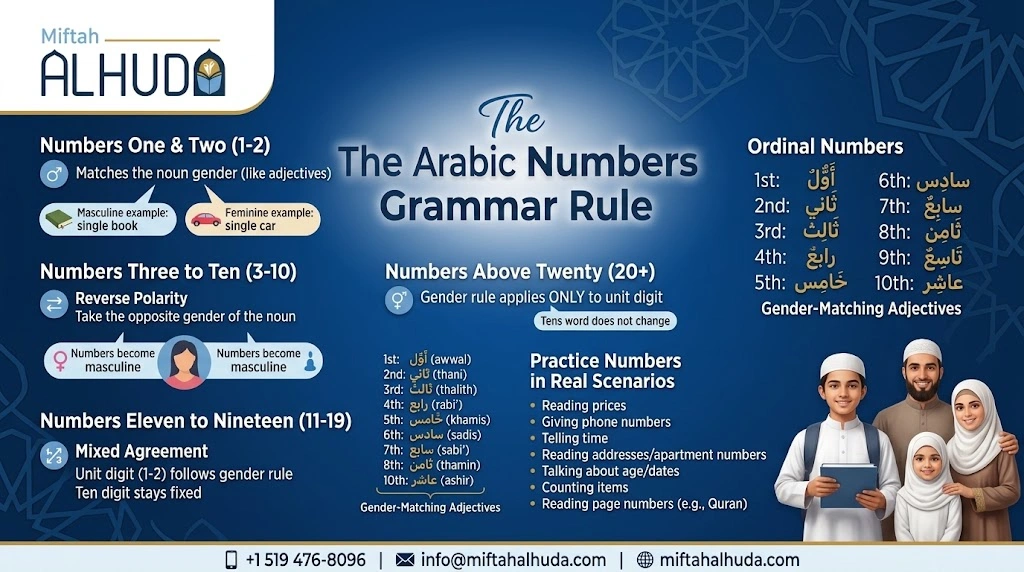
Numbers One and Two: These agree in gender with the noun they describe, just like adjectives do in Arabic. A single book uses the masculine form, a single car uses the feminine form, and the number word changes to match.
Numbers Three Through Ten: Here’s the part that surprises almost everyone. Numbers 3 to 10 take the opposite gender of the noun they’re counting. If you’re counting feminine nouns, the number word appears in its masculine form, and vice versa. Arabic grammarians call this reverse polarity, and it has no equivalent in English.
Numbers Eleven Through Nineteen: These compound numbers carry mixed agreement. The unit portion (the “one” inside “eleven,” for example) follows the same gender rule as one and two, while the “ten” portion stays fixed.
Numbers Above Twenty: Once you pass twenty, only the unit digit (the part before “wa”) follows the reverse polarity rule. The tens word itself doesn’t change for gender at all.
Don’t try to memorize every exception on the first pass. Most learners absorb this rule gradually, through repetition with real nouns, rather than through a grammar chart alone.
Ordinal Numbers in Arabic
Cardinal numbers count things. Ordinal numbers rank them, like first, second, and third in English.
1st: أول (awwal)
2nd: ثاني (thani)
3rd: ثالث (thalith)
4th: رابع (rabi’)
5th: خامس (khamis)
6th: سادس (sadis)
7th: سابع (sabi’)
8th: ثامن (thamin)
9th: تاسع (tasi’)
10th: عاشر (ashir)
Ordinals act as adjectives in Arabic, so they also shift form to match the gender of the noun they describe. The pattern is more predictable than the cardinal number rules, which makes ordinals a good area to build early confidence.
Numbers In Daily Life
Numbers stop feeling abstract once you see where they show up in daily life:
Reading prices at markets and stores.
Giving or understanding a phone number.
Telling time and discussing schedules.
Reading addresses and apartment numbers.
Talking about your age or someone else’s.
Following dates on official paperwork.
Counting siblings, years of study, or items on a list.
Reading page numbers in books, including the Quran for students of Islamic studies.
A beginner who practices numbers only in isolation tends to freeze up the first time a cashier says a price out loud. Practicing numbers inside real scenarios, not just flashcards, closes that gap faster.
Arabic Number Beginners Mistakes
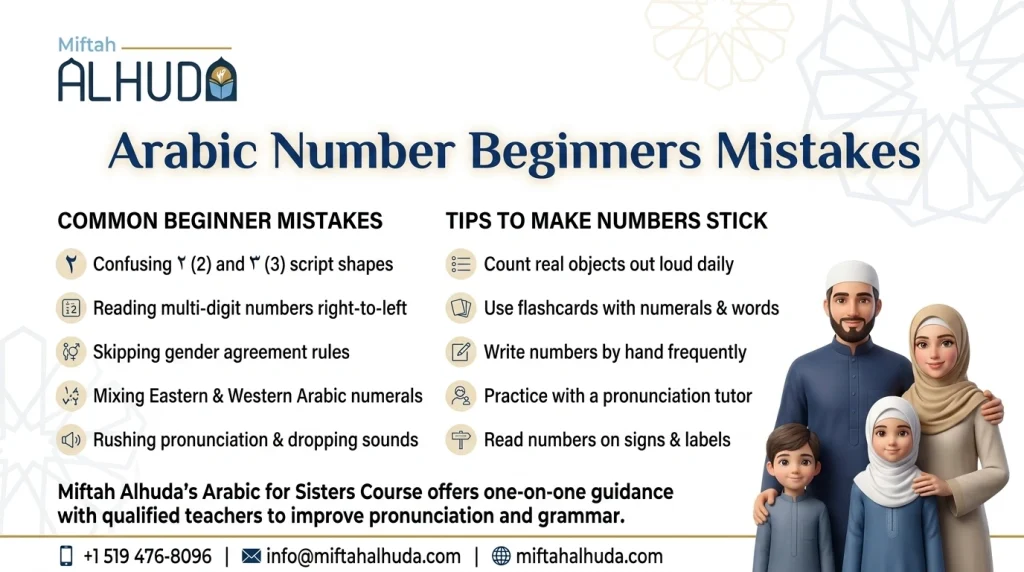
Most of these are predictable, and knowing them in advance saves weeks of frustration:
Confusing ٢ (two) and ٣ (three) in Eastern Arabic script, since the shapes look similar at first.
Reading multi-digit numbers right to left out of habit, when Arabic numerals read left to right.
Skipping the gender agreement rule entirely and using one fixed form for every number.
Mixing Eastern and Western Arabic numerals in the same sentence without realizing it.
Rushing pronunciation and dropping the “ain” or “ha” sounds that don’t exist in English.
None of these mean you’re bad at the language. They mean the system has logic that takes deliberate practice to absorb, the same as any new grammar pattern.
Tips to Make the Numbers Stick
Practice counting real objects around you out loud, daily, for five minutes.
Use flashcards that show the numeral, the Arabic word, and the transliteration together.
Listen to native speakers count prices in market videos or vlogs.
Write the numbers by hand instead of only typing them.
Read street signs, restaurant menus, or product labels whenever you encounter Arabic numerals.
Practice with a tutor who can correct your pronunciation in real time, since self-study alone tends to lock in small errors.
The biggest shift happens when numbers stop being a memorized list and start being something you reach for automatically in conversation.
Ready to Build on This with a Real Teacher? Reading about the Arabic counting system explained on a page is one thing. Saying it out loud with someone correcting your pronunciation in real time is what actually makes it stick. Miftah Alhuda’s Arabic for Sisters Course covers numbers, grammar, and conversational Arabic with one-on-one guidance from qualified teachers.
Not ready to commit yet? Book a free trial session and see how a real class compares to studying alone.
Contact Us
WhatsApp: +1 519 476-8096
E-Mail: in**@**********da.com
Facebook: https://www.facebook.com/MiftahAlhudaOfficial
Instagram: https://www.instagram.com/miftahalhudaa
Youtube: https://www.youtube.com/@MiftahAl-huda
Tiktok: https://www.tiktok.com/@miftahalhuda00“.
Frequently Asked Questions
Are Arabic numerals different from the numbers used in English?
The digit shapes differ between Eastern Arabic numerals and the Western numerals used in English, but both descend from the same Hindu-Arabic numeral system.
Why are there two different Arabic numeral systems?
Eastern and Western Arabic numerals developed separately as the numeral system spread across different regions of the Arab world, and both remain in active use today.
Is counting in Arabic difficult for beginners?
The numerals are simple to learn quickly. The gender agreement rules for numbers 3 through 10 are what take most beginners extra practice to master.
How long does it take to learn Arabic numbers?
Most learners pick up zero through ten within a few days, the teens and tens within a week or two, and natural fluency in counting within a couple of months of regular practice.
What is the easiest way to memorize Arabic numbers?
Pairing each number with a real object or daily habit, like counting steps or groceries out loud, works better than memorizing an isolated list.
Do Arabic numbers used in the Quran differ from Modern Standard Arabic?
The number words themselves are the same. Quranic Arabic and Modern Standard Arabic share the same core numeral vocabulary, though some classical phrasing appears more often in religious texts.
What the Numbers Reveal About the Language Itself
The Arabic counting system rewards patience more than memorization. Once the gender rule clicks, once Eastern and Western numerals stop blending together in your mind, the rest of the language starts to feel a little less foreign too.
Numbers were never really the hard part. Understanding why they behave the way they do was.