

You sit down with a pencil, a blank notebook page, and a YouTube video paused on the number five. You copy the shape. It looks close enough. Then you do it again the next day and it looks nothing like yesterday’s version.
That’s the moment most beginners hit when they start writing Arabic numerals practice exercises on their own. The shapes seem simple from a distance, just curves and dots, but the hand doesn’t know what the eye thinks it understands. You can recognize ٥ instantly on a page. Writing it from memory, in the right direction, with the right proportions, is a different skill entirely.
This guide walks through that gap. It covers how the numerals are formed, where most American and European learners go wrong, and how to build a short daily practice that actually sticks instead of one more worksheet collecting dust in a drawer.
What Counts as an Arabic Numeral?
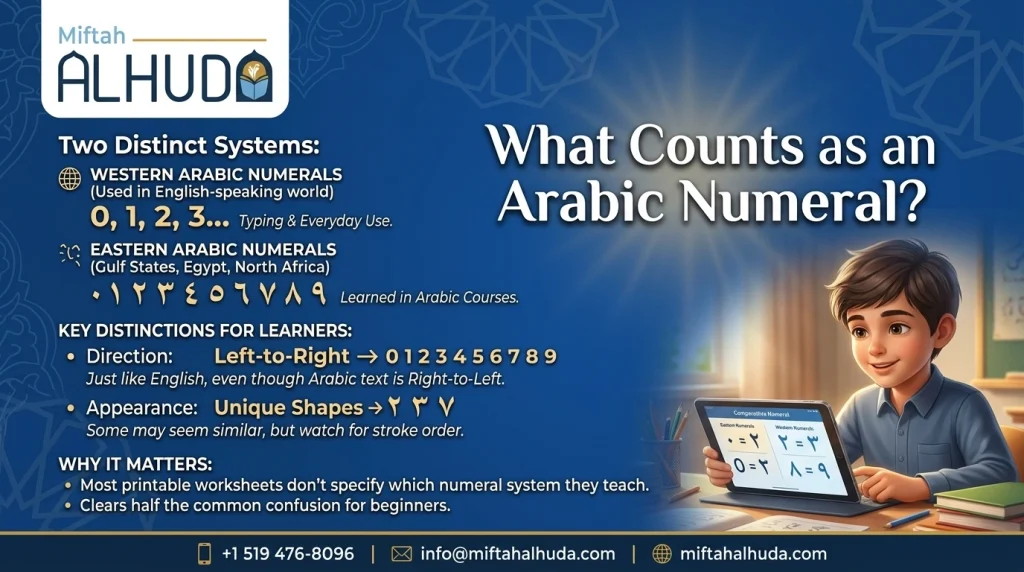
Americans and Europeans would naturally consider “Arabic numerals” to be the numerals: 0, 1, 2, 3 that they use in their typing everyday. This is technically true because these numbers are called the Western Arabic Numerals and they are used throughout the English-speaking world.
However, in many parts of the Arabic-speaking world, such as the Gulf States, Egypt, and parts of North Africa, one will find Eastern Arabic Numerals which include the following: ٠ ١ ٢ ٣ ٤ ٥ ٦ ٧ ٨ ٩. These numerals represent the numerals which most elementary Arabic courses refer to when discussing writing Arabic numerals practice.
Some things that will help when choosing your pen to write:
Numbers in Eastern Arabic are not exactly like the 0 to 9 that you have learned before, although some numbers may seem similar.
They are read and written from left to right just like the English language, even though the rest of the Arabic alphabet is right-to-left.
Every number has a stroke order, and there are some numbers (٢، ٣، ٧) that might confuse you initially.
Knowing this distinction matters because most printable worksheets online don’t specify which numeral system they’re teaching. Half the confusion beginners report isn’t about handwriting at all. It’s about not knowing which numerals they were even looking at.
The Stroke Order Nobody Explains Properly
Most worksheets show you the finished numeral. Almost none of them show you the order the strokes go in, and that gap is where bad habits start.
The Arabic numbers start from a common base point for every figure, starting from the top and writing in the way that ensures the flow is maintained when writing the next number in the series.
This step is not important for recognition at the early stages. A child or adult beginner can still produce a numeral that’s technically readable by starting wherever feels natural.
This becomes an issue at a later stage when time is of essence. Numbers meant to be written on a price tag, a telephone number, or even mathematical calculations can’t afford to take the extra time to trace them correctly. Lack of proper stroke order results in writing that is either too slow or illegible.
A few habits worth building early:
- Start each numeral from the same point every time, not wherever the pencil happens to land
- Keep proportions consistent. A ٣ that’s twice the height of a ٢ next to it reads as a mistake, not a style choice
- Write slowly for the first two weeks. Speed comes after the shape is automatic, never before.
Tracing First, Then Letting Go of the Guide Lines
Tracing gets a mixed reputation. Some learners assume it’s just busywork for kids. In practice, tracing is doing something specific: it’s building the muscle memory for stroke direction before the brain has to also manage shape and proportion from scratch.
The progression that tends to work best follows three stages.
Stage one uses dotted or light-gray numerals that the learner traces directly, usually five to ten repetitions per digit. This stage is about direction, not perfection.
Stage two removes the full guide and replaces it with a starting dot or directional arrow only. The learner reconstructs the shape with a hint, not a template.
Stage three drops the guide entirely. The numeral gets written from memory, compared against a reference, and corrected if needed.
Adults sometimes want to skip straight to stage three, assuming tracing is beneath them. It almost never works out that way.
The hand still needs the repetition, regardless of how quickly the eye understood the shape. Skipping stages tends to produce numerals that are recognizable but inconsistent, the kind that look different every single time they’re written.
What Adult Learners Get Wrong That Children Usually Don’t
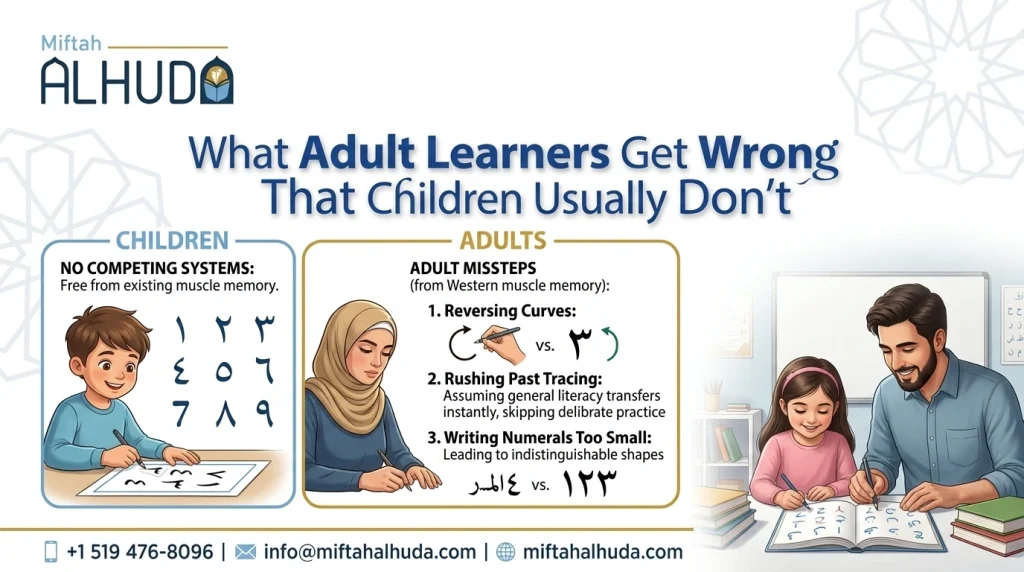
Children learning to write numbers for the first time have an advantage most adults don’t: no competing system already wired into their hand. An adult who has written 0-9 for twenty or thirty years brings that muscle memory into the new script, whether they want to or not.
This shows up in a few specific ways:
- Reversing curve direction, because the hand defaults to the motion used for the familiar Western digit
- Rushing past the tracing stage, assuming literacy in one number system transfers directly to another
- Writing numerals too small, a habit carried over from compact Western digit writing, which makes Eastern Arabic numeral shapes harder to distinguish from each other
None of this means adults learn slower. It usually means the early sessions need to be more deliberate, with attention paid to unlearning a motion before a new one can replace it cleanly.
Building a Practice Routine That Actually Holds Up

A worksheet completed once rarely produces lasting handwriting skill. What works better is short, repeated, low-pressure practice spread across several days.
A routine that fits most schedules, whether for a homeschooling parent managing several subjects or an adult learner with twenty spare minutes after work, looks something like this:
- Five to ten minutes of tracing for two or three numerals, not all ten at once
- A short recall check: cover the reference and write the same numerals from memory
- One real-world application, like writing the date, a phone number, or a grocery list total using the numerals just practiced
- A weekly review day that revisits every numeral covered so far, not just the newest ones
The real-world step matters more than it sounds. Numerals practiced only on a worksheet stay tied to that worksheet. Numerals used to label something real, a price, an age, a page number, start to feel like part of actual literacy instead of an isolated drill.
Common Mix-Ups and How to Catch Them Early
A handful of errors show up across nearly every beginner’s early pages, regardless of age or background.
Mixing up ٢ and ٣ happens constantly in the first few weeks, since both involve a curved stroke from a similar starting position. Slowing down and exaggerating the difference in height usually resolves this within a few sessions.
Confusing ٧, ٨, and ٩ is common too, particularly because all three involve loops or curls that beginners haven’t yet learned to differentiate by feel. Writing them side by side, repeatedly, in the same practice session helps the hand register the difference faster than writing them on separate days.
Writing zero (٠) as an afterthought is another pattern worth naming. Because it’s visually simple, a small dot or tiny circle, it often gets rushed or written inconsistently in size compared to the other numerals next to it. A zero that’s too small or too large throws off how a whole number reads at a glance.
Free Resources Versus Structured Practice
Free printable worksheets are everywhere, and they’re genuinely useful for the tracing stage. But most free resources stop at tracing. They don’t typically include correction, pacing, or someone checking whether the stroke order has actually become automatic.
It is at this stage that an organized program can make a true impact on one’s learning process, particularly when it comes to families or adults who are looking to learn this particular skill by trial-and-error method.
In Miftah Alhuda’s Arabic for Kids Course, however, numeral writing takes its place in a more comprehensive introduction to the basics of Arabic literacy, where a teacher monitors formation and habits of numerals in a live environment rather than allowing for correction of mistakes through a static worksheet.
Would you like to learn more and receive proper feedback on your writing skills? Sign up now for Arabic for Kids Course!
Still unsure whether a structured program is the right choice for you? Try out a free session first.
Contact Us
WhatsApp: +1 519 476-8096
E-Mail: in**@**********da.com
Facebook: https://www.facebook.com/MiftahAlhudaOfficial
Instagram: https://www.instagram.com/miftahalhudaa
Youtube: https://www.youtube.com/@MiftahAl-huda
Tiktok: https://www.tiktok.com/@miftahalhuda00“.
Frequently Asked Questions
How do beginners start writing Arabic numerals practice correctly?
Begin by tracing, not writing freely. Try two or three numerals at a time, keep a steady stroke sequence, and progress to writing from memory only when the traced symbols become second nature.
How do Arabic numerals differ from the numerals I’m currently using?
The numerals you’re currently using (0-9) are actually referred to as Western Arabic numerals. A completely different set of numerals, called Eastern Arabic numerals and denoted by ٠ to ٩, exists as well.
Are Arabic numerals always written from right to left as Arabic letters are?
No. Like in English, numerals are written left to right.
How long will it typically take for me to start writing Arabic numerals competently?
Typically, people who begin regular practice achieve legible handwriting within four to six weeks. Recognition tends to come faster than confident freehand writing.
Are tracing worksheets enough on their own?
They’re a strong starting point but rarely sufficient alone. Tracing builds stroke direction; recall practice and real-world use are what make the skill stick long term.
Why do adults sometimes struggle more than kids with this?
Adults bring decades of muscle memory from writing Western digits, which can interfere with new stroke patterns. It’s not a lack of ability, just a different starting point.
The Page That Stops Looking Foreign
Somewhere around the third or fourth week, the numerals stop looking like shapes to be copied and start looking like numbers to be read. That shift doesn’t announce itself. It just shows up one day when a five gets written without a second of hesitation.
Whether that shift happens in three weeks or eight depends less on natural ability and more on whether the early sessions were slow, consistent, and honest about which numerals were actually causing trouble.