
Your child sits down for Arabic practice. You pull out the flashcards. Within two minutes, they’re sliding off the chair, staring at the ceiling, or suddenly very interested in the family cat. Sound familiar?
Arabic counting games for kids exist precisely because memorizing numbers in a second language rarely happens through drilling alone. It happens through movement, laughter, repetition wrapped in play, and the kind of focused fun that doesn’t feel like a lesson at all.
Most parents try repetition first. They say the numbers out loud, point to them on a chart, and repeat. And it works, but then it doesn’t. The child might recall “wahid, ithnan, thalatha” for two days and forget half of it by the weekend. The problem isn’t the child’s memory. It’s that rote repetition alone gives the brain no hooks to hold meaning to.
This guide will build something practical: a real toolkit of Arabic counting activities, offline games, printable ideas, and DIY options that work for preschoolers, kindergarteners, and early elementary learners.
By the end, you’ll have enough variety to rotate activities throughout the week without repeating the same one twice in a row, which, in itself, is one of the most underrated strategies in early language learning.
Why Counting Games Work Better Than Drilling
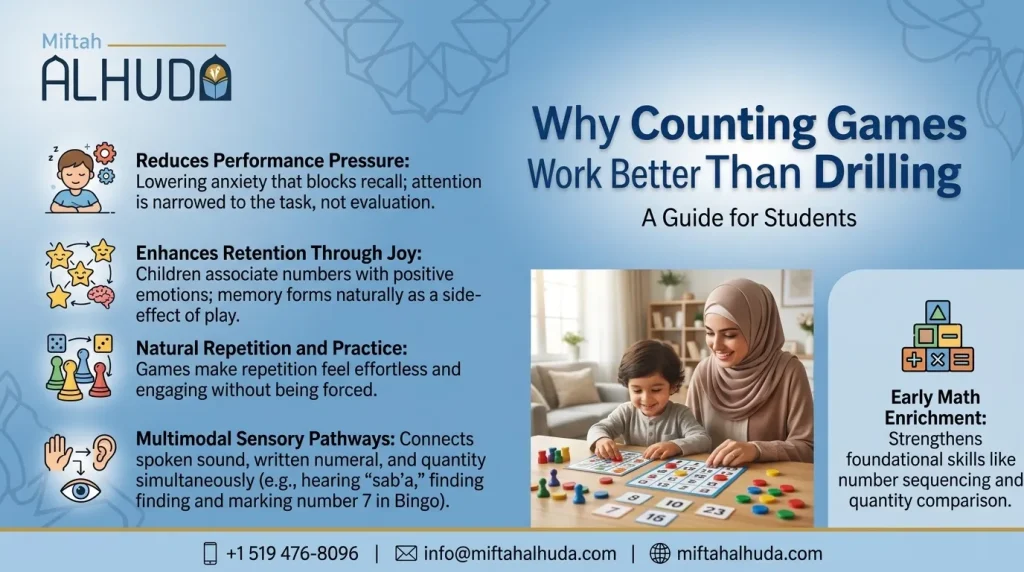
When a child plays a game, something shifts in the brain. The pressure of performance drops. Attention narrows to the task, not the evaluation of the task. This is when language acquisition does some of its best work.
Research in early childhood education consistently shows that play-based learning produces stronger retention than instruction-only approaches, especially for language. The child isn’t trying to remember the word for “three”, they’re trying to win the matching game. The memory forms as a side effect of engagement.
Play lowers the anxiety that blocks recall
Repetition happens naturally through gameplay without feeling forced
Children associate numbers with positive emotions, which deepens retention. For Muslim families, this aligns beautifully with the Islamic tradition of making learning accessible and joyful.
The Prophet Muhammad (peace be upon him) encouraged gentleness and ease in all teaching, saying: “Make things easy and do not make them difficult.” (Sahih al-Bukhari, Hadith 69, narrated by Ibn Abbas). That principle is just as relevant at the kitchen table as it is in a madrasa.
How Games Build Arabic Number Recognition
Number recognition in a second language isn’t just about hearing a word. It involves connecting the spoken sound, the written numeral, and the quantity it represents, all at once. Games that involve seeing, saying, and touching numbers at the same time build all three connections simultaneously.
A child who plays a number bingo game in Arabic will hear “sab’a” (seven) called out loud, scan their card, find the numeral 7, and mark it. That single round of play has activated auditory, visual, and fine motor pathways around one number. Do that ten times in a game and the connection starts to stick.
Encouraging Early Math Skills Through Arabic
There’s an added benefit parents often overlook: when children learn to count in Arabic, they’re also reinforcing foundational math skills, number sequencing, quantity comparison, and one-to-one correspondence, in parallel. The game becomes bilingual math enrichment without anyone calling it that.
Practicing Number Pronunciation at Home
Pronunciation is where many children stumble, especially with sounds like خ (kha) and ع (ayn) that don’t exist in English. A few practical approaches:
Say the number together before every game round starts
Let the child be the “caller” who announces numbers aloud
Use call-and-response, you say the English, they say the Arabic
Record short voice notes and play them back during car rides
Hearing themselves say the words matters. It’s different from hearing a parent say them.
The Best Arabic Counting Games for Kids
Here are some of the best Arabic counting games for kids that will keep them motivated:
1. Flashcard Matching Games
Flashcard matching is one of the most flexible Arabic number games you can run at home. Make or print two sets of cards, one with numerals (1, 2, 3…) and one with the Arabic words written out. Lay them face down and play memory-style. When a child flips a card, they must say the number aloud to claim the match.
Variation: add a third set with dots (like dice faces) so children match numeral, word, and quantity all in one round.
2. Number Memory Games
Classic memory but with an Arabic twist. You can run this with:
Numeral-to-numeral matching (finding pairs)
Numeral-to-Arabic-word matching
Numeral-to-picture matching (three apples = ثلاثة)
Keep the deck small for young learners. Eight to ten pairs is enough to hold attention without causing frustration.
3. Counting with Toys and Objects
This is the easiest entry point for toddlers and preschoolers. Simply count toys together in Arabic. Place five blocks on the table. Pick them up one by one: “Wahid, ithnan, thalatha, arba’a, khamsa.” Then jumble them. Count again.
Objects work because they give children something to hold while they learn. The tactile experience reinforces the number concept in a way that paper rarely does.
4. Dice and Board Games
Any board game with dice becomes an Arabic number game by changing one rule: before moving, the child must say their roll in Arabic. A roll of four means saying “arba’a” before placing the piece. Simple, low-effort, high-repetition.
You can also make custom Arabic dice with paper and tape, write Arabic numerals on the faces instead of pips.
5. Number Bingo
Number bingo is particularly strong for group settings, siblings, cousins, or homeschool co-ops. Create bingo cards with Arabic numerals. The caller reads numbers in Arabic only. Children must recognize the number from hearing it. This is listening comprehension and number recognition in one game.
Free printable bingo templates can be adapted easily. Fill in Arabic numerals and you’re ready.
6. Puzzle Games
Number puzzles, where children fit numbered pieces together in sequence, work well for individual play. You can find Arabic number puzzles online, or make your own by writing Arabic numerals on cardstock and cutting each in half. The child matches “5” with “خمسة” to complete each piece.
7. Color-by-Number Activities
Color-by-number pages with Arabic numeral keys serve double duty: the child practices number recognition while coloring. Keep the color-key labels in Arabic only. “١ = أحمر” (1 = red). After a few sessions, they stop checking the key. That’s the goal.
Interactive Arabic Counting Games for Preschoolers
Here are some fun Arabic counting games for kids and preschoolers:
1. Counting Fruits and Vegetables
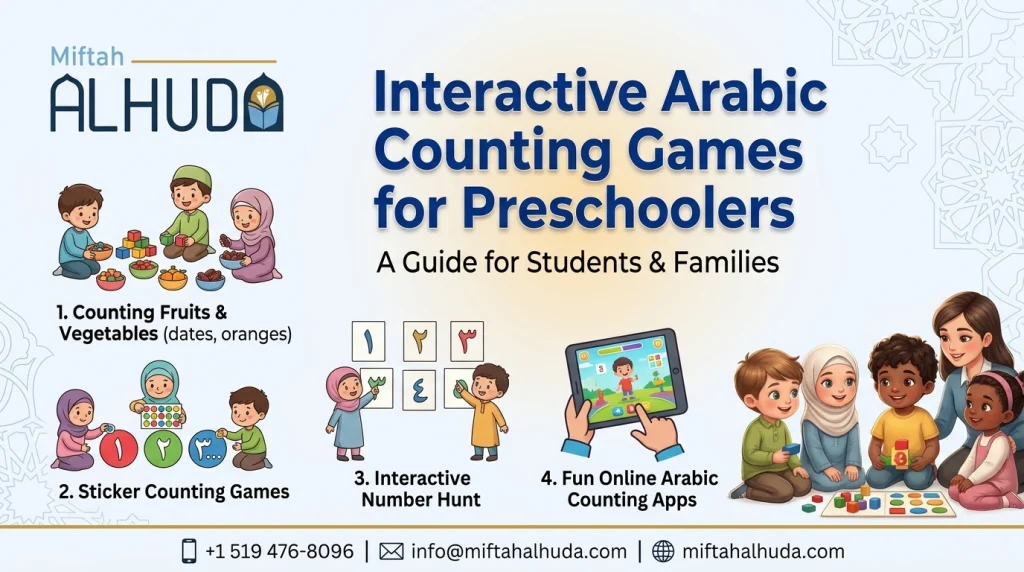
Bring fruit into the game. Hold up three dates and say “thalatha.” Give the child two oranges and ask how many. Let them answer in Arabic. This connects counting in Arabic for children to real-world objects they already know and can name.
For Muslim families, dates carry a natural connection to Sunnah, making this activity feel meaningful beyond just language practice.
2. Sorting and Grouping Activities
Give children a mixed set of objects (buttons, blocks, small toys) and ask them to make groups. “Make a group of five.” They count in Arabic as they group. This develops number recognition and quantity sense at the same time.
Sorting by color first and then counting each group adds a second layer of vocabulary practice.
3. Sticker Counting Games
Draw circles on paper, numbered in Arabic from 1 to 10. The child must place the correct number of stickers in each circle. They count aloud as they stick. The physical placement of each sticker slows them down in a good way, they’re actually counting, not guessing.
4. Number Hunt Activities
Write Arabic numerals on sticky notes and hide them around a room. Call out a number in Arabic. The child hunts for it and brings it back. This adds movement to the learning, which matters more for young children than most parents expect.
Mastering the Arabic alphabet doesn’t have to be intimidating or take months to figure out.
Ready to start reading Arabic today? Dive into our step-by-step guide to learn Alif, Ba, Ta, Tha in minutes, master their pronunciations effortlessly, and build a rock-solid foundation for your language journey!
Online Arabic Counting Games for Kids
Here are some of the best online Arabic counting games for kids:
1. Educational Websites
Several educational platforms offer Arabic number games for children, though quality varies. Look for sites that:
Use Modern Standard Arabic (Fus’ha) rather than mixed dialects
Include audio pronunciation from native speakers
Keep gameplay simple enough for young children to navigate independently
Avoid content that conflicts with Islamic values
2. Mobile Apps for Learning Arabic Numbers
Apps designed for Arabic learning for kids range from alphabet-focused to number-specific. When evaluating apps, prioritize those that require the child to produce the answer (typing or speaking) rather than just recognize it (multiple choice). Production builds stronger memory than recognition alone.
Look for apps that include audio playback of each number by a native speaker, not just text display.
3. Video-Based Counting Activities
YouTube has a strong collection of Arabic counting songs and animated counting videos for children. Counting songs work particularly well because:
Melody aids memorization in ways that flat repetition doesn’t
Children often request to hear songs again, creating natural repetition
Singing together is low-stakes, mistakes feel less exposed
Search for “Arabic numbers song for kids” and watch a few options before sharing. Choose videos that use clear Fus’ha pronunciation and include both the Arabic word and numeral on screen.
Printable Arabic Counting Activities
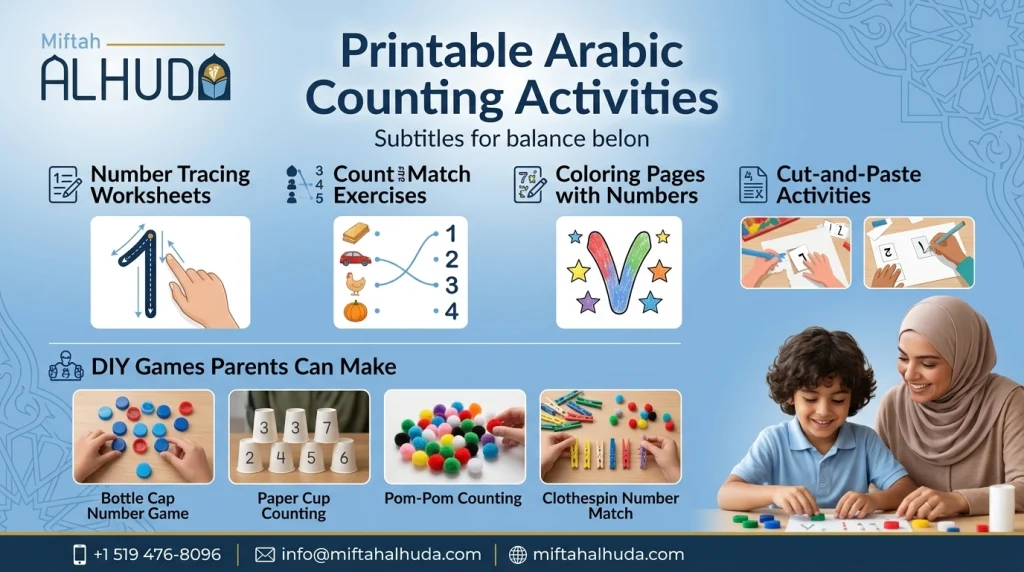
The best printable Counting activities for young kids:
1. Number Tracing Worksheets
Arabic number tracing worksheets serve two functions: they reinforce number shape recognition and build early writing skills simultaneously. Children trace the numeral while saying it aloud. The multi-sensory approach (seeing, saying, writing) is consistently more effective than any single-channel input.
Free tracing worksheets are available through teachers’ resource sites. Search “Arabic number tracing worksheet 1-10.”
2. Count and Match Exercises
Count-and-match printables show a quantity (dots, objects, or pictures) on one side and Arabic numerals on the other. The child draws a line to match them. Keep early versions to numbers 1-5. Add complexity gradually.
3. Coloring Pages with Numbers
Coloring pages that incorporate Arabic numbers give children a reason to handle and look at the numbers for an extended time. A child who spends ten minutes coloring around the numeral ٧ (7) has been exposed to that number’s shape far longer than a flashcard would allow.
4. Cut-and-Paste Counting Activities
Cut-and-paste tasks require children to count objects, find the matching Arabic numeral, cut it out, and paste it in the correct box. The sequence of steps slows the process down in a way that deepens engagement. These work especially well for children who lose interest in worksheets that feel passive.
DIY Arabic Counting Games Parents Can Make at Home
These games require basic household materials and take under fifteen minutes to prepare. The investment is minimal. The replay value is surprisingly high.
1. Bottle Cap Number Game
Collect bottle caps and write Arabic numerals on each one with a marker. Set out small containers numbered 1 through 10. The child sorts caps into the correct containers while counting aloud. Variation: use caps as counting tokens, roll a die, read the number in Arabic, place that many caps in a bowl.
2. Paper Cup Counting Activity
Number paper cups with Arabic numerals from 1 to 10. Provide a set of small objects (buttons, beans, or coins). The child fills each cup with the correct number of objects, counting in Arabic as they go. This is one of the best Arabic counting activities for developing one-to-one correspondence in young children.
3. Pom-Pom Counting Game
Write Arabic numbers on index cards. Set out a muffin tin and a pile of pom-poms. The child picks a card, reads the number (or you read it aloud), and drops the corresponding number of pom-poms into the tin. Add tweezers for fine motor practice. This simple game holds attention longer than expected, especially for children aged 3-5.
4. Clothespin Number Match
Write Arabic numerals on clothespins. Make a set of cards showing quantities (five stars, eight dots, etc.). The child clips the correct numbered clothespin to each card. The physical act of clipping adds resistance that makes the activity feel satisfying in a way flat worksheets don’t.
Arabic Counting Games for the Classroom
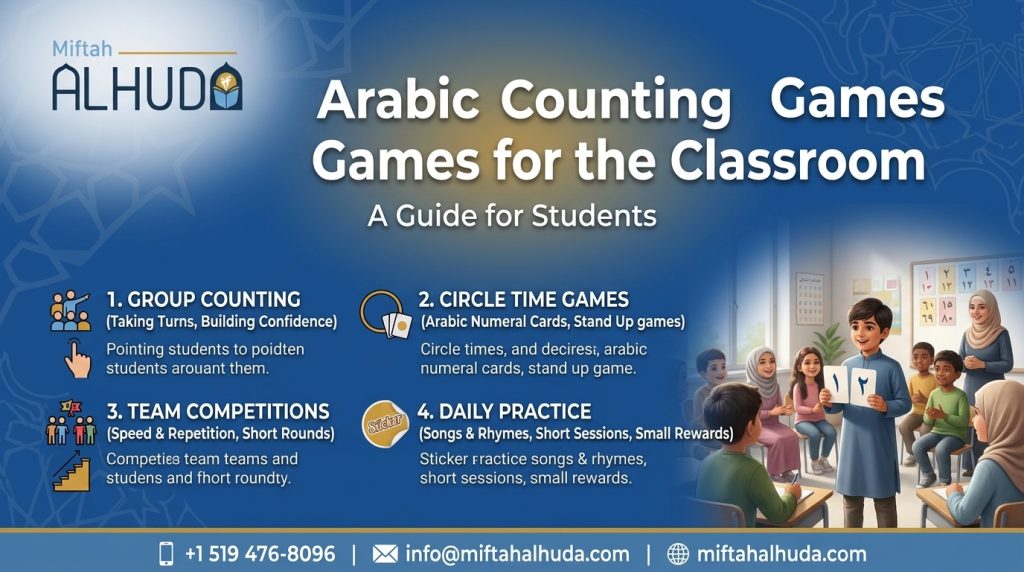
Here are the best Arabic counting games for kids for the classroom:
1. Group Counting Activities
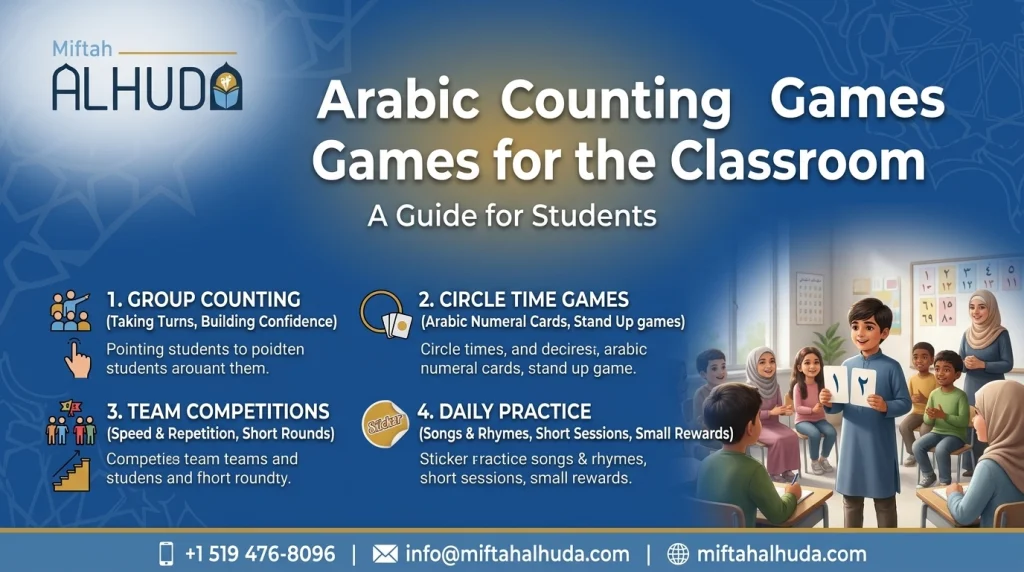
In a classroom setting, group arabic counting activities work best when children take turns leading. One child stands at the front and points to objects while the group counts together in Arabic. Rotating the “teacher” role gives every child a reason to stay engaged and builds confidence in speaking aloud.
2. Circle Time Number Games
Circle time is ideal for:
Counting the number of children present in Arabic
Passing an object around the circle while counting up or down
“Stand up if your number is…” games where each child holds an Arabic numeral card
The social pressure of circle time is lighter than a one-on-one quiz, but public enough to motivate engagement.
3. Team Challenges and Competitions
Gentle team competitions work well for kindergarten and early elementary. Divide children into two groups. Call out an Arabic number. The first team to hold up the correct numeral card wins a point. Keep scores visible. Keep rounds short. The key is volume of repetition per child, not the complexity of the challenge.
Making Arabic Number Learning Stick Over Time
Here is how to make your child remember the Arabic number and never forget it:
1. Use Songs and Rhymes
Songs should be a regular feature, not an occasional treat. A two-minute Arabic counting song at the start of each session costs nothing and primes the brain for the numbers that follow. Children absorb lyrics faster than they absorb instruction, which is worth leaning into.
Compose simple rhymes at home: “Wahid, ithnan, count with me / Thalatha, arba’a, one two three.” The sillier, the better. The child will remember the silly version longer.
2. Keep Sessions Short and Interactive
Twenty minutes of varied activity beats sixty minutes of any single exercise. For children under six, fifteen minutes is already a substantial session. End before they want to. The goal is that they associate Arabic number practice with something they’re willing to return to.
Aim for 10-20 minutes per session for preschoolers
Switch activities every 5-7 minutes to sustain attention
Always close on something the child can do successfully
3. Reward Progress with Positive Reinforcement
Small, specific rewards calibrate well for young learners. A sticker for learning numbers 1-5. A special snack for mastering 6-10. The specificity matters more than the size of the reward, the child needs to know exactly what they achieved. Vague praise (“You did great today!”) is less motivating than specific acknowledgment (“You remembered all ten numbers without any help!”).
4. Incorporate Daily Counting Practice
The most durable learning happens through consistent, brief daily contact rather than long infrequent sessions. Count steps going upstairs in Arabic. Count pieces of fruit at snack time. Count cars during a walk. This incidental counting (outside of any formal session) builds fluency in a way that structured games alone cannot.
Start Learning with Miftah Alhuda
Games and activities at home are a powerful start. But if you want your child to build real Arabic fluency, reading, speaking, writing, and connecting the language to their Deen, structured one-on-one guidance makes the difference.
Ready to give your child a head start?
Enroll in the Arabic for Kids Course at Miftah Alhuda, designed for young learners, taught by certified native Arabic teachers in engaging, faith-based online sessions.
Or try before you commit, book your child’s free trial session and see the difference a qualified teacher makes.
Contact Us
WhatsApp: +1 519 476-8096
E-Mail: in**@**********da.com
Facebook: https://www.facebook.com/MiftahAlhudaOfficial
Instagram: https://www.instagram.com/miftahalhudaa
Youtube: https://www.youtube.com/@MiftahAl-huda
Tiktok: https://www.tiktok.com/@miftahalhuda00“.
Frequently Asked Questions About Arabic Counting Games for Kids
What are the best Arabic counting games for preschoolers?
Hands-on activities work best at this age. Pom-pom counting games, bottle cap sorting, and sticker counting sheets are easy to set up and hold attention well. Flashcard memory games also work once a child knows at least five numbers.
How do I teach Arabic numbers through play?
Replace the instruction with the game. Instead of saying “today we learn four,” play a game where “four” keeps appearing, count four pieces of fruit, find the number 4 card, drop four items in a bowl. The number reaches the child through doing, not explaining.
What age should children start learning Arabic counting?
Children can begin recognizing and repeating numbers 1-5 in Arabic as early as age two or three. Formal number recognition with Arabic numerals is more appropriate from age four onward. There is no harm in starting early with songs and spoken counting.
Are online counting games effective for kids?
They can be, particularly when they require the child to produce an answer rather than just tap the right option. Audio-based games where children hear Arabic numbers spoken clearly are especially useful for developing listening comprehension alongside number recognition.
How can parents practice Arabic numbers at home without structured sessions?
Count incidentally throughout the day. Steps, snacks, toys, cars, anything that naturally involves a quantity becomes a practice opportunity. A few minutes of this kind of organic counting, done daily, accumulates into genuine familiarity over time.
Are there printable Arabic counting activities available for free?
Yes. Number tracing worksheets, count-and-match exercises, and bingo cards with Arabic numerals are widely available through teachers’ resource platforms. Search specifically for “Arabic number worksheet 1-10 printable” and preview before printing to confirm the Arabic is written correctly.
When the Games Stop Working
There comes a point in most children’s Arabic learning when the games alone aren’t enough. The novelty wears off, the numbers plateau at ten, and the gap between what they can do with a game and what they can do with real language becomes visible. This is a natural stage, not a failure.
It’s usually the point where the structure of games needs to give way to something more intentional. That doesn’t mean making it joyless, it means finding a teacher who can meet a child exactly where they are and build from there, using the same playful approach but with the guidance that a parent, however dedicated, often can’t replicate alone.
What a child does in the next six months at this stage will shape how they feel about Arabic for a long time after.