
Your child sits at the table, flashcards spread out in front of them. You say “واحد” and they repeat it back perfectly. Then you say “اثنان” and they stay silent. Five minutes later, they’ve forgotten both. You’ve been trying to teach children Arabic numbers for three weeks and feel like you’re starting from scratch every time.
Most parents take the same route: They say the numbers over and over again, test the child, and then get upset that he or she can’t seem to learn.
The strategy isn’t working because it’s not that the child can’t do it, but the fact that learning numbers in another language requires a different type of practice. It needs context.
This article will provide you with a practical way of how to teach counting in Arabic to children of various ages ranging from toddlers who have just learned about numbers and quantities, up to older children who are able to work with the numbers 1 to 20. You will discover helpful activities, the numbers 1 to 10 chart, and ways to incorporate Arabic numbers into your daily routine.
Why Arabic Numbers Matter More Than You Think
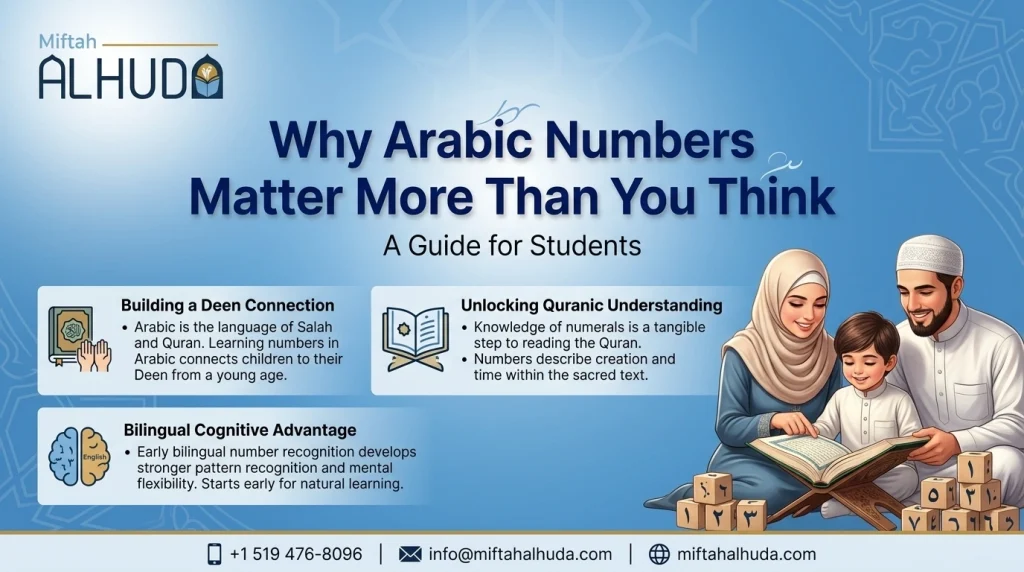
Arabic is not just a language. It is the language of Salah, the language of the Quran, the language that connects their children to their Deen. When a child learns to count in Arabic, they are not just practicing math. They are building a relationship with the Quran.
The Prophet Muhammad (peace be upon him) said: “The best of you are those who learn the Quran and teach it.” (Sahih al-Bukhari, Book 66, Hadith 49, narrated by Uthman ibn Affan).
The knowledge of Arabic numerals is usually the first tangible way to understand and read the Quran. Numbers are mentioned in the Quran numerous times and they are used for describing the process of creation and time, and a child knowing them has a great advantage.
Beyond the spiritual dimension, early number recognition in Arabic builds bilingual cognitive skills. Children who learn to count in two languages tend to develop stronger pattern recognition and mental flexibility. The earlier they start, the more naturally the second language settles in.
When to Start: Age-by-Age Expectations
Not every child is ready for the same things at the same time, and that’s worth knowing before you pick a method.
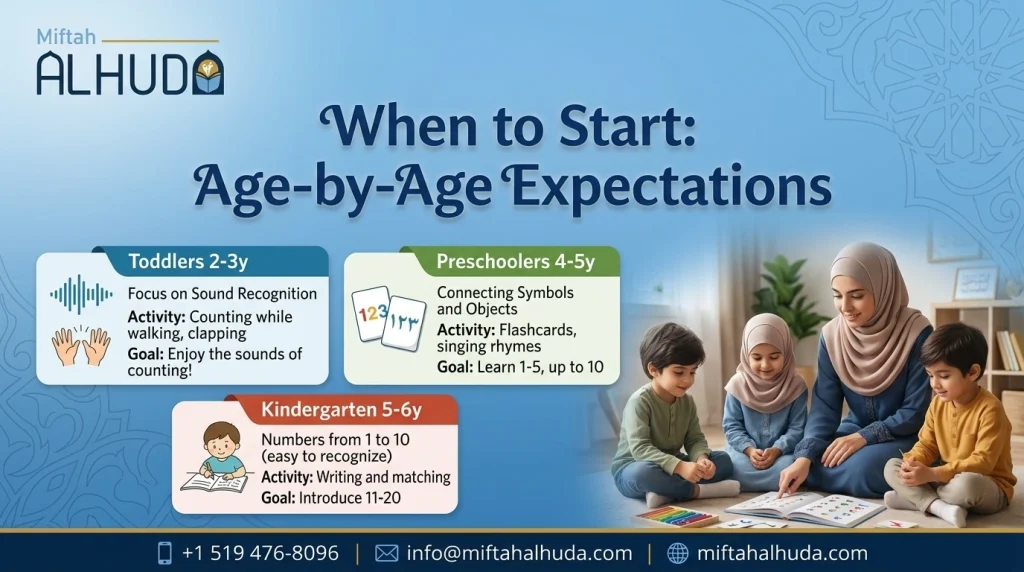
Toddlers (2-3 year olds): Emphasis should be on sound recognition. Counting while walking, eating, clapping, etc., will make the right start here. There is no point in hoping that they will learn to call it “three.” Enjoy the sound of it!
Preschoolers (4-5 year olds): Ready to make the connection between the number symbol (both eastern arabic ١٢٣ and western 123) and the number of things. Flash cards, finger counting and singing little rhymes will do the job. Learning numbers from 1 to 5 is a must here; further up to 10.
Children in kindergarten (5-6 year olds): Numbers from 1 to 10 will be easy for them to recognize and remember; many are ready to try 11 to 20, too. Writing and matching activities suit this age group well.
The temptation is to rush. Seeing a four-year-old struggle with “سبعة” doesn’t mean they’re behind. It usually means they need more listening time before production practice begins.
Arabic Numbers 1 to 10: A Quick Guide
Before you can teach children Arabic numbers, you need to feel confident with them yourself. Here is a simple reference for numbers 1 through 10:
| Number | Arabic Numeral | Arabic Word | Transliteration | Pronunciation Tip |
| 1 | ١ | وَاحِد | Wāhid | “WAH-hid” |
| 2 | ٢ | اِثْنَان | Ithnān | “ith-NAAN” |
| 3 | ٣ | ثَلَاثَة | Thalāthah | “tha-LAA-tha” |
| 4 | ٤ | أَرْبَعَة | Arba’ah | “AR-ba-ah” |
| 5 | ٥ | خَمْسَة | Khamsah | “KHAM-sa” |
| 6 | ٦ | سِتَّة | Sittah | “SIT-ta” |
| 7 | ٧ | سَبْعَة | Sab’ah | “SAB-ah” |
| 8 | ٨ | ثَمَانِيَة | Thamāniyah | “tha-MAA-ni-ya” |
| 9 | ٩ | تِسْعَة | Tis’ah | “TIS-ah” |
| 10 | ١٠ | عَشَرَة | ‘Asharah | “AH-sha-ra” |
For numbers 11 to 20, the pattern builds on ten (‘asharah). Eleven is أَحَدَ عَشَرَ (ahada ‘ashara), twelve is اثنا عَشَرَ (ithnā ‘ashara), and so on through twenty (عِشْرُون, ‘ishrūn).
Once children see the pattern, they can often predict the next number, which makes the jump from 10 to 20 feel less daunting.
The Best Activities To Teach Children Arabic Numbers
There are many activities to choose from, and here are the best of them:
1. Counting Objects in the Room
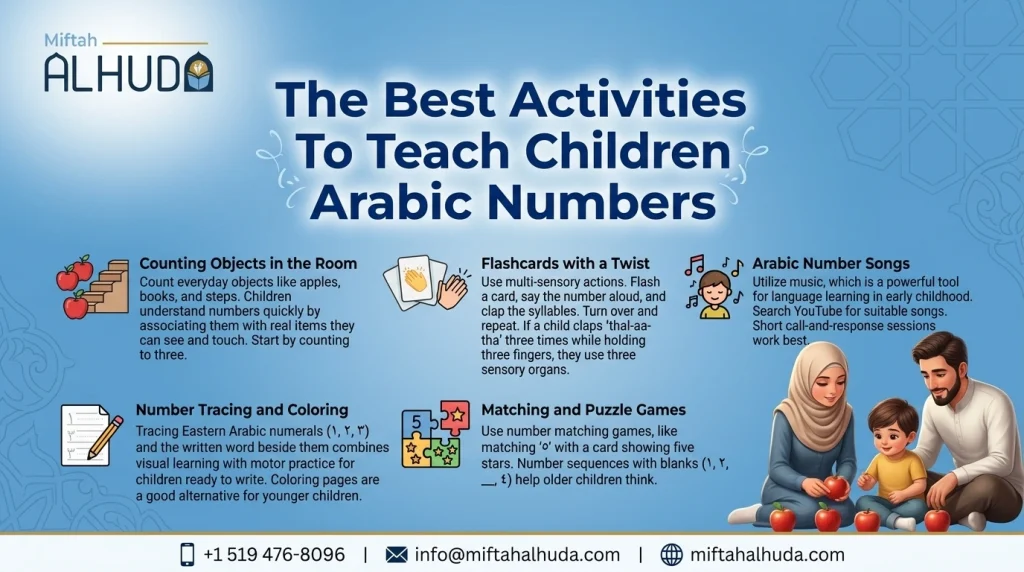
This is the least utilized technique and it applies at all ages. Take three apples and count them in Arabic. Count how many steps you take to reach the door. Before sleeping, count how many books are on the bookshelf.
Children understand numbers quicker when they associate numbers with objects rather than playing cards since they can see, touch, and even eat the objects.
The idea here is to have your kids get used to the sounds of counting in Arabic without having an actual lesson. When children hear “واحد، اثنان، ثلاثة” each time they go up the stairs, they learn the sound without actually having a lesson.
2. Flashcards with a Twist
Flashing cards are effective, but not in cases where they serve as tests. Flash the card, speak the number aloud, clap the syllables and turn over the card to repeat the process. If a child claps “thal-aa-tha” three times while holding three fingers, the child uses three sensory organs at once.
Some parents add a small movement to each number. Jumping three times for ثلاثة, clapping four times for أربعة. The sillier it feels, the more likely children are to remember it the next day.
3. Arabic Number Songs
Music is one of the most powerful tools for language learning in early childhood. A counting song heard five times stays in a child’s memory longer than twenty individual repetitions.
YouTube has several Arabic number songs designed for young children. Search for “Arabic numbers song for kids” and preview a few before choosing one, since different songs suit different age groups.
The call-and-response approach works especially well: you sing the number, your child echoes it back. Keep sessions short, three to five minutes at most, and end before they lose interest.
4. Number Tracing and Coloring
For children ready to write (typically ages 4 and up), tracing Arabic numerals combines visual learning with motor practice. Tracing worksheets that show both the Eastern Arabic numeral (١، ٢، ٣) and the written Arabic word beside it are particularly effective. The act of tracing while saying the number aloud adds another sensory layer.
Coloring pages featuring Arabic numbers are another option for younger children who aren’t ready for tracing. Coloring while hearing the number repeated keeps them engaged without the pressure of fine motor control.
5. Matching and Puzzle Games
Number matching games with a “٥” on one card and five stars on another card are effective for learning numbers without making it look like learning. For kids above this age, number sequences with blanks like ١، ٢، __، ٤ can be used to help them think.
Common Mistakes Parents Make at Home
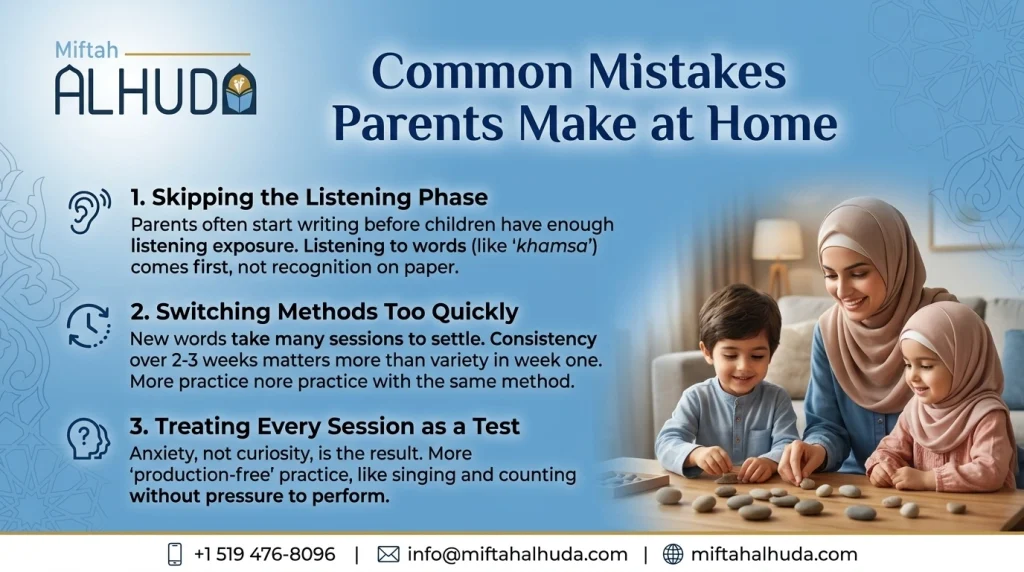
Her are some of the common mistakes most people for in when teaching children Arabic numbers:
1. Skipping the Listening Phase
Many parents start with recognition and writing before children have had enough listening exposure. A child who has heard “خمسة” fifty times in natural conversation is going to recognize it on a flashcard faster than one who has only seen it on paper. Listening comes first.
2. Switching Methods Too Quickly
It takes more exposure than most parents expect for a new word to settle. If a child doesn’t recognize a number after three sessions, the answer is usually more practice with the same method, not a new method. Consistency over two to three weeks matters more than variety in week one.
3. Treating Every Session as a Test
Children learn through positive engagement, not evaluation. If every Arabic number session ends with “now tell me what this is,” the child starts to feel anxious rather than curious. Mix in more production-free practice: singing, counting objects together, watching a number song without any pressure to perform.
The Miftah Alhuda Arabic for Kids Course
If you are looking for structured, faith-centered Arabic learning for your child, the Arabic for Kids Course at Miftah Alhuda is designed specifically for young learners.
The course covers:
Basics of Arabic: Alphabet, pronunciation, and early reading through songs and stories
Vocabulary & conversation: Family, colors, food, and common Islamic terms such as “Bismillah” and “Alhamdulillah”
Grammar made simple: Roots of three letters and agreement by using games rather than memorizing them
Arabic for the heart: Short Quranic words, duas, and Salah vocabulary woven into every lesson
Writing and reading: Illustrated stories in Modern Standard Arabic with teacher guidance
The classes are individual, live, and flexible in scheduling with the ability to accommodate busy class schedules and time zone differences in North America and Europe. The instructors have certification and training in working with children in bilingual western environments as well as how to keep the children truly motivated rather than bored with lessons.
For those parents who experience the problem of children responding in English only when addressed in Arabic, this course is a direct solution to their needs. This course motivates children by relating the language to their Islamic identity and daily life.
Ready to Take the Next Step?
Enroll your child in the Arabic for Kids Course today and give them structured, faith-based Arabic learning built for Western families.
Book a free trial session to meet your child’s teacher, see the teaching style firsthand, and start with no commitment.
Contact Us
WhatsApp: +1 519 476-8096
E-Mail: in**@**********da.com
Facebook: https://www.facebook.com/MiftahAlhudaOfficial
Instagram: https://www.instagram.com/miftahalhudaa
Youtube: https://www.youtube.com/@MiftahAl-huda
Tiktok: https://www.tiktok.com/@miftahalhuda00“.
Frequently Asked Questions
What is the age at which children should learn Arabic numbers?
Children can be introduced to the sounds of Arabic number digits from the age of 2 while counting. However, the recognition of digits would work effectively starting from age 4.
What are the Arabic numbers from 1 to 10?
These are واحد (1), اثنان (2), ثلاثة (3), أربعة (4), خمسة (5), ستة (6), سبعة (7), ثمانية (8), تسعة (9), عشرة (10).
Are the Arabic numbers different from English numbers?
Numerals which we refer to as Arabic numbers (1, 2, 3 …) are widely used across the globe. However, in Arabic-speaking countries, there is the use of Eastern Arabic numerals (١، ٢، ٣).
Which are the best activities for teaching Arabic numerals to preschoolers?
The best and most appropriate methods are counting household items, Arabic numeral songs, and visual flashcards with movements.
How can you motivate children to learn Arabic numerals?
Keep lessons brief (5 to 10 minutes), employ motion and music, count actual objects not just symbols, and no testing. Engagement is always better than drilling.
Can children learn Arabic numbers online?
Yes. Live one-on-one online sessions with qualified teachers, like those at Miftah Alhuda, provide structured learning with immediate feedback, which is often more effective than apps alone.
The Question Worth Sitting With
A parent in Germany once said: “My daughter knows the Arabic numbers. She can say them in order. But she doesn’t feel them yet.” That observation is worth paying attention to. Counting and comprehending numbers are two separate concepts.
The child who counts their dates during iftar in Arabic and says “اثنان” to their little brother or sister as he hands them two cookies is developing something other than the one who practices with flash cards and then continues to the next concept.
The methods in this guide work best when they are woven into the texture of daily life. Not as separate study sessions, but as small moments. How many prayers did we pray today? How many Surahs do you know? Those questions, asked in Arabic, do more for number learning than most formal lessons. Which raises a question worth sitting with: how many moments in your child’s week are already Arabic moments, just waiting to be named?