
You get to the checkout counter, someone asks the price, and you freeze. The numbers are there in your head, somewhere. You practiced them twice last week. But when the moment arrives, your mouth produces something between “ithnayn” and a polite apology.
That is not a memory problem. That is a pronunciation problem, and it is more common among beginners than most learning apps acknowledge, that’s when you start searching for an Arabic number pronunciation guide.
Most resources give you a list. A table of numbers, some transliterations, maybe a small audio clip buried three scrolls down.
But what they usually don’t do is tell you why some of the Arabic numerals seem difficult to pronounce, what new sounds your tongue will need to produce, and how the phonological processes involved in the numerals are really performed after the number ten.
The Arabic number pronunciation guide is made for people who are trying to learn how to say Arabic out loud, not really how to read it. Here below you will see, in a practical way, all the sounds that might trip up an English speaker. Also, we explain the Arabic numbers structure, starting from 21, and why some pronunciation details are important, even when they feel small at first.
Why Arabic Numbers Don’t Sound As Expected?

Every Arabic number from one to ten is a completely different word and has nothing to do with one, two, three and so on. Each word needs to be learned individually, which is actually less of a burden than it sounds, because ten words are manageable in a week.
The sounds themselves are where beginners run into trouble. A few key points:
- The “th” sound in numbers like thalatha (three) and thamaniya (eight) is the unvoiced version, like in the English word “think,” not “the.” Your tongue goes between your teeth.
- The letter ع (ayn) appears in words like arba’a (four) and sab’a (seven). There is no English equivalent. It comes from the throat, not the lips or tongue.
- The kh in numbers like khamsa (five) is a soft rasp at the back of the throat, similar to the “ch” in the Scottish “loch.”
These are not impossible sounds. They are simply sounds your mouth has not practiced yet. Native English speakers typically need a few weeks of deliberate repetition before those particular sounds stop feeling unnatural.
Arabic Number Pronunciation Guide
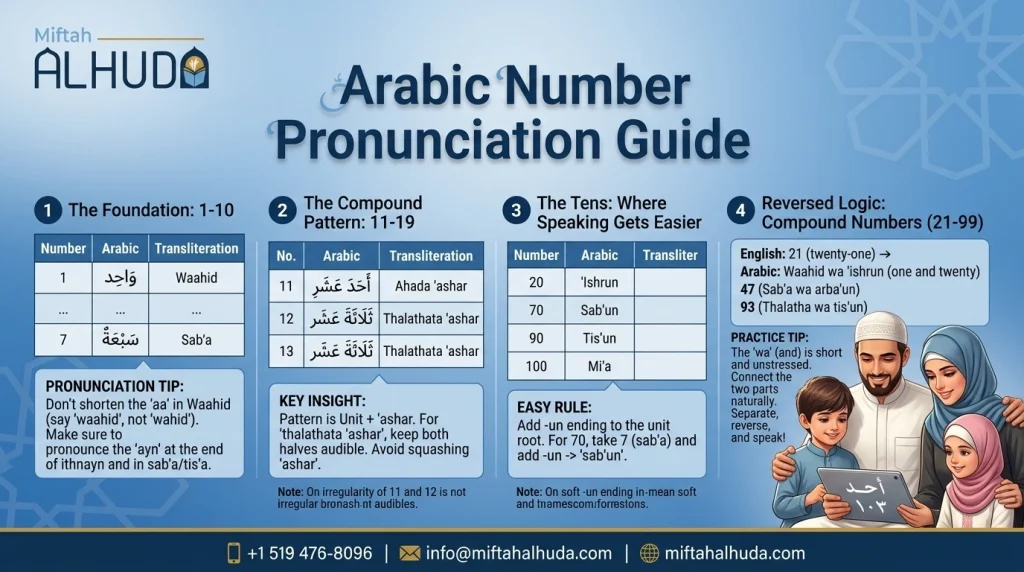
Arabic Numbers 1 to 10: The Foundation You Keep Coming Back To
These ten words are the building blocks for everything else. Once you can say them cleanly, the rest of the system starts to make sense.
| Number | Arabic | Transliteration |
| 1 | وَاحِد | Waahid |
| 2 | اثْنَان | Ithnayn |
| 3 | ثَلَاثَة | Thalatha |
| 4 | أَرْبَعَة | Arba’a |
| 5 | خَمْسَة | Khamsa |
| 6 | سِتَّة | Sitta |
| 7 | سَبْعَة | Sab’a |
| 8 | ثَمَانِيَة | Thamaniya |
| 9 | تِسْعَة | Tis’a |
| 10 | عَشَرَة | ‘Ashara |
A few things worth noting as you practice these aloud:
There is also a long ‘aa’ in Waahid. Most new learners tend to shorten it, resulting in the pronunciation ‘wahid.’
The ‘ayn’ at the end of ithnayn is long, not a short ‘n.’ Make sure not to shorten it.
The letter ع that you see in sab’a and tis’a is followed by an apostrophe, which you must pronounce.
Numbers 11 to 19: The Compound Pattern
Teen numbers in Arabic follow a logical structure. Each one is formed by combining the unit number with the word for ten (‘ashar). The pattern is:
Unit + ‘ashar = teen number
| Number | Arabic | Transliteration |
| 11 | أَحَدَ عَشَر | Ahada ‘ashar |
| 12 | اثْنَا عَشَر | Ithna ‘ashar |
| 13 | ثَلَاثَةَ عَشَر | Thalathata ‘ashar |
| 14 | أَرْبَعَةَ عَشَر | Arba’ata ‘ashar |
| 15 | خَمْسَةَ عَشَر | Khamsata ‘ashar |
| 16 | سِتَّةَ عَشَر | Sittata ‘ashar |
| 17 | سَبْعَةَ عَشَر | Sab’ata ‘ashar |
| 18 | ثَمَانِيَةَ عَشَر | Thamaniyata ‘ashar |
| 19 | تِسْعَةَ عَشَر | Tis’ata ‘ashar |
The most common mistake at this stage is rushing the compound. When you say “thalathata ‘ashar,” each half needs room. Beginners often squash the ‘ashar so much it disappears. Keep both halves audible.
Eleven and twelve are slightly irregular, which is familiar territory for English speakers. They do not simply follow the unit-plus-ten pattern exactly, so they need individual memorization.
The Tens: Where Speaking Gets Easier
This is the part many beginners do not expect: Arabic tens are actually easier to learn than English tens. Once you have twenty, the rest follow an almost mechanical pattern.
| Number | Arabic | Transliteration |
| 20 | عِشْرُون | ‘Ishrun |
| 30 | ثَلَاثُون | Thalathun |
| 40 | أَرْبَعُون | Arba’un |
| 50 | خَمْسُون | Khamsun |
| 60 | سِتُّون | Sittun |
| 70 | سَبْعُون | Sab’un |
| 80 | ثَمَانُون | Thamanun |
| 90 | تِسْعُون | Tis’un |
| 100 | مِئَة | Mi’a |
Every number from 30 to 90 takes the root of the corresponding unit number and adds the -un ending. That is a real shortcut. If you know seven is “sab’a,” then seventy is “sab’un.” The connection is direct and audible.
The -un ending is soft. Many beginners over-pronounce it and make it sound like “-oon.” In Modern Standard Arabic (MSA), the ending is more clipped. Think of it like a quiet exhale, not a long vowel.
Compound Numbers 21 to 99: The Reversed Logic
English says “twenty-one.” Arabic says the equivalent of “one and twenty.”
That reversal catches people off guard the first time. The unit comes first, then “wa” (meaning “and”), then the ten.
21 = Waahid wa ‘ishrun (one and twenty)
35 = Khamsa wa thalathun (five and thirty)
47 = Sab’a wa arba’un (seven and forty)
93 = Thalatha wa tis’un (three and ninety)
The word wa (and) is short and unstressed. It connects the two parts without drama. Beginners sometimes pause before it as if it is a separate word to be announced. It is not. Let it flow into the unit and ten naturally, the way “and” floats inside casual English speech.
One such exercise can be like this: take any number from 21 to 99, separate it into the units and tens, write down their English names, switch them around mentally, put “wa” between them, and read the result aloud. Do it ten times a day for two weeks straight, and it will get stuck in your head really quickly.
Hard Sounds for English Speakers: A Focused Breakdown
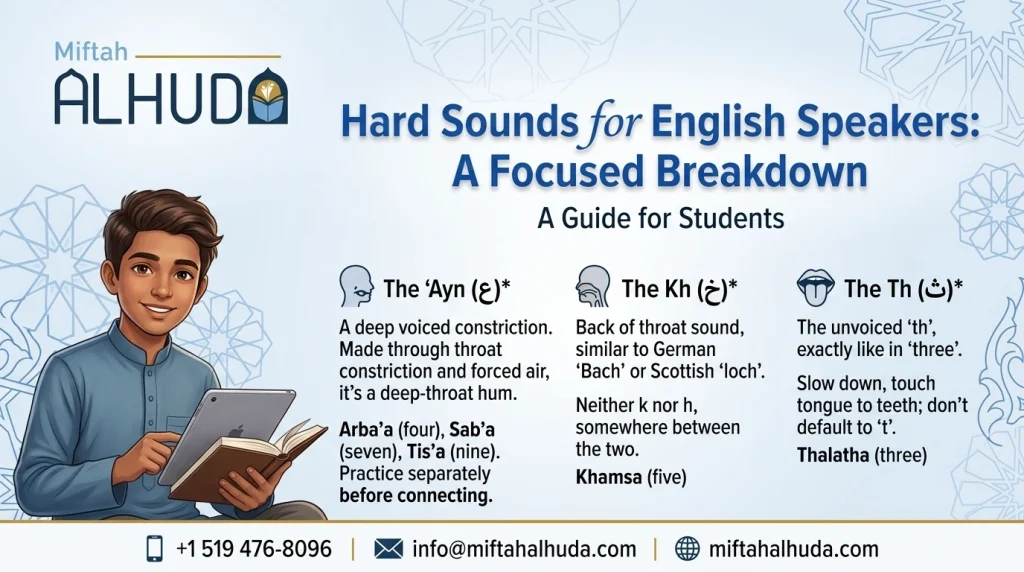
This section of our Arabic number pronunciation guide is worth reading slowly, because the sounds below account for most of the clarity problems beginners have when speaking Arabic numbers.
The Ayn (ع)
This is probably the most foreign sound in the number vocabulary. It appears in:
Arba’a (four)
Sab’a (seven)
Tis’a (nine)
Arba’un (forty)
Sab’un (seventy)
Tis’un (ninety)
Ayn is made through throat constriction as well as forcing the air out of it. Instructors describe it as the sound one makes just before vomiting, which describes it perfectly, but it sounds discouraging.
A more pleasant way of putting it would be to say that it is a voiced constriction, similar to a hum coming from deep within your throat.
First practice it alone, separate from the numbers. Say “a” normally, then try to produce it from deeper. When your teacher or an audio reference confirms you are producing something close, then connect it to arba’a and sab’a.
The Kh (خ)
It comes up in khamsa (five) and its variant khamsun (fifty). Its sound is made in the back of the throat, similar to that in the German pronunciation of Bach and also in the Scottish loch. Neither a k nor an h, it lies somewhere in between the two.
The Th (ث)
This appears in thalatha (three), thamaniya (eight), and their related forms. It is the unvoiced “th,” exactly like the English word “three” itself. Some beginners surprisingly have trouble with this one because they default to a “t” sound under pressure. Slow down and let the tongue touch the teeth.
Practical Contexts: Using Numbers in Real Situations
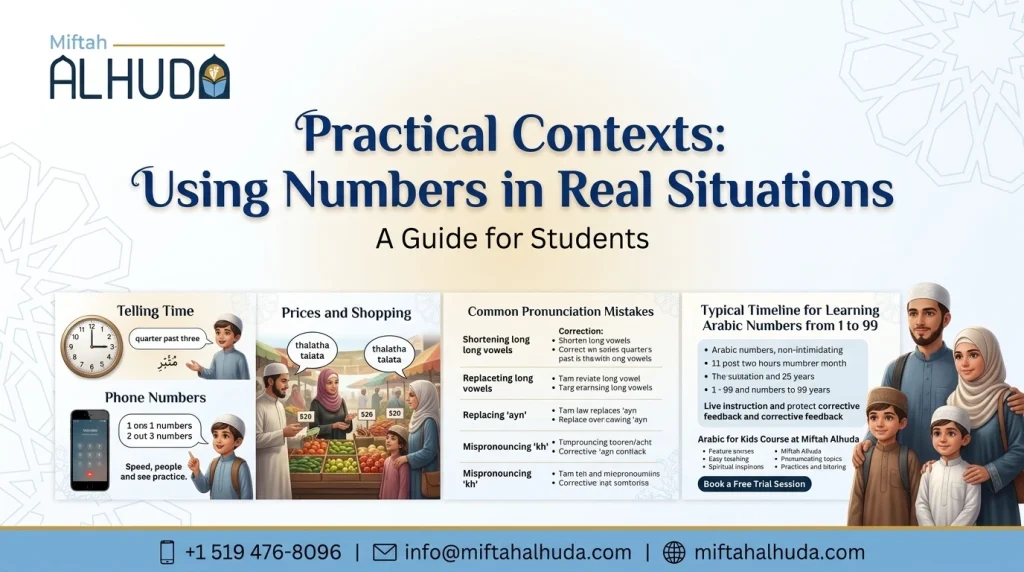
Knowing how numbers sound in isolation is one thing. Using them in context is another, and the context shapes how you say them.
Telling Time
Arabic time uses ordinal numbers rather than cardinal ones for most hours. But the minutes use regular numbers. A sentence like “quarter past three” (rub’ ba’da al-thalitha) requires you to produce “thalitha” quickly inside a phrase. That is different from saying it as a standalone word.
Practice complete time phrases, not isolated numbers, as soon as you have the basics.
Prices and Shopping
The most common real-world use of Arabic numbers for beginners. Vendors often speak quickly and with a regional dialect. Egyptian Arabic, for instance, turns the “th” in thalatha into a simple “t,” making it “talata.”
Gulf Arabic has its own rhythm. Modern Standard Arabic is what most courses teach, but the market will often give you something closer to the local dialect.
Knowing that this variation exists saves a lot of confusion. The number 3 is still three, even if it sounds like “talata” instead of “thalatha.”
Phone Numbers
Arabic phone numbers are said separately like in English. It is all you need to know 1 through 9 and zero, which is ‘sifr’. It is the rate at which one pronounces the figures that counts; hence practicing these ten figures is worthwhile.
The Most Common Beginner Mistakes (And How to Fix Them)
Most pronunciation errors with Arabic numbers cluster around the same handful of problems:
Shortening long vowels. Waahid should have a long “aa.” Beginners often say “wahid” and lose the distinction.
Replacing ayn with a glottal stop. Saying “arba-a” with a small throat catch rather than a full ayn. The ayn needs more depth.
Over-stressing the -un ending. Making “thalathun” sound like “thalathoon.” The ending is brief.
Pausing before “wa” in compound numbers. Twenty-three is one continuous phrase, not three separate units.
Pronouncing kh as “k” or “h”. Khamsa starts with neither. It is the back-of-throat rasp.
All of these are fixable with targeted correction. The issue is that most self-study tools cannot tell you when you are making them.
How Long Does Learning Arabic Numbers Actually Take?
Number one to ten will require one to two weeks for the most serious beginner learner. The same applies to number eleven to twenty, which will take one more week. Numbers up to ninety-nine, especially the tens and complex ones, might require two to four weeks.
This is a realistic period, and not an intimidating one. Two months of practice should see a beginner having a working knowledge of numbers. The real difficult thing is becoming proficient to such a level that even the native person or fast talker does not need to repeat himself or herself. That takes longer, and honestly depends less on memorization than on listening to numbers in real speech frequently.
One factor that consistently speeds things up: corrective feedback from a teacher. Someone who can hear your “arba’a” and tell you the ayn needs more throat. You can practice in isolation for weeks and entrench a pronunciation habit that takes months to undo. Live instruction short-circuits that.
If you want structured guidance on speaking Arabic correctly from the start, the Arabic for Kids Course at Miftah Alhuda teaches pronunciation with live feedback from qualified teachers. Start with a solid base before the habits set.
Not sure if it is the right fit? Book a Free Trial Session and hear for yourself.
Contact Us
WhatsApp: +1 519 476-8096
E-Mail: in**@**********da.com
Facebook: https://www.facebook.com/MiftahAlhudaOfficial
Instagram: https://www.instagram.com/miftahalhudaa
Youtube: https://www.youtube.com/@MiftahAl-huda
Tiktok: https://www.tiktok.com/@miftahalhuda00
Frequently Asked Questions
Q: How do I pronounce Arabic numbers 1 to 10?
Each of the first ten numbers has its own word. The main pronunciation challenges for English speakers are the “ayn” sound in arba’a, sab’a, and tis’a, and the “kh” in khamsa. Both require throat engagement rather than lip or tongue placement, which takes deliberate practice.
Q: How long does it take to learn Arabic numbers for daily use?
Most beginners can handle numbers 1 to 20 within two to three weeks of consistent practice. Numbers up to 100 typically take four to six weeks. Being able to use them confidently in fast conversation, like with a vendor or on a phone call, takes longer, mostly because speed and listening comprehension develop separately from memorization.
Q: Is there a need for me to know two number systems in Arabic?
The Arabic language consists of eastern numerals (١، ٢، ٣), which are mostly found in Arabic writing and western numerals (1, 2, 3). Regarding speaking, the use of either type of numerals will not make any difference in terms of pronunciation. As far as understanding written material is concerned, learning eastern numerals is quite valuable.
Q: Can I learn Arabic number pronunciation without a teacher?
You can make significant progress independently, especially in memorizing the words. The gap is in pronunciation accuracy. Without feedback, it is easy to develop habits like replacing the ayn with a glottal stop or shortening long vowels, and those habits are harder to undo than to avoid in the first place. Even occasional sessions with a qualified teacher make a measurable difference.
The Moment Numbers Stop Being a List
There is a shift that happens around the six-week mark for most learners. Numbers stop being a reference table you consult and start being something you reach for automatically. You hear a price and your brain processes it without running through a translation step.
That shift does not happen because you memorized harder. It happens because you used the numbers in real exchanges enough times that they attached to meaning rather than just to a list.
Getting there requires more than a guide. It requires something close to repeated real conversation, the kind where a mistake gets corrected immediately and a correct pronunciation gets confirmed. That feedback loop is difficult to replicate with an app or a chart alone.
The good news is that Arabic numbers are actually one of the more logical systems in the language, especially from thirty onward. The difficulty is concentrated in a small set of sounds that, once you have them, open the door to the entire numerical vocabulary at once.