
Have you ever stood in prayer during Witr and had a strong feeling of peace of mind as you recited those powerful words? That is the magic of dua qunoot.
This wonderful supplication is more than just another set of words we whisper in salah; it is a real conversation with Allah that has unexpected dua qunoot benefits that many of us ignore.
In today’s fast-paced world, dua qunoot is a hidden gem. Understanding its benefits, as supported by Hadith and scholars, can improve your night prayers.
At Miftah Al-Huda Academy, we believe that internalizing such tremendous duas enhances your worship and draws you closer to Allah. Let us experience its great power together.
What Is Dua Qunoot?
Before we go into the dua qunoot benefits, let’s make sure everyone is on the same page. What exactly is the definition of dua qunoot?
The Linguistic Meaning of Qunoot
The term “Qunoot” is taken from the Arabic root “q-n-t,” which means humility, obedience, and standing in devotion. Consider it the spiritual posture of a heart that is entirely dedicated to Allah. When you recite dua qunoot, you are not simply speaking words; you are embodying a profound condition of submission.
When and Where Is Dua Qunoot Recited?
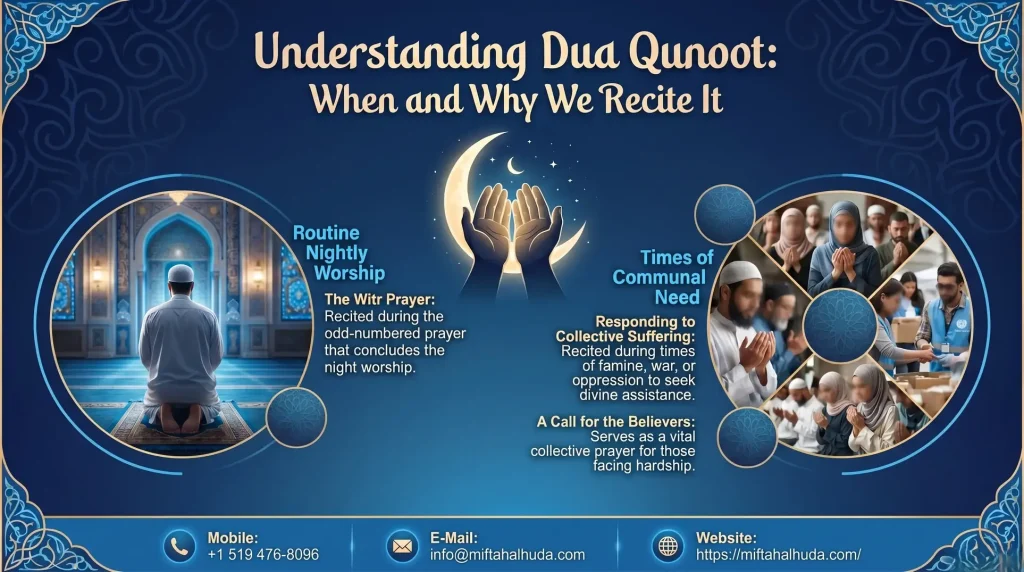
Dua Qunoot is traditionally said during the Witr prayer, which is the odd-numbered prayer at the end of night worship.
But here’s the interesting part: it’s also recited during times of communal suffering, like famine, war, or oppression, as a collective call to ask Allah for assistance. This dua is needed by the believers.
The Authentic Sources: Hadith Evidence for Dua Qunoot
Let’s go to the core of the matter. Why should we believe that the dua qunoot benefits are true? Because they are founded on actual prophetic teachings.
Prophetic Traditions Highlighting Its Importance
The Prophet Muhammad (peace be upon him) did not simply recite dua qunoot casually. He taught, practiced, and emphasized its importance.
It has been narrated to us in the authentic hadith found in Sunan Abu Dawud, Sunan al-Tirmidhi, Sunan al-Nasa’i, Sunan Ibn Majah, Sunan al-Bayhaqi, and other collections, with a sahih isnad from al-Hasan ibn Ali (may Allah be pleased with him and his father) who said:
Allah’s Messenger taught me some phrases to say during Al-Witr “Allahummahdini fiman hadait, wa a’fini fiman afait, wa tawallani fiman tawallait, wa barik Li fima atait, wa qini sharra ma qadait, fa Innaka taqdi wa la yuqda Alaik, wa innahu la yadhillu man walait, tabarakta Rabbana wa ta’alait.”
” O Allah guide me among those You have guided, pardon me among those You have pardoned, befriend me among those You have befriended, bless me in what You have granted, and save me from the evil that You decreed. Indeed You decree, and none can pass decree, and none can pass decree upon You, indeed he is not humiliated whom You have befriended, blessed are You our Lord and Exalted.”
Imam al-Tirmidhi said: “This is a hasan hadith, and we do not know of any narration from the Prophet ﷺ regarding Qunoot that is better than this.”
It is recommended to say after this dua:
“Allahumma salli ‘ala Muhammad wa ‘ala ali Muhammad wa sallim”
(O Allah, bless the Prophet and all his descendants).
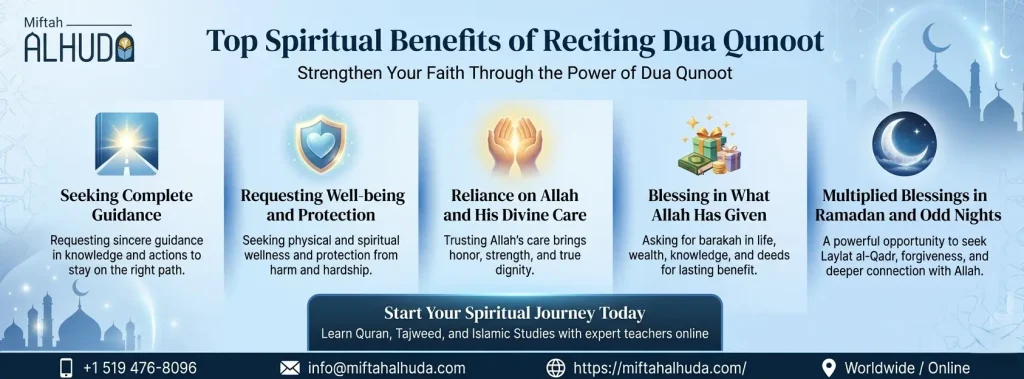
Top Spiritual Benefits of Reciting Dua Qunoot

Let’s dive into the most significant spiritual dua qunoot benefits.
1. Seeking Complete Guidance
It is a request for authentic guidance in both knowledge and act.
2. Requesting Well-being and Protection
It requests physical and spiritual wellness, protection against illnesses of the heart and body, and protection from the bad divine decree.
3. Reliance on Allah and His Divine Care
It asks Allah to take the believer under His divine care and protection, which brings true honor and dignity, for none whom Allah supports and guards is ever humiliated.
4. Blessing in What Allah Has Given
It asks barakah (blessing) on whatever Allah has bestowed, whether it is life, monetary wealth, knowledge, or good acts, so that it is helpful and fruitful.
5. Multiplied Blessings in Ramadan and Odd Nights
Reciting Qunoot on Ramadan’s odd nights is one of the most potent dua qunoot benefits, as supplications during these favorable times carry more weight and acceptability, providing a unique opportunity to seek Laylat al-Qadr, forgiveness, and a deeper connection with Allah.
Views from Classical Scholars like Ibn Taymiyyah and Al-Nawawi
Ibn Taymiyyah highlighted that Qunoot is a way to become closer to Allah and seek His help in times of need. Al-Nawawi emphasized its significance in spiritual purification. Their findings confirm that the dua qunoot benefits are multifaceted.
Contemporary Scholars on the Relevance of Qunoot Today
Modern Al-Azhar scholars emphasize that dua qunoot is extremely relevant. In our era of global crises, mental health issues, and spiritual detachment, the dua qunoot benefits provide timeless solutions. It is urgently needed.
Practical Tips to Incorporate Dua Qunoot in Your Daily Worship
Recognizing the benefits is one thing; experiencing them is another. Here’s how you make it stick.
1. Creating a Consistent Supplication Routine
Begin small. Commit to saying dua qunoot in your Witr prayer simply three times per week. Gradually increase. Consistency beats intensity.
2. Teaching Dua Qunoot to Children and Family
Want to multiply your blessings? Teach your children. Make this a family habit. Explain the meaning, share the stories, and watch as their faith grows. The dua qunoot benefits apply to the entire household, not just you.
Accepting the Transformational Power of Dua Qunoot
The dua qunoot benefits are real, powerful, and accessible to all believers. This supplication contains a wealth of divine gifts, ranging from spiritual elevation to psychological healing.
It’s more than simply a ritual; it’s a way to create a connection with Allah, supported by authentic Hadith and enriched by centuries of knowledge.
Why not start tonight? Raise your hands and open your heart to feel the transformational power of dua qunoot for yourself.
Join Miftah Al-Huda Academy to learn Dua Qunoot with proper pronunciation, meaning, and heartfelt implementation, along with many other powerful duas that will draw you closer to Allah Almighty.
Whether you are a beginner or looking to deepen your connection with your night prayers, our structured courses will help you internalize these beautiful supplications so they become a living part of your worship.
Enroll now and start your journey toward more peaceful, focused, and accepted prayers Start Your Free Trial Today!
Contact Us
- WhatsApp: +1 519 476-8096
- E-Mail: in**@**********da.com
- Facebook : https://www.facebook.com/MiftahAlhudaOfficial
- Instagram:https://surl.li/smlfaq
- Youtube: https://surl.li/inbncd
- Tiktok:https://surl.li/ldzmww
Frequently Asked Questions About Dua Qunoot Benefits
1. What is the difference between Qunoot Nazilah and Qunoot al-Witr, and when should each be recited?
Qunoot al-Witr is a year-round Sunnah that is recited during the Witr prayer. Qunoot Nazilah is recited in obligatory prayers during times of communal crisis (such as war or plague) and is discontinued once the hardship is over.
2. What should I do if I forget to recite Dua Qunoot in the Witr prayer? Does it require prostration of forgetfulness (sujood al-sahw)?
According to the majority of scholars (Shafi’i and Hanbali), Qunoot is a recommended Sunnah, so leaving it out does not necessitate sujood al-sahw.
The Hanafi school considers it Wajib, so if omitted unintentionally, sujood al-sahw is recommended but not mandatory for prayer validity.
3. What is the scholarly ruling on raising the hands during Dua Qunoot must they be raised, or is it optional?
Raising the hands during Dua Qunoot is recommended (Sunnah), but not required. The practice of raising hands in supplication follows the Prophet’s guidance, but emphasizes sincerity and presence of heart.
4. How did the Companions of the Prophet (peace be upon them) practice and transmit the recitation of Dua Qunoot?
The Companions memorized Qunoot from the Prophet ﷺ and passed it down through oral teaching and practice. They recited it in Witr on a regular basis and prayed together in times of hardship under the leadership of the Caliph or Imam.
5. What are the unique dua qunoot benefits for believers seeking to overcome spiritual dryness or lack of khushoo’ (humility) in their nightly prayers?
Consistent recitation softens the heart and removes spiritual numbness. Renewing one’s connection with Allah and reviving the sense of worship are two of the most powerful dua qunoot benefits in this context, which restore spiritual vitality and deepen humility in prayer.