

Think of Izhar Shafawi as the stage’s spotlight. This Tajweed rule allows the Meem Sakinah (مْ) to shine eloquently from your lips, unlike other rules that may blend or soften sounds.
It keeps the sound clean, sharp, and completely defined, with no nasal concealing or blending. What was the result? Your recitation becomes notably cleaner, more accurate, and elegantly polished, transforming good reading into genuinely outstanding tilawah.
Miftah Al-Huda Academy provides a well-structured, easy-to-follow program that instructs learners how to properly grasp and memorize Izhar Shafawi, changing their recitation into one that is both linguistically faultless and profoundly spiritual.
What Does Izhar Shafawi Really Mean?
Let’s break down the name so you’ll remember it forever.
Breaking Down the Words “Izhar” and “Shafawi”
“Izhar” is derived from the Arabic word meaning “to make clear,” “to declare,” or “to manifest openly.” The word “Shafawi” refers to the lips (shafah). So the term Izhar Shafawi literally means “to make the Meem evident from the lips.”
In practice, this involves saying the Meem fully and clearly with your lips closed briefly, without using any nasal resonance (ghunnah), before moving on to the following letter.
How Does It Differ from Other Meem Sakinah Rules?
Meem Sakinah follows three basic rules: Izhar, Ikhfa, and Idgham. Izhar Shafawi is the one who keeps it absolutely clear. There’s no hiding or merging, just pure, honest pronunciation.
The Exact Rule of Izhar Shafawi Explained Simply
Here’s the golden rule you must remember: When a Meem Sakinah (مْ) at the end of a word is followed by any letter except ب (ba) or م (meem) in the next word, you use Izhar Shafawi.
The 26 Trigger Letters You Need to Know
That’s true; this rule applies to 26 of the 28 Arabic letters! The only two exceptions are ب (Ikhfa) and م (Idgham). Every other letter from (أ) to ( ي) wants you to pronounce the Meem clearly.
Quick Decision Guide for Beginners
Reading a verse and see مْ followed by a letter? Ask yourself: Is it ب or م? If not, then relax and enunciate the Meem loudly and clearly. Simple as that!
Correct Pronunciation Techniques for Izhar Shafawi
When learning this for the first time, focusing on the physical feeling helps more than anything.
Lip Position and Sound Production
Close your lips lightly for the Meem, hold it for a little while without allowing air to escape via your nose, and then flow smoothly into the next letter. It should feel clean, similar to squeezing your lips together to say “mm” in English without humming.
Common Mistakes That Ruin Your Recitation
Many learners add a slight ghunnah (nasal sound) by accident, resulting in the pronunciation Ikhfa. Others rush through it, losing their clarity. You’ll catch these patterns fast if you record yourself and listen back.
11 Rich Quranic Examples of Izhar Shafawi
| Quranic Verse | Surah & Ayah | Example of Izhar Shafawi | Explanation |
| ﴿أَلَمْ يَجْعَلْ كَيْدَهُمْ فِـي تَضْلِيلٍ﴾ | Al-Fil (105:2) | كَيْدَهُمْ فِـي | Meem Sakinah is followed by Fa |
| ﴿لَكُمْ دِينُكُمْ وَلِيَ دِينِ﴾ | Al-Kafirun (109:6) | لَكُمْ دِينُكُمْ | Meem is followed by Dal |
| ﴿إِنَّمَا نُطْعِمُكُمْ لِـوَجْهِ اللَّهِ لَا نُرِيدُ مِنكُمْ جَـزَاء وَلَا شُكُوراً﴾ | Al-Insan (76:9) | نُطْعِمُكُمْ لِـوَجْهِ | Meemis followed by Lam |
| ﴿الْحَمْدُ للّهِ رَبِّ الْعَالَمِينَ﴾ | Al-Fatiha (1:2) | الْحَمْدُ | Meem is followed by Dal |
| ﴿وَإِذَا خَلَوْاْ إِلَى شَيَاطِينِهِمْ قَـالُواْ إِنَّا مَعَكْمْ إِنَّمَا نَحْنُ مُسْتَهْزِئُونَ﴾ | Al-Baqarah (2:14) | شَيَاطِينِهِمْ قَـالُواْ | Meem is followed by Qaf |
| ﴿ اللّهُ يَسْتَهْزِئُ بِهِمْ وَيَمُدُّهُمْ فِـي طُغْيَانِهِمْ يَـعْمَهُونَ﴾ | Al-Baqarah (2:15) | يَمُدُّهُمْ فِـي | Meem is followed by Fa |
| ﴿خَتَمَ اللّهُ عَلَى قُلُوبِهمْ وَعَلَى سَمْعِهِمْ وَعَلَى أَبْصَارِهِمْ غِشَاوَةٌ وَلَهُمْ عَذَابٌ عظِيمٌ﴾ | Al-Baqarah (2:7) | قُلُوبِهمْ وَعَلَى | Meem is followed by Waw |
| ﴿مُهْطِعِينَ مُقْنِعِي رُءُوسِهِمْ لاَ يَرْتَدُّ إِلَيْهِمْ طَرْفُهُمْ وَأَفْئِدَتُهُمْ هَوَاء﴾ | Ibrahim (14:43) | رُءُوسِهِمْ لاَ | Meem is followed by Lam |
| ﴿خَاشِعَةً أَبْصَارُهُمْ تَـرْهَقُهُمْ ذِلَّةٌ وَقَدْ كَانُوا يُدْعَوْنَ إِلَى السُّجُودِ وَهُمْ سَالِمُونَ﴾ | Al-Qalam (68:43) | أَبْصَارُهُمْ تَـرْهَقُهُمْ | Meem is followed by Ta |
| ﴿وَسَقَاهُمْ رَبُّهُمْ شَرَاباً طَهُوراً﴾ | Al-Insan (76:21) | سَقَاهُمْ رَبُّهُمْ | Meem is followed by Ra |
| ﴿نَحْنُ خَلَقْنَاهُمْ وَشَدَدْنَا أَسْرَهُمْ وَإِذَا شِئْنَا بَدَّلْنَا أَمْثَـالَهُمْ تَـبْدِيلاً﴾ | Al-Insan (76:28) | خَلَقْنَاهُمْ وَشَدَدْنَا | Meem is followed by Waw |
Izhar Shafawi vs. Ikhfa Shafawi vs. Idgham Shafawi
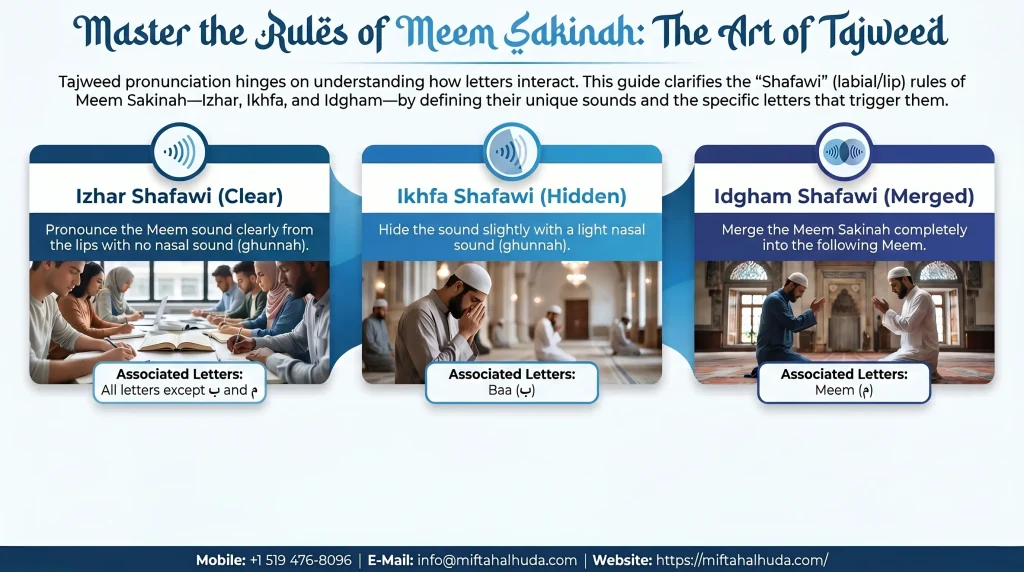
This comparison is where many students get their “aha!” moment.
Side-by-Side Comparison Table
| Rule | Meaning & Characteristics | Associated Letters |
| Izhar Shafawi | Clear lips, no ghunnah, full Meem sound. | All letters except (ب, م) |
| Ikhfa Shafawi | Hidden with a light nasal sound (ghunnah) | ب (Baa) |
| Idgham Shafawi | Merge completely into the next Meem. | م (Meem) |
Real Audio Differences You Can Feel
Imagine Izhar articulating distinctly on stage, Ikhfa whispering with a soft hum, and Idgham merging two sounds into a seamless note. Each has its own beauty when done right.
Step-by-Step Learning Path to Master Izhar Shafawi

You do not need talent; all you need is a decent, clear plan. That is precisely what Miftah Al-Huda Academy focuses on while teaching Tajweed rules to students such as Izhar Shafawi.
Give your child the gift of reading the Quran with clarity and love. Our 1-on-1 Tajweed & Arabic courses are built for English-speaking families, with flexible schedules, personalized lesson plans, and teachers who understand the needs of non-Arabic speakers. From Tajweed for kids to Arabic for the whole family, every session is tailored to your child’s pace and goals.
Enroll today and start building a foundation that lasts a lifetime.
Week-by-Week Practice Plan
Miftah Al-Huda Academy suggests this practical 4-week system that has helped hundreds of students rapidly learn the rule:
- Week 1: Focus on Rule Recognition and Identification. Students must identify instances of Izhar Shafawi in at least 20 ayahs per day, developing strong visual and auditory awareness of the rule.
- Week 2: Emphasize Articulation Technique and Muscle Memory. Practice accurate lip placement and phonemic precision with mirror work and frequent drills to internalize the proper articulation point.
- Week 3: Develop Applied Recitation in Context. Students recite whole surahs at a regulated pace, focusing on accurate application of Izhar Shafawi within a continuous textual flow.
- Week 4: Advance to fluency and integration. Gradually increase recitation speed while retaining rule correctness, aiming for seamless integration with other Tajweed rules and melodic patterns.
Daily Drills That Actually Work
Miftah Al-Huda Academy emphasizes short but steady practice. Spend five minutes per day repeating “مْ + different letters” combinations. Consider it as gym reps for your lips and tongue: simple, effective, and shockingly powerful.
Fun Ways to Teach It to Kids and Beginners
Miftah Al-Huda Academy makes learning enjoyable for young students and beginners. Turn the rule into an exciting game called the “Clear Lips Challenge!” Reward them every time they pronounce the Meem perfectly. Children often master Izhar Shafawi faster because they naturally enjoy making big, exaggerated lip movements.
Troubleshooting and Self-Assessment
Recording Yourself Like a Pro
One of the best habits encouraged by Miftah Al-Huda Academy is recording yourself regularly. Use your phone, recite a few verses, then listen back critically. Ask yourself: Did the Meem stay completely clear? Was there any unwanted nasal sound leaking in?
Integrating Izhar Shafawi into Daily Recitation
Miftah Al-Huda Academy suggests using this rule in your daily life. Apply it to your five daily prayers. Begin with shorter surahs and then progress to longer ones. With proper guidance and practice, the rule will eventually become automatic, without your conscious effort.
Conclusion
Mastering Izhar Shafawi is similar to learning to speak a language with a beautiful accent: little effort, big reward. When you understand this rule, you are not only correcting a pronunciation mistake. You are bringing brightness to your entire tilawah. Allah’s words begin to flow with a particular sparkle that melts hearts and heals the soul.
Miftah Al-Huda Academy is here to guide you through this path, providing straightforward guidance and proven steps.
“The Quran deserves our best effort, and your first step starts right here. Master Izhar Shafawi with expert guidance. Register now at Miftah Al-Huda Academy to book your Free Trial Lesson and let our instructors lead you toward a perfect recitation, verse by verse.”
Contact Us
- WhatsApp: +1 519 476-8096
- E-Mail: in**@**********da.com
- Facebook : https://surl.li/yqeyas
- Instagram:https://surl.li/smlfaq
- Youtube: https://surl.li/inbncd
- Tiktok:https://surl.li/ldzmww
Frequently Asked Questions
1. Can Izhar Shafawi occur within a single word, or does it only happen between two words?
It is possible in both! Izhar Shafawi, unlike other Meem Sakinah rules, can occur within a single word (e.g., أَنْعَمْتَ – An’amta) or between two different words (e.g., لَكُمْ دِينُكُمْ – Lakum Deenukum).
2.Why are the letters Waw (و) and Fa (ف) considered the most critical letters in this rule?
Tajweed scholars advise readers to continue with caution while dealing with Waw and Fa. Because the letter Fa has a similar articulation point to Meem, and Waw has the same articulation point (the lips), the tongue naturally wants to hide (Ikhfa) the Meem before them. Extra effort must be made to ensure that the Meem is totally clear here.
3. Why are the letters Ba (ب) and Meem (م) the only exceptions to this rule?
Because identity causes a Meem Saakinah and another Meem to merge completely (Idgham Shafawi). When it comes into contact with a Ba, it is hidden because they share the same lip articulation point. The remaining 26 letters do not share these similar behavioral characteristics, requiring plain clarity (Izhar).
4. What type of mistake is it if I accidentally blend or hide the Meem during Izhar Shafawi?
It’s classified as Lahn Khafiy (Hidden/Subtle Mistake). While it does not alter the Arabic word’s core lexical meaning, it does break the rules of beautiful recitation and perfect rhythm.
5. How can I control my breathing to ensure a clean Izhar Shafawi?
To pronounce the Meem, form a gentle, quick contact with your lips before moving on to the next letter. Avoid making a sudden pause or taking a breath between the Meem and the next letter because it creates an artificial break (Sakt).
Ready to Perfect Your Tajweed? Start with a Free Trial!
Reciting the Quran with clarity and beauty shouldn’t feel overwhelming. Now that you know how to avoid blending sounds during Izhar Shafawi, take the next step in perfecting your recitation. At Miftah Alhuda, our expert native tutors make mastering Tajweed rules smooth and engaging.
Claim your Free Trial Class today and get personalized feedback on your Izhar Shafawi and overall Quranic pronunciation—100% free with no commitment!