

You’ve probably looked at Arabic script, like alif ba ta sa in Arabic at least once and felt like it was completely impenetrable. Not difficult the way a new grammar rule is difficult, but more like standing in front of a locked door with no obvious handle. That moment, for most Western beginners, happens right at the start: the letters themselves.
What makes it harder is that the resources available are all over the place. Some apps start you with games. Some courses throw 28 letters at you in week one. Some YouTube videos sound fine but never actually explain why the same letter looks different in three different words. Nobody explains the logic first, and without that logic, the alphabet feels like rote memorization of completely arbitrary shapes. Which, for most people, doesn’t stick.
This article walks you through the first four letters of the Arabic alphabet, alif, ba, ta, and sa, in a way that actually builds understanding rather than just recognition. By the time you finish reading, you’ll know what makes these letters work, how to approach them without confusion, and exactly what to do next.
Why Starting With Alif Ba Ta Sa Is the Right Move?
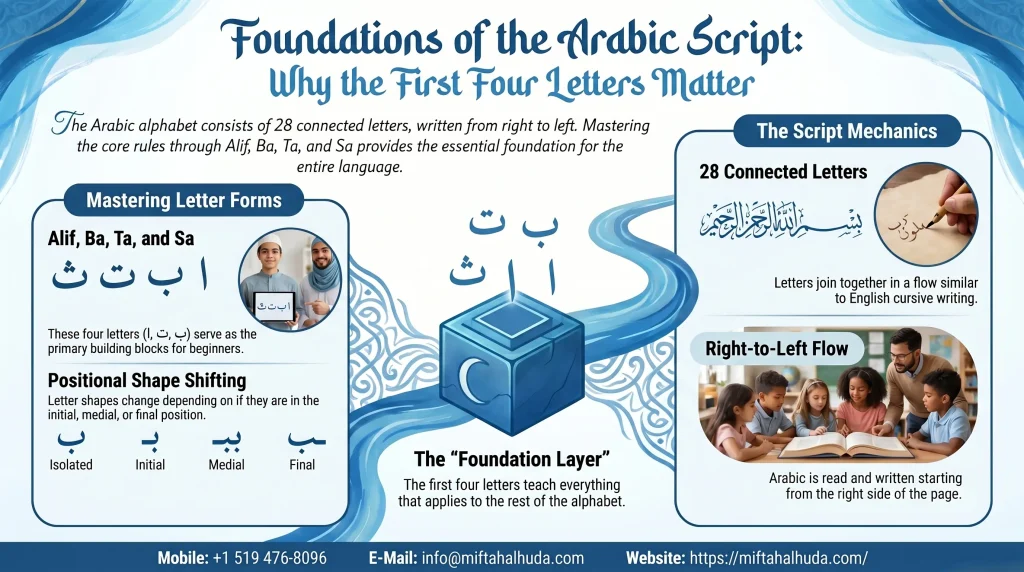
The Arabic alphabet has 28 letters. That number tends to stop people before they even begin, honestly. But the first four letters, alif (ا), ba (ب), ta (ت), and sa (ث), aren’t just a random starting point. They teach you everything that applies to the rest of the alphabet, which means the learning that happens here carries further than most beginners expect.
The Arabic alphabet is read from right to left. Arabic is also called a connected script because of the joining nature of the majority of the letters; the letters connect to each other, just as letters do in English writing.
Moreover, there are a lot of letters whose shapes change depending on their position in the word, whether they are initial, medial, or final letters. However, it will be easy for you to understand the concept when we look at letters like alif, ba, ta, and sa.
Think of these four letters as the foundation layer. They’re not just the first thing to memorize. They’re the first thing to understand.
The alif ba ta sa in Arabic Letters Up Close
Alif (ا): The One That Stands Alone
Alif is a single vertical stroke. In terms of shape, it’s the simplest letter in the Arabic alphabet, but it behaves in a way that surprises most beginners: it doesn’t connect to the letter that comes after it.
Every other letter in a word reaches forward and backward. Alif only reaches back, which means it always creates a small break in the script flow on its right side.
Pronunciation-wise, alif most commonly represents a long “aa” vowel sound, though it can also carry a glottal stop (a catch in the throat, like the sound between the syllables in “uh-oh”).
In beginner texts, it’s almost always marked with a diacritic (a small symbol above or below it) that tells you exactly what sound to make. When those symbols are present, alif becomes much more readable than it first appears.
Ba (ب): The First Connector
Ba is shaped like a shallow dish with a single dot below it. The dot placement is what distinguishes ba from ta and sa, which share the same dish-shaped body.
This is one of the more counterintuitive aspects of Arabic script for new learners: several letters share a base form and are distinguished only by the number and placement of dots. Ba has one dot below. Ta has two dots above. Sa has three dots above.
The sound itself is familiar, it’s the same “b” as in the English word “back.” No surprises there. What takes practice is writing the letter in its connected forms, where the dish shape flattens and elongates to join the letters around it.
Ta (ت): Almost the Same, Differently Dotted
Ta shares its base form with ba completely. Same shallow dish shape. Same general proportions. The only difference is that ta carries two dots above the body instead of one dot below. In terms of sound, ta is a clean “t,” very close to the English “t” in “tell.”
Many beginners, when they first see ba and ta side by side, wonder how they’ll ever tell the letters apart quickly when reading. The short answer is: the dots become automatic faster than you’d expect.
After a few sessions of active reading practice, the dot pattern registers before the mind consciously processes it. The same way English readers don’t pause to check whether an “i” and an “l” are different letters, the brain just knows.
Sa (ث): The Letter That English Doesn’t Have
Sa is where most Western learners slow down, and for a reasonable reason. Its sound, the “th” in “think,” not the “th” in “this”, doesn’t exist as a letter in English. It exists as a sound, but there’s no single character for it.
Sa carries three dots above the same dish-shaped base shared by ba and ta. The sound requires placing the tip of the tongue lightly between the upper and lower front teeth and pushing air through.
It’s actually a sound English speakers produce constantly (in words like “thin,” “three,” and “thunder”), but isolating it and connecting it to a written symbol takes a bit of focused practice.
The Dot System and Letter Positions
This is something that you should learn from the beginning: most of the 28 Arabic letters can be divided into groups that have the same basic form. It is through the dots (one, two, or three; either above or below) that members of each group are differentiated.
Ba, ta, and sa form one such family. If you learn the base shape and the dot pattern together, rather than treating each letter as a completely separate design, the alphabet starts to feel much more manageable.
The position system matters too. In Arabic, each letter has up to four forms: isolated (standing alone), initial (start of a word), medial (middle of a word), and final (end of a word).
Alif, which doesn’t connect forward, actually has fewer form variations than most letters. Ba, ta, and sa all follow a consistent pattern as they move through positions, the dish shape stays recognizable; the letter’s “tail” and connection points change. Seeing this as a pattern rather than memorizing four separate shapes per letter saves significant time.
How to Actually Build the Habit of Reading The Alif Ba Ta Sa In Arabic?

Learning to recognize alif ba ta sa in Arabic is one thing. Building the ability to actually read them on sight, without pausing is another, and the gap between those two stages is where most self-study attempts stall.
A few approaches that genuinely work:
Write each letter in all four of its positional forms before you try to read it.
Muscle memory through the act of writing will strengthen the visual recognition process in ways passive observation cannot achieve. There is no need for it to be in flawless Arabic calligraphy; all that is needed is a notebook and a pen.
Focus on letter clusters rather than just individual letters.
Find an easy book such as the Noorani Qaida that was written specifically for such practice and begin reading short syllables such as ba, short vowel sound; ta, short vowel sound and so forth.
Use audio.
The sa sound in particular is hard to lock in without hearing it repeatedly from a native speaker. Find recordings, YouTube channels that teach alif ba ta sa pronunciation, or a tutor who can correct the tongue position, and match your own pronunciation to what you hear.
Getting the sound wrong early tends to stick, and fixing it later is harder than getting it right in the first few weeks.
One thing a lot of learners do, which slows them down more than they realize: they keep cycling through the same four letters without ever moving forward into simple words.
The letters start to feel known but not usable. The better move is to push into short words that include these letters as soon as the shapes feel familiar, even if reading those words feels slow and effortful at first. Using the letters in real words is what cements them.
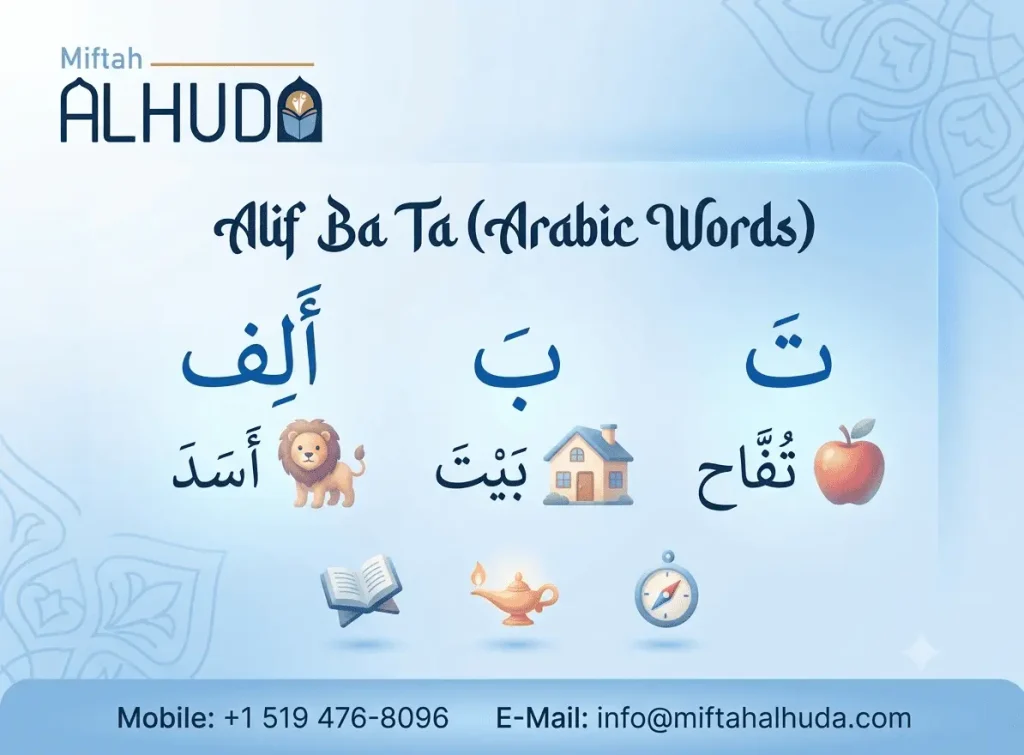
alif ba ta arabic words
The Part Nobody Thinks About Until Month Two
There’s something that happens with Arabic beginners around the four or five week mark that’s worth mentioning here, because it catches a lot of people off guard. The letters feel known, you recognize alif, ba, ta, and sa without hesitation, but reading still feels painfully slow.
A single short sentence takes thirty seconds. That gap between knowing the letters and actually reading fluidly is real, and it’s longer than most resources suggest it will be.
This isn’t failure. It’s just a stage. Reading speed in any new script develops through volume, hours of low-level text exposure, not just alphabet practice. The letters themselves are the first gate, and this article has walked you through that gate.
What comes next is simpler in concept but requires more patience in practice: reading short texts slowly and consistently, day after day, until the letters stop needing to be decoded and start being seen.
The learners who get through that stage are, almost without exception, the ones who kept going during the slow part.
If you’re looking for a structured course that takes beginners from the Arabic alphabet all the way through to confident reading, Arabic for Kids Course at Miftah Al Huda offers guided, teacher-led lessons designed for learners starting from zero. Start today.
Start Today with a Free Trial! Enjoy full access to our courses for free with no commitment.
Contact Us
WhatsApp: +1 519 476-8096
E-Mail: in**@**********da.com
Facebook: https://surl.li/yqeyas
Instagram: https://surl.li/smlfaq
Youtube: https://surl.li/inbncd
Tiktok: https://surl.li/ldzmww
Frequently Asked Questions
1. How many letters does the Arabic alphabet contain?
The number of Arabic alphabet letters equals 28. First letters are alif, ba, ta, sa; they are used to acquaint learners with the essential features (dots, letter position, script direction from right to left) which can be observed in all following letters.
2. Is it difficult to learn alif ba ta sa if I have no experience studying Arabic?
The problem is not in the pronunciation; only sa may require some practice. As for ba, ta, the most challenging aspect is writing because these letters use different directions and script which takes time to get used to.
3. Why do ba, ta, and sa letters look the same?
Ba, ta, and sa belong to the same group of letters, which makes them look alike; what differs is the number of dots – ba has one dot underneath, ta has two dots above, sa has three dots above. Dotting system is a specific feature of Arabic letters, rather than their deficiency.
4. Should I learn to write the letters or just read them?
I would recommend doing both but first learning to write because it will reinforce the letter shapes much more effectively. You don’t even need very good handwriting; any form of writing is sufficient to help you recognize letters.
5. How long does it take to get comfortable reading alif ba ta sa?
For most people who practice consistently, it will probably take up to two weeks. Developing your reading skills and being able to read smoothly and without stopping at each letter is likely to take about three weeks of reading practice.
6. Can children learn alif ba ta sa the same way adults do?
The key concepts are the same but children are likely to benefit more from audio-visual methods such as songs and games. While adults tend to respond well to explanation-based lessons that involve writing and reading, the order (sequence, shape, sound, writing, reading words) can be applied to either age group.