
Imagine waking up to the sound of collective prayers sound through your neighborhood, the smell of fresh grilled meat filling the air, and a profound sensation of happiness combined with kindness. Eid al-Adha is celebrated by millions of Muslims worldwide. But have you ever considered the exact meaning of Eid al-Adha in Islam? Why is this celebration still touching hearts across different nations and continents more than 1,400 years later?
In this article, we’ll take a look at the deep story, powerful rituals, and life-changing lessons behind Eid al-Adha. If you’re a Muslim looking to strengthen your faith or simply curious about this major Islamic festival, you’ve come to the right place.
At Miftah Al-Huda Academy, we are dedicated to making these timeless teachings available and meaningful to everyone. Let’s go in together.
The Heart-Wrenching Test of Prophet Ibrahim: A Father’s Ultimate Act of Obedience
The entire Eid al-Adha celebration centered around a single great spiritual story. In a dream, Prophet Ibrahim (peace be upon him) received a command from Allah to sacrifice his beloved son Ismail.
Think about that for a moment. This was more than just giving up money or time; it was asking a father to give up what he valued the most. However, Ibrahim did not hesitate. He was ready to go through with the entire trust. At the last moment, Allah replaced Ismail with a ram, accepting the father and son’s submission.
This is not only ancient history. It is the basis for the meaning of Eid al-Adha in Islam: full surrender to God’s will, even when it is extremely difficult.
How One Family’s Sacrifice Shaped Islamic Tradition?
Every year, Muslims recall this tremendous trial during the month of Dhul-Hijjah. The sacrifice teaches us that true faith requires action, not just words.
This great act of obedience tells us that Allah never loads a soul beyond its capacity, and that every suffering can be transformed into a blessing when combined with sincere faith in Him.
Submission Over Everything: What True Tawhid Means in Action
Eid al-Adha focuses on Tawhid, or God’s oneness. By volunteering to sacrifice his son, Prophet Ibrahim proved that nothing, not even family, should come before Allah.
This is a hurdle in our busy life. Are we really putting God first? Or do our occupations, ambitions, and pleasures occasionally take priority?? The meaning of Eid al-Adha in Islam calls us to sincere devotion.
Eid al-Adha vs. Eid al-Fitr: Understanding the Two Eids
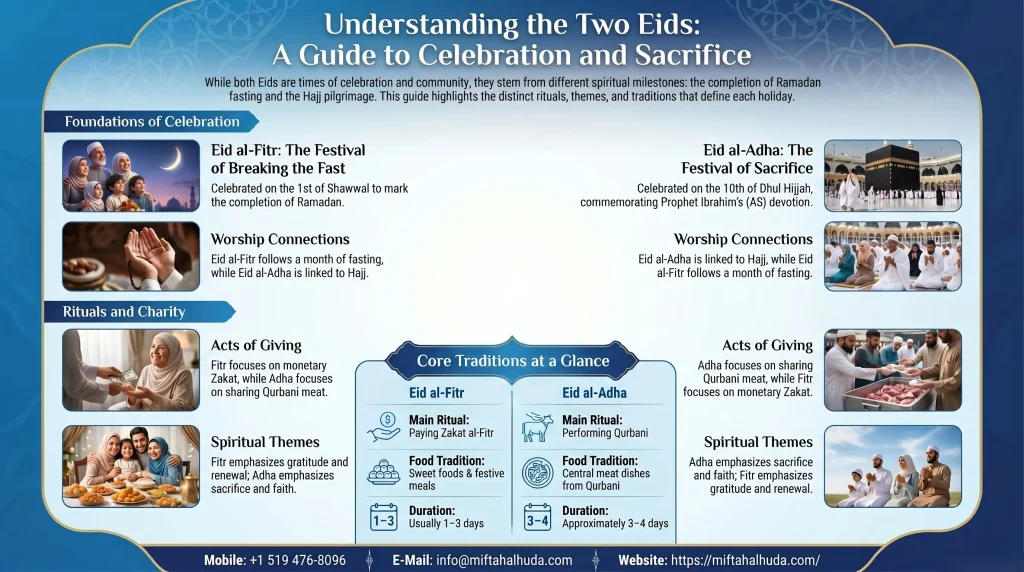
| Aspect | Eid al-Adha | Eid al-Fitr |
| Meaning | Known as the Festival of Sacrifice | Known as the Festival of Breaking the Fast |
| Main Purpose | Commemorates the sacrifice and obedience of Prophet Ibrahim (AS) | Celebrates the completion of Ramadan fasting |
| Islamic Month | Celebrated on the 10th of Dhul Hijjah | Celebrated on the 1st of Shawwal |
| Connection to Worship | Linked to Hajj pilgrimage and Qurbani | Linked to fasting during Ramadan |
| Main Ritual | Performing Qurbani (animal sacrifice) | Paying Zakat al-Fitr before Eid prayer |
| Charity Focus | Sharing Qurbani meat with the poor and needy | Helping the poor through Zakat al-Fitr |
| Spiritual Theme | Sacrifice, obedience, faith, and devotion | Gratitude, self-discipline, and spiritual renewal |
| Duration | Lasts about 3–4 days | Usually lasts 1–3 days |
| Food Tradition | Meat dishes are central due to Qurbani | Sweet foods and festive meals are common |
How Muslims Celebrate Eid al-Adha?
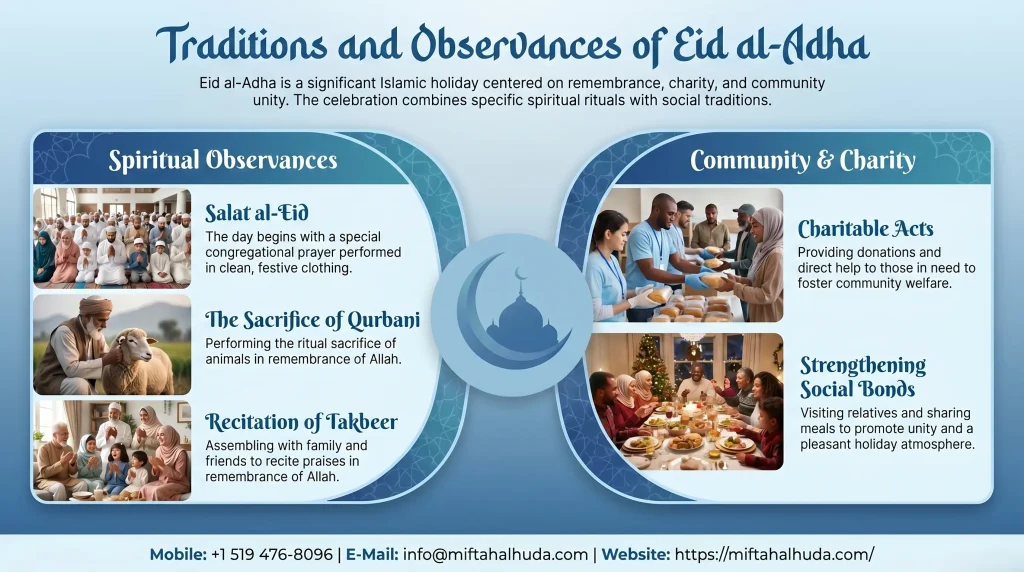
The day opens with Salat al-Eid, a special congregational prayer. Muslims dress cleanly, assemble with family and friends, and recite Takbeer in remembrance of Allah.
Common Eid traditions include:
- Performing Eid prayers.
- The sacrifice of Qurbani animals.
- visiting relatives.
- Charitable donations.
- Sharing meals.
- Helping those in need.
In many cultures, Eid al-Adha is celebrated as a pleasant community holiday marked by charity and unity.
The Emotional Moment of Qurbani: Choosing, Slaughtering, and Sharing the Sacrifice
The act of Qurbani is profoundly emotional. Families carefully choose healthy animals, say Allah’s name when slaughtering, then divide the meat into three parts.
It is not about the meat itself. It is about being generous, empathetic, and remembering others who are less fortunate. This practical sharing represents the actual meaning of Eid al-Adha in Islam.
Unity in Diversity: How Eid al-Adha Erases Borders and Social Divides?
On Eid morning, rich and poor, Arab and non-Arab, black and white, stand together in prayer. The festival eloquently illustrates how faith can transcend nationality, wealth, and prestige.
In today’s divided world, this message feels more meaningful than ever.
Why Eid al-Adha Matters More Than Ever in a Divided World?
In times of selfishness and divisiveness, the lessons of sacrifice, generosity, and solidarity are effective antidotes. Eid al-Adha teaches us that true happiness comes from giving, not simply receiving.
It also emphasizes the necessity of a massive charity, since countless tons of meat are provided to people in need.
Common Misconceptions About Eid al-Adha
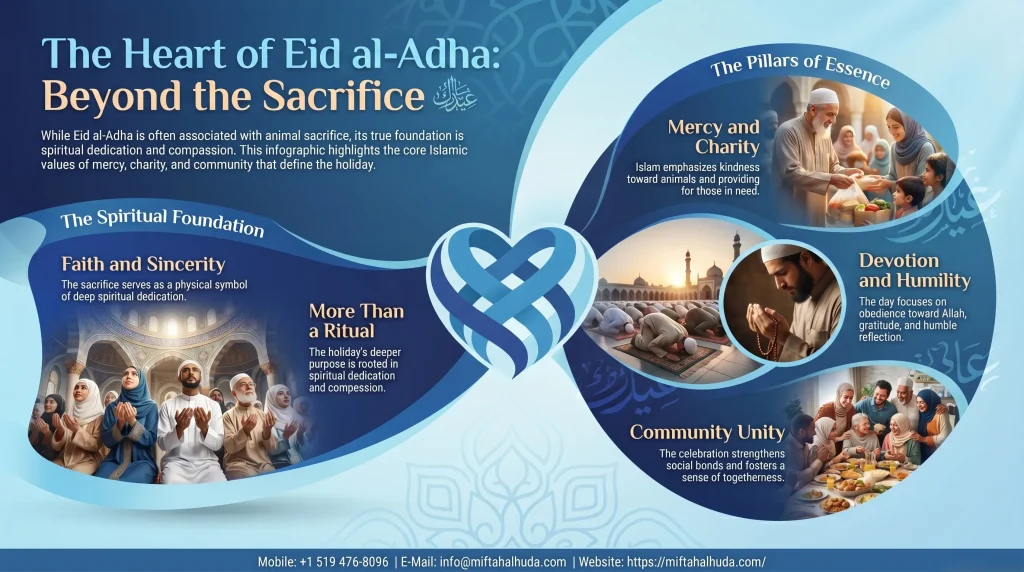
Some people falsely believe that Eid al-Adha is only about animal sacrifice. In actuality, the deeper reason is spiritual dedication and compassion.
Islam emphasizes:
- Mercy to animals.
- Charity for the poor.
- Obedience towards Allah.
- Community unity.
- Gratitude and humility.
The sacrifice itself symbolizes faith and sincerity.
Carrying the Spirit Forward
Eid al-Adha is not intended to be a one-day event. The actual challenge is to maintain its spirit throughout the year to be more giving, obedient, and related to our faith.
Conclusion
The meaning of Eid al-Adha in Islam extends far beyond feasts and celebrations. It serves as a powerful annual reminder to value religion, sacrifice, family, and community. We reconnect with our faith’s essential principles by reflecting on Prophet Ibrahim’s (AS) story, honoring Hajar’s strength, and performing Qurbani with sincerity.
This Eid, we invite you to not only enjoy the festivities but also to reflect seriously on what you are prepared to give for Allah and something bigger. The answer may change your life.
At Miftah Al-Huda Academy, we seek to keep these timeless values alive by providing authentic Islamic knowledge and assisting Muslims in living the true spirit of Eid al-Adha throughout the year, not only during the festival.
May Allah recognize our efforts, enhance our faith, and deliver peace, unity, and blessings to the entire Ummah.
Eid Mubarak!
Take Your Faith to the Next Level This Eid
While the joy of Eid al-Adha fills our homes and hearts, the real question remains: How can we carry its beautiful lessons of sacrifice, obedience, and sincerity into our daily lives?
Miftah Al-Huda Academy is here to help you do exactly that. Through clear, authentic, and practical Islamic education, we help you understand and live your deen with deeper conviction.
Start Today with a Free Trial ! Enjoy full access to our courses for free with no commitment.
Contact Us
- WhatsApp: +1 519 476-8096
- E-Mail: in**@**********da.com
- Facebook : https://surl.li/yqeyas
- Instagram:https://surl.li/smlfaq
- Youtube: https://surl.li/inbncd
- Tiktok:https://surl.li/ldzmww
Frequently Asked Questions About the Meaning of Eid al-Adha in Islam
1. Can Eid al-Adha be celebrated without performing Qurbani?
Yes, Muslims can celebrate Eid al-Adha even if they can’t pay to do Qurbani.
2. What should Muslims say to greet each other on Eid al-Adha?
“Eid Mubarak,” or “Blessed Eid,” is a common greeting.
3. Is Qurbani mandatory for every Muslim?
Qurbani is only needed for financially capable Muslims, according to Islamic rules.
4. Can one Qurbani animal be shared among multiple people?
Yes, larger animals, such as cows, can be shared among several people, according to Islamic principles.
5. How does Eid al-Adha promote unity among Muslims?
It unites communities together via prayer, shared meals, charity, and communal religious celebrations.
6. What are the best acts of worship during Eid al-Adha?
Prayer, Takbeer, charity, Qurbani, Quran recital, and family bonding are among the most popular acts.