

Ikhfa Shafawi is one of the easiest Tajweed rules, however it is commonly misunderstood. It focuses on a single letter, one distinct sound, and a highly subtle process. Sounds simple, right? That is exactly where the catch is. The actual expertise is not in knowing a rule, but in striking that precise, delicate balance between pronunciation and melody.
In this article, Miftah Al-Huda Academy will give you the key to unlocking this rule, breaking it down with simple examples so you can make quick progress toward your performance goals.
Ikhfa Shafawi: The Hidden Whisper Between Silence and Sound

Ikhfa Shafawi is a delicate phonetic rule in Tajweed science that only applies to one letter, Ba.
The Rule
When the letter Ba follows a Meem Sakinah, the reciter conceals the Meem and sustains a resonant Ghunnah (nasal sound) for two counts during the transition.
Feel It in Your Mouth: The Exact Lip Position That Creates Magic
Getting the physical feeling correct is the quickest method to master Ikhfa Shafawi. Here’s how to position your mouth and lips for optimal performance:
- Keep your lips gently closed just enough for a soft, natural touch without using force.
- Don’t press too hard; excessive pressure transforms the sound into a full Meem instead of the desired concealment.
- Allow the sound to flow naturally into your nose, relax your jaw, and let light Ghunnah resonate behind your nose while your lips remain gently connected.
- Imagine you’re humming quietly as you prepare to pronounce “b”. This relaxed position produces the smooth, elegant sound you are seeking for.
Pro-Tip: Try whispering the Meem instead of speaking it out. It’s present but not fully obvious, which helps you achieve the perfect “Hidden” sound.*
Step-by-Step Pronunciation Guide
Take it slowly and repeat these four simple steps, until they become second nature:
- Identify the Meem Sakinah: Look for the Meem with a sukoon. This is your start sign.
- Check to see whether Ba is next: Immediately scan the letter following. Seeing the letter Ba (ب) signals the need for Ikhfa Shafawi.
- Apply light Ghunnah: Bring your lips together for a pleasant touch and vibrate a soft nasal hum for two counts.
- Don’t completely pronounce the Meem: Keep the Meem hidden and flow right into the Ba without making a strong “M” sound.
Practice this process slowly at first. With enough repetition, your mouth will recognize the pattern.
Ghunnah Secrets: Crafting That Sweet Nasal Resonance Without Force
The nasal hum (Ghunnah) should feel like a gentle vibration behind your nose, not forced or shouted. Keep the intensity modest and pleasant so that it supports rather than overwhelms the recitation. This regulated resonance is what gives Ikhfa Shafawi its distinctive beauty.
Avoid These 7 Deadly Mistakes That Kill the Beauty of Ikhfa Shafawi! (And How to Fix Them?)
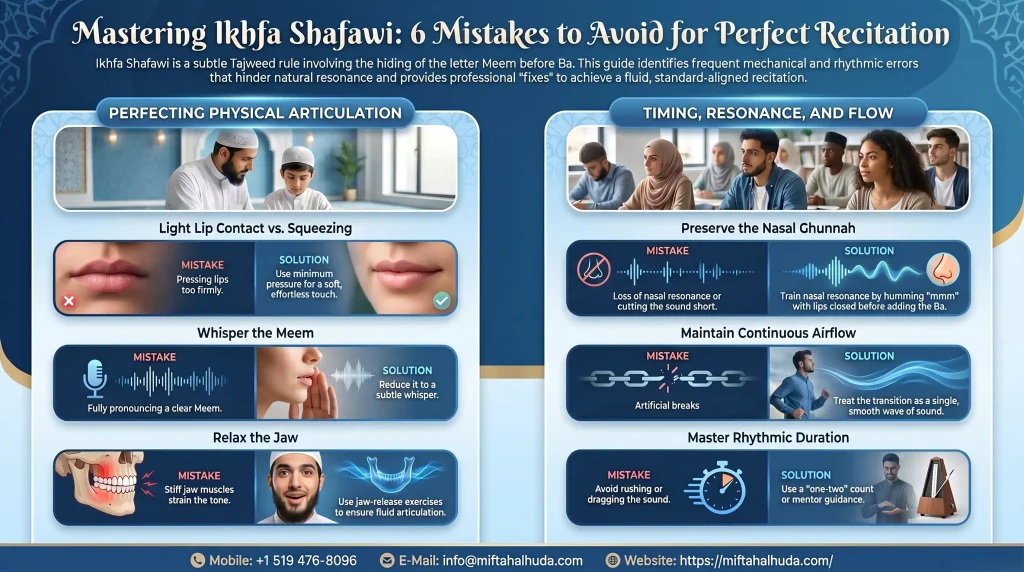
Break the cycle of recitation mistakes with Miftah Al-Huda Academy. We’ve mapped the 7 most frequent Ikhfa Shafawi errors and the ultimate roadmap to help you overcome them forever.
- Pressing the Lips Too Firmly: Squeezing the lips together with too much pressure, causing the subtle hiding to sound harsh and strong.
Solution: Use minimum pressure during lip contact; articulation should be soft and effortless. We recommend practicing in front of a mirror to ensure the touch is light, fluid, and natural.
- Omitting the Nasal Sound: By removing the Ghunnah from the execution, the rule loses its resonant charm.
Solution: Humming “mmm” with your lips lightly closed before adding the Ba will help you train your nasal resonance.
- Holding Ghunnah for Incorrect Durations: Failing to pace the sound appropriately, resulting in it being either excessively hurried or awkwardly dragged.
Solution: While a simple ‘one-two’ count is a useful starting point, the guidance of a mentor is extremely useful. Our academy’s instructors perfect your rhythmic timing and align your Ghunnah duration with precise Tajweed standards.
- Inserting Unnecessary Pauses: Creating an artificial break between the Meem and the Ba rather than preserving a smooth transition.
Solution: Put your focus on continuous airflow. Consider it as a single smooth wave rather than two distinct letters.
- Fully Pronouncing the Meem: uttering a clear, standard Meem, which fully negates the objective of concealing it.
Solution: Reduce the Meem until it is a whisper. Record and compare your voice to that of professional reciters.
- Tensing the Jaw: Keeping the jaw muscles stiff and inflexible, which produces a strained and unnatural acoustic tone.
Solution: Relax your jaw deliberately before starting. Our instructors will train you on specific jaw-release exercises designed to eliminate tension and ensure a natural, fluid articulation during your recitation.
- Rushing the Transition: Speeding through the letters without giving the rule its proper, rhythmic time.
Solution: Start slowly and gradually increase speed until the movement feels natural.
Inside Words or Between Them? Mastering Both Worlds Seamlessly
The same light-touch technique applies whether the Meem and Ba are inside a single word or span two words. This consistency promotes application across various Quranic structures and decreases mental stress during recitation.
Easy Quran Examples of Ikhfa Shafawi
| Quranic Verse | Surah | Ikhfa Shafawi Position | Simple Explanation |
| ﴿سَلْهُم أَيُّهُم بِـذَلِكَ زَعِيمٌ﴾ | Surah Al-Qalam (40) | أَيُّهُم بِـذَلِكَ | The Meem Sakinah in “أَيُّهُم” comes before the letter Ba (ب), so the Meem is pronounced with a light hidden sound and ghunnah. |
| ﴿فَإِذَا هُم بِـالسَّاهِرَةِ﴾ | Surah An-Nazi’at (14) | هُم بِـالسَّاهِرَةِ | The Meem in “هُم” is followed by the letter Ba (ب), so the Meem is hidden slightly with a soft nasal sound. |
| ﴿وَمَا صَاحِبُكُم بِـمَجْنُونٍ﴾ | Surah At-Takwir (22) | صَاحِبُكُم بِـمَجْنُونٍ | The Meem in “ صَاحِبُكُم” comes before Ba (ب), so Ikhfa Shafawi is applied with light ghunnah. |
| ﴿ثُمَّ يُقَالُ هَذَا الَّذِي كُنتُم بِـهِ تُكَذِّبُونَ﴾ | Surah Al-Mutaffifin (17) | كُنتُم بِـهِ | The Meem in “كُنتُم” is followed by the letter Ba (ب), causing the Meem sound to be partially hidden. |
| ﴿فَبَشِّرْهُم بـِعَذَابٍ أَلِيمٍ﴾ | Surah Al-Inshiqaq (24) | فَبَشِّرْهُم بـِعَذَابٍ | The Meem in “فَبَشِّرْهُم” appears before Ba (ب), so the Meem is recited with a hidden sound and gentle ghunnah. |
| ﴿لَّسْتَ عَلَيْهِم بِـمُصَيْطِرٍ﴾ | Surah Al-Ghashiyah (22) | عَلَيْهِم بِـمُصَيْطِرٍ | The Meem in “ عَلَيْهِم” comes before the letter Ba (ب), so the Meem is hidden slightly during recitation. |
| ﴿فَدَمْدَمَ عَلَيْهِمْ رَبُّهُم بِـذَنبِهِمْ فَسَوَّاهَا﴾ | Surah Ash-Shams (14) | رَبُّهُم بِـذَنبِهِمْ | The Meem in “رَبُّهُم” is followed by Ba (ب), therefore Ikhfa Shafawi is applied with nasal ghunnah. |
| ﴿أَلَمْ يَعْلَم بِـأَنَّ اللَّهَ يَرَى﴾ | Surah Al-‘Alaq (14) | يَعْلَم بِـأَنَّ | The Meem in “يَعْلَم” comes before the letter Ba (ب), so the Meem is pronounced in a hidden manner with ghunnah. |
From Mechanical Practice to Artful Fluency

- Start with isolated syllable drills like ‘mim-ba,’ repeating them slowly while maintaining proper lip contact. Gradually add full phrases, then complete verses. Regular brief sessions are more effective than occasional extended ones at developing automatic habits.
- To execute well, three factors must work together: accurate lip position, controlled nasal resonance, and controlled airflow. When these factors come together, the rule feels artistic rather than mechanical.
- Learners whose native languages lack similar sounds may exaggerate the Meem or ignore nasal vibration. Focused listening to professional reciters combined with slow-motion repetition frequently eliminates these difficulties within weeks.
The Silent Grace of Recitation
Ikhfa Shafawi is the art of “gentle touch.” When the Meem meets the Ba, this transition creates more than a rule; it brings the lips together in a soft, seamless meeting without any pressure. This fine balance, combined with a resonant Ghunnah, elevates your recitation to a heartfelt melody, adding depth to your Salah and Taraweeh.
Miftah Al-Huda Academy transforms technical details into effortless skills. Mastery begins with a single, guided step towards vocal excellence.
Begin Your Transformation with Miftah Al-Huda
At Miftah Al-Huda Academy, we believe Tajweed should be felt as much as it is studied. Our expert tutors provide the structured guidance needed to turn complex rules like the delicate Ikhfa Shafawi into second nature, helping you recite with newfound ease and confidence.
Your path to a more beautiful recitation is just a click away.
[Sign up for your FREE Trial today and let your journey begin!]
Contact Us
- WhatsApp: +1 519 476-8096
- E-Mail: in**@**********da.com
- Facebook : https://surl.li/yqeyas
- Instagram:https://surl.li/smlfaq
- Youtube: https://surl.li/inbncd
- Tiktok:https://surl.li/ldzmww
Frequently Asked Questions
1. Does completely hiding the Meem sound change the rule’s essence compared to partially concealing it?
If the Meem disappears completely, the pronunciation becomes incorrect. Ikhfa Shafawi requires only partial concealment, not complete removal. The listener should still notice the Meem sound lightly with ghunnah.
2. Does your recitation speed change the way you pronounce Ikhfa Shafawi?
Yes. Slow recitation makes the ghunnah clearer and easier to notice. Even in faster recitation, the reciter maintains the rule, applying it with greater speed and smoothness. Balance is essential in both styles.
3. What are the best Surahs to practice Ikhfa Shafawi for beginners?
For beginners, Surah Al-Fil , followed by Surah Al-Alaq and Al-Ghashiyah. These short chapters offer clear examples that help you master the “soft lip touch” and nasal resonance effortlessly.
4. Does Ikhfa Shafawi require stopping the airflow completely?
No. The airflow through the nose should be gentle during the ghunnah. Completely stopping the airflow can make the recitation sound fake.
5. What is the biggest sign that I am applying Ikhfa Shafawi correctly?
Your Meem sound will be soft and partially hidden, whereas the ghunnah will be audible and smooth before the Ba letter.