

You enter into your first class of Arabic language, and your teacher draws four shapes on the board: ا ب ت ث. She informs you that these are the first four letters.
Well, seems easy, doesn’t it? Then, your teacher asks you to recite alif ba ta sa, and you attempt to imitate the alif ba ta sa pronunciation in Arabic; but the final letter does not come out quite right. You know what I am talking about, don’t you?
This is typical for most students, who expect learning Arabic alphabets similar to learning the alphabets of any other language, seeing, hearing, and then pronouncing. However, here is the catch – pronouncing certain letters, such as Sa (ث), requires some specific oral position, which English-speaking individuals lack as their reference. This is not an issue of inability or unwillingness to learn. This is something no one ever bothered telling you about before.
This guide on the alif ba ta sa pronunciation in Arabic walks through each of the four letters and that Arabic alphabet as a whole with the kind of physical, step-by-step pronunciation breakdown that most beginner resources skip.
By the end, you won’t just know what the letters look like. You’ll know exactly what your mouth should be doing when you say them.
What The Alif Ba Ta Sa Pronunciation in Arabic Actually Sound Like?
Before getting into each letter individually, it helps to understand what kind of sounds Arabic uses. Arabic is a consonant-heavy language, and its alphabet is technically called an abjad, meaning the letters represent consonants rather than full syllables.
Short vowel sounds (the “ah,” “ih,” and “uh” sounds) are added via small marks written above or below the letters, not by separate letters themselves. That’s why written Arabic can look dense to a newcomer: a lot of the vowel information is implied rather than shown.
With that in mind, the first four letters of Arabic give you a useful preview of how the whole system works.
Alif (ا): The Long “Aa” Sound
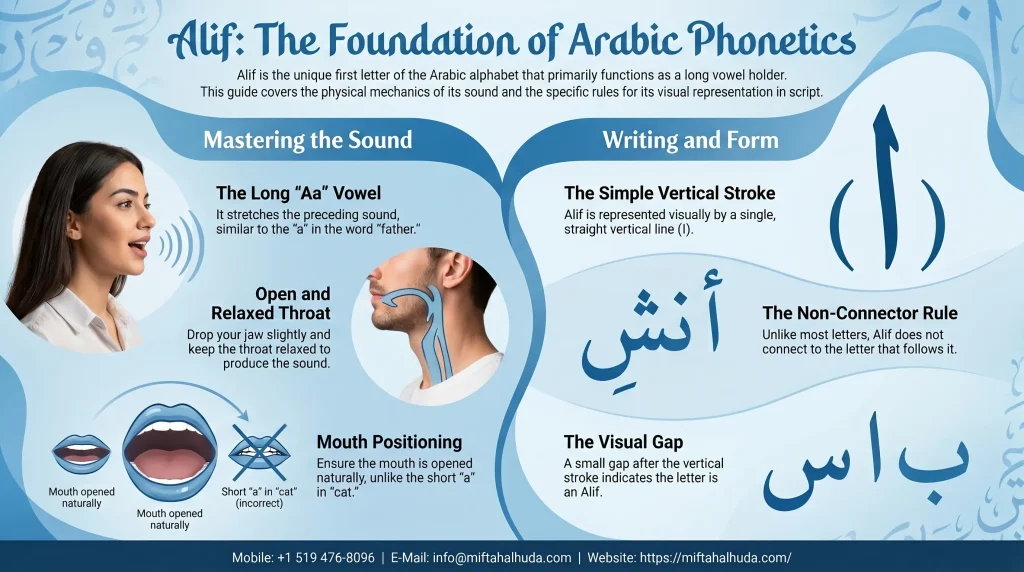
Alif is the first letter and, honestly, the most unusual one. It doesn’t function exactly like a consonant. In most beginner contexts, Alif acts as a vowel holder or a lengthening marker, stretching the “aa” sound that precedes it. Think of the “a” in “father”, not the short clipped “a” in “cat,” and not quite the “ay” in “day.”
It is located right in the middle. Your mouth will be opened naturally, while your jaw will be dropped slightly, and you will produce this sound using your throat which must remain open and relaxed. Alif is represented by a simple vertical stroke (ا), which, compared to other letters of Arabic alphabet, does not connect to the next letter. This means that any little gap appearing at the end of a vertical stroke during writing indicates Alif.
Ba (ب): The Sound “B”
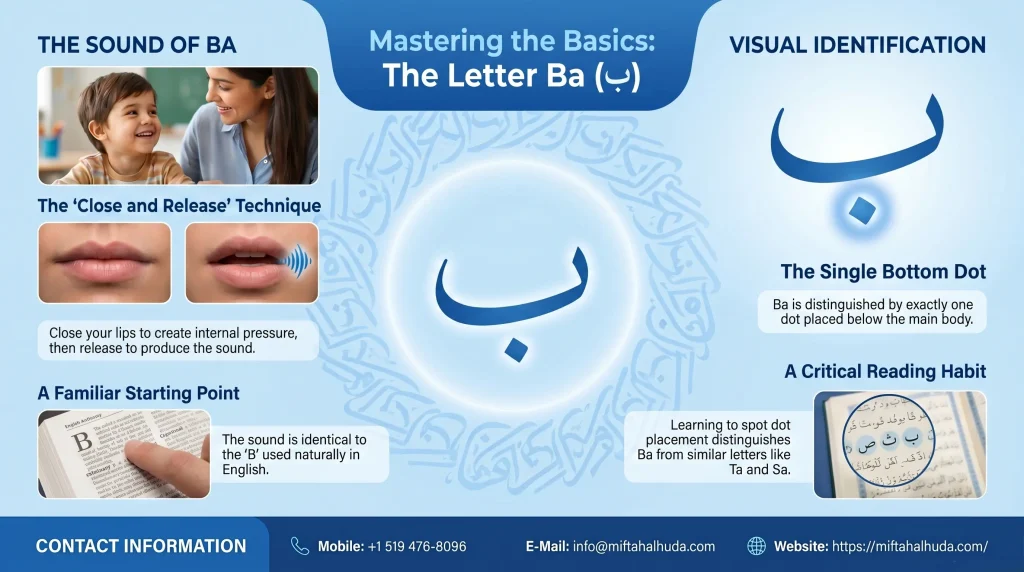
This letter is the easiest one among those four, since this sound is familiar to us and we can use it naturally. Close your lips and create some internal pressure, then release it – this is Ba.
The written form has a distinctive single dot placed below the body of the letter, which matters, because Ta and Sa look almost identical to Ba, with the only difference being dot placement. Recognizing dots quickly becomes a critical reading skill in Arabic, and Ba is where that habit starts.
Ta (ت): The Soft “T” Sound
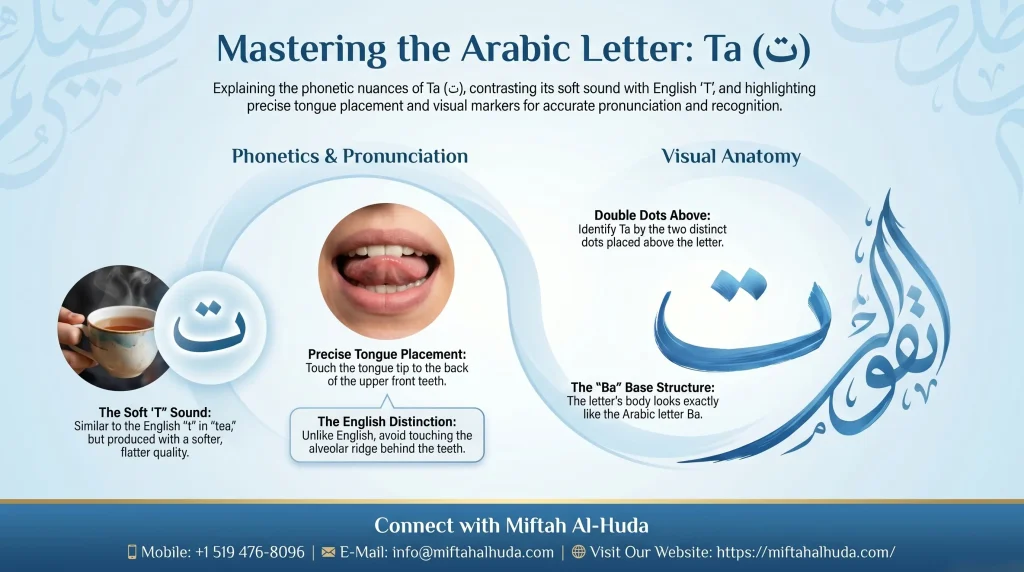
Ta is pronounced like the “t” in “tea” or “top,” but with a subtle physical difference from the English version. In English, the tongue usually touches the area just behind the upper front teeth (called the alveolar ridge).
In Arabic, the tongue tip touches the back of the upper front teeth themselves, which produces a slightly softer, flatter sound. It’s a small distinction, and many beginners produce a good-enough Ta without thinking about it, but if a native speaker keeps gently correcting your “t” sounds, this is likely why. Ta looks exactly like Ba but with two dots placed above the letter instead of below.
Sa (ث): The “Th” Sound That Surprises Everyone
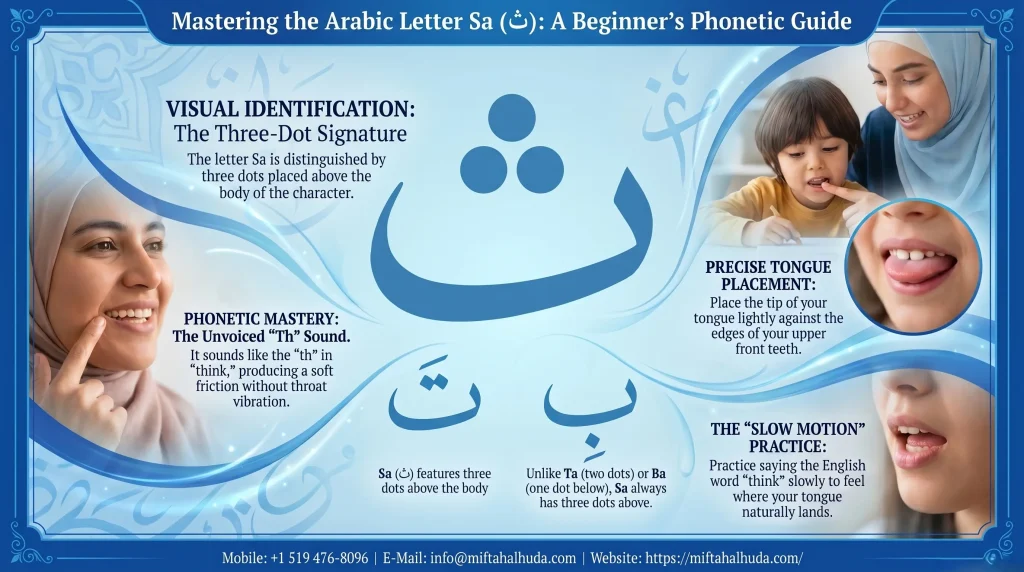
This is where most beginners need to slow down. Sa (ث) is pronounced like the “th” in “think” or “thank you,” not the “th” in “the” or “there.” The difference matters: the first is an unvoiced sound (no vibration in your throat), while the second is voiced.
Sa is unvoiced. To produce it correctly, place the tip of your tongue lightly against the edges of your upper front teeth, just barely touching, with a small gap for air to pass through. Exhale gently and you should get that soft, friction-like “th” sound.
If you’ve never consciously made this sound before, practice with the word “think” in slow motion, paying attention to where your tongue lands. That’s the position for Sa. The written form has three dots above the body, which distinguishes it from Ta (two dots) and Ba (one dot below).
The Dot System: How Arabic Keeps Similar Letters Separate
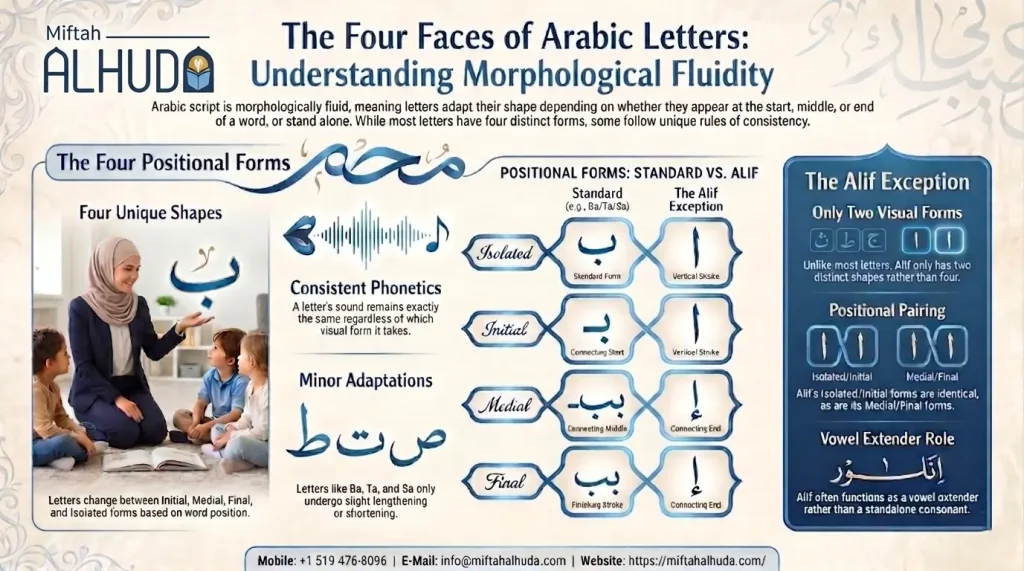
One of the things that trips up early readers is that Alif, Ba, Ta, and Sa all share similar base shapes (except Alif, which stands alone). The Arabic writing system uses a combination of a base form and dots to distinguish between letters that would otherwise look identical. Ba, Ta, and Sa are the clearest early example of this logic. Same curved body, different dot count and position:
Ba: one dot below. Ta: two dots above. Sa: three dots above.
This isn’t arbitrary. The dot system runs through much of the Arabic alphabet, there are several other letter groups that follow the same pattern of shared shape and distinguishing dots. Learning to read dots accurately from the start is one of the most useful habits a beginner can build. It makes the whole alphabet more systematic and less like a collection of unrelated shapes to memorize.
How Letters Change Shape Depending on Where They Sit?
Something that surprises many beginners: Arabic letters don’t always look the same. Each letter has up to four forms depending on where it appears in a word, at the beginning (initial), in the middle (medial), at the end (final), or standing alone (isolated).
For Ba, Ta, and Sa, these form changes are relatively minor. The body lengthens slightly in the medial position, and shortens or gains a finishing stroke in the final position. Once you’ve seen a few examples, the pattern becomes recognizable fairly quickly.
Alif, however, is the exception again. Its isolated and initial forms are identical (that same straight vertical stroke), and its medial and final forms are also the same as each other. So Alif has only two distinct visual forms rather than four. This consistency makes it simpler in some ways, though its role as a vowel extender rather than a standalone consonant means it still takes some time to fully understand.
What matters for pronunciation: the letter’s sound doesn’t change with its position. The forms are a writing convention, not a phonetic one. A Sa sounds like “th” whether it opens a word or closes it.
What Does “Alif Ba Ta” Actually Mean?
“Alif Ba Ta” isn’t actually saying anything as a statement would do. This is a name, or, more accurately, the name of the Arabic alphabet using the phonetic sounds of the first three letters. Like the English “ABC”, “Alif Ba Ta” (or even “Alif Ba Ta Sa”, the first four letters) can be used as shorthand to talk about the Arabic alphabet.
The actual names of each letter do hold a meaning in classical Arabic. The name Alif (أَلِف) stems from the same Semitic root as the words “ox” or “cattle”. This refers to the origins of the letter before it was adapted for use in Arabic script. The name Ba (بَاء) is connected to the Semitic word for “house”. The other two names, Ta (تَاء) and Sa (ثَاء), don’t have any meanings as independent words.
Arabic Alphabet Pronunciation Chart
Here’s a complete reference chart for all 28 letters. The “Sound Guide” column uses everyday English words to approximate the pronunciation, not perfect phonetic transcriptions, but practical anchors you can actually use.
| Letter | Name | Sound Guide | Example Word |
| ا | Alif | “a” in father | أَب (ab – father) |
| ب | Ba | “b” in ball | بَيت (bayt – house) |
| ت | Ta | “t” in tea | تُفَّاح (tuffah – apple) |
| ث | Sa (Tha) | “th” in think | ثَعلب (tha’lab – fox) |
| ج | Jeem | “j” in jam | جَمَل (jamal – camel) |
| ح | Ha | Strong “h” (no English equal) | حَليب (haleeb – milk) |
| خ | Kha | “ch” in Scottish loch | خُبز (khubz – bread) |
| د | Dal | “d” in door | دَرس (dars – lesson) |
| ذ | Thal | “th” in the | ذَهَب (thahab – gold) |
| ر | Ra | Rolled “r” | رَأس (ra’s – head) |
| ز | Zay | “z” in zoo | زَيتون (zaytun – olive) |
| س | Seen | “s” in sun | سَماء (sama’ – sky) |
| ش | Sheen | “sh” in ship | شَمس (shams – sun) |
| ص | Sad | Emphatic “s” (deeper) | صَبر (sabr – patience) |
| ض | Dad | Emphatic “d” (deeper) | ضَوء (daw’ – light) |
| ط | Ta (emphatic) | Emphatic “t” (deeper) | طَريق (tariq – road) |
| ظ | Tha (emphatic) | Emphatic “th” (deeper) | ظِل (thil – shadow) |
| ع | Ayn | Voiced throat sound (no English equal) | عَيْن (ayn – eye) |
| غ | Ghayn | French “r” / gargling sound | غُرفة (ghurfa – room) |
| ف | Fa | “f” in fan | فَم (fam – mouth) |
| ق | Qaf | Deep “k” from back of throat | قَلب (qalb – heart) |
| ك | Kaf | “k” in king | كِتاب (kitab – book) |
| ل | Lam | “l” in love | لَيل (layl – night) |
| م | Meem | “m” in moon | مَاء (ma’ – water) |
| ن | Noon | “n” in no | نَجمة (najma – star) |
| ه | Ha | Soft “h” in hello | هَواء (hawa’ – air) |
| و | Waw | “w” in well or “oo” in moon | وَرد (ward – rose) |
| ي | Ya | “y” in yes or “ee” in see | يَد (yad – hand) |
A few notes worth keeping in mind as you use this chart. The four “emphatic” letters (Sad, Dad, Ta emphatic, Tha emphatic) are the ones that take the most practice for English speakers, their sounds are produced further back in the mouth with the tongue slightly flattened, which affects the surrounding vowels.
Ayn and Ghayn are genuinely new sounds with no English equivalent; don’t be discouraged if they take weeks to feel natural. And the chart uses simplified approximations throughout, the goal here is a usable starting point, not a formal phonetics course.
Games That Actually Help You Remember the Arabic Alphabet
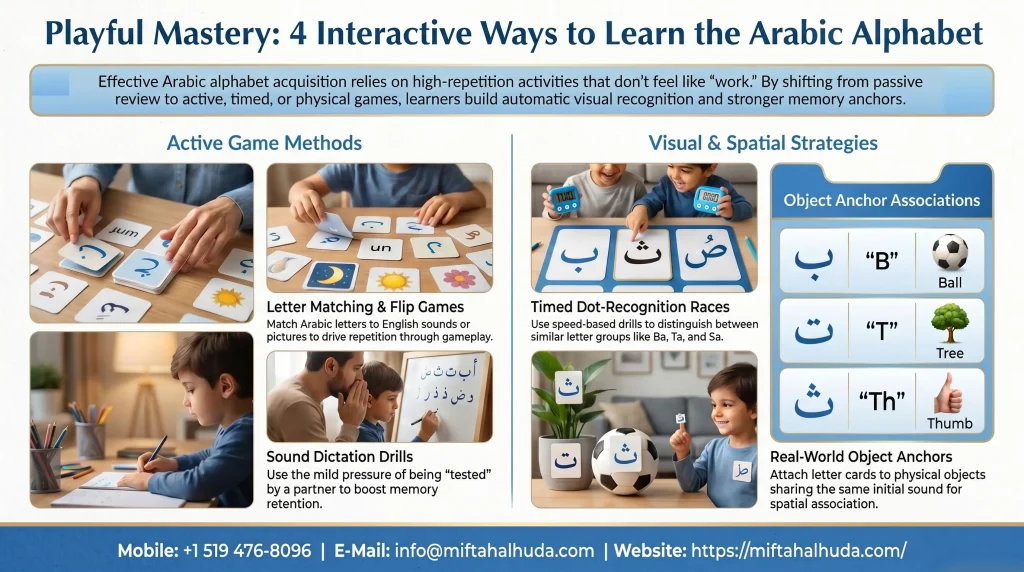
The honest truth about alphabet games is that they work best when they create repetition without it feeling like repetition. A flashcard you flip once doesn’t do much. A game you play for ten minutes without realizing how many times you’ve seen each letter is a completely different experience.
Letter Matching and Flip Games
The classic memory card game translates well to Arabic letters. You create pairs of cards, one card shows the Arabic letter, the other shows the English sound or a picture of a word that starts with that sound. Flip them face down, then take turns uncovering pairs.
For young learners especially, this works because the repetition is driven by the game itself rather than willpower. Adults benefit too, though they often prefer digital versions where the card sets are already built and the scoring adds a small layer of competitive motivation.
Sound Dictation Drills as a Game
This one works with two people. One person says an Arabic letter name out loud, the other has to write it from memory without looking. Switch roles after every five letters.
It sounds simple, which is partly why it works, the mild pressure of being “tested” creates better retention than passive review. A variation that works well for solo learners is using a pronunciation audio track and pausing after each letter to write it before the audio continues.
Dot Counting Races
Because Ba, Ta, Sa, and several other letter groups in Arabic, are distinguished entirely by dots, a timed dot-recognition drill builds a specific skill that most games don’t target. Write or display a string of similar-looking letters in random order and race against a clock to identify each one correctly.
The constraint of speed forces the visual recognition to become automatic rather than deliberate, which is the goal. Families learning together can do this as a relay, with each player identifying one letter before passing to the next.
Connecting Letters to Objects
This works especially well in the first two weeks, when the shapes are still completely new. Assign each letter a concrete object whose English name starts with the same sound, Ba for “ball,” Ta for “tree,” Sa for “thumb” (since Sa sounds like “th”).
Then surround yourself with those objects, even temporarily. Stick a small card with the letter Ba next to a ball in the room. The spatial and visual association creates a memory anchor that abstract flashcards don’t. It feels slightly ridiculous as an adult, and it works anyway.
The Best Learning Resources for Arabic Alphabet Beginners
Resources vary a lot in what they’re actually useful for. Some are excellent for letter recognition and writing. Others work better for pronunciation. A few are genuinely strong for both.
Noorani Qaida
This is one of the oldest and most widely used beginner frameworks for learning Arabic letters, particularly for learners approaching Arabic through Quranic recitation. It teaches letters in a systematic sequence, then introduces vowel marks (harakat), then simple combinations.
The pace is purposeful and slower than many digital apps, although it is more comprehensive. It is effective to use it in conjunction with a teacher who will be able to give pronunciations on the spot because the text does not come with audio instructions.
Arabic Alphabet Apps (Alef and Others)
Some applications are available today where learners can access an interactive course on the Arabic alphabet. The best ones provide audio clips of native speakers of each letter, trace letters to help learners write them, and quizzes which focus on the letters the learner struggles with.
When one decides to practice the language for five to ten minutes each day, then an app is definitely a viable solution. The limitation is that apps can’t tell you whether your pronunciation is correct, they can only model the right sound and let you compare.
YouTube Channels with Native Speaker Pronunciation
Regarding pronunciation, nothing can beat seeing the mouth movements of an Arab while pronouncing each individual letter. On YouTube, there are numerous Arabic learning video tutorials where you will clearly see the mouth and tongue movements for each letter of the alphabet, especially those for which there is no equivalent sound in the English language. It is imperative to find such a channel where each letter will be discussed at leisure.
Structured Online Classes with a Teacher
Apps and videos can take you a long way with letter recognition and approximate pronunciation. They can’t tell you in real time that your Sa is coming out slightly voiced, or that your Ayn is starting from the wrong position in the throat.
A teacher who hears you and corrects you in the moment is qualitatively different from any self-study resource, particularly in the first month. This is where formal instruction earns its place, not for the information it provides, which you can find elsewhere, but for the feedback it gives you that no app currently can.
The Part Most Guides Don’t Tell You About Practice
Knowing the correct sound is not the same as being able to produce it on demand. That gap, between recognition and production, is where most beginners spend more time than they expected.
A teacher I know who works with adult English-speaking learners describes it this way: the first week, students can hear the difference between Ta and Sa when someone else says them. By week two, they can often feel the physical distinction. Consistent independent production usually takes until week three or four, depending on how much daily practice happens in between.
The implication is that practicing alif ba ta sa pronunciation in Arabic isn’t a one-session task. It’s closer to building a muscle memory. Short, daily practice sessions (even five to ten minutes) tend to outperform longer, sporadic ones.
Reading out loud matters more than reading silently. And hearing native speakers regularly, even if you’re not yet following the full conversation, trains your ear in ways that flashcards alone can’t replicate.
A few practical things that actually move the needle: reading each letter aloud as you write it. Recording yourself and comparing to a native pronunciation example. Practicing Ba, Ta, and Sa in contrast drills, not each letter separately, but cycling through all three in sequence so your mouth learns the physical shift from one to the next. And if you find yourself repeatedly unsure about Sa, a mirror is genuinely useful: you should be able to see your tongue touching your teeth when you produce that sound correctly.
Ready to Start Learning Arabic the Right Way?
If you’re looking for structured Arabic lessons that take you from alif ba ta sa all the way through reading fluently, the Arabic for Kids Course at Miftah Alhuda offers expert-guided instruction designed for beginners. Enroll today.
Not sure yet? Book a free trial session with a Miftah Alhuda teacher and experience the learning approach before committing to anything.
Contact Us
WhatsApp: +1 519 476-8096
E-Mail: in**@**********da.com
Facebook: https://surl.li/yqeyas
Instagram: https://surl.li/smlfaq
Youtube: https://surl.li/inbncd
TikTok: https://surl.li/ldzmww
Frequently Asked Questions
1. How do you pronounce Sa (ث) if you’ve never made a “th” sound before?
Place your tongue tip lightly against your upper front teeth and exhale gently, the sound should feel like soft air escaping between your tongue and teeth. The word “think” in English produces the exact same sound.
2. Why do Ba, Ta, and Sa look so similar in Arabic?
They share the same base shape and differ only in dot placement: Ba has one dot below, Ta has two dots above, and Sa has three dots above. Reading the dots accurately is one of the most important early skills in Arabic literacy.
3. How long does it take to pronounce the Arabic alphabet correctly?
Most beginners can recognize and approximate all 28 letters within two to four weeks of consistent practice. Producing them accurately, especially letters with no English equivalents, usually takes a few weeks longer.
4. Does Alif always sound like “aa”?
Not exactly. Alif can serve different functions depending on the context. It often acts as a vowel elongator, extending the sound of the letter before it. In other cases, it carries a Hamza (a glottal stop). Beginners typically start with the long “aa” reading, which covers most early encounters with the letter.
5. Should I learn to write Arabic letters at the same time as learning to pronounce them?
Writing and pronunciation reinforce each other well when practiced together, especially for letters like Ta and Sa where the visual distinction (dot count) directly connects to the sound difference. Starting both at once is generally more efficient than learning one before the other.
The Part That Textbooks Usually Save for Later
There’s a reason this guide focuses so specifically on just four letters rather than rushing through all 28. The habits you build with alif ba ta sa pronunciation in Arabic carry directly into everything else.
The physical precision you develop for Sa (tongue position, airflow, voicing) is the same kind of awareness you’ll need for letters like Dha, Zha, and several others further into the alphabet. The dot-reading habit you build with Ba, Ta, and Sa will save you from confusion dozens of times over in the following months.
Starting slow here is not a limitation. It’s actually the shape that faster progress later depends on. Most learners who struggle in month two or three can trace the problem back to rushing through the first four letters before the pronunciation really settled in.
Getting these four right is less about the four letters and more about understanding how Arabic sounds work as a system. Once that clicks, the rest of the alphabet becomes considerably less daunting than it looks from the outside.