
Learning about the juz amma surahs is one of the most rewarding starting points for anyone beginning their journey with the Quran, and it’s a journey Miftah Al-Huda Academy has guided countless students through.
Juz Amma is the 30th and final section (juz) of the Holy Quran, and it holds a uniquely important place in everyday Muslim life. It is usually the first part children memorize, and many of its short chapters are recited daily in the five obligatory prayers.
This guide walks through what Juz Amma is, the full list of surahs it contains, their core themes, and why the juz amma surahs remain central to Islamic practice today.
Why Is Juz Amma Important?
Allah Says:
“And We have certainly made the Qur’an easy for remembrance, so is there any who will remember?” (Al-Qamar 54:22)
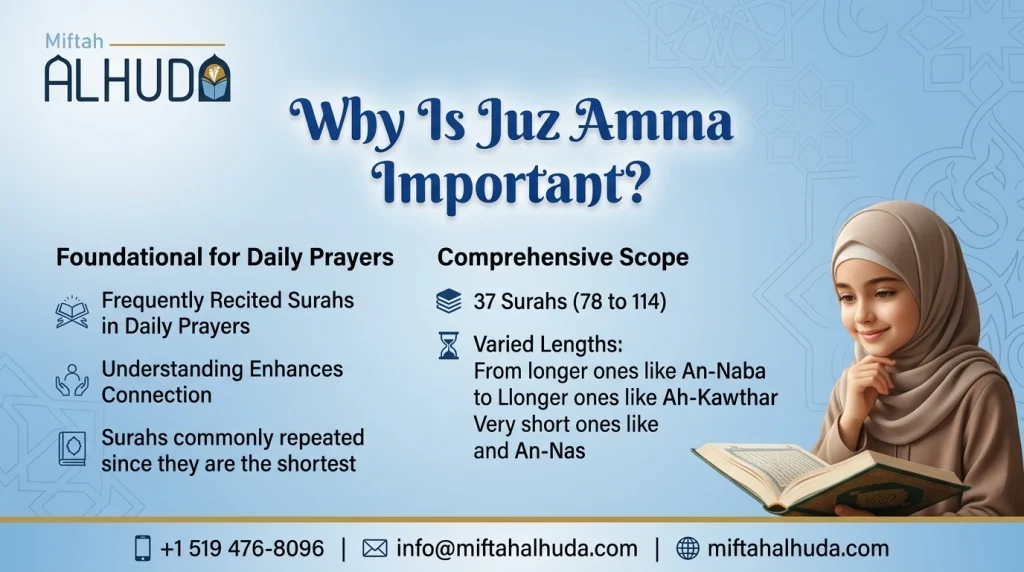
Juz Amma is especially familiar to Quran students since its shorter surahs are commonly repeated during daily prayers. Learning them is consequently more than just memory. Understanding their meanings can help familiar verses become relevant reminders during prayer and in daily living.
How Many Surahs Are in Juz Amma?
Juz Amma contains 37 surahs, including Surahs 78 to 114.
The surahs vary greatly in length. Some, such as An-Naba and Al-Ghashiyah, have several dozen verses, whilst others, such as Al-Kawthar, Al-Asr, and An-Nasr, are quite short.
Juz Amma Surahs in Order
Here is the complete order of the Juz Amma surahs:
| Order | Surah Name | Surah Number |
| 1 | An-Naba | 78 |
| 2 | An-Nazi’at | 79 |
| 3 | Abasa | 80 |
| 4 | At-Takwir | 81 |
| 5 | Al-Infitar | 82 |
| 6 | Al-Mutaffifin | 83 |
| 7 | Al-Inshiqaq | 84 |
| 8 | Al-Buruj | 85 |
| 9 | At-Tariq | 86 |
| 10 | Al-A’la | 87 |
| 11 | Al-Ghashiyah | 88 |
| 12 | Al-Fajr | 89 |
| 13 | Al-Balad | 90 |
| 14 | Ash-Shams | 91 |
| 15 | Al-Layl | 92 |
| 16 | Ad-Duha | 93 |
| 17 | Ash-Sharh | 94 |
| 18 | At-Tin | 95 |
| 19 | Al-Alaq | 96 |
| 20 | Al-Qadr | 97 |
| 21 | Al-Bayyinah | 98 |
| 22 | Az-Zalzalah | 99 |
| 23 | Al-Adiyat | 100 |
| 24 | Al-Qari’ah | 101 |
| 25 | At-Takathur | 102 |
| 26 | Al-Asr | 103 |
| 27 | Al-Humazah | 104 |
| 28 | Al-Fil | 105 |
| 29 | Quraysh | 106 |
| 30 | Al-Ma’un | 107 |
| 31 | Al-Kawthar | 108 |
| 32 | Al-Kafirun | 109 |
| 33 | An-Nasr | 110 |
| 34 | Al-Masad | 111 |
| 35 | Al-Ikhlas | 112 |
| 36 | Al-Falaq | 113 |
| 37 | An-Nas | 114 |
The Main Themes of Juz Amma Surahs
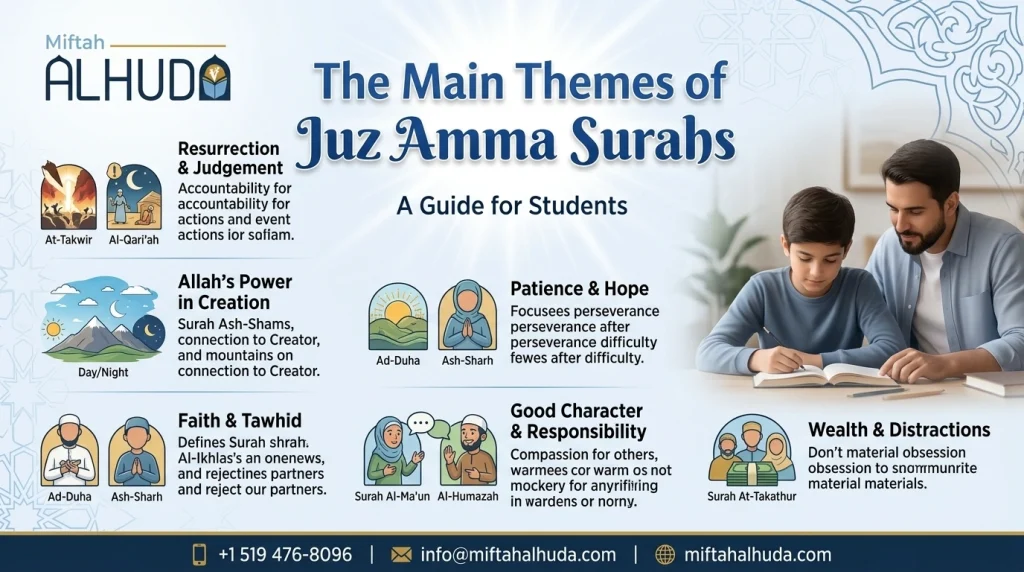
The brilliance of Juz Amma rests in how its surahs approach key concepts from several perspectives. One chapter may depict resurrection with powerful scenes, but another may stress on gratitude, human character, or seeking refuge in Allah.
1. Resurrection and the Day of Judgment
The Hereafter is one of the most frequent themes in Juz Amma.
Surahs such as Al-Naba, At-Takwir, Al-Infitar, Al-Inshiqaq, and Al-Qari’ah narrate events concerning resurrection and accountability.
Allah Says:
“The Day when mankind will stand before the Lord of the worlds?” (Al-Mutaffifin 83:6)
The verses remind us that worldly life is temporary and that our actions have consequences.
A Reminder of Accountability
The descriptions of the Last Day challenge believers to look beyond their immediate desires. Wealth, position, and worldly successes do not guarantee absolute security. What is important is how we respond to Allah and live our lives.
2. Allah’s Power and Creation
Another important theme is the manifestation of Allah’s power in creation.
Juz Amma regularly pays attention to the sky, earth, mountains, night, day, human creation, and other signs that surround us.
Surah Ash-Shams , for example, calls attention to a number of produced signs before moving to spiritual purification.
This establishes a deep connection: witnessing creation can inspire the heart to recognize the Creator.
3. Faith and Tawhid
Tawhid, or Allah’s oneness, is an important theme throughout the final juz.
Perhaps the most obvious example is Surah Al-Ikhlas, which focuses on Allah’s absolute uniqueness and perfection.
Its short length makes it simple to remember, but its religious message is extremely profound.
Surah Al-Ikhlas and the Oneness of Allah
The Surah Al-Ikhlas explains that Allah is One and incomparable. It rejects the idea of Allah having an equal, parent, child, or counterpart. As a result, the surah is a critical chapter for learning the basics of Islamic faith.
In fact, the Prophet ﷺ taught that this short surah is equivalent to one-third of the Qur’an: Abu Darda’ reported Allah’s Apostle (ﷺ) as saying:
Is any one of you incapable of reciting a third of the Qur’an in a night? They (the Companions) asked: How could one recite a third of the Qur’an (in a night)? Upon this he (the Holy Prophet) said: “‘Say: He is Allah, One’ (Qur’an. cxii) is equivalent to a third of the Qur’an.” (Sahih Muslim )
4. Patience During Hardship
Juz Amma also includes great reminders to persevere.
Surah Ad-Duha reassures Prophet Muhammad ﷺ at tough times and reminds him of Allah’s compassion.
The occasion of revelation for Surah Ad-Duha,narrated by Jundub ibn Sufyan:
Once the Prophet (ﷺ) fell ill and did not offer the night prayer (Tahajjud prayer) for a night or two. A woman (the wife of Abu Lahab) came to him and said, “O Muhammad ! I do not see but that your Satan has left you.” Then Allah revealed (Surat-Ad-Duha): ‘By the fore-noon, and by the night when it darkens (or is still); Your Lord has not forsaken you, nor hated you.’ (Sahih al-Bukhari)
Surah Ash-Sharh also promotes relief, ease, and endurance.
Allah Says: “So verily, with the hardship, there is relief,” (Ash-Sharh 94:5)
Hope After Difficulty
The message is especially relevant when life seems overwhelming. Difficult circumstances do not imply that Allah has abandoned the believer.
The surahs inspire us to keep hope, push ourselves, and remember Allah’s blessings.
5. Good Character and Social Responsibility
Juz Amma is about more than just believing. It also discusses how people treat each other.
Surah Al-Ma’un criticizes religious behavior that lacks real compassion for others. Surah Al-Humazah warns against damaging attitudes like mockery, criticism, and an excessive attachment to wealth.
These teachings remind us that worship should influence our character.
6. Wealth and Worldly Distractions
Several surahs caution against growing obsessed with material possessions.
Surah At-Takathur discusses how competition for worldly abundance can divert people’s attention until they face death and accountability.
The message is simple: wealth can be good, but it should never be the goal of life.
A Closer Look at Important Juz Amma Surahs
Surah An-Naba: The Great News
Surah An-Naba opens Juz Amma and emphasizes the fact of resurrection and the Hereafter.
It encourages reflection on creation while portraying the Day of Judgment as an unavoidable fact.
Its placement at the beginning of Juz Amma highlights one of the section’s main themes: humans will eventually return to Allah.
Surah An-Nazi’at: The Reality of Resurrection
Surah An-Nazi’at continues to emphasize resurrection and accountability. It also tells the story of Musa and Pharaoh, comparing submission and arrogance.
The surah urges followers to remember that worldly power is temporary.
Surah Abasa: A Lesson in Human Dignity
Surah Abasa teaches a valuable lesson about paying genuine attention to those seeking guidance.
It teaches us to evaluate people based on their sincerity rather than their social status.
This surah is a valuable reminder of humility and fairness.
Surah At-Takwir: When the Universe Changes
Surah At-Takwir vividly portrays events surrounding the Last Day.
Its imagery conveys a strong sense of urgency and pushes the reader to reflect on what genuinely requires attention before the Day arrives.
Surah Al-Mutaffifin: Honesty in Transactions
Surah Al-Mutaffifin discusses dishonest measurement and weighing.
Its message goes beyond commercial transactions. It promotes fairness, integrity, and the understanding that Allah knows what people do, even if others do not.
Surah Al-A’la: Glorifying the Most High
Surah Al-A’la encourages believers to glorify Allah and reflect on His creation and guidance.
It also contrasts the fleeting nature of this life with the eternal significance of the Hereafter.
Surah Al-Ghashiyah: Two Destinations
Surah Al-Ghashiyah depicts scenes from the Hereafter and contrasts the situations of different people.
It also draws attention to creation, such as the camel, sky, mountains, and earth, prompting people to focus on what is around them.
Allah Says:
“Then do they not look at the camels – how they are created? And at the sky – how it is raised?” (Al-Ghashiyah 88:17-18)
Short Juz Amma Surahs Every Muslim Should Know
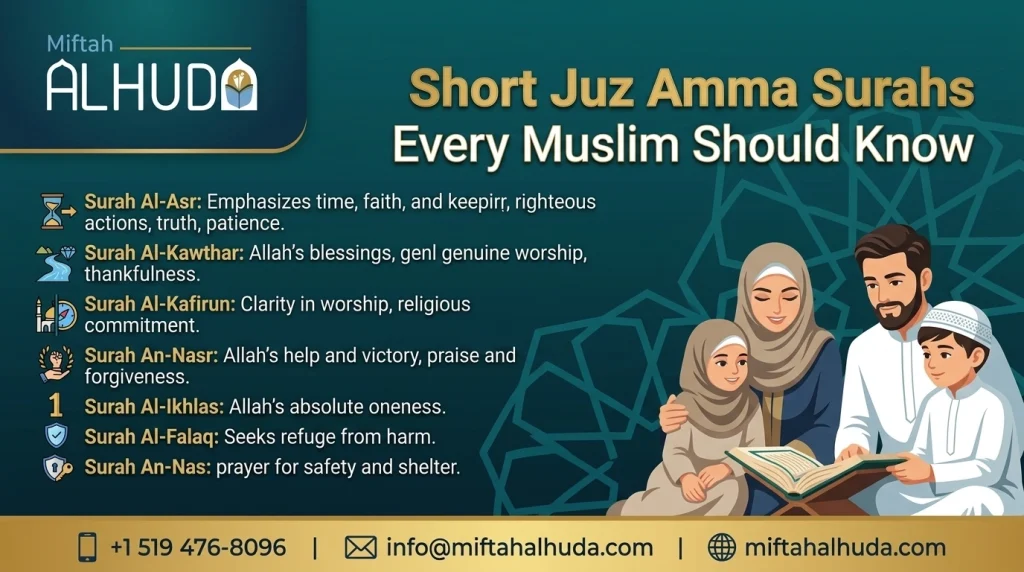
Some of the shortest and most easily remembered surahs are toward the end of Juz Amma.
Surah Al-Asr
Surah Al-Asr emphasizes the value of time and lists faith, righteous actions, truth, and patience as necessary virtues.
Surah Al-Kawthar
Surah Al-Kawthar is one of the shortest in the Quran. It stresses Allah’s blessings and directs the believer to genuine worship and thankfulness.
Surah Al-Kafirun
Surah Al-Kafirun focuses on clarity in matters of worship and religious commitment.
Farwah b. Nawfal quoted his father as saying that the Prophet (ﷺ) said to Nawfal (his father): Recite (the Surah) ‘Say, O you disbelievers!’ and then go to sleep at its end, for it is a declaration of freedom from polytheism. Sahih (Al-Albani)
Surah An-Nasr
Surah An-Nasr describes Allah’s help and victory, and it encourages believers to praise Allah and seek His forgiveness.
Surah Al-Ikhlas
Surah Al-Ikhlas presents a concise declaration of Allah’s absolute oneness.
Surah Al-Falaq
Surah Al-Falaq instructs believers to seek refuge in Allah from a variety of harm.
Surah An-Nas
The Quran finishes with Surah An-Nas, which is a powerful prayer for safety and shelter in Allah.
‘A’isha reported that when Allah’s Messenger (ﷺ) fell ill, he recited over his body Mu’awwidhatan and blew over him and when his sickness was aggravated I used to recite over him and rub him with his band with the hope that it was more blessed. (Sahih Muslim)
Juz Amma Surahs for Beginners
Juz Amma provides a practical starting point for beginners because many of its surahs are small enough to learn progressively.
Rather than trying to recall everything at once, students might establish a consistent habit.
1. Start With Meaning
Memorizing Arabic words without comprehending their meaning can make the process seem mechanical. Learning the core meaning of each surah puts the verses into context, making them easier to remember.
2. Listen and Repeat
Regular listening can help students get more familiar with pronunciation, rhythm, and verse endings.
Students can listen to a reliable recitation, follow the Arabic text, and practice small sections until their pronunciation is comfortable.
3. Practice in Salah
When a surah has been correctly memorized, repeating it during prayer can help to reinforce recall.
This generates a natural cycle of learning, comprehension, memorization, recitation, and revision.
How to Study Juz Amma Surahs Effectively
A good study plan does not need to be difficult.
Step 1: Choose One Surah
Begin with just one surah rather than shifting between chapters.
Step 2: Read the Arabic
Learn how the verses are written.
Step 3: Learn the Translation
To better understand the primary point, read a reliable translation.
Step 4: Study Key Vocabulary
Learning repeated Quranic words can gradually improve Arabic comprehension.
Step 5: Listen to Recitation
Pay attention to the pronunciation, stopping points, and verse construction.
Step 6: Review Consistently
Short daily revising sessions are frequently more maintainable than longer ones.
Juz Amma and Quran Memorization
Juz Amma is often chosen as a starting point for Quran memorization because its surahs range from extremely short chapters to lengthier parts.
However, memorizing should not be limited to storing words in memory.
The overarching goal is to link memorizing to comprehension and correct recitation.
When students comprehend what they’re saying, each verse is easier to remember and more meaningful during prayer.
Juz Amma Memorization Plan for Children (Sample 37-Week Schedule)
A simple approach: begin at the end of Juz Amma (the shortest, easiest surahs) and
go backward toward An-Naba, as is the usual strategy employed with little children.
| Week | Surah | Verses | Review Frequency |
| 1 | An-Nas | 6 | Daily for 1 week, then weekly |
| 2 | Al-Falaq | 5 | Daily for 1 week, then weekly |
| 3 | Al-Ikhlas | 4 | Daily for 1 week, then weekly |
| 4 | Al-Masad | 5 | Daily for 1 week, then weekly |
| 5 | An-Nasr | 3 | Daily for 1 week, then weekly |
| 6 | Al-Kafirun | 6 | Daily for 1 week, then weekly |
| 7 | Al-Kawthar | 3 | Daily for 1 week, then weekly |
| 8 | Al-Ma’un | 7 | Daily for 10 days, then twice weekly |
| 9 | Quraysh | 4 | Daily for 1 week, then weekly |
| 10 | Al-Fil | 5 | Daily for 10 days, then twice weekly |
| 11 | Al-Humazah | 9 | Daily for 10 days, then twice weekly |
| 12 | Al-Asr | 3 | Daily for 1 week, then weekly |
| 13 | At-Takathur | 8 | Daily for 10 days, then twice weekly |
| 14 | Al-Qari’ah | 11 | Daily for 10 days, then twice weekly |
| 15 | Al-Adiyat | 11 | Daily for 10 days, then twice weekly |
| 16 | Az-Zalzalah | 8 | Daily for 10 days, then twice weekly |
| 17 | Al-Bayyinah | 8 | Daily for 2 weeks, then twice weekly |
| 18 | Al-Qadr | 5 | Daily for 1 week, then weekly |
| 19 | Al-Alaq | 19 | Daily for 2 weeks, then twice weekly |
| 20 | At-Tin | 8 | Daily for 10 days, then twice weekly |
| 21 | Ash-Sharh | 8 | Daily for 1 week, then weekly |
| 22 | Ad-Duha | 11 | Daily for 10 days, then twice weekly |
| 23 | Al-Layl | 21 | Daily for 2 weeks, then twice weekly |
| 24 | Ash-Shams | 15 | Daily for 2 weeks, then twice weekly |
| 25 | Al-Balad | 20 | Daily for 2 weeks, then twice weekly |
| 26 | Al-Fajr | 30 | Daily for 2–3 weeks, then twice weekly |
| 27 | Al-Ghashiyah | 26 | Daily for 2–3 weeks, then twice weekly |
| 28 | Al-A’la | 19 | Daily for 2 weeks, then twice weekly |
| 29 | At-Tariq | 17 | Daily for 10 days, then twice weekly |
| 30 | Al-Buruj | 22 | Daily for 2–3 weeks, then twice weekly |
| 31 | Al-Inshiqaq | 25 | Daily for 2–3 weeks, then twice weekly |
| 32 | Al-Mutaffifin | 36 | Daily for 3 weeks, then twice weekly |
| 33 | Al-Infitar | 19 | Daily for 2 weeks, then twice weekly |
| 34 | At-Takwir | 29 | Daily for 2–3 weeks, then twice weekly |
| 35 | Abasa | 42 | Daily for 3–4 weeks, then twice weekly |
| 36 | An-Nazi’at | 46 | Daily for 3–4 weeks, then twice weekly |
| 37 | An-Naba | 40 | Daily for 3–4 weeks, then continuous rotation |
Common Mistakes When Learning Juz Amma
Several missteps could slow progress.
Memorizing Without Reviewing
New memorization can fade fast if not revised. A learner should keep older surahs while learning new ones.
Ignoring Pronunciation
A minor alteration to an Arabic letter or vowel can alter its meaning.
Rushing Through the Surahs
Speed does not equate to mastery. A slower, more consistent approach often results in higher long-term retention.
Focusing Only on Memorization
Understanding the basic message of each surah makes Quran learning more meaningful.
Final Thoughts on Juz Amma Surahs
The Juz Amma surahs are a strong source of reminders on faith, Tawhid, resurrection, accountability, gratitude, patience, morality, and seeking Allah’s protection. From An-Naba to An-Nas, these surahs continuously return the believer to the most fundamental question: Who is our Creator? Why are we here? How should we live? And where are we eventually headed?
Studying Juz Amma with meaning, consistent review, correct recitation, and thought helps transform memorization into a more profound Quranic learning experience. Whether we are beginners repeating familiar chapters or expert students strengthening our understanding, the final juz provides lessons that are applicable at all stages of life.
Start Your Juz Amma Journey With Miftah Al-Huda Academy
Every hafiz begins with a single surah; the only real question is when you start. Miftah Al-Huda Academy offers structured, one-to-one Quran memorization programs built around qualified teachers, proper tajweed, and a pace that fits your life, whether you’re a parent enrolling your child, a new Muslim taking your first steps, or an adult ready to finally complete your Hifz.
Book your free trial class with Miftah Al-Huda Academy today and take the first step toward mastering the juz amma surahs with expert guidance by your side.
Contact Us
- WhatsApp: +1 519 476-8096
- E-Mail: in**@**********da.com
- Facebook: https://www.facebook.com/MiftahAlhudaOfficial
- Instagram: https://www.instagram.com/miftahalhudaa
- Youtube: https://www.youtube.com/@MiftahAl-huda
- Tiktok: https://www.tiktok.com/@miftahalhuda00
Frequently Asked Questions
Why is Juz Amma usually taught first to children?
Because its surahs are short, rhythmic, and frequently recited in daily prayer, they give children a practical foundation for salah while their vivid imagery makes memorization more engaging.
What is the shortest surah in Juz Amma?
Surah Al-Kawthar, with only three verses, is the shortest surah in the entire Quran, despite carrying a profound message about divine abundance and gratitude.
Can I recite Juz Amma surahs in prayer without knowing the meaning?
Yes, correct Arabic recitation fulfills the requirement of prayer, though scholars strongly encourage learning the meanings alongside memorization to deepen concentration and connection during salah.