

Salah is considered one of the most essential acts of worship in Islam. It is a daily prayer in which Muslims stand before Allah to remember Him, seek His guidance, and deepen their bond with their Creator. Allah states in the Quran:
“Verily! I am Allah! La ilaha illa Ana (none has the right to be worshipped but I), so worship Me, and perform As-Salat (Iqamat-as-Salat) for My Remembrance.” (Surah Ta-Ha, 20:14)
Understanding how to pray Salah correctly is an important step for a new Muslim, a youngster learning the basics, or anyone looking to improve their prayers.
This Muslim Salah guide from Miftah Al-Huda Academy walks us through the basics of prayer, from preparation and purification to the movements and recitations that occur throughout Salah.
While details may differ amongst recognized schools of Islamic jurisprudence, the fundamental structure of the five daily prayers is based on the Quran and Sunnah.
What Is Salah in Islam?
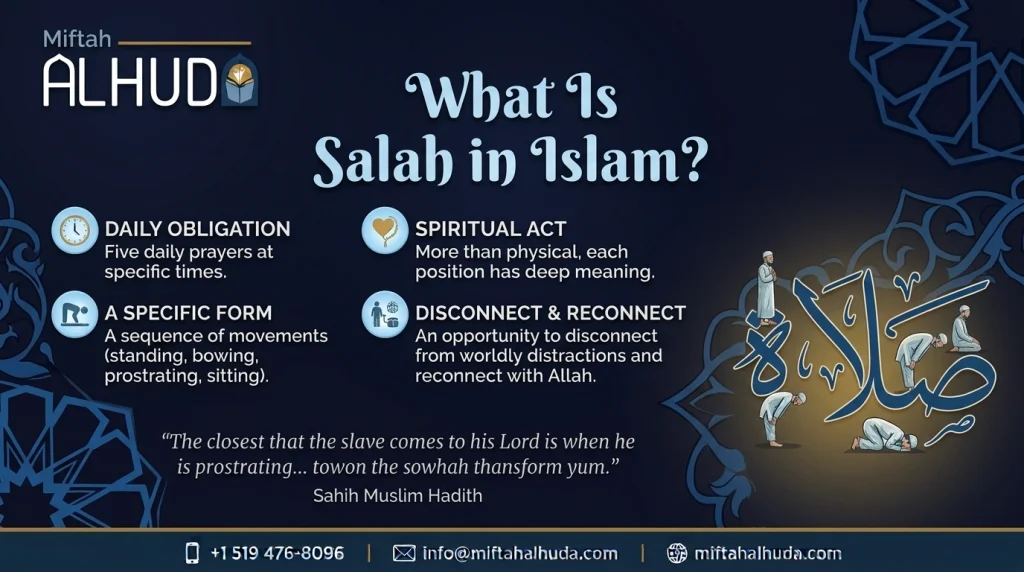
Salah is a formal Islamic prayer that is performed at specific times throughout the day and night. Salah, unlike a simple personal supplication, has a particular form that includes standing, bowing, prostration, sitting, Quranic recital, and remembrance of Allah.
The prayer is more than just a set of physical actions. Each position holds spiritual significance. When we rise, we show humility before Allah. When we bow, we are expressing surrender. When we place our forehead on the ground in sujood, we show complete humility and dedication. The Prophet (ﷺ) stated:
“The closest that the slave comes to his Lord is when he is prostrating, so invoke Allah much (in prostration).” (Sahih Muslim)
For Muslims, Salah is a daily opportunity to disconnect from worldly distractions and reconnect with Allah.
Why Is Salah So Important for Muslims?
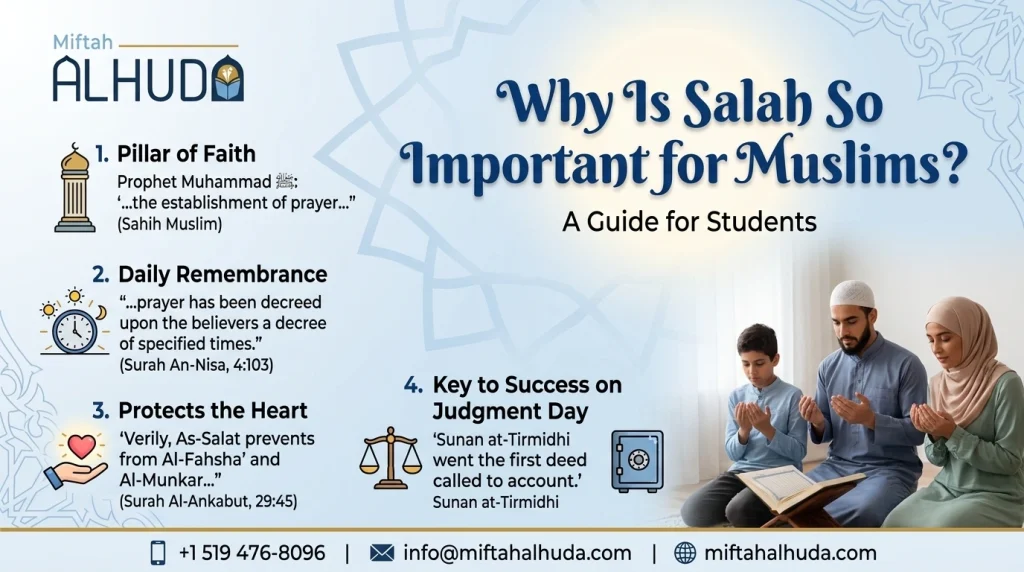
Salah holds a vital place in Islamic devotion. The Prophet ﷺ referred to it as the religion’s pillar and one of the five pillars of Islam:
“(The superstructure of) al-Islam is raised on five (pillars), testifying (the fact) that there is no god but Allah, that Muhammad is His bondsman and messenger, and the establishment of prayer, payment of Zakat, Pilgrimage to the House (Ka’ba) and the fast of Ramadan. “ (Sahih Muslim)
The five daily prayers divide the Muslim’s day into regular moments of remembrance. Allah commands in the Quran:
“And when you have completed the prayer, remember Allah standing, sitting, or [lying] on your sides. But when you become secure, re-establish [regular] prayer. Indeed, prayer has been decreed upon the believers a decree of specified times.” (Surah An-Nisa, 4:103)
Prayer also helps establish discipline and protects the heart from wrongdoing:
“Recite (O Muhammad SAW) what has been revealed to you of the Book (the Quran), and perform As-Salat (Iqamat-as-Salat). Verily, As-Salat (the prayer) prevents from Al-Fahsha’ (i.e. great sins of every kind, unlawful sexual intercourse, etc.) and Al-Munkar (i.e. disbelief, polytheism, and every kind of evil wicked deed, etc.) and the remembering (praising, etc.) of (you by) Allah (in front of the angels) is greater indeed [than your remembering (praising, etc.) Allah in prayers, etc.]. And Allah knows what you do.” (Surah Al-Ankabut, 29:45)
Whether we are working, studying, traveling, or caring for our family, Salah reminds us that worship is still an important part of our life. The Prophet ﷺ stressed its importance on the Day of Judgment:
“The first of man’s deeds for which he will be called to account on the Day of Resurrection will be Salat. If it is found to be perfect, he will be safe and successful; but if it is incomplete, he will be unfortunate and a loser. If any shortcoming is found in the obligatory Salat, the Glorious and Exalted Rubb will command to see whether His slave has offered any voluntary Salat so that the obligatory Salat may be made up by it. Then the rest of his actions will be treated in the same manner.” (Sunan at-Tirmidhi)
The Five Daily Prayers
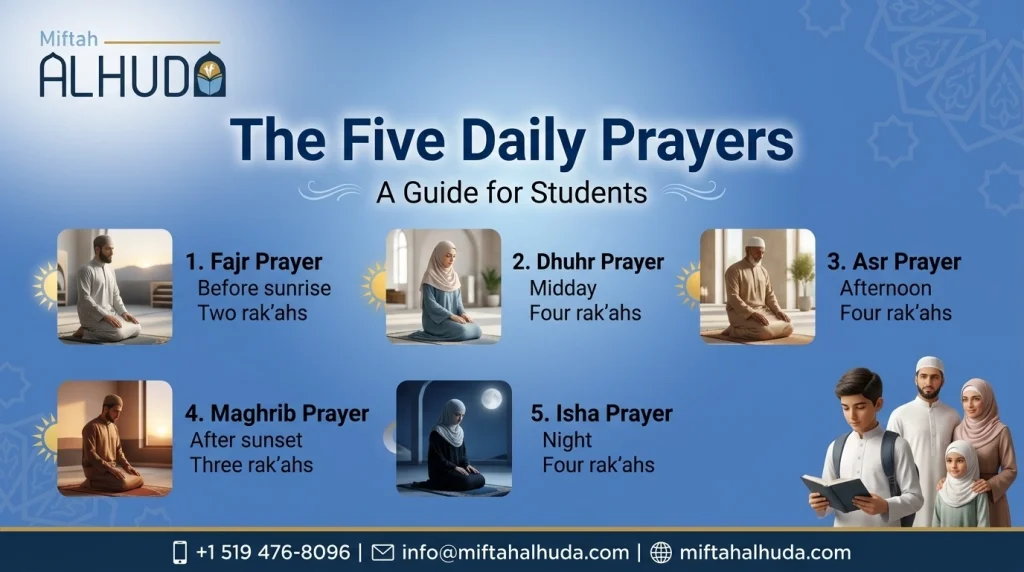
Every day, Muslims do five obligatory prayers.
1. Fajr Prayer
Fajr is performed before sunrise. It consists of two obligatory rak’ahs that start the day with worship and remembrance.
2. Dhuhr Prayer
Dhuhr is a midday prayer. It includes four obligatory rak’ahs and is performed after the sun has reached its highest.
3. Asr Prayer
Asr is the afternoon prayer, which includes four obligatory rak’ahs.
4. Maghrib Prayer
Maghrib starts after sunset and includes three obligatory rak’ahs.
5. Isha Prayer
Isha is the night prayer, which includes four obligatory rak’ahs.
The exact beginning and end timings of each prayer are determined by the sun’s position and hence vary throughout the year and by location.
Conditions Before Performing Salah
Before beginning Salah, we must ensure that many essential conditions are met.
Purification and Wudu

Purification is an essential component of preparation for prayer. Muslims usually conduct wudu, or ablution, before Salah when purification is required.
Covering the Awrah
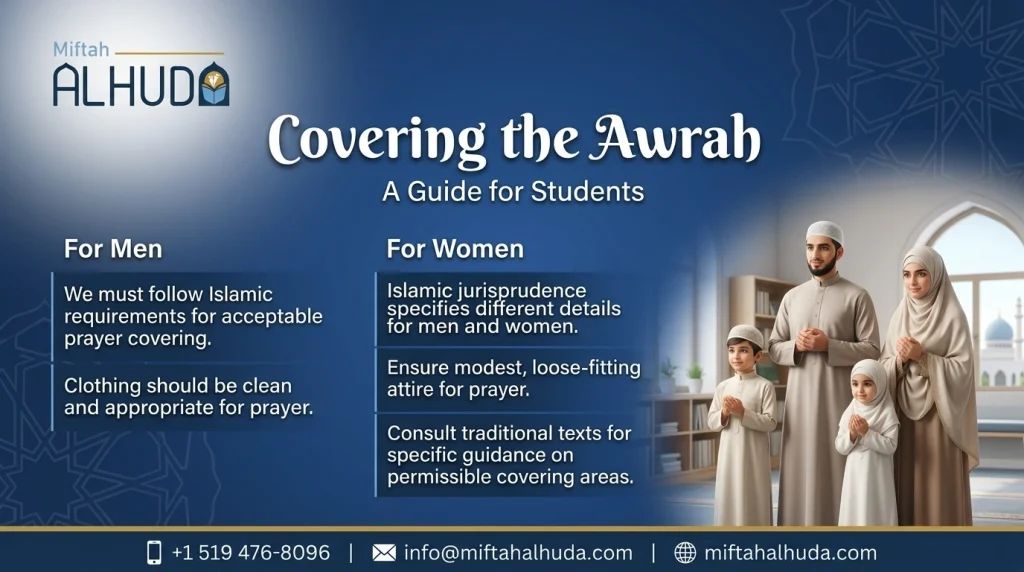
We must follow Islamic requirements for acceptable prayer covering . According to Islamic jurisprudence, men and women have different specific details. Clothing should be clean and appropriate for prayer.
Facing the Qiblah

Muslims face the Qiblah, the direction of the Ka’bah in Makkah, while praying. Allah says:
“And from wherever you go out [for prayer], turn your face toward al-Masjid al-Haram. And wherever you [believers] may be, turn your faces toward it in order that the people will not have any argument against you, except for those of them who commit wrong; so fear them not but fear Me. And [it is] so I may complete My favor upon you and that you may be guided.” (Surah Al-Baqarah, 2:150)
Knowing the Prayer Time
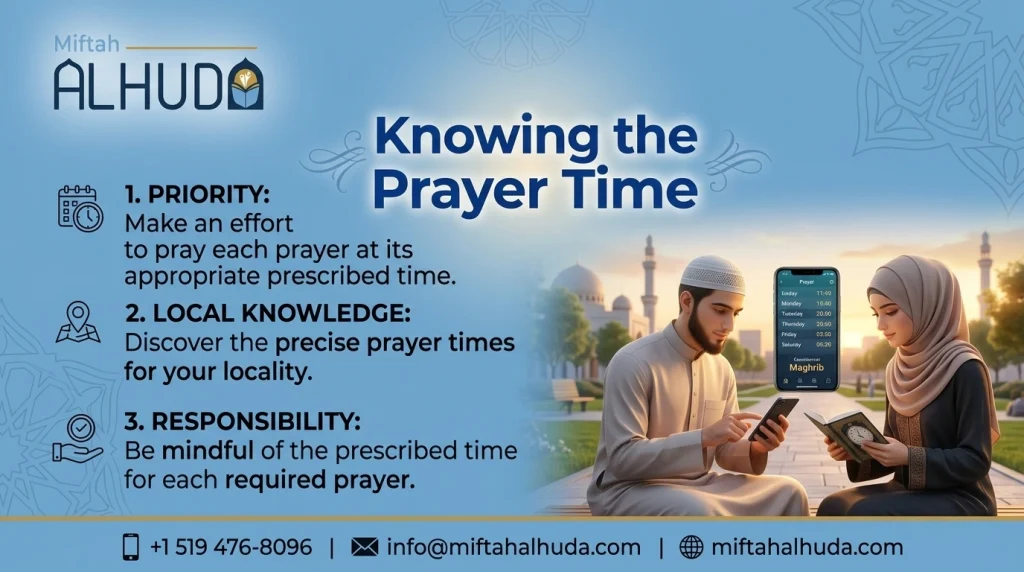
The prescribed time for each required prayer. We should discover the prayer times for our locality and make an effort to pray each prayer at the appropriate time.
Making the Intention
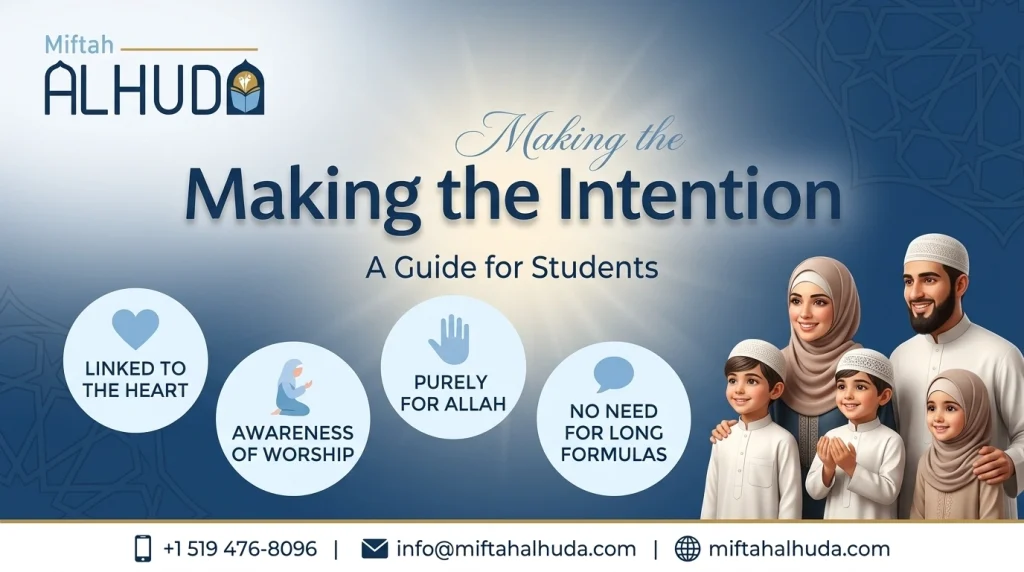
The intention, or niyyah, is linked to the heart. We should be aware of the prayer we are about to offer and how we plan to worship Allah through it. There is no need to translate the intention into a long stated formula.
How to Pray Salah Step by Step?
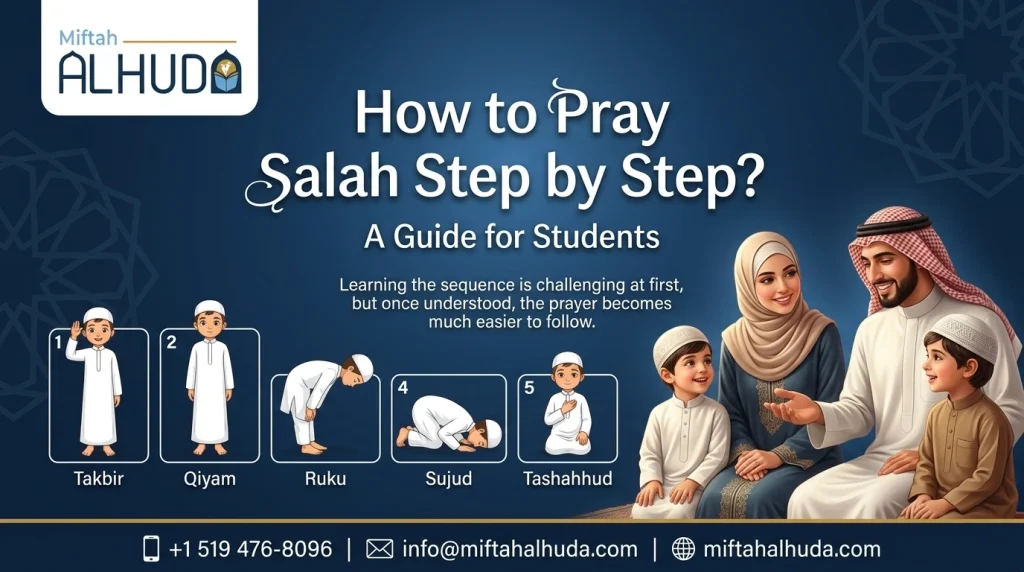
Learning the Salah sequence can be challenging at first. However, once the basic pattern is understood, the prayer becomes much easier to follow.
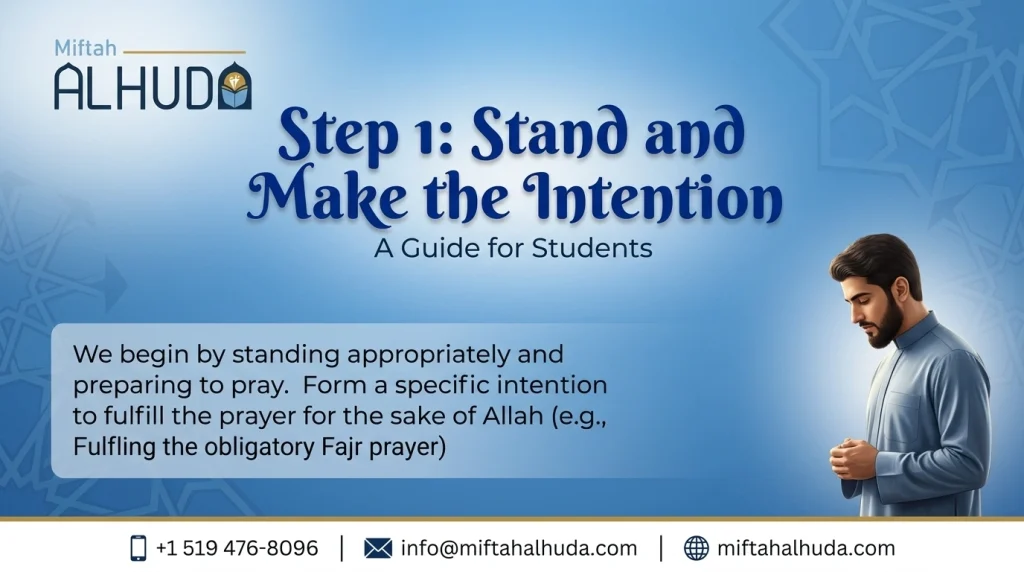
Step 1: Stand and Make the Intention
We begin by standing appropriately and preparing to pray the precise prayer. For example, when we pray Fajr, we intend to fulfill the obligatory Fajr prayer for the sake of Allah.
Step 2: Begin With Takbir
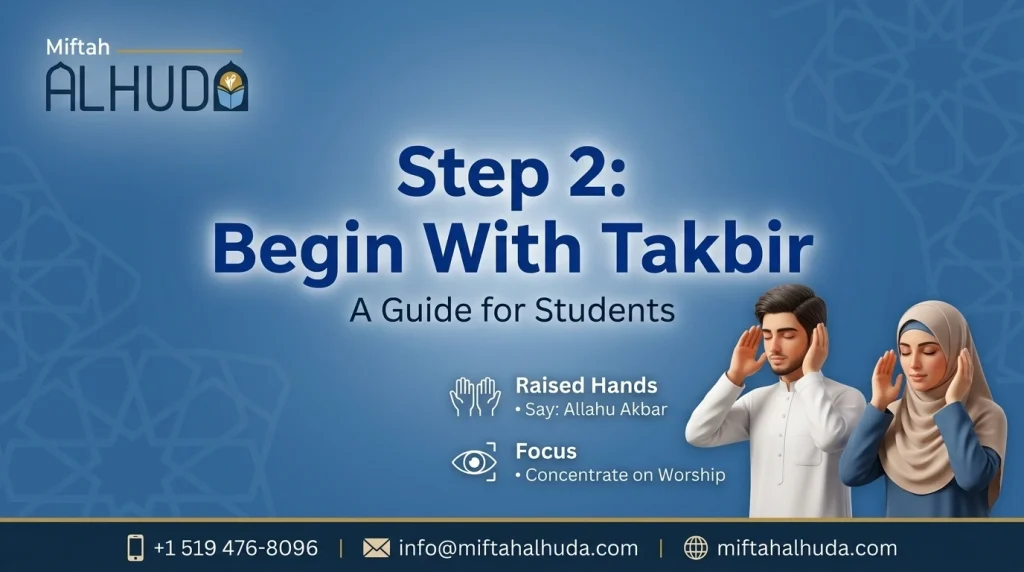
We raise our hands in accordance with the established Sunnah and say Allahu Akbar. This opening Takbir marks the start of Salah. Once the prayer begins, we concentrate on the worship and eliminate extraneous speech and actions.
Step 3: Recite Al-Fatihah and Another Surah
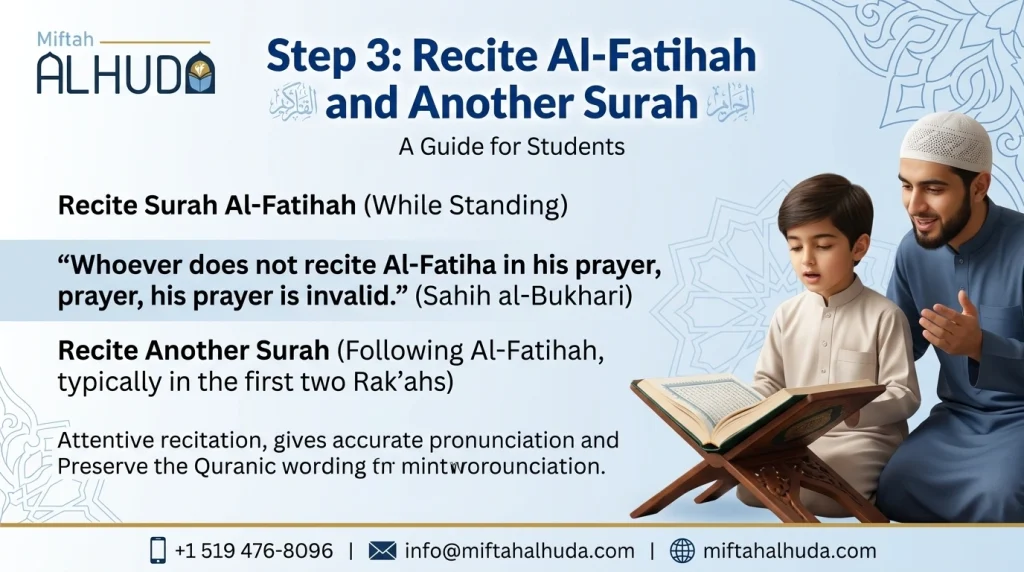
While standing, we recite Surah Al-Fatihah. The Prophet (ﷺ) stated:
“Whoever does not recite Al-Fatiha in his prayer, his prayer is invalid.” (Sahih al-Bukhari)
Following Al-Fatihah, another section of the Quran is typically read in the first two rak’ahs of an obligatory prayer. The recitation should be done attentively since accurate pronunciation helps preserve the wording of the Quran.
Step 4: Perform Ruku
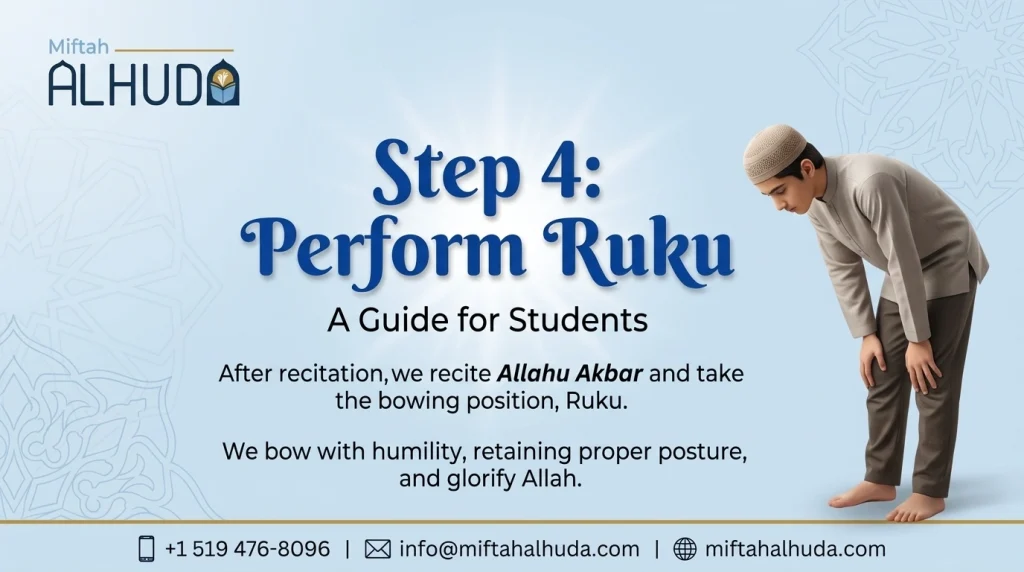
After recitation, we recite Allahu Akbar and take the bowing position known as ruku. We bow with humility, retaining the proper posture, and glorify Allah.
Step 5: Rise From Ruku
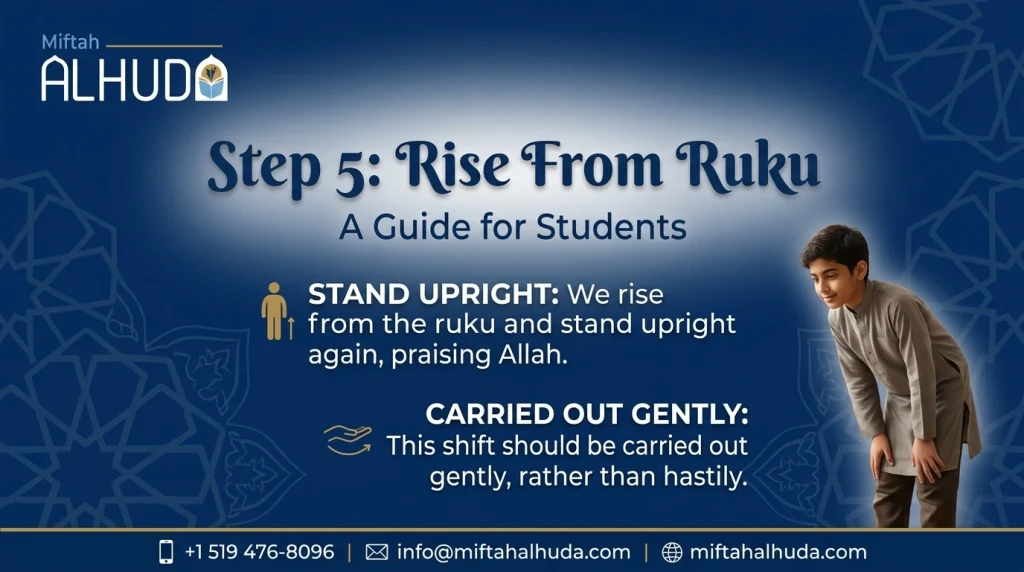
We rise from the ruku and stand upright again, praising Allah. This shift should be carried out gently, rather than hastily.
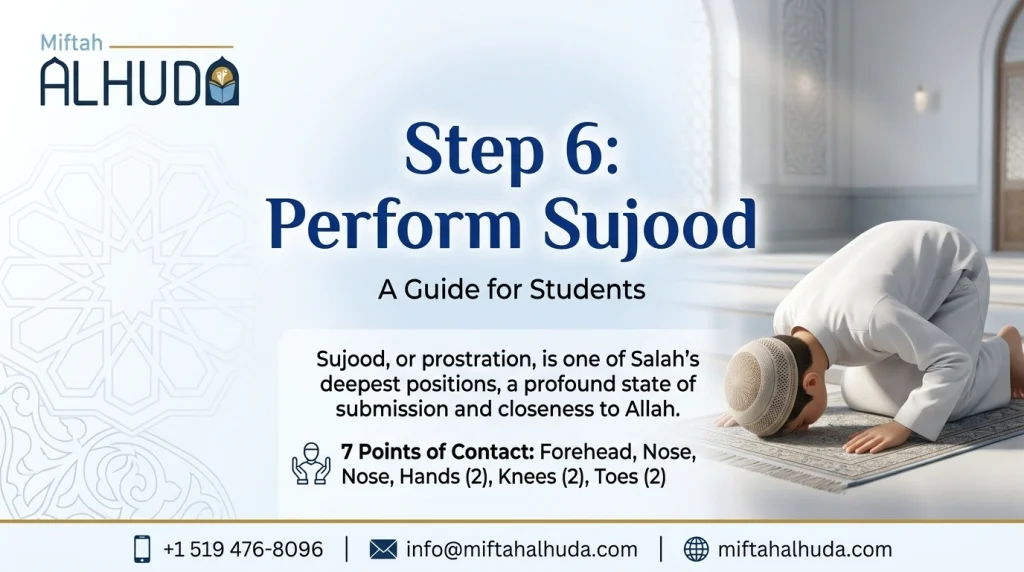
Step 6: Perform Sujood
We next move on to sujood, or prostration. Sujood is considered one of Salah’s deepest positions.
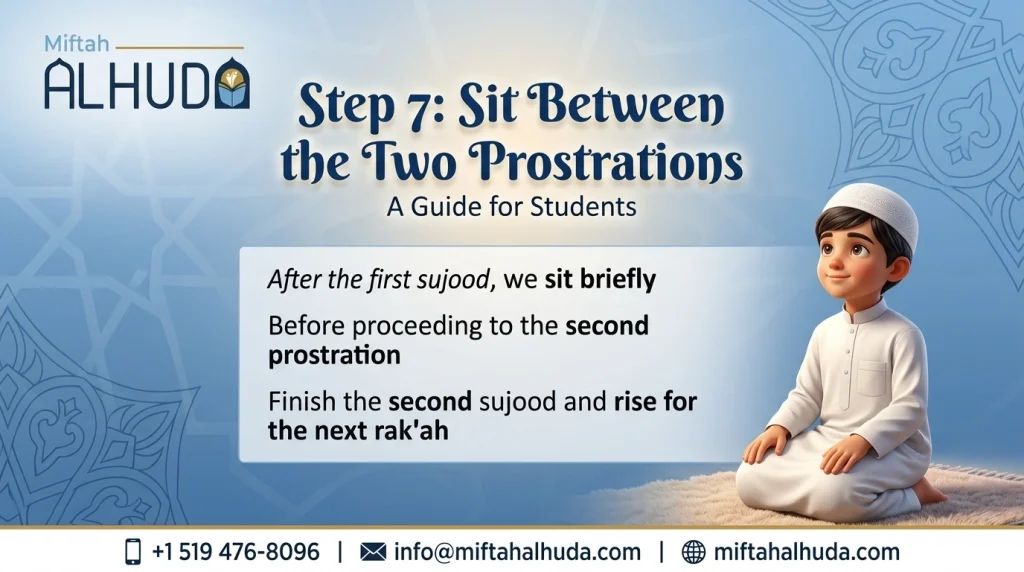
Step 7: Sit Between the Two Prostrations
After the first sujood, we sit briefly before proceeding to the second prostration. We then finish the second sujood and rise for the following rak’ah.
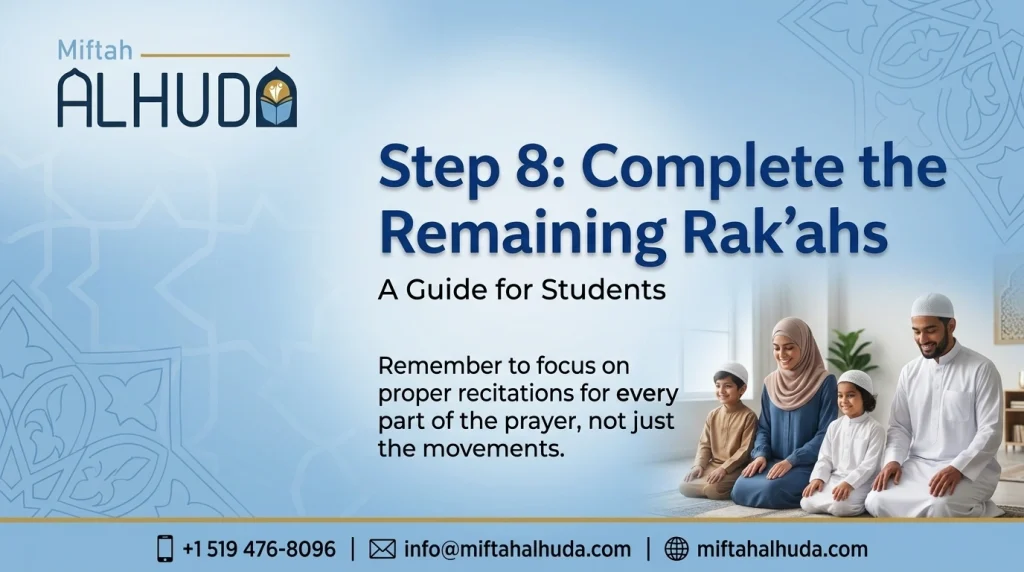
Step 8: Complete the Remaining Rak’ahs
We repeat the essential pattern based on the number of rak’ahs in the specific prayer:
| Prayer | Obligatory Rak’ahs |
| Fajr | 2 |
| Dhuhr | 4 |
| Asr | 4 |
| Maghrib | 3 |
| Isha | 4 |
We should learn not only the movements, but also the proper recitations for every part of the prayer.
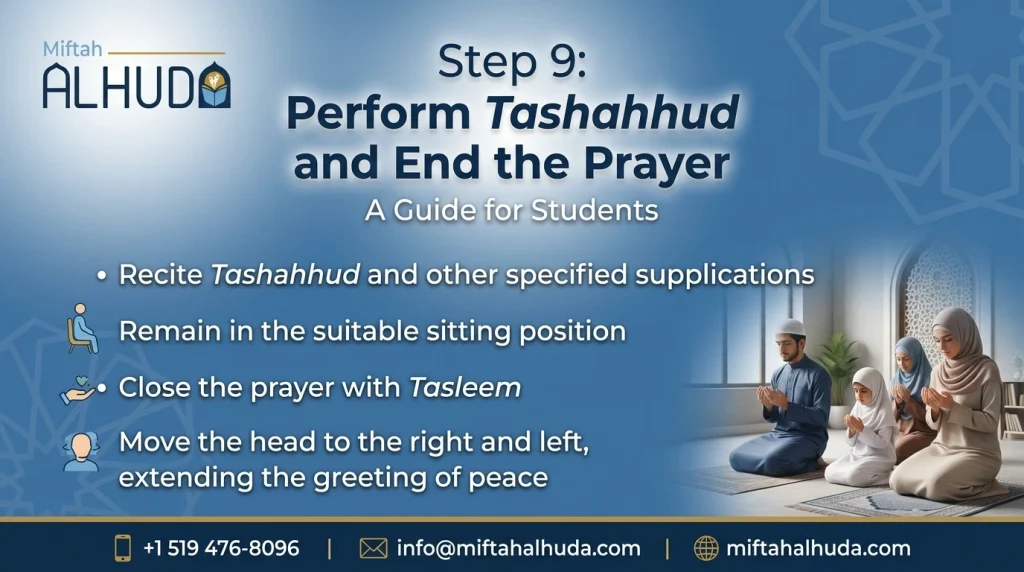
Step 9: Perform Tashahhud and End the Prayer
We recite Tashahhud and other specified supplications based on the prayer and established Sunnah while sitting in the suitable position. The prayer closes with Tasleem, which involves moving the head to the right and left while extending the appropriate greeting of peace. At this point, the official Salah has ended.
Common Salah Mistakes to Avoid
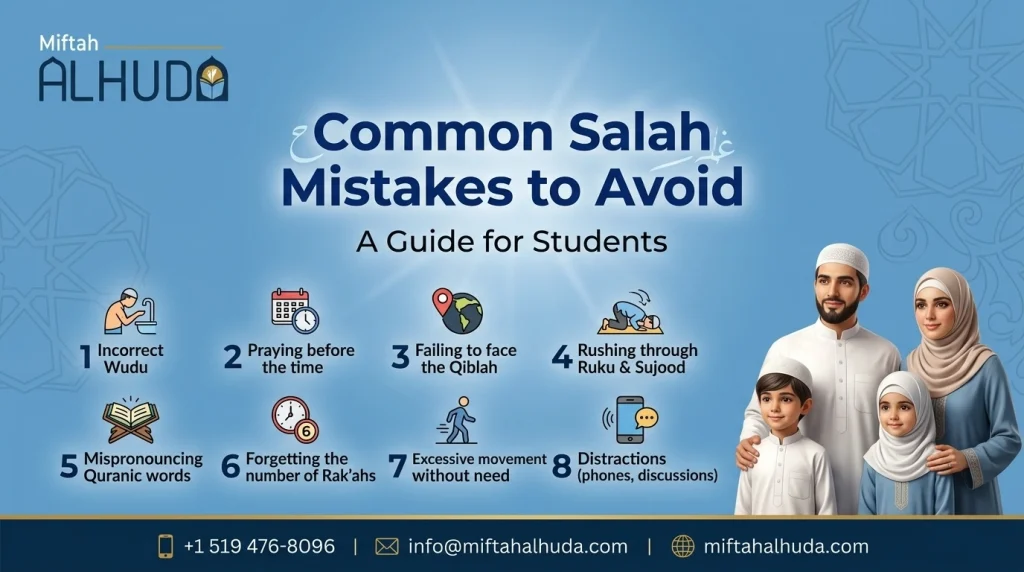
Learning correctly is easier when we understand what mistakes to avoid. Common difficulties include:
- Performing wudu incorrectly.
- Praying before the prayer time begins.
- Failing to face the Qiblah when able to do so.
- Rushing through ruku or sujood.
- Mispronouncing Quranic words.
- Forgetting the number of rak’ahs.
- Move excessively without a genuine need.
- Getting distracted by phones or discussions.
- Salah is treated as a routine rather than an act of worship.
One particularly crucial thing is to be calm when praying. This is demonstrated in the well-known hadith of the man who prayed hastily. The Prophet ﷺ instructed him three times to repeat his prayer:
Allah’s Messenger (ﷺ) entered the mosque and a person followed him. The man prayed and went to the Prophet and greeted him. The Prophet (ﷺ) returned the greeting and said to him, “Go back and pray, for you have not prayed.” The man went back prayed in the same way as before, returned and greeted the Prophet who said, “Go back and pray, for you have not prayed.” This happened thrice. The man said, “By Him Who sent you with the Truth, I cannot offer the prayer in a better way than this. Please, teach me how to pray.” The Prophet (ﷺ) said, “When you stand for Prayer say Takbir and then recite from the Holy Qur’an (of what you know by heart) and then bow till you feel at ease. Then raise your head and stand up straight, then prostrate till you feel at ease during your prostration, then sit with calmness till you feel at ease (do not hurry) and do the same in all your prayers. (Sahih al-Bukhari)
Salah should not become a race. Each position demands sufficient time to be completed properly.
Tips for Learning Salah Correctly
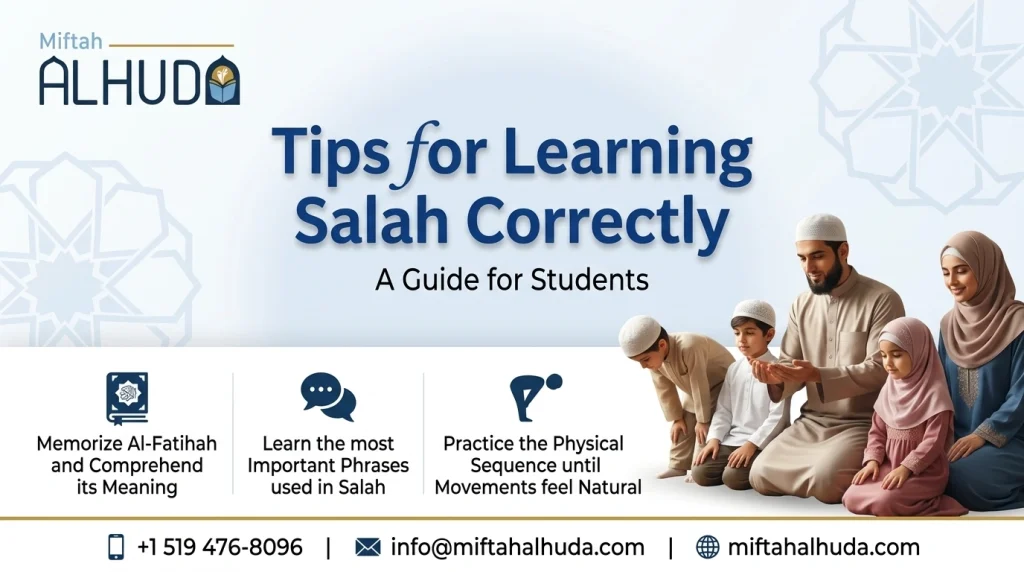
If we’re still learning, we shouldn’t try to memorize everything in one day. A realistic method is to study in stages:
- Memorize Al-Fatihah and comprehend its meaning.
- Learn the most important phrases used in Salah.
- Practice the physical sequence until the movements feel natural.
It is also beneficial to learn from a trained teacher who can spot pronunciation and movement mistakes that we may overlook. Learning Tajweed is very useful for Quranic recitation because even minor mistakes in pronunciation can alter the meaning of an Arabic word.
Conclusion
Learning Muslim Salah correctly requires knowledge, practice, sincerity, and patience. We start with purification and prayer periods, then master the necessary movements and recitations before gradually enhancing our concentration and knowledge.
Whether we are new to Salah or simply want to improve our prayer, regular learning can change how we approach this important act of worship.
Most importantly, we should not be discouraged by mistakes as we learn. With consistent practice, qualified instruction, and serious desire, we can enhance our Salah and perform it with greater confidence, correctness, and khushu, recalling Allah’s promise:
“And establish prayer and give zakah and bow with those who bow [in worship and obedience].” (Surah Al-Baqarah, 2:43)
Ready to learn how to pray Salah step by step? Join Miftah Al-Huda Academy and build your confidence in performing Salah correctly with guided online learning.
Start your free trial today and take the first step toward improving your prayer.
Contact Us
- WhatsApp: +1 519 476-8096
- E-Mail: in**@**********da.com
- Facebook: https://www.facebook.com/MiftahAlhudaOfficial
- Instagram: https://www.instagram.com/miftahalhudaa
- Youtube: https://www.youtube.com/@MiftahAl-huda
- Tiktok: https://www.tiktok.com/@miftahalhuda00
Frequently Asked Questions About Muslim Salah
1. What should we learn first when learning Salah?
We should start with the fundamentals of prayer, including wudu, Al-Fatihah, important prayer phrases, and the proper movement sequence.
2. Can we pray Salah without knowing Arabic?
A person learning to pray should focus on memorizing the required Arabic recitations. Islam gives instruction to people who are still learning, and they should keep studying until they can do the prescribed recitations.
3. Why is wudu important before Salah?
Wudu, a ritual purification for prayer, prepares us physically and spiritually for worship, as taught by the Prophet (ﷺ).
4. What is khushu in Salah?
Khushu refers to humility, concentration, and a focused heart during worship, which are mentioned in the Quran as defining characteristics of successful believers (Surah al-Mu’minun).
5. How can we become more confident in performing Salah?
The best way is consistent practice paired with reliable instruction, following the Prophet’s ﷺ method of correcting the prayer step by step, as evidenced in the hadith of the man who prayed hastily.