
Islam is based on a clear and strong basis known as the 5 Arkan of Islam, or the Five Pillars of Islam. These five important acts of worship establish a Muslim’s relationship with Allah, deepen faith, promote discipline, and provide guidance in daily life.
The Five Pillars include Shahada, Salah, Zakat, Sawm, and Hajj. Each pillar has a specific purpose, but they work together as the supporting columns of a solid building. Understanding them enables us to grasp not just what Muslims do, but also the basic spiritual principles that support Islamic worship.
At Miftah Al-Huda Academy, we believe that understanding the Five Pillars is the first step in every learner’s journey to a greater connection with Allah. This guide represents our mission of making Islamic knowledge clear, accessible, and grounded in real understanding.
What Are the 5 Arkan of Islam?
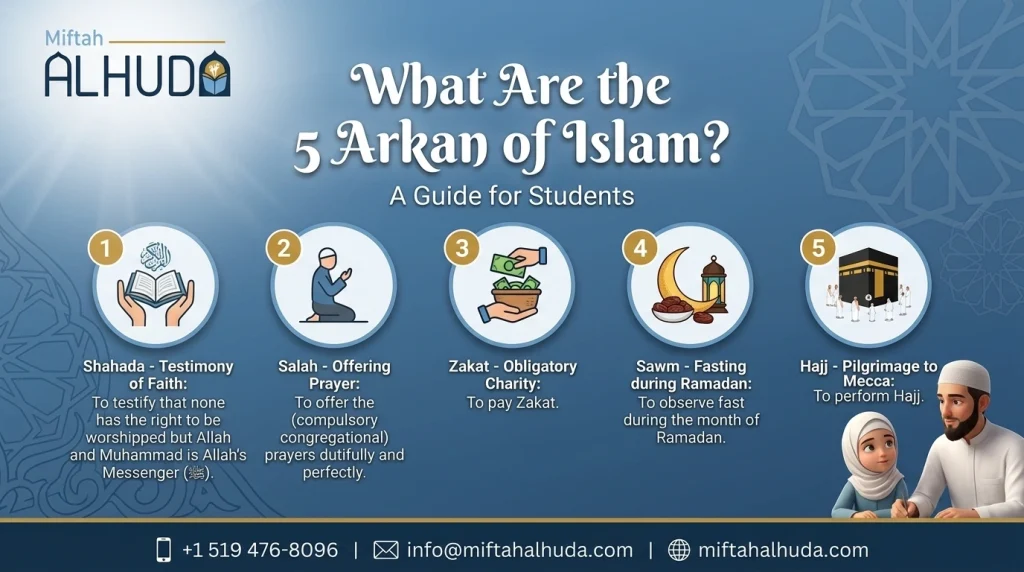
Narrated Ibn ‘Umar: Allah’s Messenger (ﷺ) said: Islam is based on (the following) five (principles):
- To testify that none has the right to be worshipped but Allah and Muhammad is Allah’s Messenger (ﷺ).
- To offer the (compulsory congregational) prayers dutifully and perfectly.
- To pay Zakat (i.e. obligatory charity) .
- To perform Hajj. (i.e. Pilgrimage to Mecca)
- To observe fast during the month of Ramadan.
(Sahih al-Bukhari 8)
When the conditions are met, Muslims must follow these 5 arkan of islam. They work together to connect belief and action.
Why Are the Five Pillars Important?
In Islam, faith is more than just heartfelt beliefs. Islamic worship includes words, acts, sacrifice, discipline, and accountability. The Five Pillars provide a practical framework within which Muslims can express their faith.
They teach us to remember Allah on a regular basis, care for others, manage our desires, and acknowledge our reliance on our Creator.
1. Shahada: The Declaration of Faith
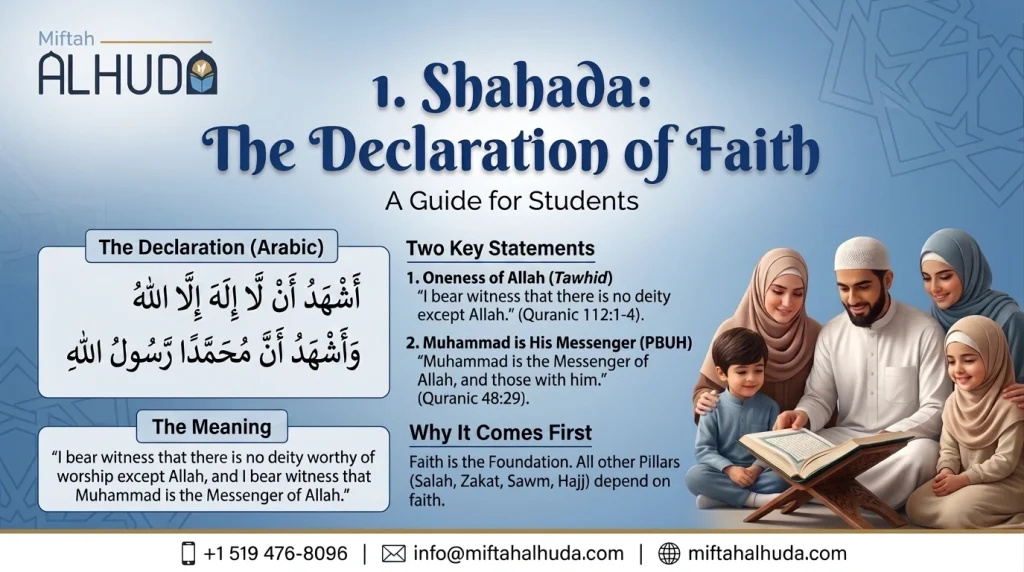
The Shahada is the first of the Five Pillars and serves as the foundation for Islamic belief.
The declaration is:
Ashhadu an la ilaha illa Allah, wa ashhadu anna Muhammadan rasul Allah.
It means:
“I bear witness that there is no deity worthy of worship except Allah, and I bear witness that Muhammad is the Messenger of Allah.”
The Meaning of Shahada
The Shahada has two important statements. First, it emphasizes Allah’s oneness and rejects the worship of anything other than Him. Second, it affirms Prophet Muhammad ﷺ as Allah’s Messenger.
Allah says in the Qur’an:
Allah witnesses that there is no deity except Him, and [so do] the angels and those of knowledge – [that He is] maintaining [creation] in justice. There is no deity except Him, the Exalted in Might, the Wise. (Surah Aal-‘Imran, 3:18)
And He says:
So know, [O Muhammad], that there is no deity except Allah and ask forgiveness for your sin and for the believing men and believing women. And Allah knows of your movement and your resting place.(Surah Muhammad, 47:19)
Why Shahada Comes First?
Faith is the foundation for all other pillars. Salah is performed by Muslims based on faith, as is Zakat, fasting, and Hajj.
Shahada serves as the foundation for the other pillars.
2. Salah: The Five Daily Prayers
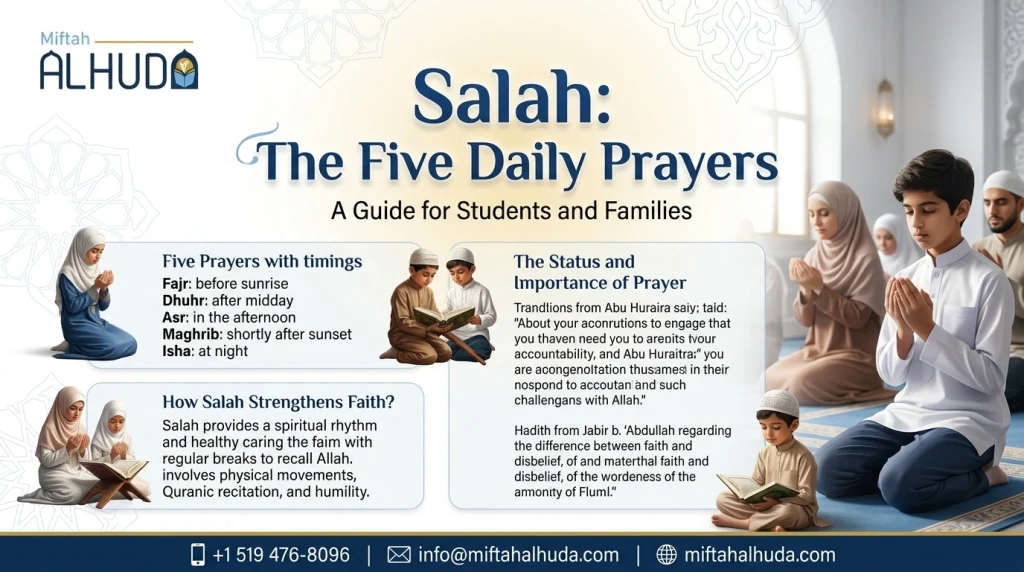
Salah, or Islamic prayer, is Islam’s second pillar. Muslims are obligated to do five obligatory prayers every day.
Allah commands in the Qur’an:
“And establish prayer and give zakah and bow with those who bow [in worship and obedience].” (Surah Al-Baqarah, 2:43)
There are five prayers:
- Fajr: before sunrise
- Dhuhr: after midday
- Asr: in the afternoon
- Maghrib:shortly after sunset
- Isha: at night
How Salah Strengthens Faith?
Salah allows Muslims to take regular breaks from worldly activities to recall Allah. Whether working, studying, traveling, or managing a busy family life, the five prayers provide a spiritual rhythm throughout the day.
The prayer involves physical movements with Quranic recitation, supplication, humility, and remembrance.
The Status and Importance of Prayer
The First Thing a Servant Is Held Accountable For: Abu Huraira told of hearing God’s Messenger say, “The first of his deeds for which a man will be taken into account on the day of resurrection will be his prayer. If it is sound he will be saved and successful, but if it is unsound he will be unfortunate and miserable.
The Difference Between Faith and Disbelief: It is narrated on the authority of Abu Zubair that he heard Jabir b. ‘Abdullah saying. I heard the Messenger of Allah (may peace and blessings be upon him) observing this: Between man and polytheism and unbelief is the abandonment of salat. (Sahih Muslim)
3. Zakat: Obligatory Charity
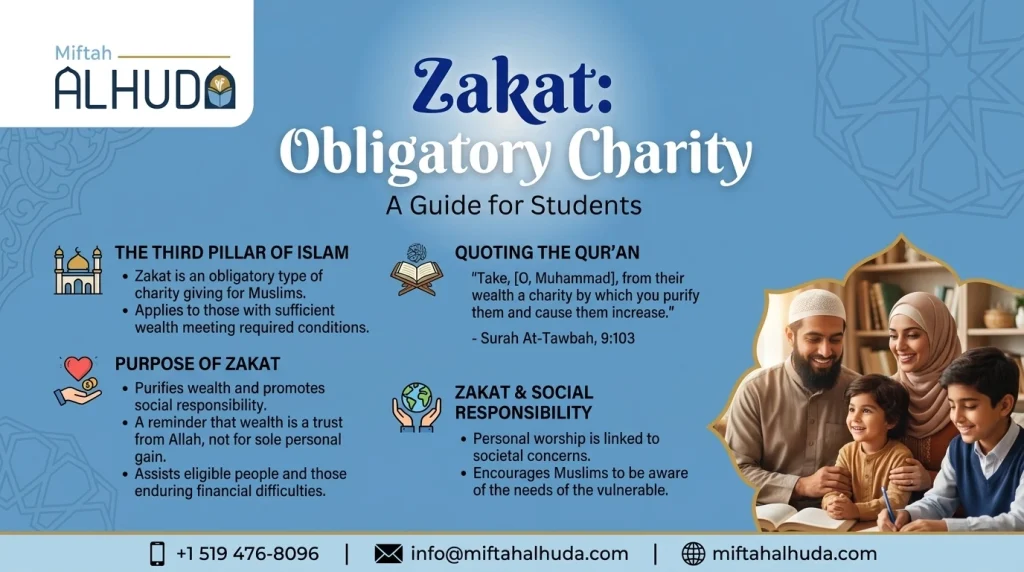
The third of the 5 Arkan of Islam is Zakat. Zakat is an obligatory type of charity giving for Muslims who have sufficient wealth and meet the required conditions.
Allah says in the Qur’an:
“Take, [O, Muhammad], from their wealth a charity by which you purify them and cause them increase .” (Surah At-Tawbah, 9:103)
What Is the Purpose of Zakat?
Zakat purifies wealth and promotes social responsibility. It reminds Muslims that wealth is ultimately a trust from Allah, not something that exists solely for personal gain.
It also assists eligible people enduring financial difficulties, as well as other groups defined in Islamic law.
Zakat and Social Responsibility
Personal worship is fundamentally linked to societal concerns. Zakat encourages Muslims to be aware of the needs of others.
A powerful Muslim community is more than just a group of wealthy individuals. It is one in which people appreciate their obligations to those who are vulnerable.
Zakat Is More Than Giving Money
Zakat emphasizes generosity and detachment from material possessions on a fundamental level. It challenges the idea that personal wealth should be at the core of one’s life.
4. Sawm: Fasting During Ramadan
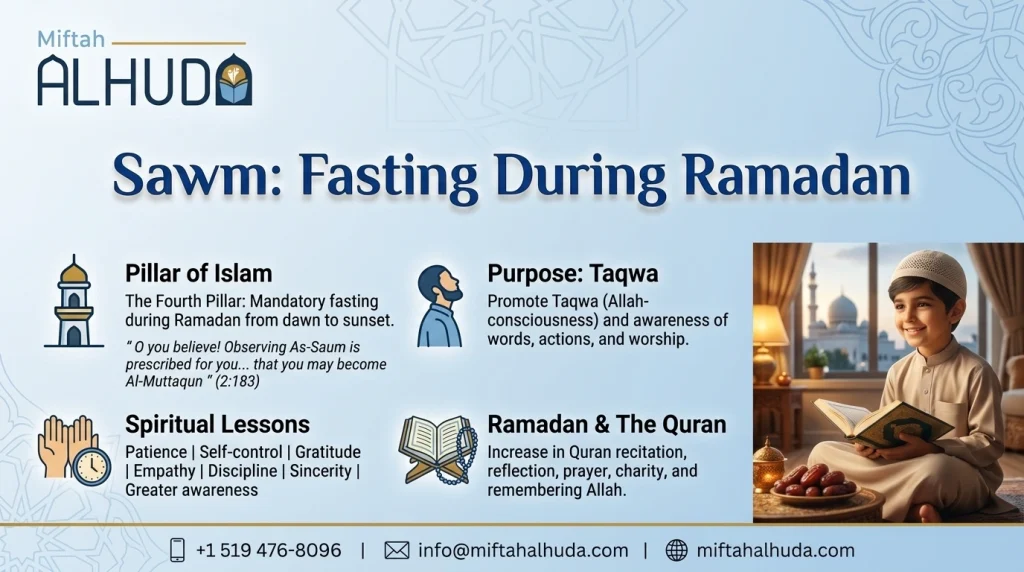
The fourth pillar is Sawm, which includes the mandatory fasting performed during the month of Ramadan.
Muslims fast from dawn to sunset, fasting from eating and drink, as well as any other acts that can invalidate the fast.
Allah says in the Qur’an:
” O you who believe! Observing As-Saum (the fasting) is prescribed for you as it was prescribed for those before you, that you may become Al-Muttaqun “ (Surah Al-Baqarah, 2:183)
What Is the Purpose of Ramadan Fasting?
Fasting is not just about feeling hungry. Its purpose is to promote Taqwa, or Allah-consciousness and awareness.
Ramadan urges Muslims to be more observant of their words, actions, worship, and relations with others.
Spiritual Lessons of Sawm
Fasting teaches a number of essential qualities:
- Patience
- Self-control
- Gratitude
- Empathy
- Discipline
- Sincerity
- Greater awareness of Allah
Think about having something you regularly take for granted and willingly giving it up for a greater purpose. This is one of the most effective things fasting can offer.
Ramadan and the Quran
Ramadan has a special connection with the Quran. During this month, Muslims tend to increase their Quran recitation, reflection, prayer, charity, and Allah remembering.
Many Muslims regard Ramadan as an annual opportunity to recharge spiritually and create habits that will last beyond the month.
5. Hajj: The Pilgrimage to Makkah
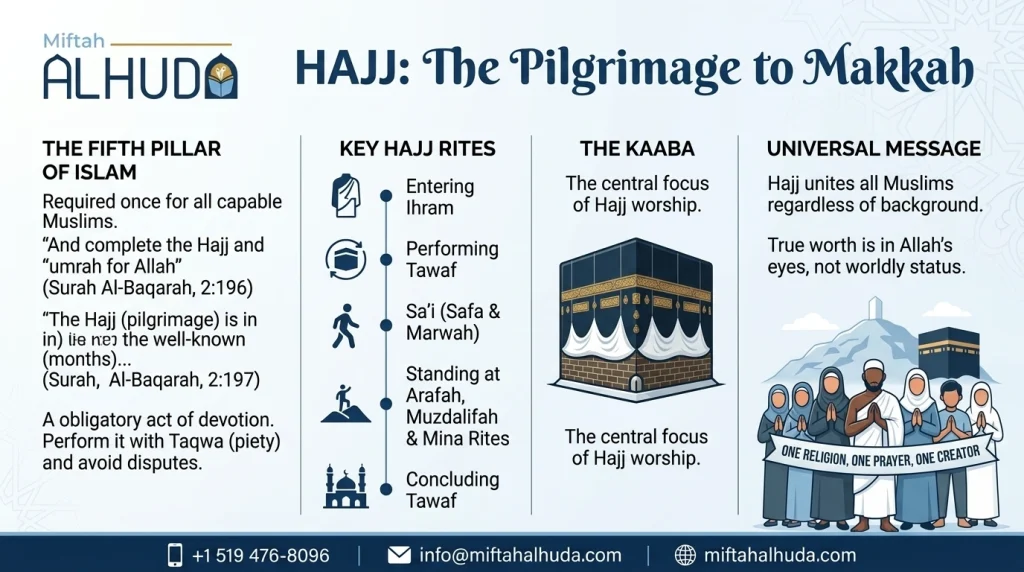
The fifth pillar is Hajj, the pilgrimage to Makkah. It is obligatory once in a Muslim’s lifetime for those who are physically and financially capable of performing it and meet the necessary requirements.
Allah says in the Qur’an:
“And complete the Hajj and ‘umrah for Allah.” (Surah Al-Baqarah, 2:196)
“The Hajj (pilgrimage) is (in) the well-known (lunar year) months (i.e. the 10th month, the 11th month and the first ten days of the 12th month of the Islamic calendar, i.e. two months and ten days). So whosoever intends to perform Hajj therein by assuming Ihram), then he should not have sexual relations (with his wife), nor commit sin, nor dispute unjustly during the Hajj. And whatever good you do, (be sure) Allah knows it. And take a provision (with you) for the journey, but the best provision is At-Taqwa (piety, righteousness, etc.). So fear Me, O men of understanding!” (Surah Al-Baqarah, 2:197)
What Happens During Hajj?
Hajj is performed during the Islamic month of Dhul-Hijjah and involves:
- Entering the state of Ihram
- Performing Tawaf around the Kaaba
- Performing Sa’i between Safa and Marwah
- Standing at Arafah
- Spending time at Muzdalifah
- Performing the rites associated with Mina
- Completing the relevant concluding rites of the pilgrimage
The Universal Message of Hajj
The Hajj unites Muslims from many countries, cultures, languages, and social backgrounds together for worship.
The pilgrimage exemplifies a powerful principle: a person’s spiritual worth is determined by Allah, not his or her worldly standing.
Millions of Muslims can unite for a common goal, facing the same direction and worshiping the same Creator.
How the 5 Arkan of Islam Work Together?
The Five Pillars are not distinct practices. They constitute an integrated system.
- Shahada establishes belief.
- Salah keeps a daily connection with Allah.
- Zakat promotes responsibility for others.
- Sawm fosters self-control and Taqwa.
- Hajj represents devotion, sacrifice, unity, and obedience.
Collectively, these practices address several aspects of a Muslim’s life.
Faith and Action
One of the most crucial lessons from the Five Pillars is the connection between belief and practice.
A person may grasp Islamic teachings intellectually, but devotion transforms them into real experience.
For example, belief in Allah motivates us to pray. Believing that wealth is a trust motivates us to give. Believing that Allah is aware of our deeds pushes us to be sincere and self-controlled.
How Can Children Learn the Five Pillars?
Teaching children about the 5 Arkan of Islam can start with basic explanations and practical examples.
Instead than forcing children to recall definitions alone, we can connect each pillar with a common concept:
- Shahada: What do we believe?
- Salah: How do we worship Allah every day?
- Zakat: How do we help others?
- Sawm: How do we practice patience and self-control?
- Hajj: How do Muslims demonstrate unity and devotion?
Miftah Al-Huda Academy makes use of stories, age-appropriate activities, visual charts, and regular revision to make Islamic learning more meaningful and accessible for every student.
Conclusion
The 5 Arkan of Islam Shahada, Salah, Zakat, Sawm, and Hajj form the foundation of Islamic practice. Each pillar has a distinct purpose, yet all five point to a same goal: living in faith, worship, obedience, responsibility, and awareness of Allah.
We can have a greater appreciation for Islamic worship by comprehending the significance behind each pillar rather than simply remembering their names. Whether we are starting our Islamic studies or renewing basic knowledge, the Five Pillars are an important starting point for understanding Islam and putting its teachings into practice.
Want to Learn the Five Pillars in Depth?
Understanding the 5 Arkan of Islam is just the beginning. At Miftah Al-Huda Academy, our islamic courses go deeper into each pillar covering their meanings, evidence from the Quran and Sunnah, and how to apply them in daily life.
Book your free trial class today and start building a solid foundation in the Five Pillars of Islam with guidance from qualified teachers.
Contact Us
- WhatsApp: +1 519 476-8096
- E-Mail: in**@**********da.com
- Facebook: https://www.facebook.com/MiftahAlhudaOfficial
- Instagram: https://www.instagram.com/miftahalhudaa
- Youtube: https://www.youtube.com/@MiftahAl-huda
- Tiktok: https://www.tiktok.com/@miftahalhuda00
Frequently Asked Questions About the 5 Arkan of Islam
1. Are the Five Pillars the Foundation of Islam?
Yes. They are the five foundational practices known as the Five Pillars of Islam. They establish a framework for fundamental acts of worship and religious practice.
2. Does Every Muslim Have to Perform Hajj?
Hajj is a once-in-a-life obligation for Muslims who are able to participate and complete the necessary requirements. Physical and financial abilities are critical concerns.
3. Is Zakat the Same as Voluntary Charity?
No. Zakat is an obligatory form of donating for Muslims who meet the rules, although voluntary charity, also known as Sadaqah, is broader and extends beyond Zakat.
4. Why Do Muslims Fast During Ramadan?
Muslims fast during Ramadan as a form of worship and submission to Allah. Fasting also promotes Taqwa, patience, gratitude, self-control, and awareness of others’ needs.
5. Do the Five Pillars Cover Everything in Islam?
The Five Pillars are essential, but Islam includes much more. Islamic teachings cover a wide range of matters, including belief, morality, family life, justice, personal conduct, communal responsibilities, and many others.