
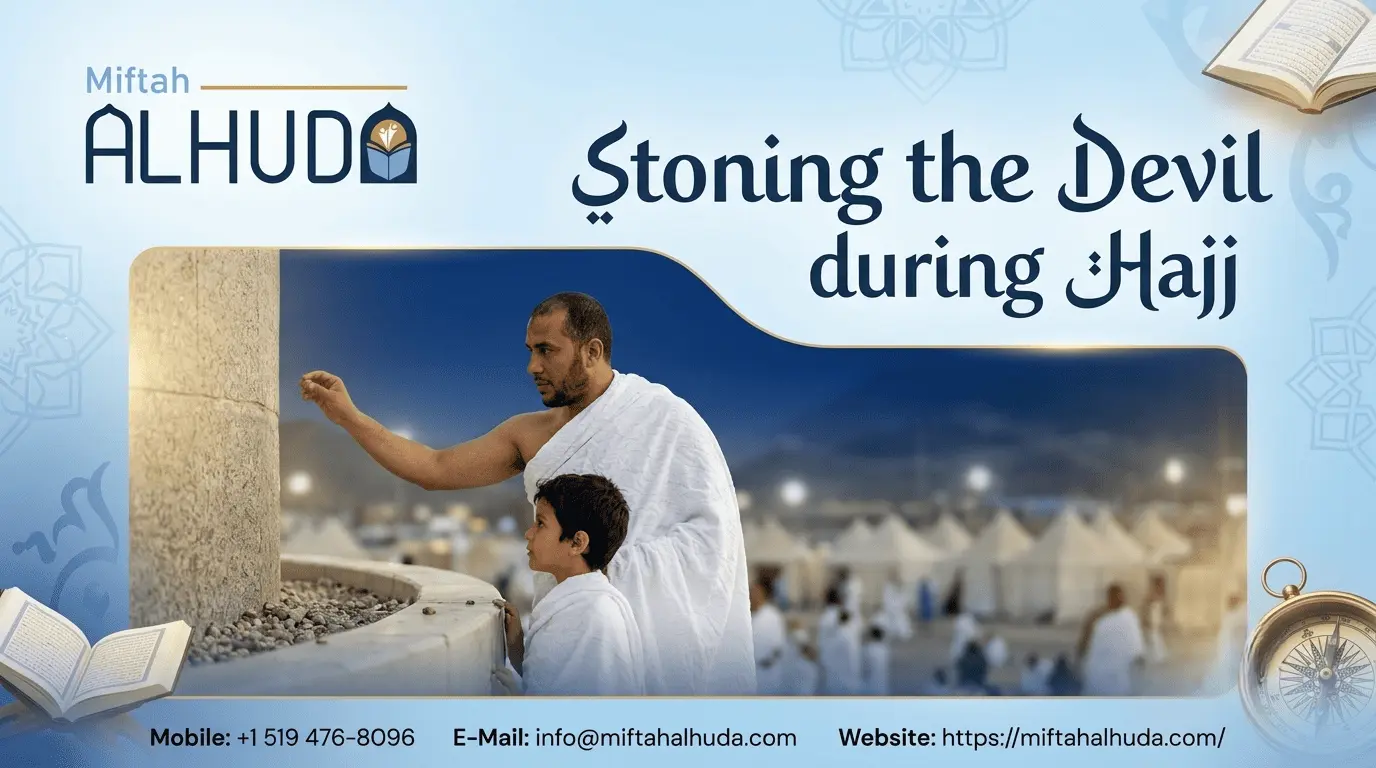
Imagine a pilgrim on Eid morning. He has barely slept in two days. He stood at Arafah until dusk and spent the night on the ground at Muzdalifah. Now he holds seven small pebbles in his palm and walks toward a long stone wall in Mina, surrounded by hundreds of thousands of others doing the same. He raises his hand, says “Allahu Akbar,” and throws.
From the outside, it looks like the simplest act of the whole pilgrimage. Beneath it lie four thousand years of history, a precise set of legal conditions, and one of the most personal spiritual lessons Hajj can offer.
Most English speakers know this rite as stoning the devil during Hajj. The name captures something real, but it also causes misunderstandings. Some pilgrims believe Satan is physically trapped inside the pillars. Others throw large rocks and shout curses. Many have no idea how many pebbles to throw, when the valid time begins, or what to do if an elderly parent cannot reach the Jamarat at all.
In this guide, Miftah Al-Huda Academy takes you through the rite from its origins to its practical details: what the name really means, what the Quran and Sunnah teach, how the four schools rule on key questions, and how to perform each throw correctly and safely. Where scholars disagree, we say so clearly, so you can follow your school with confidence.
Learn your deen with a qualified teacher — Explore Fiqh Classes →What Is the Stoning of the Jamarat?

In Islamic law the rite is called ramy al-jamarat, “throwing at the Jamarat.” The word jamrah (plural jamarat) originally meant a small pebble. It came to mean the place where pebbles are thrown, and the gathering of pebbles there.
There are three Jamarat in Mina, along the road between Muzdalifah and Makkah:
| Name | Also Called | Position | When It Is Stoned |
| Jamrat al-Sughra | Al-Jamrah al-Ula (the First) | Closest to Masjid al-Khayf, farthest from Makkah | Days of Tashriq only |
| Jamrat al-Wusta | The Middle Jamrah | Between the other two | Days of Tashriq only |
| Jamrat al-Aqabah | Al-Jamrah al-Kubra (the Great) | At the edge of Mina, closest to Makkah | Day of Sacrifice and Days of Tashriq |
Jamrat al-Aqabah has a unique status. It is the only Jamrah stoned on the 10th of Dhul Hijjah, and it opens the rites of the Day of Sacrifice. On the Days of Tashriq, all three are stoned in sequence.
Is “Stoning the Devil” an Accurate Name?

The phrase stoning the devil during Hajj is common in English-language media, travel writing, and Muslim guidebooks. It is worth considering what it gets right and what it gets wrong.
What the Name Gets Right?
The rite does commemorate an encounter with Satan. According to a well-known report from Abdullah ibn Abbas, Satan appeared to Prophet Ibrahim (peace be upon him) at the three Jamarat sites, and Ibrahim drove him away with pebbles each time. Ibn Abbas then said that you stone Satan and follow the way of your father Ibrahim. So the link between the Jamarat and Satan has a solid basis in early Muslim tradition.
What the Name Gets Wrong?
The name can suggest that Satan is physically present inside the pillars, or that the pillars are statues of him. Neither is true. The Jamarat are markers of where an event took place. They are not idols, and nothing “lives” inside them.
A more precise understanding: the pilgrim is not attacking Satan in a stone wall. He is re-enacting Ibrahim’s refusal of Satan in obedience to Allah, declaring Allah’s greatness with each throw. The real battlefield is the heart, and the pebbles are the outward sign of an inner decision.
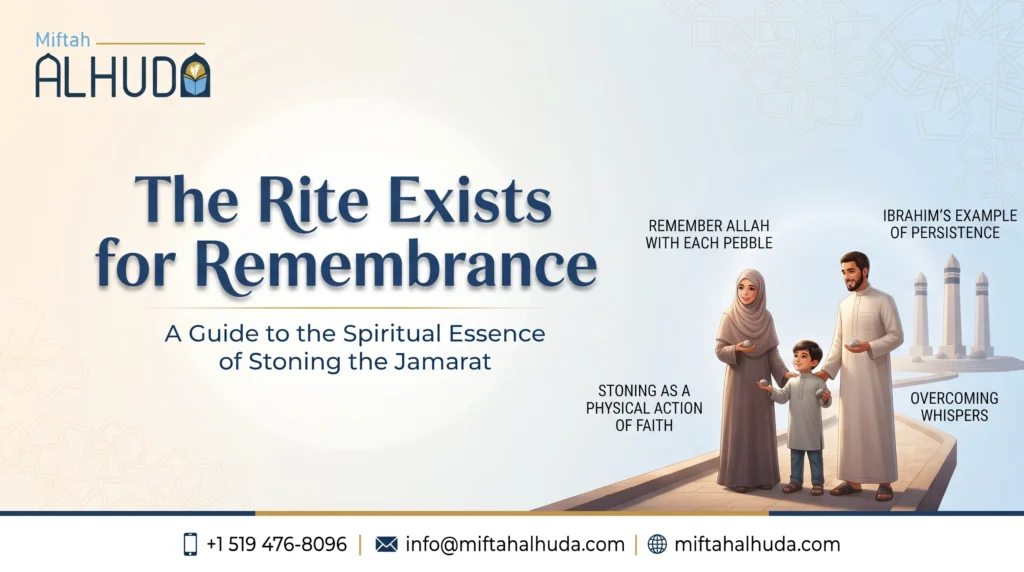
The Rite Exists for Remembrance
Narrated Aisha, Mother of the Believers:
The Messenger of Allah (ﷺ) said: “Going round the House, going between as-Safa and al-Marwah, and throwing at the Jamarat were only established for the remembrance of Allah.” (Sunan Abi Dawud 1888; Jami’ at-Tirmidhi 902)
Some hadith scholars have questioned this narration’s chain, but its meaning is supported by the whole structure of the rite, which revolves around the takbir said with each pebble.
This is the key to the whole subject. Once you understand that the essence of stoning the devil during Hajj is the remembrance of Allah, the anger, pushing, and theatrics fall away, and only worship remains.
The Story Behind the Rite: Ibrahim and Satan in Mina
The report from Ibn Abbas, recorded by Ibn Khuzaymah, al-Hakim, and al-Bayhaqi and graded authentic by several scholars, tells how Satan appeared to Ibrahim as he carried out Allah’s commands in the rites of pilgrimage.
Satan appeared at Jamrat al-Aqabah, and Ibrahim threw seven pebbles at him until he sank into the ground. Satan reappeared at the second site, and Ibrahim again threw seven pebbles. The same happened at the third. In some narrations, the encounters took place as Ibrahim set out to carry out the command he had seen in his dream concerning his son, with Satan whispering doubt at every step.
Whatever the exact details, the moral pattern is the same in every version:
- Allah gave Ibrahim a clear command.
- Satan did not attack him openly; he whispered hesitation, fear, and reasons to turn back.
- Ibrahim refused him, three times.
This is why the stoning takes place at three sites over several days. Temptation rarely comes only once. It returns, changes shape, and tries again. The believer’s response must be as persistent as the whisper.
The Quran on Satan’s Strategy
The Quran records Iblis’s declared plan in his own words:
قَالَ فَبِمَا أَغْوَيْتَنِي لَأَقْعُدَنَّ لَهُمْ صِرَاطَكَ الْمُسْتَقِيمَ ثُمَّ لَآتِيَنَّهُم مِّن بَيْنِ أَيْدِيهِمْ وَمِنْ خَلْفِهِمْ وَعَنْ أَيْمَانِهِمْ وَعَن شَمَائِلِهِمْ ۖ وَلَا تَجِدُ أَكْثَرَهُمْ شَاكِرِينَ
“[Iblis] said: Because You have put me in error, I will surely sit in wait for them on Your straight path. Then I will come to them from before them and from behind them and on their right and on their left, and You will not find most of them grateful [to You].” (Surah al-A’raf, 7:16–17)
He sits on the straight path itself. He does not wait in places of sin where people have already given him their loyalty; he waits on the road of obedience, exactly where Ibrahim was walking. Every pilgrim in Mina is on that road.
Allah also commands us directly how to treat this enemy:
Live 1-to-1 classesLearn it properly, with a real teacherCertified teachers · Flexible times · Free trial classExplore Fiqh Classes →إِنَّ الشَّيْطَانَ لَكُمْ عَدُوٌّ فَاتَّخِذُوهُ عَدُوًّا ۚ إِنَّمَا يَدْعُو حِزْبَهُ لِيَكُونُوا مِنْ أَصْحَابِ السَّعِيرِ
“Indeed, Satan is an enemy to you; so take him as an enemy. He only invites his party to be among the companions of the Blaze.” (Surah Fatir, 35:6)
The Jamarat are where that command becomes a physical action.
The Legal Status of the Stoning
All four schools agree that stoning the Jamarat is an obligatory act (wajib) of Hajj, not a pillar (rukn). The distinction matters:
- If a pillar is missed, such as standing at Arafah, the Hajj is invalid.
- If an obligatory act is missed and not made up in time, the Hajj remains valid, but an expiation is required, usually a sacrifice (dam) slaughtered in the Haram and given to the poor.
So a pilgrim who could not stone because of illness or crowding has not lost his Hajj. At the same time, no one should treat stoning as optional. The Prophet ﷺ stoned on the Day of Sacrifice and on each day of his stay in Mina.
Abu az-Zubayr narrated that he heard Jabir ibn Abdullah say: “I saw the Messenger of Allah stoning the Jamrah while on his camel, saying: ‘O people, learn your rites, for I do not know whether I will perform Hajj after this year.'” (Sunan an-Nasa’i 3062)
That he said this at the Jamarat is a fitting reminder to every pilgrim standing there.
How Many Pebbles, and When?
The table below shows the complete stoning schedule.
| Day | Jamarat Stoned | Pebbles | Time (Majority View) |
| 10 Dhul Hijjah (Day of Sacrifice) | Jamrat al-Aqabah only | 7 | Sunnah: after sunrise, in the forenoon |
| 11 Dhul Hijjah | Sughra, then Wusta, then Aqabah | 21 (7 each) | After midday (zawal) |
| 12 Dhul Hijjah | Sughra, then Wusta, then Aqabah | 21 (7 each) | After midday |
| 13 Dhul Hijjah (if staying) | Sughra, then Wusta, then Aqabah | 21 (7 each) | After midday |
| Total | 49 if hastening, 70 if staying |
Jabir narrated: “The Prophet stoned on the Day of Sacrifice in the forenoon, and on the days after it, after the sun had passed its zenith.” (Jami’ at-Tirmidhi 894)
The choice between leaving on the 12th or staying until the 13th, and the sunset rule that governs it, is explained in detail in our Mina During Hajj guide.
The Pebbles: Size, Material, and Where to Get Them
How Big Should a Pebble Be?
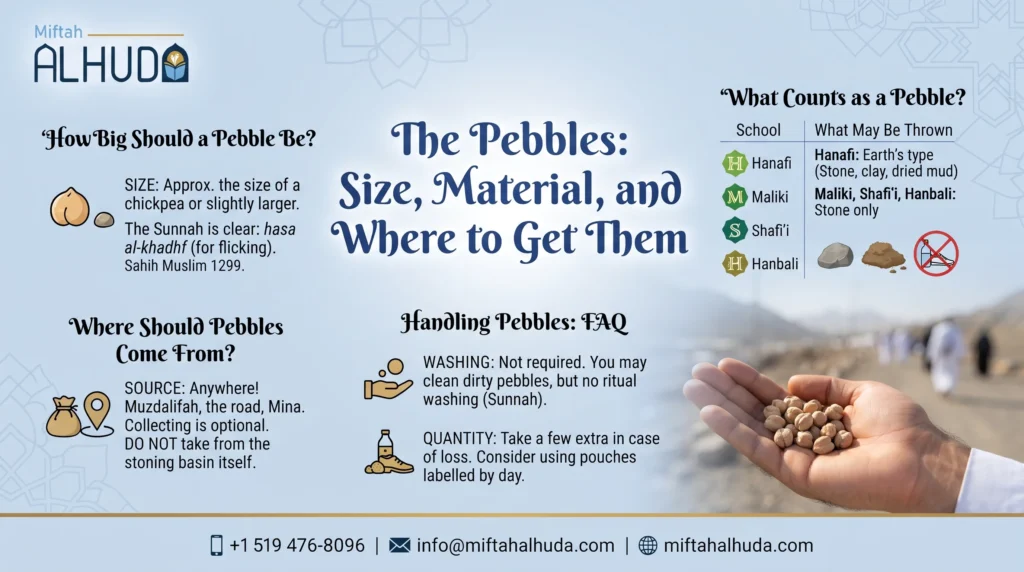
The Sunnah is clear: small pebbles, about the size of a chickpea or slightly larger. The classical term is hasa al-khadhf, the kind of pebble a person flicks between thumb and forefinger.
Jabir ibn Abdullah reported: I saw the Messenger of Allah (ﷺ) throwing at the Jamrah with pebbles the size used for flicking. (Sahih Muslim 1299)
The Prophet ﷺ linked pebble size to a larger principle. When pebbles of this size were placed in his hand, he said “like these,” and then warned against extremism in religion, because it destroyed those who came before (Sunan an-Nasa’i 3057).
Umm Jundub al-Azdiyyah heard the Prophet ﷺ say, while he was at the bottom of the valley: “O people, do not kill one another; when you throw at the Jamrah, throw small pebbles.” (Sunan Abi Dawud 1966)
Pebble size is a matter of both Sunnah and safety. A large stone thrown from the back of a dense crowd can cause serious injury.
What Counts as a Pebble?
| School | What May Be Thrown |
| Hanafi | Anything of the earth’s type: stone, clay, dried mud, and similar |
| Maliki | Stone only |
| Shafi’i | Stone only |
| Hanbali | Stone only |
All schools agree that throwing bottles, umbrellas, shoes, coins, or other objects does not count. Such items have no place in the rite, and throwing them harms other pilgrims.
Where Should Pebbles Come From?
Pebbles can be collected anywhere: Muzdalifah, the road, or Mina. Our Muzdalifah During Hajj guide explains why collecting them there is convenient but optional.
Most scholars advise against taking pebbles from the stoning basin itself. Pebbles in the basin have already been used for the rite; many scholars disliked reusing them, and some considered it invalid. Since pebbles are plentiful elsewhere, there is no reason to take them from the basin.
Do You Need to Wash Them?
No. Washing pebbles is not part of the Sunnah. If a pebble is dirty you may clean it, but there is no ritual washing.
How Many to Carry?
If you collect all your pebbles at once, take a few extra in case some fall or miss. Many pilgrims keep each day’s pebbles in a separate small pouch labelled by day, so they never have to count in the crowd.
7 Conditions for a Valid Throw

This is the most technical part of the rite, and many sincere pilgrims make avoidable mistakes. Scholars list several conditions for each throw to count.
- It must be thrown: According to most scholars, placing a pebble in the basin or dropping it from directly above does not count as throwing. The act is called ramy, “throwing.”
- Each pebble must be thrown separately: If you throw all seven pebbles in one handful, the majority count it as a single throw. You then simply throw six more, one at a time.
- The pebble must land in the basin: The target is the basin (al-marma) around the pillar, not the pillar itself. A pebble that strikes the wall and falls into the basin counts. A pebble that lands in the basin without touching the wall also counts. A pebble that misses the basin does not count and must be replaced.
- You must be reasonably sure it landed: If you are not sure a pebble reached the basin, throw another. Don’t let this become obsessive: if you saw it fly toward the basin normally, act on that strong likelihood.
- The pebble must be the right material: As explained in the table above.
- It must be thrown within the valid time: As explained in the next section.
- The order must be kept on the Days of Tashriq: The majority (Maliki, Shafi’i, and Hanbali) consider the sequence Sughra, Wusta, Aqabah a condition. If you stone them out of order, you must redo the stoning from the point where the order broke. The Hanafi school considers the order a Sunnah, so breaking it is disliked but the stoning still counts.
A Practical Note on Distance
Many pilgrims think they must reach the front of the crowd and stand right next to the wall. They do not. Every pebble that lands in the basin counts, and today’s basins are very large. You can throw from several metres away as long as you aim carefully. Pushing to the front for a “better” throw endangers you and others and adds nothing to the validity of the rite.
Timings: When Does the Valid Window Open and Close?
Timing questions cause more anxiety than almost anything else about stoning the devil during Hajj, mainly because groups follow official schedules that may differ from what pilgrims read in books. The schools differ, and those differences provide real flexibility.
The Day of Sacrifice (10th)
| School | Earliest Valid Time for Jamrat al-Aqabah |
| Hanafi | From true dawn on the 10th |
| Maliki | From true dawn on the 10th |
| Shafi’i | After the middle of the night before the 10th |
| Hanbali | After the middle of the night before the 10th |
The Sunnah, as Jabir described, is to stone after sunrise in the forenoon. In the Shafi’i and Hanbali views, which many Hajj groups follow, the weak and elderly who leave Muzdalifah after midnight, and those accompanying them, may stone earlier.
Ata’ said: Someone told me that Asma’ threw at the Jamrah at night. I said: We threw at night. She said: We used to do so in the lifetime of the Messenger of Allah (ﷺ). (Sunan Abi Dawud 1943)
Stoning After Sunset
Can a pilgrim stone Jamrat al-Aqabah after sunset on the 10th, or stone in the evening on the Days of Tashriq? Ibn Abbas reported that the Prophet ﷺ was being asked questions on the Day of Sacrifice at Mina and kept saying, “No harm.” A man asked, “I threw after evening had come,” and he replied, “No harm.” (Sahih al-Bukhari 1735). On this basis, and given the dangers of daytime crowding, many contemporary scholars permit stoning at night, with the night counted as belonging to the day before it. Many Hajj groups now schedule evening and night stoning for exactly this reason.
The Days of Tashriq (11th, 12th, and 13th)
The majority hold that stoning on these days begins after the sun passes its zenith (zawal), at the start of Dhuhr time, following the Prophet’s practice. In this view, stoning before midday on these days is invalid. A narration from Imam Abu Hanifa permits stoning before midday on the day of departure (yawm al-nafr), and some early and contemporary scholars have allowed it more broadly in times of severe crowding. If your group’s schedule raises this question, ask its scholar rather than deciding on your own.
Delaying and Combining Days
The Prophet ﷺ allowed the camel herders to stone on the Day of Sacrifice and then combine the stoning of the next two days on one of them (Sunan Abi Dawud 1975; Jami’ at-Tirmidhi 955). On the basis of this concession, most scholars allow a pilgrim with a genuine need to delay his stoning and make it up on a later Day of Tashriq, provided he does so before the end of the 13th. When combining, he completes the earlier day’s stoning (Sughra, Wusta, and Aqabah) before starting the next day’s.
The Maliki school is stricter here: stoning after its own day counts as a make-up, and a sacrifice may be due for the delay.
Step by Step: How to Perform the Stoning
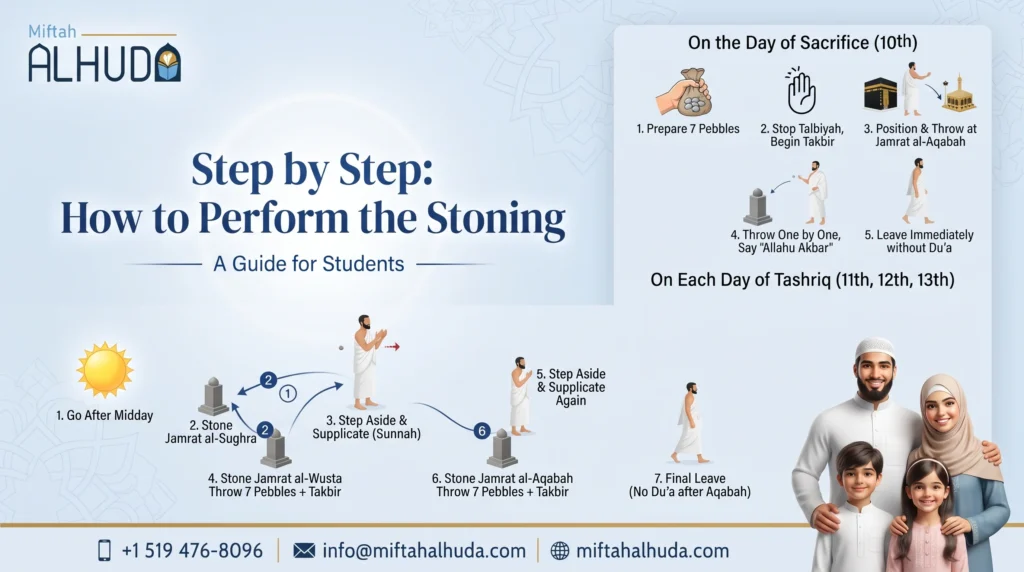
The method below is based mainly on Jabir’s description of the Farewell Pilgrimage in Sahih Muslim (1218) and Abdullah ibn Umar’s detailed account in Sahih al-Bukhari (1751–1753).
On the Day of Sacrifice (10th)
Step 1. Have your pebbles ready: Before entering the crowded area, keep seven pebbles in a pouch or in your hand. Don’t block the flow of people to count them.
Step 2. Stop the talbiyah: In most schools, the talbiyah you have recited since entering ihram ends when you throw the first pebble at Jamrat al-Aqabah; from then on, the takbir with each pebble replaces it. (The Maliki school ends the talbiyah earlier, on the Day of Arafah.)
Step 3. Position yourself as the Prophet ﷺ did, if possible: Abdullah ibn Mas’ud stood with the Ka’bah on his left and Mina on his right, threw seven pebbles at Jamrat al-Aqabah, and said: “This is where the one to whom Surah al-Baqarah was revealed stood” (Sahih al-Bukhari 1749; Sahih Muslim 1296). In today’s one-way system, stay on the designated route and throw from wherever you can do so safely.
Step 4. Throw seven pebbles, one at a time: Say “Allahu Akbar” with each pebble. Raise your hand and throw; there is no need to throw hard.
Step 5. Leave without stopping to supplicate: The Prophet ﷺ did not stand for supplication after Jamrat al-Aqabah. Move on and make room for others.
Step 6. Continue the rites of the day: The sacrifice, shaving or trimming, and Tawaf al-Ifadah follow. Our guides Mina During Hajj and Ihram for Hajj cover the order of these rites and the first release from ihram.
On Each Day of Tashriq (11th, 12th, and 13th)
Step 1. Go after midday: Or at the time assigned to your group, following the rulings explained above.
Step 2. Begin with Jamrat al-Sughra: Throw your seven pebbles one at a time, saying “Allahu Akbar” with each.
Step 3. Step aside and supplicate: Ibn Umar reported that after stoning the first Jamrah, the Prophet ﷺ moved forward to level ground, stood facing the qiblah for a long time, raised his hands, and supplicated (Sahih al-Bukhari 1751). This is one of the most neglected Sunnahs of Hajj. Move away from the crowd, face the qiblah, raise your hands, and make your own dua for as long as you are able.
Step 4. Move on to Jamrat al-Wusta: Repeat the seven throws, with a takbir for each pebble.
Step 5. Move aside and supplicate again: Ibn Umar reported that after the middle Jamrah, the Prophet ﷺ moved to the left, stood facing the qiblah for a long time, raised his hands, and supplicated.
Step 6. Finish at Jamrat al-Aqabah: Throw your final seven pebbles, glorifying Allah with each.
Step 7. Leave without supplicating: As on the 10th, there is no standing dua after the Aqabah. Ibn Umar said this is how he saw the Prophet ﷺ do it.
A Simple Way to Remember the Pattern
Three Jamarat, two duas. Stone the first and supplicate. Stone the second and supplicate. Stone the last and leave.
Stoning on Behalf of Others: The Rules of Proxy (Tawkil)
Not every pilgrim can reach the Jamarat. Scholars allow a pilgrim who is genuinely unable to stone to appoint someone to stone on his behalf.
Jabir said: “We performed Hajj with the Messenger of Allah (ﷺ), and there were women and children with us. We said the talbiyah on behalf of the children and stoned on their behalf.” (Sunan Ibn Majah 3038)
The chain of this narration is weak, but scholars agree on acting on its meaning for those who cannot stone themselves.
Who May Appoint a Proxy?
- The seriously ill and hospitalized.
- Elderly people who cannot safely enter the crowd.
- Pregnant women who fear harm to themselves or their babies.
- People with disabilities who cannot reach the site.
- Young children, whose guardians stone for them.
A healthy pilgrim who simply wants to avoid the crowds may not use a proxy. Crowding is better handled by going at a quieter time, such as late evening, than by delegating the rite.
Conditions for the Proxy
According to the majority, the person throwing on someone else’s behalf must himself be performing Hajj that year. He should be a Muslim of sound mind, and children old enough to throw for themselves should be encouraged to do so.
How the Proxy Stones?
A common practice accepted by many scholars is to stone for yourself first and then for the other person at each Jamrah, before moving on to the next. For example, on the 11th:
- At Jamrat al-Sughra, throw your own seven pebbles, then seven for the person you represent.
- Step aside and supplicate.
- At Jamrat al-Wusta, throw your own seven first, then the other seven.
- Step aside and supplicate.
- At Jamrat al-Aqabah, throw your own seven, then the other seven, and leave.
Some scholars require you to finish your own full round at all three Jamarat before starting the round for someone else. Either way, the key is to complete your own stoning first, in the correct order.
Special Cases and Common Questions
“My period began. Can I still stone?”
Yes. Ritual purity is not required for stoning. A woman who is menstruating or experiencing postnatal bleeding throws the pebbles just like other pilgrims. Only tawaf is postponed until she is pure.
“I lost count and am not sure if I threw six or seven.”
Build on the number you are certain of. If you are unsure whether it was six or seven, count six and throw one more.
“I stoned the three Jamarat out of order on the 11th.”
The majority say you should go back and stone in the correct order from where it broke. For example, if you began with the Aqabah, that stoning does not count; stone the Sughra and Wusta first, then the Aqabah again.
“I missed a few pebbles at one Jamrah and only realized later.”
If the Days of Tashriq have not ended, go back and complete what you missed, along with whatever follows it in the sequence, according to the majority view. The schools differ on what expiation, if any, is owed for a few missed pebbles once the days have passed. Ask a scholar.
“I missed an entire day’s stoning.”
Make it up on the next Day of Tashriq before that day’s stoning, as explained above. In all four schools, if the days pass without making it up, a sacrifice (dam) is due.
“Can I use a wheelchair at the Jamarat facility?”
Yes. The modern facility has ramps and wide walkways. Wheelchair users may throw themselves if they are able, or appoint a proxy if they cannot.
Safety and Etiquette at the Jamarat
The Prophet ﷺ modelled a calm, dignified stoning.
Qudamah ibn Abdullah al-‘Amiri reported: I saw the Messenger of Allah ﷺ throwing at the Jamrah on the Day of Sacrifice from a reddish-grey she-camel, with no striking, no pushing, and no one shouting “make way, make way.” (Jami’ at-Tirmidhi 903)
The leader of the Muslims, at the greatest gathering of his time, did not have a path forced open for himself. Every pilgrim should carry that image to the Jamarat. Some useful habits:
- Follow your group’s assigned time and route. Never walk against the flow.
- Bring only what you need. The Jamarat floors are no place for large bags or suitcases.
- Have your pebbles ready before you arrive. Don’t stop in a moving crowd to search a bag.
- Don’t bend down to pick up anything you drop. Bending in a dense crowd can be deadly.
- Stay with your companions and agree on a meeting point before entering.
- If you are vulnerable, avoid peak times. On the Days of Tashriq, the hours right after midday are usually the busiest.
- Take precautions to stay cool and hydrated.
- Never throw from far back over other pilgrims’ heads. Move to a position where your pebble will not hit anyone.
Common Mistakes When Stoning the Devil During Hajj
| Mistake | Why It Matters | What to Do Instead |
| Believing Satan is inside the pillar | Distorts the meaning of the rite | Understand the Jamarat as markers of Ibrahim’s obedience |
| Cursing, shouting, or hitting the wall | Contradicts the calm of the Sunnah and the purpose of remembrance | Say “Allahu Akbar” with each pebble |
| Throwing shoes, umbrellas, or large stones | Invalid as a rite and dangerous to others | Use small, chickpea-sized pebbles only |
| Throwing all seven pebbles at once | Counts as one throw according to the majority | Throw each pebble separately |
| Placing or dropping pebbles instead of throwing | Does not fulfil the rite | Make a real throw, however light |
| Pushing to reach the wall | Unnecessary and harmful | Throw from a safe distance into the basin |
| Stoning before midday on Tashriq days without a scholarly basis | Invalid according to the majority | Follow the valid time or your scholar’s guidance |
| Breaking the order Sughra, Wusta, Aqabah | Requires repetition according to the majority | Memorize the sequence before you go |
| Skipping the two duas on Tashriq days | Loses a confirmed Sunnah the Prophet ﷺ prolonged | Step aside, face the qiblah, and supplicate |
| Standing for dua after the Aqabah | Not the Sunnah, and it blocks the flow | Leave after the Aqabah |
| Collecting pebbles from the basin | Disliked or invalid according to many scholars | Collect them anywhere else |
| Appointing a proxy without a real excuse | The concession is for genuine inability | Stone at a quieter time instead |
| A proxy stoning for others before completing his own | Contradicts the established practice | Throw your own first, then the other person’s |
Teaching Children and New Muslims About the Jamarat
For children and new Muslims, the phrase “stoning the devil” can be confusing or frightening. A helpful way to explain it:
- Ibrahim (peace be upon him) loved Allah and obeyed Him even when it was very hard.
- Satan tried to make him stop obeying.
- Ibrahim said no, clearly and repeatedly, and threw small stones to show his refusal.
- Today, pilgrims honour Ibrahim’s courage by throwing small pebbles in the same places and declaring “Allah is the Greatest.”
- The real lesson is to say no to bad ideas and yes to Allah, wherever we are.
Families who are not at Hajj can still use the Days of Tashriq to tell this story at home, recite the takbir together, and talk about the “small pebbles” of everyday choices.
Conclusion: More Than a Throw
When the Days of Tashriq are over, the pouches are empty and Mina falls quiet. But the enemy Ibrahim refused does not stay behind. He follows every pilgrim home.
That is why stoning the devil during Hajj is training rather than an ending. In Mina, the pilgrim learns to answer Satan’s whisper with “Allahu Akbar.” At home there are no walls to mark the spot and no crowd to join the takbir; there are only ordinary moments of temptation and a decision to make.
The pebbles thrown in Mina were counted. The ones that matter most will be thrown unseen, for the rest of a lifetime.
Will you know what to do when you stand before the Jamarat with seven pebbles in your hand?
Start your free trial class with Miftah Al-Huda Academy today, and let a qualified teacher prepare you for every throw. To study the complete rulings of Hajj, school by school, join our online Fiqh classes.
Contact Us
WhatsApp: +1 519 476-8096
E-Mail: in**@**********da.com
Facebook: https://www.facebook.com/MiftahAlhudaOfficial
Instagram: https://www.instagram.com/miftahalhudaa
YouTube: https://www.youtube.com/@MiftahAl-huda
TikTok: https://www.tiktok.com/@miftahalhuda00
Frequently Asked Questions About Stoning the Devil During Hajj
1. Can I throw the pebbles with my left hand?
It is recommended to throw with the right hand, as the Prophet ﷺ preferred the right for good actions. A left-handed throw is still valid, and a pilgrim who cannot use his right hand because of injury or disability need not worry.
2. What if my pebble hits another pilgrim and then falls into the basin?
Most scholars count the throw as long as it was your throw that carried the pebble into the basin. If it hits someone and does not land in the basin, throw another in its place. Above all, avoid throwing over the heads of people in front of you.
3. I hastened and left Mina on the 12th. What should I do with my leftover pebbles?
Nothing special. Some pilgrims bury unused pebbles or throw them at the Jamarat “for the 13th,” but neither practice comes from the Sunnah. You can simply leave them on the ground anywhere.
4. Can I perform the Farewell Tawaf before finishing my stoning on the last day?
No. Tawaf al-Wada is meant to be your last act in Makkah, after all the Hajj rites, including the final day of stoning, are complete. Most scholars hold that if you do it before stoning, you must repeat it afterwards.
5. Is stoning the Jamarat part of Umrah?
No. Stoning is specific to Hajj. Umrah consists of ihram, tawaf, sa’i, and shaving or trimming, with no stoning.
Planning your pilgrimage? Compare the best Hajj packages for 2027 before you book.
Keep reading
Learn your deen with a qualified teacher
Live one-to-one Fiqh classes that explain the rulings clearly and practically.
4 Responses