

When you ask an older relative how they went to Hajj, you will most likely hear a story about patience. Some sold a plot of land or saved for decades. Some sailed for weeks across the sea, while others traveled across deserts by bus. They found lodging when they arrived and asked strangers for directions to Mina. The journey was the test, and just arriving in Makkah felt like a miracle.
Today’s pilgrim encounters a different type of test. The journey no longer takes months; instead, it begins on a screen, long before reaching the airport. You create an official account, upload documents, wait for a booking window to appear, and then select from dozens of possibilities. They are labeled with phrases that are unfamiliar to first-timers, such as classifications, zones, shifting and non-shifting, camp names, and service tiers. Your grandparents’ challenge was to reach the House of Allah. Yours is to choose intelligently how you will achieve it.
That choice is more important than most people think. The package you select determines various things:
- How far you walk to the Haram five times a day, and where you sleep in Mina.
- Consider factors such as the distance your elderly mother must move to the Jamarat, the presence of a knowledgeable scholar during questioning, and the fulfillment of a sacrifice.
This is not a vacation booking. It is the initial decision made during an act of worship.
Choosing between hajj packages is now one of the most important decisions a pilgrim makes, and in most situations, there is no lawful way to reach Arafah without one. This guide from the teachers at Miftah Al-Huda Academy explains: Learn about the modern package system, what each component means for worship, how to read Saudi service categories, Islamic law on Hajj payment, and how to avoid costly mistakes.
Why Hajj Now Runs Through Packages?
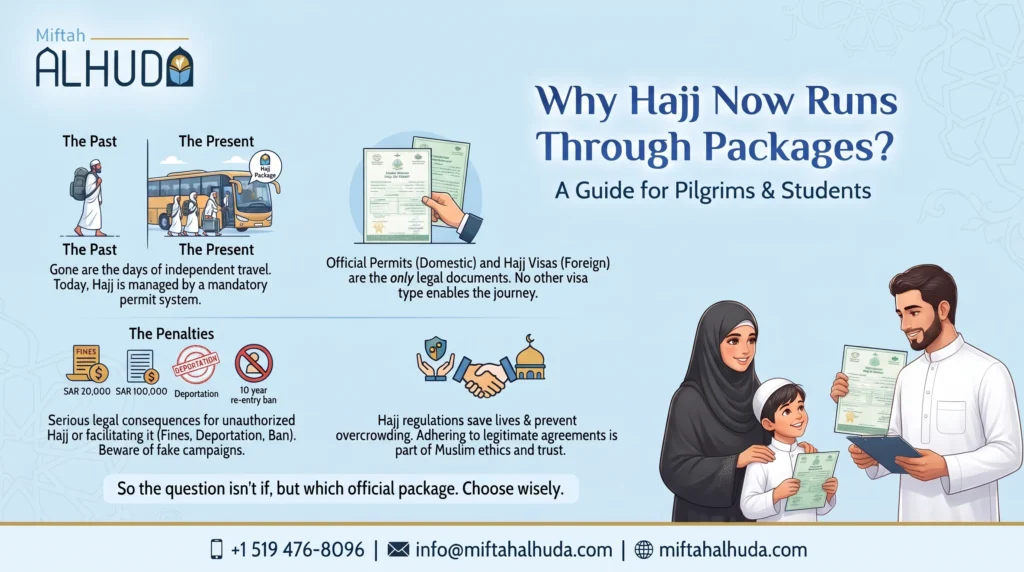
A generation ago, some pilgrims traveled to Makkah on their own, found lodging upon arrival, and organized their own transportation to the sacred sites. That era is over. Today, Hajj is organized using a permit system, with the package being the vehicle that transports the permit.
According to the Saudi Ministry of Hajj and Umrah, Hajj can only be performed with an official permit for domestic pilgrims or a regular Hajj visa for foreign pilgrims.
It has said unequivocally that no other visa type enables its holder to make the journey, and it has cautioned the public against fake campaigns and deceptive advertising.
The penalties are serious. Anyone discovered performing or trying Hajj without a permit would face a fine of up to SAR 20,000. People who facilitate violations of the law, such as sponsoring a visit visa for someone who later attempts Hajj, can face fines of up to SAR 100,000, which increase with the number of violators involved.
Residents and overstayers discovered attempting to sneak into Hajj are deported and forbidden from reentering the Kingdom for ten years.
This is important for religious reasons as well as legal ones. Scholars in Saudi Arabia and elsewhere have emphasized that these regulations save lives and prevent overcrowding, which has caused disasters in the past. A Muslim’s ethics include adhering to legitimate agreements that benefit the public.
A Hajj based on deception begins with a breach of trust, and pilgrims who recognize this cease looking for shortcuts.
So the main question isn’t whether you should use one of the official hajj packages. The question is which one, through which channel, and on what terms.
The Three Channels: How Pilgrims Actually Book
Where you live influences how you book. There are three primary routes.
| Channel | Who Uses It | How It Works |
| The Nusuk Hajj platform | Pilgrims from countries served directly by the platform, including the US, Canada, the UK, Europe, and Australia | Pilgrims register online, choose from packages offered by Saudi-authorized providers, and pay through the platform |
| National Hajj missions and quotas | Pilgrims from countries with an official quota managed by their government, such as Egypt, Pakistan, Indonesia, Malaysia, Bangladesh, and Nigeria | Each country receives a quota, often divided between a government scheme and licensed private operators |
| Domestic Hajj | Citizens and residents of Saudi Arabia | Domestic packages are booked through the official local channels with a permit |
Western pilgrims have seen a significant shift. According to one volunteer organization that has directed pilgrims for decades, the Nusuk system requires pilgrims from Australia, the United Kingdom, the United States, and Canada to register on the platform, have their documents validated, and then purchase a package there, with the Ministry approving certain organizations to sell packages through it.
This has a practical impact that many first-time pilgrims overlook. A local travel agent could still be part of your experience. It may manage your group, give a guide, or arrange your flights.
However, the majority of the booking occurs within the official system. Any company that promises to be able to secure your Hajj outside of that system should be viewed suspiciously.
For pilgrims in quota countries, the question is usually whether to apply for the government or a private program. Government schemes are frequently cheaper and more tightly regulated, but they may involve a lottery and provide fewer options. Private schemes cost more but provide better hotels, smaller groups, and more flexibility. Both are legal as long as the operator has a valid license from your country’s Hajj authority.
The 1448 AH Timeline: When to Act
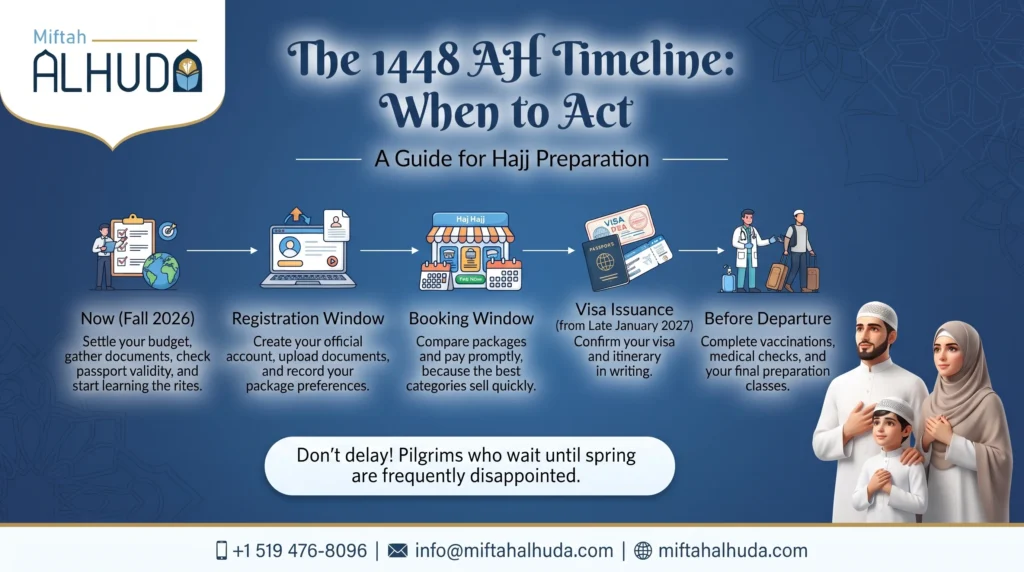
Hajj packages are no longer something you reserve a few weeks before departure. The official season runs on a long schedule that begins in the summer before Hajj.
Saudi authorities handed over the 1448 AH roadmap to participating countries . According to that schedule, Hajj visas will be issued on January 28, 2027, Hajj flights will begin on April 8, 2027, and the Hajj itself is scheduled for May 15, 2027 (9 Dhul Hijjah), depending on moon sightings.
Contracts for comprehensive service packages, including tents, Makkah and Madinah hotels, catering, and transportation, will be available through the Nusuk Masar platform from July 29, 2026 to January 23, 2027.
Pilgrims who book through the Nusuk Hajj platform are still limited to 1447 AH packages as of this writing, and the Ministry has yet to declare an opening date for the 1448 season.
The previous cycle launched account registration in October 2025 and bookings on February 1, 2026, and the 2027 cycle is scheduled to follow suit. These are predicted dates, not guaranties, so keep an eye on the official platform.
| Period | What to Do |
| Now (fall 2026) | Settle your budget, gather documents, check passport validity, and start learning the rites |
| Registration window | Create your official account, upload documents, and record your package preferences |
| Booking window | Compare packages and pay promptly, because the best categories sell quickly |
| Visa issuance (from late January 2027) | Confirm your visa and itinerary in writing |
| Before departure | Complete vaccinations, medical checks, and your final preparation classes |
The lesson is quite easy. Pilgrims who wait until spring to “start thinking about Hajj” are frequently disappointed when the packages they desired are no longer available.
Anatomy of a Hajj Package: What You Are Really Paying For?
At first glance, hajj packages appear to be holiday packages. In reality, every component affects your worship. A long walk to the Haram limits how many prayers you can attend. A distant Mina camp saps your energy for the stoning. A missing guide influences whether or not you perform the rites correctly.
| Component | Usually Included | Questions to Ask |
| Hajj visa and permit | Yes, through the official system | Who submits my documents, and when will I see confirmation? |
| International flights | Sometimes | Are flights included? Which airline and route? What are the baggage limits? |
| Makkah accommodation | Yes | Which hotel, which zone, how many people per room, and how far is it from the Haram? |
| Madinah accommodation | Often | How many nights, and is the visit before or after Hajj? |
| Mina and Arafah tents | Yes | Which camp, how far from the Jamarat, and what bedding is provided? |
| Transport between the holy sites | Yes | Bus or train? How are elderly pilgrims moved? |
| Meals | Varies | Full board, partial, or none? Are special dietary needs catered for? |
| Hady (sacrifice) | Varies | Is it included in the price? Who carries it out, and what proof will I receive? |
| Religious guidance | Varies widely | Who is the scholar? Which madhhab does he follow? In what language does he teach? |
| Ziyarah tours | Sometimes | Are the visits in Makkah and Madinah included or extra? |
| Travel and medical insurance | Sometimes | What does it cover, including cancellation and hospitalization? |
The sacrifice deserves special attention because it is an act of worship rather than just a line item. Pilgrims who owe a hady have a religious obligation.
According to the official 1448 AH operating schedule, the hady contract can only be completed through the Nusuk system. Before you pay, inquire whether the hady is included in the price or arranged separately, and keep all receipts.
Decoding Saudi Package Categories

The official system standardizes packages, allowing pilgrims to compare like with like. According to the Nusuk platform, package categories were standardized to facilitate comparison and selection, with options tailored to pilgrims’ various service-level preferences and budgets. Understanding the vocabulary is half the battle of choosing. nusuk
Standard, Premium, and Luxury
Most published descriptions of the system categorize packages into three service tiers. Each tier is based on the hotel’s quality, tent standard, mode of transportation, and services offered. The higher the tier, the closer and more comfortable everything becomes, and the higher the price.
A higher tier does not increase the validity or rewards of your Hajj. The Prophet ﷺ performed Hajj using a simple saddle. Comfort is a tool, not an indicator of acceptance.
For an elderly parent or a pilgrim with a heart condition, however, a higher tier can mean the difference between performing every rite in person and requiring a proxy for the stoning. In that case, the additional cost benefits worship directly.
Shifting and Non-Shifting
The official framework provides service categories in both shifting and non-shifting formats.
A Non-Shifting package guaranties that you will stay at the same Makkah hotel for the duration of your stay. During the days surrounding the main rites, Shifting packages typically include a stay in a hotel located further away from the Haram, usually in the Aziziyah district. You then relocate to a hotel near the Haram before or after them.
Shifting packages are less expensive and more convenient because the Aziziyah area is close to Mina. However, they require packing and moving during the most exhausting part of the journey. A family with young children or elderly parents should carefully consider the move.
The Makkah Zones
Nusuk categorizes Makkah accommodations into Zones A, B, C, and M, with varying access to Al-Masjid Al-Haram and the sacred sites of Mina, Muzdalifah, and Arafah.
- Zone A is characterized as being within walking distance of the Haram and typically having a view of its courtyards.
- Zone B accommodations are near the Haram, and some provide shuttles during prayer times.
- Zone C is further away, and only a few Zone C accommodations provide prayer-time shuttles, so you should clarify transport frequency and pickup locations with the provider, especially if anyone in your group has impaired mobility.
- Zone M is focused on access to religious sites rather than the Haram.
Consider how many daily prayers you plan to attend in the Haram. In hot weather, inquire about the distance an elderly family member can walk. Consider whether you would want to spend money on proximity or on another family member’s home. The answers link to your zone.
The Mina Camp: The Detail Most Pilgrims Overlook
Many pilgrims meticulously compare places to stay without considering Mina. That is a mistake, as the Mina camp defines the most physically grueling days of Hajj.
The official platform makes the distinction obvious. The Majar Al-Kabsh camp is around 300 to 700 meters from the Jamarat Bridge, whereas the Al-Muaisim camp is about 4 kilometers distant.
For a young, healthy pilgrim, a longer walk may be feasible. For a seventy-year-old who must make the round walk to the Jamarat over several days, the situation is very different.
You normally cannot choose your specific tent, but your package decides your camp. Before you book, ask your provider which camp your package includes.
What Really Drives the Price?
Prices for Hajj packages vary greatly. According to a travel publisher’s assessment of the 2026 season, package prices ranged from roughly $3,400 in government-subsidized markets like Indonesia to more than $15,000 for premium packages from the US and UK, with the ultimate cost depending on departure country, hotel distance from the Haram, and package tier. Prices change seasonally, so use these values as a basic guide.
Several factors influence whether the price goes up or down:
- Your departing country and channel: Government-subsidized plans are significantly less expensive than private packages bought from outside.
- Hotel zones and star ratings: The proximity to the Haram is the single most important variable.
- Shift or non-shift: Staying in a single hotel costs additional.
- Mina Camp: Camps near the Jamarat attract greater extra costs.
- Length of stay: A three-week package is more expensive than a ten-day one.
- Flights and seasons: Airfare during the Hajj period is always pricey.
- Group size and services: Smaller groups with specialized scholars and medical support incur higher operating costs.
The Hidden Costs That Never Appear in the Headline Price
A package price rarely represents the complete cost. Budget separately for the following items:
- Vaccinations and medical exams.
- If not included, obtain travel insurance.
- The hady, if not included.
- Meals outside of the package plan.
- If your shuttle service is infrequent, consider taking a taxi to the Haram.
- Mobile data and phone charges.
- Ihram clothing, comfortable sandals, and personal items.
- Gifts and Zamzam water allowances.
- Money left behind to cover your family’s expenses while traveling.
A family that arranges for the entire cost travels with peace of mind. A family that merely budgets for the headline price may end up borrowing in Makkah.
The Islamic Side of Paying for Hajj
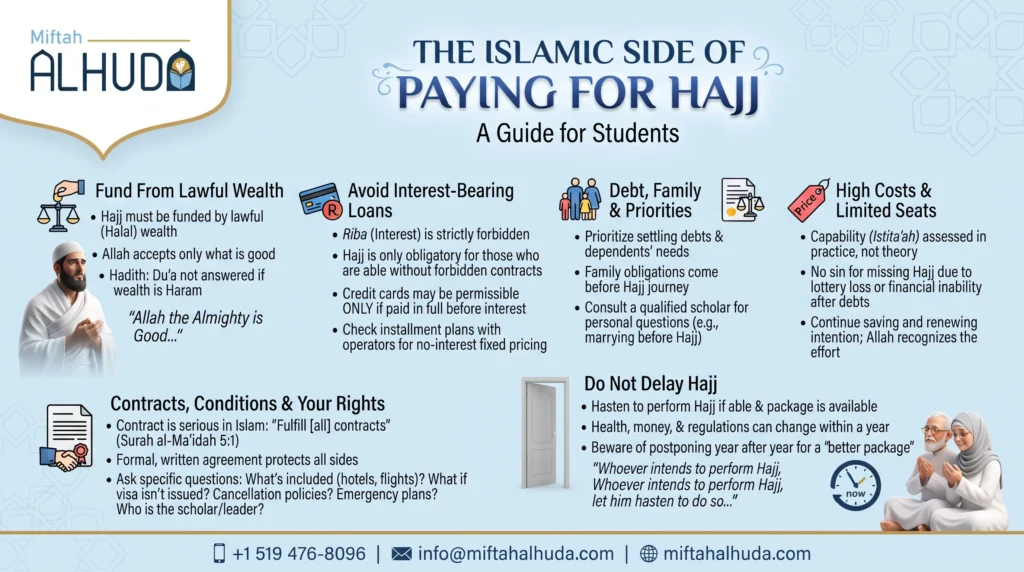
Most guides to hajj packages stop. A Muslim pilgrim must ask more in-depth questions because the money used to transport to Arafah is part of his or her worship.
Your Hajj Should Be Funded From Lawful Wealth
On the authority of Abu Hurayrah (ra):
The Messenger of Allah (ﷺ) said, “Allah the Almighty is Good and accepts only that which is good. And verily Allah has commanded the believers to do that which He has commanded the Messengers. So the Almighty has said: “O (you) Messengers! Eat of the tayyibat [all kinds of halal (legal) foods], and perform righteous deeds.” [23:51] and the Almighty has said: “O you who believe! Eat of the lawful things that We have provided you.” [2:172]” Then he (ﷺ) mentioned [the case] of a man who, having journeyed far, is disheveled and dusty, and who spreads out his hands to the sky saying “O Lord! O Lord!,” while his food is haram (unlawful), his drink is haram, his clothing is haram, and he has been nourished with haram, so how can [his supplication] be answered? [Muslim]
عَنْ أَبِي هُرَيْرَةَ رَضِيَ اللهُ عَنْهُ قَالَ: قَالَ رَسُولُ اللَّهِ صلى الله عليه و سلم “إنَّ اللَّهَ طَيِّبٌ لَا يَقْبَلُ إلَّا طَيِّبًا، وَإِنَّ اللَّهَ أَمَرَ الْمُؤْمِنِينَ بِمَا أَمَرَ بِهِ الْمُرْسَلِينَ فَقَالَ تَعَالَى: “يَا أَيُّهَا الرُّسُلُ كُلُوا مِنْ الطَّيِّبَاتِ وَاعْمَلُوا صَالِحًا”، وَقَالَ تَعَالَى: “يَا أَيُّهَا الَّذِينَ آمَنُوا كُلُوا مِنْ طَيِّبَاتِ مَا رَزَقْنَاكُمْ” ثُمَّ ذَكَرَ الرَّجُلَ يُطِيلُ السَّفَرَ أَشْعَثَ أَغْبَرَ يَمُدُّ يَدَيْهِ إلَى السَّمَاءِ: يَا رَبِّ! يَا رَبِّ! وَمَطْعَمُهُ حَرَامٌ، وَمَشْرَبُهُ حَرَامٌ، وَمَلْبَسُهُ حَرَامٌ، وَغُذِّيَ بِالْحَرَامِ، فَأَنَّى يُسْتَجَابُ لَهُ؟”. [رَوَاهُ مُسْلِمٌ]
The man in this hadith resembles a pilgrim: he has traveled far, is covered in dust, and raises his hands to the sky. However, his supplication is obstructed by unlawful wealth. Scholars from the four schools agree that a Hajj paid for with illegal money still fulfills the obligation outwardly, so the pilgrim is not required to repeat it.
However, the pilgrim is sinful because of how he obtained the money, and many scholars have warned that the acceptance and reward of such a Hajj are in grave danger.
Before booking, sit down and discuss your finances honestly. If any of your savings came from a doubtful source, purify them, repent, and fund your Hajj with what you know to be lawful.
Interest-Bearing Loans and Credit
To cover the cost of a package, some pilgrims consider taking out an interest-based loan. Riba is forbidden in Islam, and scholars have not made an exception for Hajj. Hajj is only obligatory for those who are able, and a person who can only get there through a forbidden contract is not among the able.
Many contemporary scholars view paying with a credit card in full before any interest is charged differently. Some allow it when the holder is confident of paying on time.
Others advise against using cards whose contracts contain any interest clauses. Installment plans provided directly by an operator at a fixed total price with no interest or late payment penalty are generally considered permissible sales on deferred terms. If your situation is unclear, consult a reputable scholar before signing.
Debt, Family, and Priorities
A person who owes debts should consult with the creditor to settle what is owed, or make clear arrangements to repay it. A person’s obligations to dependents take precedence over the journey, so plan for your family’s needs while you are away.
Scholars also discuss a pilgrim who wants to perform Hajj but also needs to marry and is concerned about falling into sin if he delays his marriage. Many jurists allow him to marry first in that case. These are personal questions, so direct them to a qualified teacher rather than a brochure.
When Packages Are Expensive or Seats Are Limited?
Capability (istita’ah) is assessed in practice, not in theory. If the only legal way to perform Hajj is through an official package, then the cost of the most basic available package is the measure. A person who cannot afford even that, after deducting debts and supporting dependents, is not obligated.
A pilgrim who registers sincerely but is not chosen in a lottery or is unable to secure a seat before packages sell out has not sinned. The obligation was impeded by circumstances beyond his control.
Many scholars encourage such a person to continue saving and registering each season, renewing the intention. Allah recognizes the effort, even if the door does not open that year.
Do Not Delay Without a Reason
Scholars, on the other hand, warn those who can afford it not to postpone Hajj every year. It was narrated from Ibn ‘Abbas that Fadl said – or vice verse:
“The Messenger of Allah (ﷺ) said: ‘Whoever intends to perform Hajj, let him hasten to do so, for he may fall sick, lose his mount, or be faced with some need.’” (Sunan Ibn Majah )
حَدَّثَنَا عَلِيُّ بْنُ مُحَمَّدٍ، وَعَمْرُو بْنُ عَبْدِ اللَّهِ، قَالاَ حَدَّثَنَا وَكِيعٌ، حَدَّثَنَا إِسْمَاعِيلُ أَبُو إِسْرَائِيلَ، عَنْ فُضَيْلِ بْنِ عَمْرٍو، عَنْ سَعِيدِ بْنِ جُبَيْرٍ، عَنِ ابْنِ عَبَّاسٍ، عَنِ الْفَضْلِ، – أَوْ أَحَدِهِمَا عَنِ الآخَرِ، – قَالَ قَالَ رَسُولُ اللَّهِ صلى الله عليه وسلم “ مَنْ أَرَادَ الْحَجَّ فَلْيَتَعَجَّلْ فَإِنَّهُ قَدْ يَمْرَضُ الْمَرِيضُ وَتَضِلُّ الضَّالَّةُ وَتَعْرِضُ الْحَاجَةُ ” .
Health, money, and regulation can all change within a single year. A person who has the means today but continues to wait for a “better package” may forfeit the opportunity totally. If you can go and there is a suitable package available, take it.
Contracts, Conditions, and Your Rights
When you book a package, you engage into a contract, which Islamic law takes seriously. Allah says:
يَا أَيُّهَا الَّذِينَ آمَنُوا أَوْفُوا بِالْعُقُودِ
“O you who have believed, fulfill [all] contracts.” (Surah al-Ma’idah 5:1)
The Prophet ﷺ also said:
“Muslims are bound by their conditions.” (Sunan Abi Dawud 3594)
This works in both directions. The operator is bound by its promises, and you are bound by your agreements. A formal, written agreement provides the best level of protection for all sides. Before paying, ensure that your contract or booking confirmation answers the following questions:
So, what precisely is included? Inquire about named hotels, zones, camps, meals, flights, and transportation. Do not accept a broad “5-star hotel” instead of a specific property.
- What if the visa isn’t issued? Is the refund full, partial, or none?
- What are the cancellation policies? Remember the deadlines and costs for each level.
- Can the operator substitute hotels? If so, the substitution should be in the same or higher category.
- Is the Hady included? How will it be carried out, and what proof will you get?
- Who serves as the group’s scholar and leader? Please provide names and contact information.
- What happens when there is an emergency? Who handles hospitalization, misplaced passports, and domestic situations at home?
A reputable operator welcomes these inquiries. An operator who avoids them has given you valuable information.
Red Flags: How to Recognize a Scam
Every season, sincere Muslims lose their savings, and sometimes their chance of performing Hajj, to fraudulent sellers. The Prophet ﷺ stated:
“Whoever cheats us is not one of us.” (Sahih Muslim 102)
”لَیْسَ مِنَّا مَنْ غَشَّنَا“
Fraud in the name of Hajj is one of the ugliest forms of deception because it preys on people at their most hopeful. Learn to recognize the warning signs.
- “Hajj on a visitor visa” or “Hajj without a permit”: This is not an option provided by any legitimate operator. It subjects you to the fines, deportation, and entry bans mentioned above.
- Prices are far below the market: If a package costs half of what others charge, inquire about what is missing or whether it exists at all.
- Guaranteed visas are issued before the official window opens: Nobody can guarantee a visa that the authorities have not yet issued.
- Payments made only in cash, with no receipt provided: Legitimate payments generate a paper trail.
- Sellers who appear exclusively on social media: Request a physical address, a license number, and references from previous pilgrims.
- Pressure tactics: “Only two seats left; pay today” is a sales technique, not a religious argument.
- There is no license from your country’s Hajj authority or official platform: Verify the license yourself using official sources. Do not rely solely on a website’s logo.
- Refusal to provide details in writing: If it is not written down, then it was not promised.
If you suspect fraud, report it to your country’s Hajj authority and Saudi authorities via official channels. This may prevent another family from suffering the same loss.
Beyond Price: The Human Side of a Package
Two hajj packages from the same category can offer widely differing experiences. The difference is usually determined by who runs them.
The Scholar Who Travels With You
The value of a package is determined by the quality of its religious guidance. When questions arise in the middle of the night at Muzdalifah or in a crowded hallway on the Day of Sacrifice, the person who answers them determines the legitimacy of your rites and your peace of mind.
Ask a few questions whether a qualified scholar travels with the group, not just a tour leader who has “been many times.” Inquire as to which madhhab he follows and whether he can fairly guide pilgrims from other schools.
Inquire about the language he teaches in and the number of pilgrims for which he is responsible. You can sit alongside a scholar in charge of forty pilgrims. A scholar in charge of four hundred cannot.
Preparation Before Departure
Some operators provide a single orientation session a week before departure. Others schedule a series of classes over several months. More preparation means fewer mistakes on the ground, which leads to fewer expiations and less anxiety.
Support for Women, the Elderly, and the Sick
Ask for information about the availability of female workers to assist female pilgrims, how the company handles menstruation-related questions about tawaf and travel dates, and whether wheelchairs and medical personnel are available.
Seek clarification about how the group transports senior pilgrims on Muzdalifah night and stoning days, as well as whether proxy stoning is available for those who require it.
Group Culture
Every group has a culture. Some are silent and focused on worship, while others are outgoing. Some have rigorous schedules, while others are more casual. Talk with people who have gone with the operator in prior years. Ask them what they wish they had known.
Matching the Package to the Pilgrim
There is not a single “best” package. There is just one best package for a certain pilgrim.
First-time pilgrims gain the most from intensive religious instruction and pre-departure classes. Hotel luxury is less important than having someone competent nearby when questions occur.
The elderly pilgrim benefits most from proximity: a closer zone, a closer Mina camp, and transportation options that decrease walking. For an elderly parent, a closer camp is often more valuable than a better hotel.
Families with children benefit from Non-Shifting packages, which eliminate the need for a mid-Hajj shift, as well as operators who have expertise working with young pilgrims. The authorities set age limits for children each season, so confirm them before you plan.
Women who travel without a male relative must first comprehend the current regulations and the fiqh. The authorities have amended the rules on this topic in recent years, and scholars have differing opinions on traveling without a mahram. Discuss the religious issue with a scholar, and then validate the official criteria with the platform or your operator.
Pilgrims suffering from chronic illness or disability should emphasize medical care, accessible accommodations, and a scholar who may advise on concessions such as proxies, combining prayers when necessary, and the departure hours allowed for the weak.
Budget-conscious pilgrims can move to Hajj on Standard or Shifting packages and should not feel any worse for it. Spend wisely on what benefits your health, such as a nearby camp, and save on what does not, such as a fancy hotel room you will rarely use.
Saudi residents have their own domestic package and permit system. Their first issue is usually obtaining a location and a permit, not selecting a hotel.
A Step-by-Step Booking Roadmap
- Set your intentions and settle your finances: Confirm that your funds are legal, your debts are in order, and your family is taken care of.
- Identify your channel: Determine whether you booked through the Nusuk platform, a national mission, or a domestic program.
- Make sure your documents are ready ahead of time: Check that your passport will be valid beyond your travel dates, and acquire any necessary photos, IDs, and records.
- Shortlist licensed operators: Verify each license using official sources and obtain references from previous pilgrims.
- Compare the entire picture: Consider the overall cost, zone, Mina camp, shifting or non-shifting, hady, scholar, group size, and preparation classes.
- Send your questions in writing: Keep each answer.
- Register and book as soon as the official window is open: Good packages sell fast.
- Pay exclusively via official or traceable means: Keep all receipts and confirmations.
- Complete the medical prerequisites: Get the vaccinations required by the government, such as the meningococcal vaccine, as well as those recommended by your doctor.
- Begin organized preparation: Learn the rites, your school’s rules, and the supplications carefully before you go.
Common Mistakes When Choosing Hajj Packages
| Mistake | Why It Matters | What to Do Instead |
| Comparing only headline prices | Packages at similar prices can differ greatly in zone, camp, and services | Compare total cost and specific inclusions |
| Ignoring the Mina camp | Distance to the Jamarat affects health and stamina on the hardest days | Ask which camp your package uses |
| Assuming the hady is included | Many pilgrims find out too late | Confirm in writing and keep proof |
| Booking through unlicensed sellers | Risks losing your money and facing legal penalties | Verify licenses through official sources |
| Waiting until spring to plan | The best packages sell early in the season | Prepare documents and finances now |
| Choosing luxury over guidance | A beautiful hotel cannot answer your fiqh questions | Prioritize a qualified scholar and preparation |
| Borrowing with interest to afford a package | Riba is prohibited, and Hajj is not obligatory without lawful means | Save, or wait until you are able |
| Not reading the cancellation policy | Visa delays and emergencies happen | Know the refund terms at every stage |
| Booking a Shifting package for frail relatives without thinking | Moving hotels mid-Hajj is exhausting | Consider Non-Shifting for elderly or young family members |
| Relying on the operator for all religious knowledge | Group guidance is limited in crowds and chaos | Study the rites yourself before you travel |
The Preparation No Package Can Sell You
A package can take your body to Makkah, but it cannot transport your understanding. Hotel keys, bus seats, and tent allocations are distributed upon arrival. The knowledge of what to do at each rite, why you do it, and what to say must come from home.
We see it every season. Pilgrims who spent months choosing a package and a few hours learning the rites frequently spend Hajj worried, asking people what to do and wondering if they did everything correctly.
Pilgrims who prepare their hearts and minds with the same care that they do their bookings move through each day calmly. They may concentrate on what Hajj is intended to be: standing before Allah with nothing between them and Him.
Pick your package wisely. Then devote as much attention to your preparation as you did to your booking.
Conclusion: Choose With Knowledge, Travel With Trust
Hajj packages have become the gateway to pilgrimage. Choosing between them is not solely a consumer decision. It is the initial step in performing an act of worship.
A wise decision begins with lawful money, a clear understanding of your obligations, and honest priorities. It continues with understanding your channel, booking within the official timeline, and carefully reading Saudi categories such as tier, zone, shifting or non-shifting, and the Mina camp that shapes your most difficult days. It concludes with a written contract, a licensed operator, a qualified scholar, and the determination to avoid anything that appears too good to be true.
Do your part carefully, then place your trust in Allah. The One who called Ibrahim to proclaim the pilgrimage to mankind will bring you to His House if He so desires.
Booked your Hajj? Now prepare for it with a qualified Miftah Al-Huda Academy teacher.
Start your free trial class today!
Contact Us
WhatsApp: +1 519 476-8096
E-Mail: in**@**********da.com
Facebook: https://www.facebook.com/MiftahAlhudaOfficial
Instagram: https://www.instagram.com/miftahalhudaa
YouTube: https://www.youtube.com/@MiftahAl-huda
TikTok: https://www.tiktok.com/@miftahalhuda00
Frequently Asked Questions About Hajj Packages
1. Can I book Hajj accommodation directly with a hotel in Makkah and skip a package?
Not for the Hajj itself. Accommodation in Mina and Arafah is included in official hajj packages, and the Hajj visa or permit is attached to them. Hotels in Makkah and Madinah can be booked separately for other trips, but during the Hajj season, your accommodations are included in your official package.
2. Is my Hajj less rewarded if I choose the cheapest package?
No. Reward is based on sincerity, proper performance of the rites, and good conduct, not hotel stars. A pilgrim in a Standard package who worships with concentration may fare better than a pilgrim in a luxury suite who spends his days distracted. Choose a higher tier only if it is truly beneficial to your health or worship.
3. What happens if I pay for a package and my visa is not issued?
This is dependent on your contract and booking channel. That is why you should read the refund policy before proceeding. Legitimate operators and official platforms provide clear terms for visa refusals. If the terms are not written down, request them in writing before transferring any money.
4. Can I switch to a different category or zone after booking?
Sometimes, but it usually involves selecting a different package, and availability may be limited. Check the change and cancellation policies before paying, and choose carefully the first time.
5. Is it permissible to perform Hajj on behalf of a deceased parent through a package?
Yes. Performing Hajj on behalf of a deceased parent who did not participate is well established in the Sunnah. According to the Shafi’i and Hanbali schools, the performer must first complete his own obligatory Hajj. Inform your operator ahead of time, and reach an agreement with your scholar on the form and purpose of the Hajj.
6. Should I pay a deposit to an operator before the official booking window opens?
Be very cautious. Some licensed operators conduct legitimate pre-registration for their groups, but no one can guarantee a visa until the authorities issue it. If you pay in advance, ensure that the operator is licensed, that the deposit terms are written, and that the refund conditions are clear if the booking does not go through.
3 Responses