

Years after the Farewell Pilgrimage, a student named Bakr ibn Abdullah brought a question to Anas ibn Malik, the Companion who had served the Prophet ﷺ since childhood. People were debating which kind of pilgrimage the Messenger of Allah ﷺ had performed.
Anas bin Malik said I heard the Apostle of Allaah(ﷺ) uttering talbiyah(labbaik) aloud for both Hajj and ‘Umrah. He was saying in a loud voice “Labbaik for ‘Umrah and Hajj, labbaik for ‘Umrah and Hajj”. (Sunan Abi Dawud)
That answer leads to one of the most interesting discussions in pilgrimage fiqh. It is about hajj qiran, the type of Hajj in which a pilgrim performs both Umrah and Hajj under a single, unbroken ihram.
Many Islamic scholars, including Imam Ahmad, Ibn Taymiyyah, and Ibn al-Qayyim, concluded that this was the form the Prophet ﷺ performed.
Nonetheless, Qiran remains the least understood of the three forms of Hajj. Most international pilgrims perform Tamattu’, and many first hear the word “Qiran” when a late flight or a woman’s monthly cycle causes a change in plans. This guide from Miftah Al-Huda Academy is entirely dedicated to Qiran: what it is, how it begins, what it requires, where scholars disagree, and how to navigate it calmly.
What Is Hajj Qiran? A Clear Definition

Hajj qiran is a type of pilgrimage in which a person enters one ihram that covers both Umrah and Hajj and remains in it until the rites of the Day of Sacrifice release him. There is no break between the two acts, and no return to normal life in the middle. The Umrah is not carried out as a separate, completed unit. Most scholars say it is absorbed into the Hajj, so that the Hajj rites fulfill both acts simultaneously.
What distinguishes the qarin from all other pilgrims is that he performs two acts of worship within one sacred state. He enters and leaves it once, and everything in between is part of his Umrah and Hajj.
The Meaning of the Word “Qiran”
The Arabic word qiran (قِران) derives from the root q-r-n, which means to join, couple, or bind two things together. The image is precise. In Qiran, Umrah and Hajj are not performed one after the other. They walk together, bound in a single ihram, from the miqat to the Day of Sacrifice.
Did the Prophet ﷺ Perform Hajj Qiran?
This is one of the most well-known debates in Islamic law, and understanding it gives you confidence in the form you chose.
Why the Narrations Seem to Differ?
The Farewell Pilgrimage was described differently by the Companions. Some reports describe the Prophet ﷺ’s pilgrimage as a combination of Umrah and Hajj, while others say that he entered ihram for Hajj. Other Companions confirmed what Anas heard: a talbiyah for both Umrah and Hajj.
How the Scholars Reconciled Them?
The scholars did not consider these reports to be contradictory. They looked for an explanation that did justice to each narrator:
- According to Imam al-Nawawi, the Prophet ﷺ first entered ihram for Hajj and then added Umrah to it, becoming a qarin. Those who reported Hajj described the beginning, whereas those who reported Qiran described the final state.
- In Zad al-Ma’ad, Ibn al-Qayyim compiled extensive evidence to conclude that the Prophet ﷺ was a qarin. Those who described his pilgrimage as Hajj alone meant that he performed only the rites of Hajj, with no separate Umrah rites.
- Imam Ahmad stated, “I have no doubt that the Messenger of Allah ﷺ was a qarin, although Tamattu’ is more beloved to me.” This statement shows how a scholar can affirm the Prophet ﷺ’s own practice while recommending a different form for others.
Why He Remained in Ihram?
The clearest explanation comes from a question asked by his wife Hafsah. Hafsah said Apostle of Allaah(ﷺ), how is it that the people have put off their ihram and you did not put off your ihram after your ‘Umrah. He said I have matted my hair and garlanded my sacrificial animal, so I shall not put off my ihram till I sacrifice my sacrificial animals (Sunan Abi Dawud).
He had brought camels from Madinah and designated them as offerings before the journey began. A pilgrim who drives his hady in this manner remains in ihram until it reaches the place of slaughter on the Day of Sacrifice.
The Garlanded Offering: A Quranic Window Into Qiran
The Prophet’s words to Hafsah refer to a practice that the Quran itself protects. Before departing, a pilgrim would hang a garland (qiladah), such as sandals or a cord, around the neck of his sacrificial animal, marking it as dedicated to the House of Allah. Allah says:
يَا أَيُّهَا الَّذِينَ آمَنُوا لَا تُحِلُّوا شَعَائِرَ اللَّهِ وَلَا الشَّهْرَ الْحَرَامَ وَلَا الْهَدْيَ وَلَا الْقَلَائِدَ
“O you who believe! Violate not the sanctity of the Symbols of Allah, nor of the Sacred Month, nor of the animals brought for sacrifice, nor the garlanded people or animals, etc. [Marked by the garlands on their necks made from the outer part of the tree-stems (of Makkah) for their security],” (Surah al-Ma’idah 5:2)
And in the same surah:
جَعَلَ اللَّهُ الْكَعْبَةَ الْبَيْتَ الْحَرَامَ قِيَامًا لِّلنَّاسِ وَالشَّهْرَ الْحَرَامَ وَالْهَدْيَ وَالْقَلَائِدَ ۚ ذَٰلِكَ لِتَعْلَمُوا أَنَّ اللَّهَ يَعْلَمُ مَا فِي السَّمَاوَاتِ وَمَا فِي الْأَرْضِ وَأَنَّ اللَّهَ بِكُلِّ شَيْءٍ عَلِيمٌ
“Allah has made the Ka’bah, the Sacred House, standing for the people and [has sanctified] the sacred months and the sacrificial animals and the garlands [by which they are identified]. That is so you may know that Allah knows what is in the heavens and what is in the earth and that Allah is Knowing of all things.” (Surah al-Ma’idah 5:97)
The garlanded animal was a public declaration. Anyone who saw it on the road knew its owner was a pilgrim heading for the House, having committed in advance to a sacrifice that could not be withdrawn.
This is the setting of the Prophet’s Qiran: his ihram was tied to a hady he had already dedicated, and it could not be ended until the animal reached its place of slaughter.
Nowadays, hardly any pilgrim brings an animal from home; the hady is bought in Makkah. Today’s qarin is not bound to Qiran by a garlanded animal; he chooses it freely. Understanding this lets him appreciate both the practice’s origins and the ease Allah has given in its current form.
Three Ways a Pilgrim Becomes a Qarin

Many pilgrims believe Qiran can only begin at the miqat. In reality, scholars identify three routes, and the second is the most important for modern pilgrims to understand.
1. Intending Both Together at the Miqat
This is the standard route. At or before the miqat, the pilgrim says, “Labbayka ‘umratan wa hajjan,” and enters ihram for both. Qiran governs everything that follows.
2. Adding Hajj Onto an Umrah Already Begun
A pilgrim may enter ihram for Umrah and then add Hajj to it before the Umrah is done. Scholars call this idkhal al-hajj ‘ala al-‘umrah (bringing Hajj into Umrah). All four schools accept it, but they set different deadlines:
- The Shafi’i and Hanbali schools set the deadline before beginning the tawaf of Umrah.
- The Hanafi school allows it until the pilgrim has completed the majority of the tawaf, meaning four circuits.
- The Maliki school allows it before the tawaf is completed, but doing it after the tawaf has begun is disliked.
The safest way is to add Hajj before beginning the tawaf, which is acceptable to all schools.
3. Adding Umrah Onto Hajj Already Begun
This is the reverse: a pilgrim enters ihram for Hajj only and later decides to add Umrah. The majority of scholars hold that this does not make a valid Qiran because the ihram has already been committed to Hajj. The Hanafi school accepts it, with reservations, under certain conditions. If you entered ihram for Hajj alone, talk to a scholar before attempting to change your form.
An Undefined Intention: The Lesson of Ali and Abu Musa
When Ali arrived from Yemen during the Farewell Pilgrimage, he declared that he was entering ihram with whatever the Prophet ﷺ intended. Because Ali had brought a hady, the Prophet ﷺ instructed him to remain in ihram as he himself was.
Abu Musa al-Ash’ari made a similar declaration, but he had no hady, so he was told to complete an Umrah and leave ihram.
Scholars conclude from this that an ihram whose type has not yet been specified is valid and can be defined later. It’s a fascinating detail, but in practice, having a clear intention from the start is always preferable and far less confusing.
When Plans Change: Aisha’s Path Into Qiran
Aisha, the Mother of the Believers, provides the most practical lesson in the entire subject of hajj qiran.
`Aisha said, “We set out with the sole intention of performing Hajj and when we reached Sarif, (a place six miles from Mecca) I got my menses. Allah’s Messenger (ﷺ) came to me while I was weeping. He said ‘What is the matter with you? Have you got your menses?’ I replied, ‘Yes.’ He said, ‘This is a thing which Allah has ordained for the daughters of Adam. So do what all the pilgrims do with the exception of the Tawaf (Circumambulation) around the Ka`ba.” `Aisha added, “Allah’s Messenger (ﷺ) sacrificed cows on behalf of his wives.” (Sahih al-Bukhari 294)
“Hajj” here refers to the journey of the Hajj season; in other narrations Aisha explains that she had entered ihram for Umrah.
How the Scholars Read Her Story?
- The majority understood that Aisha had become a qarinah. She had entered ihram for Umrah and then added Hajj before performing tawaf, following the second route described above. Her single tawaf and sa’i completed both acts. Jabir reports that the Prophet ﷺ sacrificed a cow on her behalf on the Day of Sacrifice (Sahih Muslim), which the majority understood as the hady of her Qiran.
- The Hanafi school understood that she set her Umrah aside, performed Hajj alone, and then made up the abandoned Umrah from At-Tan’im.
A Path Forward for Women Today
According to the majority, a woman who enters ihram for Umrah and starts her period before her tawaf, with no expectation of becoming pure before the 8th, has a clear path. She adds Hajj to her Umrah, becomes a qarinah, and takes part in all rites except tawaf, which she performs after becoming pure. She has not lost anything. She is following the exact instructions given to the most beloved of the Prophet’s wives. A woman who follows the Hanafi school should consult her scholar about the steps and any expiation required by that school.
The Central Debate: One Tawaf or Two?
This is the question that best defines hajj qiran. Is the qarin performing one set of rites for both acts, or two complete sets?
The Majority View: One Tawaf and One Sa’i
According to the Maliki, Shafi’i, and Hanbali schools, the qarin performs only the Hajj rites, which also count for his Umrah. He completes one obligatory tawaf (Tawaf al-Ifadah) and one sa’i. Their evidence includes:
- According to Aisha, those who combined Hajj and Umrah performed only one tawaf (Sahih al-Bukhari).
- The Prophet ﷺ told Aisha that her tawaf would suffice for both her Hajj and Umrah (Sahih Muslim).
- According to Ibn Umar’s narration, whoever enters ihram for Hajj and Umrah, one tawaf and one sa’i suffice for both, and he does not leave ihram from either until he leaves from both at the same time (Jami’ at-Tirmidhi).
The Hanafi View: Two Tawafs and Two Sa’is
According to the Hanafi school, the qarin performs a full tawaf and sa’i for his Umrah before proceeding to his Hajj, which has its own tawaf and sa’i. In practice, on arriving in Makkah, the Hanafi qarin:
- performs the tawaf and sa’i of Umrah.
- performs Tawaf al-Qudum for Hajj, and the sa’i of Hajj may follow it.
- performs Tawaf al-Ifadah on or after the Day of Sacrifice.
Their evidence is based on reports attributed to Ali and Ibn Mas’ud, as well as the principle that two acts of worship require separate rites.
A Hanafi Detail Every Qarin Should Know
According to the Hanafi school, if a qarin stands at Arafah before completing the majority of his Umrah tawaf, his Umrah is considered abandoned. He becomes a pilgrim of Hajj alone, owes an expiation for abandoning the Umrah, and must make it up later. Hanafi pilgrims who arrive late should try to complete their Umrah tawaf before the 9th.
Which Should You Follow?
Follow your school or the guidance of your group’s scholar. According to the majority view, performing additional circuits and sa’i does not harm a pilgrim; it is simply unnecessary. You should never perform fewer rites than your school requires.
Who Is Hajj Qiran For?
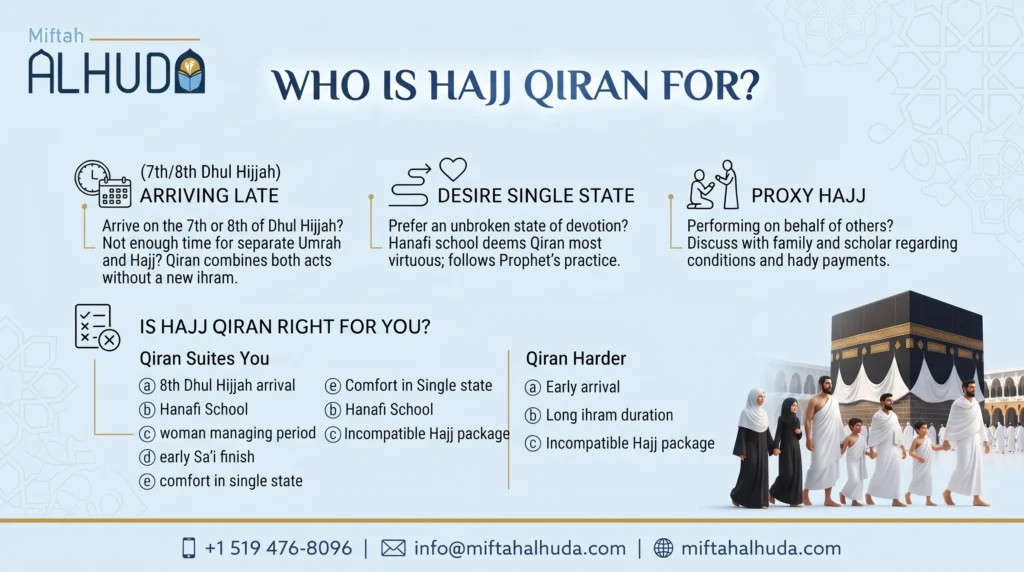
Pilgrims Arriving Late
Pilgrims who arrive in Makkah on the 7th or 8th of Dhul Hijjah often do not have enough time to perform an Umrah, leave ihram, and enter a new ihram. For them, hajj qiran is an obvious choice: they gain both acts without the need for a separate Umrah.
Pilgrims Who Want a Single, Unbroken State
Some pilgrims prefer to stay in one sacred state throughout. The Hanafi school regards Qiran as the most virtuous form, because of its uninterrupted devotion and because it was the Prophet’s own practice.
Pilgrims Performing Hajj on Behalf of Others
Pilgrims who are performing Hajj for a deceased or incapacitated relative should discuss the form with the family and a scholar. Some schools impose conditions on a proxy who changes the form chosen by the person who sent him, and the question of who pays for the hady should be settled in advance.
Is Hajj Qiran Right for You? A Decision Guide
Before you make a decision, consider your actual circumstances.
Qiran may suit you well if:
- Your flight arrives close to the 8th of Dhul Hijjah.
- You follow the Hanafi school and wish to perform its preferred form.
- You are a woman who expects her period during Umrah and wants a plan in place so that it does not derail your pilgrimage.
- You want to finish your sa’i early, after Tawaf al-Qudum as the majority allow, so that only one tawaf remains on the crowded Day of Sacrifice.
- You take comfort in remaining in one sacred state without interruption.
Qiran may be harder for you if:
- You arrive two or three weeks before Hajj and will stay in ihram for the entire time.
- You find it difficult to keep track of ihram restrictions over a long period of time.
- Your Hajj package is based on another form and does not include a hady for Qiran.
Go to Hajj Knowing Every Step
Study the fiqh of your pilgrimage one-to-one with a qualified teacher, according to your madhhab, before you travel.
Step by Step: The Journey of a Qarin

The following plan follows the majority view. Hanafi pilgrims should add the separate Umrah tawaf and sa’i mentioned earlier.
Step 1: Tell Your Operator Before You Travel
Many operators assume that all of their pilgrims will perform Tamattu’. Inform them in writing that you intend to perform Qiran so that your hady and schedule can be properly planned.
Step 2: Enter Ihram at Your Miqat
Declare your intention to perform both acts together: “Labbayka ‘umratan wa hajjan.” You are now a qarin and will remain in ihram until the Day of Sacrifice.
Step 3: Perform Tawaf al-Qudum on Arrival
When you arrive in Makkah, perform the arrival tawaf. The majority of scholars consider this tawaf a Sunnah for the qarin. The Maliki school considers it obligatory for pilgrims arriving from outside Makkah and requires an expiation if it is abandoned without reason.
Step 4: Decide About Your Sa’i
You now have an option. You can perform the sa’i of your Hajj right after Tawaf al-Qudum, in which case it counts and is not repeated later. Alternatively, you can wait until after Tawaf al-Ifadah. Many scholars recommend doing it now because the Mas’a is much less crowded than on Eid.
Step 5: Leave Your Hair Untouched
This is the most important instruction for the qarin. After your sa’i, you remain in ihram. You do not shave or trim, and nothing that ihram forbids becomes permitted. Many pilgrims surrounded by Tamattu’ groups go straight to the barber after sa’i. For the qarin, this is a violation that must be expiated.
Step 6: Wait in Ihram Until the 8th
Spend your days in worship and rest. The next section gives practical guidance for this period.
Step 7: Go to Mina on the 8th Without a New Intention
On the Day of Tarwiyah, simply travel to Mina with your group. You are already in ihram, so there is no new intention and no need to go to the Haram first.
Step 8: Arafah, Muzdalifah, and Mina
From the 9th onward, your rites on the Day of Arafah, in Muzdalifah and in Mina are the same as those of every other pilgrim.
Step 9: The Day of Sacrifice
Stone Jamrat al-Aqabah, slaughter your hady (or have it slaughtered for you), and shave or trim. Imam Abu Hanifa held that the order between these three acts is obligatory for the qarin and that breaking it requires an expiation, but his two leading students, Abu Yusuf and Muhammad al-Shaybani, disagreed. Hanafi pilgrims whose hady will be slaughtered by a program at an unknown time should ask their scholar for guidance.
Step 10: Tawaf al-Ifadah
Perform Tawaf al-Ifadah. If you did sa’i after Tawaf al-Qudum, you are done; no further sa’i is required. If you postponed it, do it now. This completes your Hajj and Umrah.
Step 11: The Days of Tashriq and Departure
Complete the stoning of the Days of Tashriq, then perform Tawaf al-Wada’ as your final act before leaving Makkah.
The Waiting Days: A Qarin’s Practical Companion
The longest test of the qarin is not a rite. It is the waiting. A pilgrim who arrives early may remain in ihram for more than two weeks, which raises questions that other pilgrims rarely face.
Keep Your Talbiyah Alive
This is a distinguishing feature of the qarin. The Umrah pilgrim ends his talbiyah when he begins tawaf, but the qarin’s ihram is also an ihram for Hajj. He continues to recite the talbiyah throughout the waiting period, in the streets, in his room, and on his way to prayer, until he begins stoning Jamrat al-Aqabah on the 10th. Let it become the rhythm of your days.
Know Which Creatures You May Remove
Not every visitor to a hotel room or camp is welcome. The prohibition on hunting does not apply to harmful creatures. The Prophet ﷺ named five animals that may be killed even within the Haram: the crow, the kite, the scorpion, the rat, and the rabid dog (Sahih al-Bukhari; Sahih Muslim). Scholars extend this to other creatures that cause harm, such as snakes.
A Nail That Breaks
Over two weeks, a nail may crack or tear painfully. Many scholars permit the pilgrim to remove only the broken part without expiation, as it causes harm and is no longer properly attached. Do not trim the rest of the nail.
Protect Your Marriage
Couples need discipline and mutual support during the long Qiran ihram. Intimacy and its preliminaries are forbidden until the final release, and breaking this rule before the first release has serious consequences, including invalidating the pilgrimage. Some couples choose a different form specifically for this reason, and there is no shame in that decision.
Treat the Days as Worship, Not Waiting
Pray in the Haram, do voluntary tawaf, read the Quran, and make your supplications. Waiting is not a waste of time. It is ihram itself, and every hour spent in it with patience counts toward your pilgrimage.
The Hady of the Qarin: Following the Prophet’s Offering
Is It Obligatory?
The four schools agree that a qarin who lives outside the Haram area must offer a hady. Although a small number of early scholars disagreed, the practice of the Companions and the later scholars supports the obligation.
The Hundred Camels of the Farewell Pilgrimage
Every qarin follows the example of the Prophet’s own hady. Jabir reports that he brought a hundred camels. On the Day of Sacrifice, he slaughtered sixty-three with his own hand and gave the rest to Ali to complete. He then ordered that a piece be taken from each camel and cooked together, and he and Ali ate from the meat and drank from the broth (Sahih Muslim 1218).
Sharing an Animal
A sheep or goat suffices for one pilgrim. A camel or cow may be shared by seven. Jabir reports that the Companions went out with the Prophet ﷺ for Hajj, and he instructed them to share camels and cows, seven pilgrims for each animal (Sahih Muslim 1318). A family traveling together may therefore share one cow or camel, as long as each share is intended as a hady.
Giving It All for Allah
Ali reports that the Prophet ﷺ placed him in charge of the camels and instructed him to give their meat, skins, and saddle coverings in charity, and not to give the butcher anything from them as payment. Ali added, “We would pay him from our own money” (Sahih Muslim 1317).
The modern qarin learns from this that the offering belongs to Allah. Nothing from it should be sold or used as payment.
If You Cannot Afford It
A qarin who cannot obtain a hady fasts ten days instead, three during Hajj and seven after returning home, as the Quran instructs (2:196).
What If…? Real Situations the Qarin Faces
What if I cut my hair after my first sa’i?
You violated ihram, but your pilgrimage is not lost. Stop immediately and remain in ihram. An expiation is due for cutting hair; ask your group’s scholar which option applies to you.
What if I forgot and made a new intention for Hajj on the 8th?
There is no harm. Your ihram was already in place, and the extra intention had no effect. Continue as a qarin.
What if I commit a violation such as applying perfume?
The majority hold that the qarin owes the same expiation as any other pilgrim. The Hanafi school holds that he owes a double expiation, since his single ihram carries two acts of worship. Hanafi scholars advise their qarin students to be extremely careful.
What if intimacy occurs before the first release?
This invalidates the pilgrimage, and for the qarin it affects both the Hajj and the Umrah. He must complete the remaining rites, make up the pilgrimage in a later year, and offer a sacrifice. The details vary by school, so consult a scholar right away.
What if I miss Arafah?
A qarin who fails to stand at Arafah has missed the Hajj for that year. The scholars generally instruct him to perform the rites of Umrah to leave ihram and to make up his Hajj later with a hady, though the details for the qarin differ between schools.
What if I want to switch from Qiran to Tamattu after arriving?
During the Farewell Pilgrimage, the Prophet ﷺ told the Companions who had entered ihram without a hady to convert their pilgrimage into an Umrah and leave ihram. Scholars disagree on whether this option remains open.
- The Hanbali school holds that it is still recommended for any qarin who has not brought a hady with him, and Ibn Abbas considered it obligatory.
- The other three schools, citing the statement of Abu Dharr in Sahih Muslim, hold that it was a special allowance for the Companions in that year.
What if my group performs one tawaf but I follow the Hanafi school?
Perform whatever additional tawaf and sa’i your school requires, even if your group does not. Your obligations follow your school, not your group’s schedule.
The Spiritual Meaning of Hajj Qiran
Commitment Before the Journey
When the Prophet ﷺ garlanded his camels in Madinah, he committed to staying in ihram until his offering was slaughtered. The qarin does the same. He commits himself at the miqat to a long, uninterrupted devotion, not knowing how hot the days or how crowded the hotel will be. There is a lesson here for every believer: true commitment to Allah is made before challenges arise, not after they have been measured.
Unity of Worship
In Qiran, two acts of worship merge. The majority of scholars hold that a single tawaf and sa’i are enough to complete them both.
This reflects a deeper aspect of Islam: devotion is not a collection of separate tasks, but a single life dedicated to Allah. The pilgrim who returns home with this understanding sees prayer, work, family, and character as parts of one act of worship.
Walking Where He Walked
Scholars who hold that the Prophet ﷺ was a qarin see the qarin as walking his exact path. During his long ihram, the Messenger of Allah ﷺ camped at al-Abtah while his Companions left ihram and re-entered it. Choosing Qiran with this awareness means following the Sunnah in its most literal sense.
A Door That Opens When Plans Close
Aisha’s story reminds us that Qiran is also a door of mercy. What looked like the end of her pilgrimage became a complete Hajj and Umrah.
When plans fail, Allah’s law often provides a path forward that we did not know existed, and knowing these paths is part of the provision every pilgrim should carry.
Conclusion: Two Acts of Worship, One Devotion
Hajj qiran is much more than a category on a booking form. It is the form Anas heard on the Prophet’s tongue, that Ali defended in public, and that Imam Ahmad had no doubt the Prophet ﷺ performed. Its essence is simple: one intention for Umrah and Hajj, one uninterrupted ihram, Hajj rites that fulfill both acts according to the majority, an offering in the manner of the Prophet’s hundred camels, and a final release on the Day of Sacrifice.
Its details, such as the three routes into Qiran, the deadlines for adding Hajj to Umrah, the debate over one tawaf or two, the Hanafi rulings on order and double expiation, the option of converting to Tamattu’, and the mercy it offers to women whose cycles change their plans, deserve careful study before you travel. A pilgrim who understands these details enters his long ihram with a clear conscience, knowing what he can do, what he must avoid, and why.
One Ihram, Zero Confusion
From the intention at the miqat to the final tawaf, our teachers will guide you through hajj qiran step by step.
Claim your free trial class today.
Frequently Asked Questions About Hajj Qiran
1. Does hajj qiran fulfill my obligatory Hajj?
Yes. All three forms of pilgrimage fulfill the Hajj obligation. If you are an adult Muslim making your first Hajj, your Qiran counts as your obligatory pilgrimage.
2. Can women perform Qiran?
Yes. Women perform Qiran exactly like men, with the same intention, single ihram, and hady. The only differences are the general rules of ihram that apply to women in every form of Hajj.
3. Do I have to say “Labbayka ‘umratan wa hajjan” every time I recite the talbiyah?
No. You declare both acts once, when you enter ihram. After that, you recite the regular talbiyah of the pilgrims, though mentioning Umrah and Hajj again is permitted.
4. Is it required to declare my intention for Qiran out loud?
No. The intention is a decision of the heart and is valid even if it is not spoken. Saying it aloud at the miqat is recommended, as the Prophet ﷺ did.
5. Do I owe one hady for the Umrah and another for the Hajj?
No. The qarin owes a single hady for his Qiran because the two acts are combined in one pilgrimage. It can be a sheep or goat, or a one-seventh share of a camel or cow.
6. Does my hady replace the Eid sacrifice (udhiyah) at home?
No. The hady is a rite of the pilgrimage, while the udhiyah is an act of worship specific to Eid al-Adha. Scholars disagree on whether pilgrims should also offer an udhiyah. Some consider it recommended for those who can afford it, while the Maliki school holds that the udhiyah is not prescribed for pilgrims. Ask your scholar whether you should arrange one with your family back home.
7. If I arrive late, can I go directly to Arafah without performing Tawaf al-Qudum?
Yes, according to the majority, because Tawaf al-Qudum is a Sunnah that falls away when time is short. Even the Maliki school, which considers it obligatory, excuses a pilgrim who fears missing Arafah. In this situation, perform your sa’i after Tawaf al-Ifadah.
8. Should I pray two rak’ahs after Tawaf al-Qudum?
Yes. The Sunnah is to pray two rak’ahs after every tawaf, behind Maqam Ibrahim if possible, or elsewhere in the mosque when it is crowded.
9. Can I perform an extra Umrah from At-Tan’im while waiting in my Qiran ihram?
No. You are already in ihram for both Umrah and Hajj, so you cannot enter a new ihram for another Umrah until you are released from your present one. If you want to perform another Umrah, do so after you have finished your Hajj.
10. Can I conclude a marriage contract during the waiting days before Hajj?
No. Unlike the Tamattu’ pilgrim, who leaves ihram after his Umrah, the qarin stays in ihram until the Day of Sacrifice. The prohibition on marriage contracts applies to him throughout this time, so any contract should be postponed until after his full release from ihram.
11. If my period begins after Tawaf al-Qudum, does it affect my Qiran?
No. Your Qiran stays valid, and you continue all of the rites alongside the other pilgrims. If you finished your tawaf before your period began, you can still perform your sa’i, because most scholars do not require ritual purity for it. The only rite you must postpone is Tawaf al-Ifadah, which you perform once you are pure.
3 Responses