

It was the morning of the fourth of Dhul Hijjah, ten years after the Hijrah. After walking between Safa and Marwa, the Prophet ﷺ addressed the thousands of Companions who had joined him. He delivered an unexpected message. Anyone who had not brought a sacrificial animal should end his ihram and consider what he had just done as an Umrah.
The Messenger of Allah (ﷺ) said: “You know that I am the most mindful of Allah among you, the most truthful and the most righteous, and were it not for my sacrificial animal, I would leave ihram as you do.” Suraqah ibn Malik asked: “Is this for this year of ours only, or forever?” He said: “Forever.” (Sahih Muslim 1216)
That moment is the living origin of hajj tamattu, the form of pilgrimage chosen today by most pilgrims arriving from outside Saudi Arabia. Many choose it because their travel agent recommended it, and never learn why it exists, what makes it valid, what it expects of them, or what to do if real life interferes with the plan.
At Miftah Al-Huda Academy, teachers help students prepare for exactly this pilgrimage. This guide focuses on Tamattu’: its meaning, proofs, scholarly debate, the conditions that make it valid, a practical timeline, the hady, and guidance for families. Follow the links to our dedicated guides as you read to learn the general rules of each rite.
What Is Hajj Tamattu? A Quick Definition
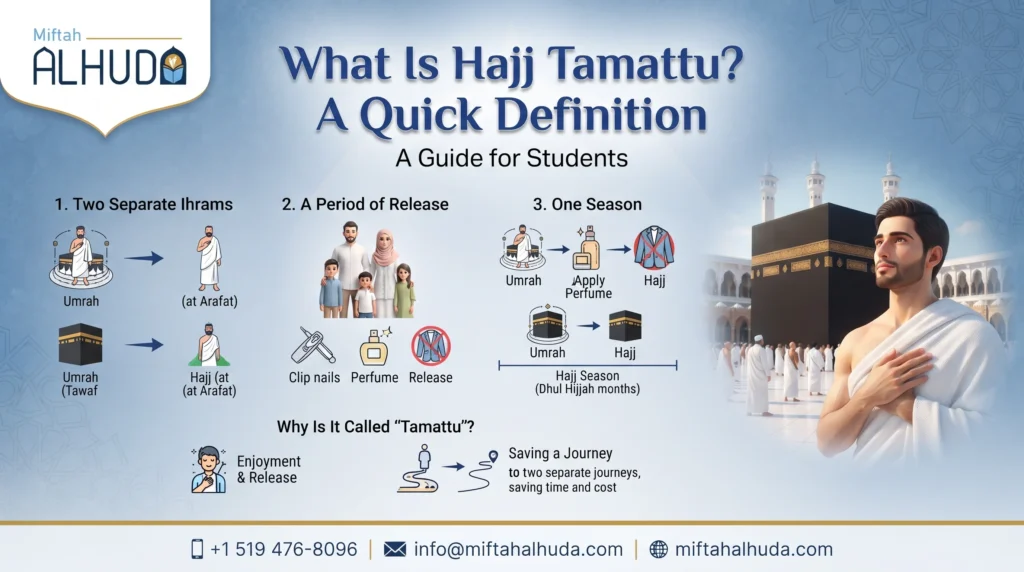
Hajj tamattu is a form of pilgrimage in which a pilgrim completes a full Umrah during the months of Hajj, then leaves ihram and lives normally before entering a new ihram for Hajj in the same season, without going home in between. Because the pilgrim performs two acts of worship in one journey, a sacrificial animal (hady) becomes necessary. Those who cannot afford it fast ten days instead: three during Hajj and seven after returning home.
In short, Tamattu has three distinguishing features:
- Two separate ihrams: one for Umrah and one for Hajj.
- A period of release in which the restrictions of ihram are lifted.
- One season: both acts take place during the same Hajj season.
Why Is It Called “Tamattu’”?
The Arabic term tamattu’ (تمتع) comes from the root m-t-‘, which means enjoyment, benefit, and provision. Scholars explain that the name refers to two kinds of enjoyment the pilgrim experiences.
The first enjoyment is release: Between the Umrah and the Hajj, the pilgrim may wear regular clothes, apply perfume, cut his hair and nails, and resume marital life. At first, some Companions hesitated to follow the Prophet’s command at Marwa. Before Islam, Arabs regarded performing Umrah during the Hajj months as one of the worst sins imaginable, and that mindset was hard to break.
The second enjoyment is saving a journey: Travelling to Makkah once took months and sometimes cost people their lives. Tamattu’ lets a pilgrim gain the reward of both Umrah and Hajj in a single trip, without a second journey from his miqat.
How the Companions Used the Word?
Before reading the classical sources, note that the Companions used “tamattu” in a broad sense that also covered what later scholars called Qiran. Abdullah ibn Umar described the Prophet’s Farewell Pilgrimage as a Tamattu’ of Umrah into Hajj (Sahih al-Bukhari 1691), even though the Prophet ﷺ stayed in one continuous ihram because of his hady. In this broad sense, everyone who performed Umrah and Hajj in the same season “enjoyed” the convenience of not having to travel twice.
Later jurists standardized the terminology. Today, when scholars say hajj tamattu, they mean the specific form with two ihrams and a period of release between them.
The Evidence for Hajj Tamattu
The Quranic Basis
Tamattu’s legal foundation is a single phrase in Surah al-Baqarah:
فَمَن تَمَتَّعَ بِالْعُمْرَةِ إِلَى الْحَجِّ فَمَا اسْتَيْسَرَ مِنَ الْهَدْيِ
“whoever performs ‘umrah [during the Hajj months] followed by Hajj [offers] what can be obtained with ease of sacrificial animals.” (Surah al-Baqarah 2:196)
Scholars draw several conclusions from this phrase:
- The verse names the practice explicitly, showing that it is legislated rather than merely tolerated.
- The words “on to Hajj” link the Umrah to the Hajj in time, which is why both must fall in the same season.
- The hady is tied to the person who performs Tamattu’, making it a distinguishing feature of this form.
- The end of the same verse makes an exception for “those whose families are not present at al-Masjid al-Haram,” a phrase that sparks an important scholarly discussion explained below.
The Prophet’s ﷺ Command at Marwa
The narration of Jabir ibn Abdullah, quoted at the start of this article, is the strongest prophetic evidence for hajj tamattu. Three details stand out:
- He wished for it, even though he couldn’t do it: A pilgrim who has brought his hady may not leave ihram until the animal reaches its place of sacrifice.
- He commanded it: He told the Companions to switch to it right away, and when some hesitated, he insisted.
- He made it permanent: His answer to Suraqah made clear that combining Umrah and Hajj during the Hajj months was not a one-year concession.
Jabir reported that the Companions who left ihram trimmed their hair, while the Prophet ﷺ and those who had brought hady stayed in ihram. On the eighth of Dhul Hijjah, the Companions entered ihram for Hajj from al-Abtah, the valley where they were camped, and set out for Mina (Sahih Muslim 1218).
The Testimony of Imran ibn Husayn
‘Imran ibn Husayn said: The verse of Tamattu’ was revealed in the Book of Allah, and the Messenger of Allah (ﷺ) commanded us to perform it. No verse was then revealed abrogating it, and the Messenger of Allah (ﷺ) did not forbid it until he died. So whatever a man said afterwards was his own opinion. (Sahih Muslim 1226)
Why Did Umar Discourage It?
Imran’s reference to “a man” is usually understood as Umar ibn al-Khattab, who encouraged people to perform Hajj and Umrah on separate journeys during his caliphate. This may surprise modern readers, but scholars have explained his view carefully.
Umar did not consider hajj tamattu invalid, nor did he deny the verse. His concerns were practical and communal. If everyone combined Umrah and Hajj, the Sacred House would be crowded for a few weeks each year and nearly empty for the rest. By encouraging separate journeys, he hoped Muslims would visit the Ka’bah all year round and the people of Makkah would benefit from a steady flow of visitors. He also cited the command to “complete the Hajj and Umrah for Allah” (2:196), which he understood as encouraging each act to have its own full journey.
Which Form of Hajj Is Best? The Four Schools Compared
All four schools agree that Tamattu’, Qiran, and Ifrad are valid. They differ on which is most virtuous, and each school has strong reasons for its preference.
| School | Preferred Form | Main Reasoning |
| Hanbali | Tamattu’ | The Prophet ﷺ wished for it, commanded it, and expressed regret that he could not perform it |
| Hanafi | Qiran | The Prophet ﷺ himself performed Qiran, and it involves a longer continuous state of ihram |
| Shafi’i | Ifrad, provided the pilgrim performs Umrah in the same year | Many narrations describe the Prophet’s ﷺ Hajj as Ifrad, and it requires no compensating sacrifice |
| Maliki | Ifrad | The practice of the Rightly Guided Caliphs, who most often performed Hajj alone |
What This Means for You in Practice?
Tamattu’ is the most practical option for most pilgrims travelling from abroad, and it is well supported by scholars. It shortens the time spent in ihram, which matters in the heat, in crowded accommodation, and over several weeks in Makkah. It is also the structure most Hajj operators are set up for. A pilgrim who follows the Hanafi, Maliki, or Shafi’i school and chooses Tamattu’ has chosen a fully valid form, even though his school ranks another form first.
The best option is the one you can perform correctly and calmly. A “best” form performed in exhaustion and confusion is worth less than a well-understood form performed with presence of heart.
The Conditions of Hajj Tamattu: When Does It Truly Count?
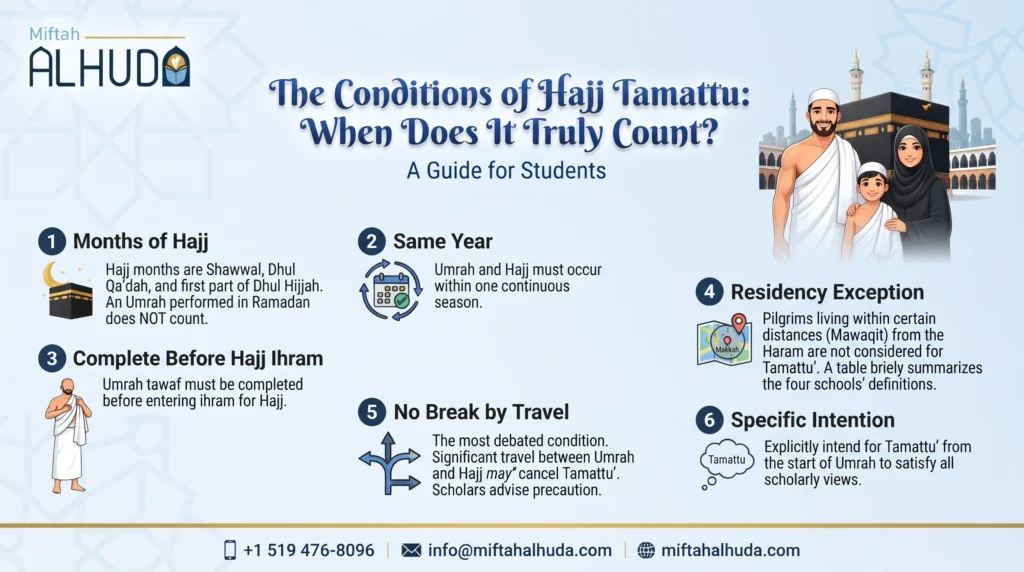
A pilgrim may intend Tamattu’ but unintentionally do something that scholars classify differently. This matters because it decides whether the hady is obligatory. Scholars list several conditions; some are agreed upon, others debated.
1. The Umrah Must Be Performed in the Months of Hajj
The Hajj months are Shawwal, Dhul Qa’dah, and the first part of Dhul Hijjah. An Umrah performed in Ramadan, even on its last night, is not the Umrah of Tamattu. For the 1448 AH season, Shawwal is estimated to begin around 9–10 March 2027, depending on the moon sighting; confirm the date with your operator.
2. The Hajj Must Be in the Same Year
An Umrah performed in Shawwal of one year cannot be linked to a Hajj in the following year. The verse speaks of Umrah leading “on to Hajj,” which scholars understand as one continuous season.
3. The Umrah Must Be Completed Before Entering Ihram for Hajj
If a pilgrim enters ihram for Hajj before completing the tawaf of his Umrah, he has joined the two acts, and his pilgrimage becomes Qiran rather than Tamattu.
4. The Pilgrim Must Not Be a Resident of the Sacred Mosque Area
The verse excludes “those whose families are not present at al-Masjid al-Haram.” Scholars differ on who counts as a resident.
| School | Who Counts as “Present at al-Masjid al-Haram” | Effect |
| Hanafi | Anyone living at or within the mawaqit | Tamattu’ is not prescribed for them; if they perform it, they have gone against the prescribed practice |
| Maliki | The people of Makkah and its immediately adjoining areas, such as Dhu Tuwa | They may perform Tamattu’ but owe no hady |
| Shafi’i | Anyone living less than the shortening distance for prayer (roughly 80 km) from the Haram | They may perform Tamattu’ but owe no hady |
| Hanbali | Same as Shafi’i, measured from the Haram | They may perform Tamattu’ but owe no hady |
A pilgrim flying in from Cairo, London, Jakarta, or Toronto clearly meets this condition, and the hady is due.
5. The Pilgrim Must Not Break the Connection by Traveling
This is the most debated condition, and it affects modern pilgrims who visit Madinah or travel elsewhere between Umrah and Hajj. The schools differ on what kind of travel breaks the link between the two acts:
| School | What Cancels the Tamattu’ (and the Hady) |
| Hanafi | Returning to one’s own homeland in between |
| Maliki | Returning to one’s homeland, or to a place as far away as it |
| Shafi’i | Returning to a miqat (or an equal distance) to enter ihram for Hajj |
| Hanbali | Traveling the distance at which prayers are shortened, or more, and then entering ihram for Hajj |
Consider a pilgrim who performs Umrah, travels to Madinah, and then enters ihram for Hajj at Dhul-Hulayfah on the way back. In the Shafi’i and Hanbali views, the hady may no longer be obligatory. In the Hanafi and Maliki views, he remains a Tamattu’ pilgrim and the hady is still due.
Many Hajj scholars advise pilgrims in this situation to offer the hady as a precaution, since it is an act of worship either way.
Our Miqat for Hajj guide explains where such a pilgrim enters ihram on the return journey. Discuss your plan with your group’s scholar before you travel.
6. Is a Specific Intention for Tamattu’ Required?
Some Hanbali scholars required the pilgrim to intend Tamattu’ at or before the Umrah; others did not. In practice, it costs nothing to intend from the start that your Umrah is the Umrah of Tamattu’, which satisfies both views.
A Complete Timeline for the Hajj Tamattu Pilgrim
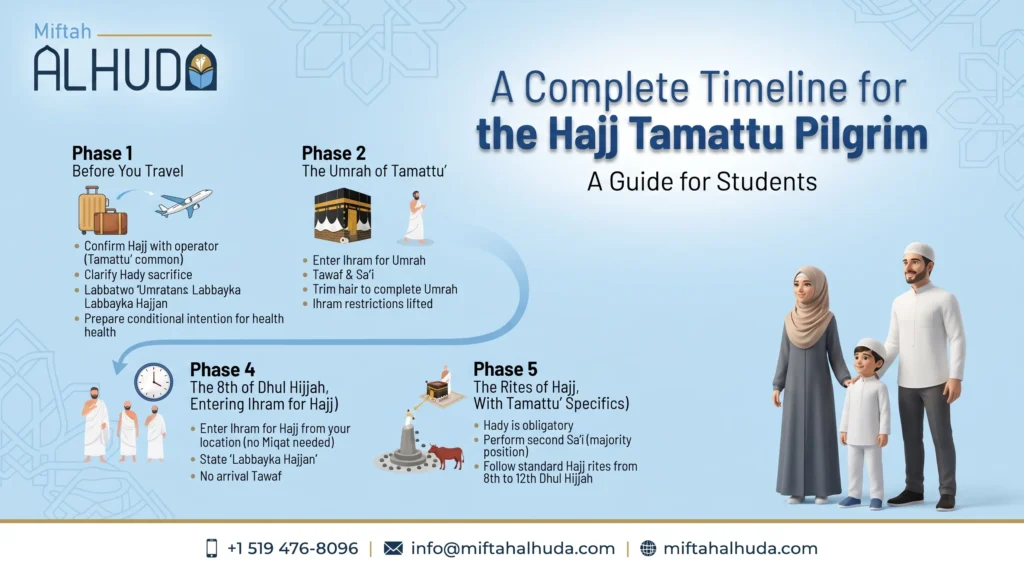
The timeline below focuses on the decisions and details specific to Tamattu’. For detailed explanations of each rite, see our guides on Ihram for Hajj, Miqat for Hajj, Sa’i Between Safa and Marwa, The Day of Arafah, Muzdalifah During Hajj, Mina During Hajj, and Stoning the Jamarat.
Phase 1: Before You Travel
Confirm your form of Hajj with your operator: Most international packages are built for Tamattu, but groups arriving close to the eighth of Dhul Hijjah may suggest Ifrad or Qiran. Whether a separate Umrah is feasible depends on your arrival date.
Clarify the hady in writing: Find out whether your package includes the hady, who will carry it out, and how you will receive confirmation.
Learn two intentions, not just one: You will enter ihram twice. The first time, at your miqat, you say “Labbayka ‘Umratan.” The second time, on the eighth of Dhul Hijjah in Makkah, you say “Labbayka Hajjan.”
Prepare a condition if you have health concerns: A pilgrim who fears that illness may stop him from completing his pilgrimage can enter ihram with a conditional intention. Our Ihram for Hajj guide explains this condition and how the schools view it.
Phase 2: The Umrah of Tamattu’
You enter ihram at or before your miqat with the intention of Umrah, perform tawaf and Sa’i, and then cut your hair. That completes your Umrah and lifts all ihram restrictions, including marital relations.
An important detail many pilgrims overlook: trim rather than shave. If only a short time separates your Umrah and Hajj, scholars recommend that men trim after Umrah rather than shaving completely. This leaves hair to shave on the Day of Sacrifice, when shaving carries the special virtue for which the Prophet ﷺ prayed three times for those who shave their heads (Sahih al-Bukhari 1727).
Phase 3: The Interval Between Umrah and Hajj
This is the “enjoyment” that gives Tamattu its name, and it has its own section below.
Phase 4: The 8th of Dhul Hijjah, Entering Ihram for Hajj
On the morning of the Day of Tarwiyah, you enter ihram for Hajj from wherever you are staying, whether a hotel in Makkah, an apartment in Aziziyah, or a group building. You do not need to go to the Haram, At-Tan’im, or any miqat. The Companions entered ihram from their camp in al-Abtah on the same principle. If your group moves to Mina on the night of the 7th, enter ihram before boarding the bus.
A common question is whether the Tamattu’ pilgrim should perform a tawaf before leaving for Mina. He does not need to. There is no tawaf before Mina and no arrival tawaf (Tawaf al-Qudum) for the Tamattu’ pilgrim’s Hajj, because the tawaf of his Umrah already marked his arrival in Makkah.
Phase 5: The Rites of Hajj, With Tamattu’ Specifics
Your Hajj begins on the eighth and follows the same order as every other pilgrim’s. Two points are specific to you.
The hady is obligatory: Unlike the Ifrad pilgrim, for whom a sacrifice is optional, you must offer the hady or fast in its place.
The question of the second Sa’i: Aisha reported that those who had entered ihram for Umrah performed tawaf of the House and went between Safa and Marwa, then left ihram, and then performed another circuit after returning from Mina for their Hajj, while those who had combined Hajj and Umrah performed only one (Sahih al-Bukhari 1556). This is the basis of the majority position that the Tamattu’ pilgrim performs a second Sa’i for his Hajj. A narration from Imam Ahmad, adopted by Ibn Taymiyyah, holds that the first Sa’i suffices, but performing the second is the safer course. Our Sa’i Between Safa and Marwa guide explains the timing and method, and our guide to Tawaf al-Ifadah covers the tawaf that comes before it.
At a Glance: The Tamattu’ Pilgrim’s Journey
| Stage | Where | Key Action | Tamattu’-Specific Note |
| First ihram | At or before the miqat | Intention: “Labbayka ‘Umratan” | Must fall in the Hajj months |
| Umrah | Masjid al-Haram | Tawaf, Sa’i, haircut | Trimming preferred if Hajj is near |
| Interval | Makkah and surroundings | Normal life | Be cautious about long-distance travel |
| Second ihram | Your residence | Intention: “Labbayka Hajjan” | On the 8th; no need to go to the Haram |
| Hajj rites | Mina, Arafah, Muzdalifah | Same as all pilgrims | No Tawaf al-Qudum |
| Day of Sacrifice and after | Mina and Makkah | Rites of the day | Hady obligatory; second Sa’i (majority view) |
| Departure | Makkah | Farewell tawaf | Final act before leaving |
The Interval: How to Use Your Days Between Umrah and Hajj
For some pilgrims the interval lasts three days; for others, three weeks. Few realize how much the way they use it shapes the quality of their Hajj.
What Is Permitted?
Everything that was forbidden in ihram is now permitted. You may dress normally, use perfume and scented soap, cut your hair and nails, and live with your spouse as usual. There is no reason to feel guilty about using these permissions. Allah built them into the rite, and the Prophet ﷺ insisted that his Companions take them despite their hesitation.
Should You Perform Extra Umrahs?
Many pilgrims fill their days by going to At-Tan’im for additional Umrahs. Scholars differ on this. Some consider it a good deed. Others point out that the Companions who stayed in Makkah during the Farewell Pilgrimage did not do so, and that the Prophet ﷺ permitted Aisha’s Umrah from At-Tan’im after Hajj for a specific reason. They recommend spending this time in voluntary tawaf around the Ka’bah instead.
Both views have scholarly support, and an extra Umrah has no effect on the validity of your Tamattu’. Most importantly, do not overwork yourself. A pilgrim who performs five Umrahs in the week before Hajj and then arrives at Arafah sick and exhausted has made a poor trade.
The Hady of Hajj Tamattu: A Complete Guide
Gratitude or Compensation
Scholars differ on the nature of this sacrifice, and the difference has practical consequences. The Hanafi, Maliki, and Hanbali schools treat it as a sacrifice of gratitude (dam shukr) for the ease of combining two acts of worship in one journey. The Shafi’i school treats it as a compensatory sacrifice (dam jubran), because the pilgrim did not enter ihram for Hajj from his miqat.
Can You Eat From Your Own Hady?
Because the majority see the hady as an act of gratitude, they allow the pilgrim to eat from it, give some as gifts, and give the rest in charity.
Jabir ibn Abdullah reported that on the Day of Sacrifice the Messenger of Allah (ﷺ) ordered that a piece from each of his sacrificed camels be put in a pot and cooked, and he ate from the meat and drank from the broth (Sahih Muslim 1218).
The Shafi’i school, which treats the hady as compensation, holds that the whole animal must be given to the poor of the Haram.
Whatever the school, the animal must be free of clear defects:
The Prophet (ﷺ) said: “A lame animal whose lameness is obvious is not to be sacrificed, nor an animal with a bad eye whose blindness is obvious, nor a sick animal whose sickness is obvious, nor an emaciated animal that has no marrow in its bones” (Jami’ at-Tirmidhi 1497).
Where and When?
The hady must be slaughtered within the boundaries of the Haram, and the safest time, accepted by all schools, is the Day of Sacrifice or the two days after it (10th to 12th of Dhul Hijjah). The schools differ on when the slaughtering period begins and ends, and our Mina During Hajj guide sets out each school’s view.
Verifying Your Hady: A Practical Checklist
Today, very few pilgrims slaughter their own animals. Most rely on their group or on officially sanctioned programs, such as the Saudi project for hady and udhiyah, where pilgrims buy a voucher and authorized slaughterhouses carry out the sacrifice on their behalf. Delegating the sacrifice is entirely valid, but because the hady is your obligation, you are responsible for making sure it is carried out.
Red Flags to Avoid
Every season, people approach pilgrims on the street or near the camps offering a “cheaper sacrifice.” There is no way to confirm that such a sacrifice is ever performed, that the animal meets the requirements, or that it is slaughtered within the Haram. Avoid these offers completely and buy only through your operator or an official outlet.
Keep Your Proof
Keep your voucher, receipt, or digital confirmation until the days of sacrifice are over. If you learn that a sacrifice you paid for was never carried out, contact your operator immediately and ask a scholar what you owe, because the obligation is yours, not the agent’s.
Hajj Tamattu With Children and Elderly Parents

Many families prefer Tamattu’ because it shortens the time spent in ihram, which especially helps the young, the elderly, and the ill. Travelling with dependents also raises questions that individual pilgrims never face.
Children
A child’s Hajj is valid, but it does not replace the obligatory Hajj, which must be performed after puberty. For a child too young to understand, the guardian makes the intention on the child’s behalf for both the Umrah and the Hajj; a child old enough to understand makes his or her own intention with guidance.
Practical points for families:
- Keep the child’s ihram simple: Scholars are lenient with young children, who may forget the restrictions. Tamattu’s shorter ihram periods make this much easier.
- Plan your Umrah around the child’s energy: Perform it at a quieter time of day, even if that means waiting a day after arrival.
- Decide on the child’s hady in advance: Many scholars hold that the hady falls on the guardian who brought the child into ihram, while others say it is paid from the child’s own wealth. Because the schools differ, consult your scholar before travelling.
Elderly Parents
For elderly pilgrims, Tamattu’ provides a valuable rest between two physically demanding stages. To make the most of it:
- Arrive early enough to rest: A few days between Umrah and Hajj give an older parent time to recover before Arafah.
- Pace the effort: If your parents are exhausted from the flight, they do not need to perform Umrah on the day they arrive. Resting first is wiser.
- Use a conditional intention: For an elderly parent who fears that a health condition may prevent them from completing the pilgrimage, a conditional intention at the miqat brings peace of mind.
- Decide realistically between hady and fasting: An elderly parent who cannot afford the hady may also struggle to fast. If fasting is truly beyond them, ask a scholar about their specific situation rather than forcing a fast that will harm them.
Common Mistakes in Hajj Tamattu and How to Avoid Them
| Mistake | Why It Matters | What to Do Instead |
| Performing the Umrah in Ramadan while intending Tamattu’ | It is not Tamattu’, and the pilgrim may be confused about the hady | Make sure your Umrah falls in Shawwal or later |
| Shaving completely after an Umrah only days before Hajj | Leaves little or no hair to shave on the Day of Sacrifice | Trim after Umrah when Hajj is near |
| Going to At-Tan’im or a miqat to enter ihram for Hajj | Unnecessary effort; the Sunnah is to enter ihram where you are staying | Enter ihram at your residence on the 8th |
| Assuming the hady is included in the package | Some packages do not include it | Confirm in writing before you travel |
| Buying a sacrifice from street sellers | There is no way to confirm it was ever carried out | Use your operator or an official channel only |
| Fasting the three days on and after Arafah | Fasting on the Day of Arafah is discouraged for the pilgrim | Finish the three days before the 9th, or, in the schools that allow it, fast them in the days of Tashriq |
| Traveling between Umrah and Hajj without knowing the rulings | May affect whether the hady is due, depending on the school | Discuss your travel plans with your group’s scholar |
| Exhausting yourself with many Umrahs before Hajj | You arrive at Arafah drained and ill | Prioritize rest and voluntary tawaf |
| Treating the interval as a vacation from worship | Wastes some of the most valuable days of your life | Pray in the Haram, prepare your supplications, and attend lessons |
| A woman abandoning her Hajj because her period began before her Umrah | The Sunnah provides a clear solution | Most scholars: switch to Qiran, as the Prophet ﷺ instructed Aisha; ask your scholar for your school’s ruling |
The Spiritual Lessons of Hajj Tamattu
Ease Is Part of the Religion
The name of this pilgrimage means “enjoyment.” The Prophet (ﷺ) did not simply allow it. He wished for it, ordered it, and corrected Companions who found the permission unsettling. Many sincere believers assume that harder worship is always better worship. Tamattu’ teaches otherwise: gratefully accepting a concession from Allah is itself obedience.
Gratitude Has a Form
The hady puts gratitude into action. Allah says of the sacrificial animals in Surah al-Hajj:
كَذَٰلِكَ سَخَّرْنَاهَا لَكُمْ لَعَلَّكُمْ تَشْكُرُونَ
“Thus have We subjected them to you that you may be grateful.” (Surah al-Hajj 22:36)
When you offer your hady, or fast in its place, remember what you are thanking Allah for: two acts of worship in a single journey, something your ancestors may have spent months travelling to complete even once.
Returning to Sacred Commitment
Tamattu’ teaches a rhythm every believer needs. You enter a sacred state, complete it, return to normal life, and then consciously enter the sacred state again. Faith is not a single moment of commitment followed by endless ease. It is a cycle of renewal: Ramadan after the rest of the year, Fajr after sleep, repentance after sin. The pilgrim who enters ihram a second time on the Day of Tarwiyah practises the very habit that will keep him steady when he returns home.
Respecting Valid Differences
The early disagreement over Tamattu shows how the Companions handled differences. Umar encouraged separate journeys, while Ali and Ibn Abbas continued to teach Tamattu’, yet they did not treat one another as having left the religion’s guidance. In crowded hotels and tents, you will meet pilgrims performing different forms and following different schools. All three forms are valid, and the Companions show how to hold your position with conviction while respecting those who hold another.
Conclusion: A Pilgrimage of Ease, Done With Knowledge
Hajj tamattu isn’t a shortcut. It is the form of pilgrimage the Prophet ﷺ wished he could perform himself, and he confirmed it for all time when Suraqah asked whether it was for one year or forever.
Its structure is straightforward: an Umrah during the Hajj months, a period of release, a new ihram for Hajj from your residence, a hady or ten days of fasting in gratitude, and the completion of your Hajj rites.
The details, however, matter. They include the timing of the Umrah, who counts as a resident of the Sacred Mosque, the effect of travel between the two acts, the conditions of the sacrificial animal, how to verify that it was actually offered, and the needs of children and elderly parents.
All of these questions are far easier to answer at home than in a crowded hotel lobby on the 7th of Dhul Hijjah.
Prepare for Your Hajj Tamattu With Confidence
Two ihrams, a hady, and many decisions to make. Learn every step one-to-one with a qualified Miftah Al-Huda Academy teacher, according to your madhhab, in our online Fiqh classes.
Book your free trial class today.
Contact Us
WhatsApp: +1 519 476-8096
E-Mail: in**@**********da.com
Facebook: https://www.facebook.com/MiftahAlhudaOfficial
Instagram: https://www.instagram.com/miftahalhudaa
YouTube: https://www.youtube.com/@MiftahAl-huda
TikTok: https://www.tiktok.com/@miftahalhuda00
Frequently Asked Questions About Hajj Tamattu
1. Does hajj tamattu fulfill both my obligatory Hajj and my obligatory Umrah?
Yes. If this is your first Hajj and you are an adult Muslim, the Hajj you perform through Tamattu’ fulfills your Hajj obligation. Its Umrah also fulfills the obligatory Umrah for scholars who consider Umrah mandatory, such as the Shafi’i and Hanbali schools.
2. If I spend the interval in Jeddah, where do I enter ihram for Hajj?
Enter ihram from wherever you are staying in Jeddah. Jeddah lies inside the miqat boundaries, so there is no need to return to a miqat or go to Makkah first. Note that, in some schools, travelling a long distance during the interval can affect whether the hady is due.
3. Can I conclude a marriage contract during the interval between Umrah and Hajj?
Yes. Once you have completed your Umrah, you are no longer in ihram, and the prohibition on marriage contracts no longer applies to you. The contract is valid as long as no party to it is in ihram at the time.
4. Can someone else pay for my hady?
Yes. A family member, friend, or sponsor may pay for your hady if it is offered on your behalf and with your permission. The sacrifice fulfills your obligation.
5. Must the three days of fasting during Hajj be consecutive?
No. Most scholars hold that the three days need not be consecutive. Fasting them in a row is better when possible, and all three must fall within the valid period during Hajj.
6. Is it better to perform the Umrah of Tamattu’ in Shawwal or in Dhul Qa’dah?
Both are valid for Tamattu’. Scholars note a special virtue in Dhul Qa’dah, since all of the Prophet’s Umrahs, except the one combined with his Hajj, took place in that month (Sahih al-Bukhari 1780). In practice, the timing usually depends on your arrival date and your group’s schedule.
5 Responses