
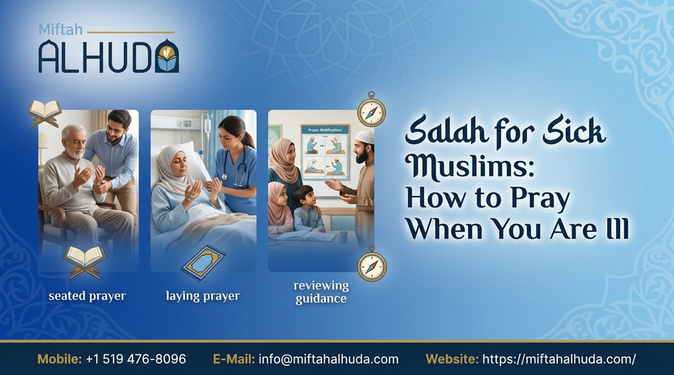
When illness makes normal movements difficult, Islam does not force us to pray beyond our capacity. Salah is essential, but how we perform it varies depending on our physical condition. Whether we are dealing with a temporary illness, a persistent illness, weakness, injury, or difficult standing, Islamic teachings offer practical solutions while emphasizing the value of prayer.
Understanding salah for a sick person situation allows us to know when we should stand, sit, and pray lying down. The fundamental premise is straightforward: we pray according to our abilities while performing the necessary Salah acts to the greatest extent practicable.
This guide, based on the teaching approach used at Miftah Al-Huda Academy, leads you through these rules step by step so you can apply them with confidence.
What Is Salah for a Sick Person?
Salah for a sick person means performing obligatory prayer in a way that is suited for one’s physical condition. A sick Muslim should perform Salah as normally as possible. If illness makes standing, bowing, prostrating, or any essential movement dangerous or difficult, concessions allow the person to modify the prayer.
Allah says:
“Allah does not charge a soul except [with that within] its capacity.” (Surah Al-Baqarah 2:286)
This idea exemplifies the mercy and practicality of Islamic law. It is reinforced elsewhere in the Qur’an:
” He has chosen you and has not placed upon you in the religion any difficulty.” (Surah Al-Hajj 22:78)
Together, these verses lay the legal basis for every concession mentioned in this article: obligations scale with capacity, and hardship is never the intended outcome of worship.
Illness does not relieve the obligation to pray, but it can alter how prayer is practiced.
Does Illness Excuse Us From Salah?
In general, being sick does not excuse a Muslim from performing Salah. Instead, the person prays according to their abilities.
The Prophet Muhammad ﷺ explained the principle clearly when he instructed an ill companion, ʿImran ibn Husayn (may Allah be pleased with him):
“Pray while standing and if you can’t, pray while sitting and if you cannot do even that, then pray Lying on your side.”(Sahih al-Bukhari)
This hadith provides an important sequence: we start with the standard form of prayer and progress to a more at ease position when physical circumstances prevent us from continuing normally.
The Prophet ﷺ not only taught but also lived by this idea. Towards the end of his life, during his final illness, he ﷺ led prayer while seated because he was unable to stand, as narrated by ʿAʾisha (may Allah be pleased with her) in Sahih al-Bukhari. This demonstrates that prayer seated during illness is a practice practiced by the Prophet ﷺ, rather than just a theoretical concession.
Can We Sit on a Chair for Salah?
Yes, a chair can be useful when illness prevents you from standing or floor movements.
A person who is unable to stand is able to perform Salah from a chair while retaining the movements they are capable of performing. If they can stand for part of the prayer but are unable to continue, they should do what they can and sit as needed.
A word on jurisprudence differences: the actual positioning of the chair, as well as the precise manner in which the seated posture and gestures for ruku and sujood are performed, can vary slightly between the four madhabs. Because these details differ, a person praying on a chair due to illness is advised to consult an expert scholar who is familiar with their own school of thought rather than presuming that one description applies generally.
When Can a Sick Person Pray Sitting?
A sick Muslim may pray seated if standing is impossible or causes severe pain or harm.
For example, sitting could be suitable if:
- Standing causes extreme discomfort.
- We become dizzy or have a serious risk of falling.
- A doctor urged us to avoid standing.
- Standing can worsen an injury.
- We are too weak to stand safely.
- We can stand briefly, but we cannot finish the prayer while standing.
The concession is based on true inability or substantial difficulty, rather than a simple desire.
How Should a Sick Person Pray Sitting?
When praying while seated, we should keep the basic structure of Salah as much as our circumstances allow.
If we can stand for takbir al-ihram, we may do so and then sit if standing becomes impossible. If standing at the start is unsafe or difficult, we can start while seated.
When bowing and prostrating are allowed, they should be done normally. If they are not possible, we utilize gestures that are within our ability.
How Do We Perform Ruku and Sujood While Sitting?
If we can bow and prostrate normally while sitting, we should.
If we are unable to physically do these actions, we can express them by moving our heads or bodies. The motion for sujood should be lower than the gesture for ruku to make the difference between the two positions obvious. The ordering of sujood lower than ruku is a matter of scholarly consensus (ijmaʿ) among jurists, as it preserves the recognizable order between the two positions even when neither can be performed in full. This is not simply a stylistic suggestion, and should not be treated as optional when gesturing is required.
The idea is not to mimic a movement that we cannot physically perform. Rather, we pray according to our actual abilities.
Can a Sick Person Pray Lying Down?
If a person is unable to pray standing or sitting, they may pray while lying down, depending on their physical ability.
This could apply to someone who is
- Bedridden.
- Extremely weak.
- Recovering from serious surgery.
- Cannot sit safely.
- Having an illness that makes sitting risky.
- If it is not too difficult, the person should face the qiblah.
If they are unable to position themselves toward the qiblah independently, they should do all they can.
How Is Salah Performed While Lying Down?
A person lying down should perform as many prayer movements as physically possible.
If physical bowing and prostration are not possible, gestures can be utilized instead. The person should nonetheless repeat the essential parts of Salah and follow the prayer sequence.
In situations where even bodily gestures are impossible, the person should continue praying according to their capacity rather than abandoning Salah.
What If We Cannot Move at All?
Severe illness can occasionally render a person unable to stand, sit, or move their body.
Islamic rules take incapacity into account. A person ought to practice whatever aspects of Salah they are comfortable with, including recitations and intent, while adhering to reliable scholarly guidance for their particular circumstance.
This highlights a fundamental aspect of Islamic worship: ability dictates how we carry out the obligation.
How Does Wudu Work When We Are Sick?
Illness can also impair purification before Salah.
If we are capable of doing wudu without causing harm or worsening our condition, we should do so normally.
However, if using water will cause serious harm, delay healing, or worsen an illness, Islamic law permits alternatives such as tayammum, subject to certain conditions.
When Can Tayammum Be Used?
Tayammum is a type of ritual purification that uses clean dirt or a suitable natural surface when water cannot be used properly.
This concession is established directly in the Qur’an:
” And if you are ill, or on a journey, or one of you comes after answering the call of nature, or you have been in contact with women (by sexual relations) and you find no water, perform Tayammum with clean earth and rub therewith your faces and hands (Tayammum). Truly, Allah is Ever Oft-Pardoning, Oft-Forgiving.” (Surah An-Nisa 4:43)
This verse demonstrates that illness, along with travel, is mentioned by name as one of the two fundamental, expressly stated grounds for tayammum, making sickness one of the most obvious and clearly demonstrated exceptions in the entire subject of purification.
A sick person can require tayammum when:
- Water is unavailable.
- Using water would do serious harm.
- A medical condition prevents the safe use of water.
There is a valid risk that using water would exacerbate the illness.
Tayammum’s specifics should be obtained from a reliable scholar, especially when medical conditions are complex.
What If We Cannot Face the Qiblah?
Facing the qiblah is still an important requirement of Salah when one is capable of doing so.
A sick person should face the qiblah if they are able to do so safely. If they are unable to shift their position because of an illness, injury, medical equipment, or physical limitations, they should pray as best they can.
Islam does not require a sick person to injure themselves in order to achieve a physical position that they cannot safely maintain.
6 Common Mistakes When Praying During Illness
Several misunderstandings can make Salah unnecessarily difficult for sick Muslims.
- Assuming Illness Cancels Prayer: Being sick does not necessarily imply that Salah is no longer required. Instead, the prayer can often be changed.
- Using a Chair Without a Need: A chair should be used when there is a true need, not just because it is more convenient.
- Forcing painful movements: When Islamic concessions apply, we should not intentionally execute movements that could worsen an injury or disease.
- Abandoning Prayer Because of Bed Rest: Being confined to bed does not always prevent us from praying. We can execute Salah based on our physical abilities.
- Ignoring Purification: While illness can impact how we conduct wudu, purification must still be addressed in accordance with appropriate Islamic rulings.
- Assuming one description of the seated position fits everyone: Because the four schools of jurisprudence disagree on many aspects of seated prayer and gestures, applying a single description without taking into account one’s own madhab or individual medical advice can lead to mistakes.
A Simple Guide to Salah for Sick Person Situations
We can remember the method using this basic sequence:
- Can we stand safely? Pray standing.
- Can we stand, but only with effort or danger of injury? Pray sitting when necessary.
- Can we sit and not move normally? Pray when seated and use gestures for movements that we can’t do (sujood gesture is lower than ruku gesture).
- Can we neither stand nor sit? Pray while lying down, as best we can.
- Can’t we make physical movements? Perform the prayer by engaging in whatever actions and recitations we are capable of.
- Can water be used safely? Perform wudu.
- Can water inflict genuine harm? Consider tayammum in accordance with its conditions.
Why Islam Makes Prayer Easier During Illness?
The concessions made to sick Muslims reflect the balance of Islamic devotion. Salah remains a key act of devotion, but Allah does not force us to put ourselves in excessive risk.
This balance enables us to preserve our connection with Allah even when our bodies are weakened.
Illness may alter the position of our bodies, but it does not have to break the bond between our hearts and our Creator.
How Can We Learn the Correct Method of Prayer When Sick?
Because illnesses vary considerably, the most beneficial route of action may sometimes be determined by what we can physically do. Learning the basic rulings of Salah for a sick person situation can give us confidence, while tailored instruction ideally from a scholar knowledgeable with our school of thought can help us apply those rulings appropriately.
Miftah Al-Huda Academy offers structured assistance to help students learn Islamic teachings and Salah in a way that is both simple and practical.
Conclusion
Salah for a sick person is based on mercy, ability, and consistency. When we can stand, we stand.When we can stand, we do. When sickness stops us from standing, we sit. We pray according to the position our condition allows when sitting is not an option. We also modify purification and other criteria when a true illness renders normal performance dangerous or impossible.
The idea is not to forsake Salah to abandon we are sick, but to worship Allah according to our ability while seeking reliable guidance whenever our circumstances become unclear including instruction on particular problems that may differ amongst schools of jurisprudence.
Illness can raise many questions about how to maintain our worship while respecting our physical limitations. With Miftah Al-Huda Academy, we can deepen our understanding of Salah through guided Islamic learning and practical instruction. Start your journey with a free trial and learn in a supportive environment that helps turn knowledge into confident practice.
Contact Us
- WhatsApp: +1 519 476-8096
- E-Mail: in**@**********da.com
- Facebook: https://www.facebook.com/MiftahAlhudaOfficial
- Instagram: https://www.instagram.com/miftahalhudaa
- Youtube: https://www.youtube.com/@MiftahAl-huda
- Tiktok: https://www.tiktok.com/@miftahalhuda00
Frequently Asked Questions
1. What Is the Correct Way to Perform Salah for a Sick Person?
The appropriate prayer method for a sick person is determined by their physical ability. They should pray standing if possible, sit when standing is impossible, and adopt other permissible positions or gestures when illness prevents normal movement.
2. What if we lose consciousness during prayer because of illness?
If a person loses consciousness, the decisions on missing prayers vary depending on the duration and circumstances. A qualified scholar can provide advice on the individual case.
3. Can someone help a sick person change their prayer position?
Yes. If assistance is required to sit, stand, or face the qiblah, another person may assist when practically practicable.
4. Does chronic illness change the way we pray permanently?
It can if the condition persistently limits specific movements. The person continues to perform Salah according to their current physical ability.
5. What should a sick Muslim prioritize during Salah?
The goal is to keep the prayer going and fulfill its vital elements as accurately as possible within the limits of the person’s physical capacity.