

Ramadan is a sacred month for devotion, self-discipline, and spiritual development. To ensure that fasting is valid and accepted, every Muslim should understand the intention for fasting Ramadan rules. In Islam, every act of worship, including fasting, is founded on niyyah (intention). Knowing when and how to make the intention ensures that your fast meets both the legal and spiritual requirements of Ramadan.
In this guide from Miftah Al-Huda Academy, we will explain the intention for fasting Ramadan rules, including the meaning of niyyah, its relevance, Islamic scholars’ recommended timing, and common mistakes to avoid. Understanding these rules might help you deal with Ramadan with more confidence, sincerity, and a commitment.
What Is Niyyah (Intention) in Islam?

Niyyah is the Arabic word meaning intention, and it refers to the heart’s honest decision to perform an act of worship entirely for the sake of Allah.
It distinguishes an ordinary action from a religious act. For example, avoiding food due to a diet is not considered fasting in Islam; fasting is performed only when accompanied by the intention to obey Allah’s commands. This is why knowing the intention for fasting Ramadan rules is critical for a proper fast.
It has been narrated on the authority of Umar b. al-Khattab that the Messenger of Allah (ﷺ) said:
(The value of) an action depends on the intention behind it. A man will be rewarded only for what he intended. The emigration of one who emigrates for the sake of Allah and His Messenger (ﷺ) is for the sake of Allah and His Messenger (ﷺ) ; and the emigration of one who emigrates for gaining a worldly advantage or for marrying a woman is for what he has emigrated. Sahih Muslim 1907a
This fundamental principle indicates that fasting is more than just abstaining from food and drink; it is an act of devotion committed with genuine intent for Allah.
Why the Correct Intention Matters So Much in Ramadan?
The intention for fasting Ramadan rules is critical because niyyah gives fasting a religious meaning and ensures that it is practiced correctly. Its significance can be summarized as:
- It is a condition for a valid fast. Ramadan fasting is one of Islam’s Five Pillars, hence it must be followed out in accordance with Islamic law.
- Fasting is a private act of worship. Fasting, unlike prayer or charity, has no evident outward sign. An act of worship differs from simply avoiding food and drink because of its intention.
- Every Ramadan fast is a distinct obligation. Since fasting is associated with each day of Ramadan, scholars discussed whether the intention should be repeated everyday or once for the full month.
- It represents sincerity (ikhlas). A real intention to fast entirely for Allah’s pleasure enhances the spiritual benefit, whereas showing off or fasting for other motives reduces the worth of the worship.
Quranic and Hadith Foundations for the Intention of Fasting
While the Quran outlines the obligation to fast, the Prophet Muhammad (peace be upon him) expanded on specific rules regarding niyyah, which were later systematized by Islamic jurists.
يَا أَيُّهَا الَّذِينَ آمَنُوا كُتِبَ عَلَيْكُمُ الصِّيَامُ كَمَا كُتِبَ عَلَى الَّذِينَ مِن قَبْلِكُمْ لَعَلَّكُمْ تَتَّقُونَ
O you who believe! Observing As-Saum (the fasting) is prescribed for you as it was prescribed for those before you, that you may become Al-Muttaqun (the pious – see V. 2:2).[ Al-Baqarah : 183]
One of the most frequently cited hadiths regarding fasting intention is Narrated Hafsah, Ummul Mu’minin:
The Messenger of Allah (ﷺ) said: He who does not determine to fast before dawn does not fast. Sahih (Al-Albani)
The majority of scholars say that this hadith establishes a basic principle: for obligatory fasting, such as Ramadan, the intention must be present before dawn (Fajr) each day, or at the very least be determined before the start of the month, depending on the school of thought followed.
The Core Intention for Fasting Ramadan Rules
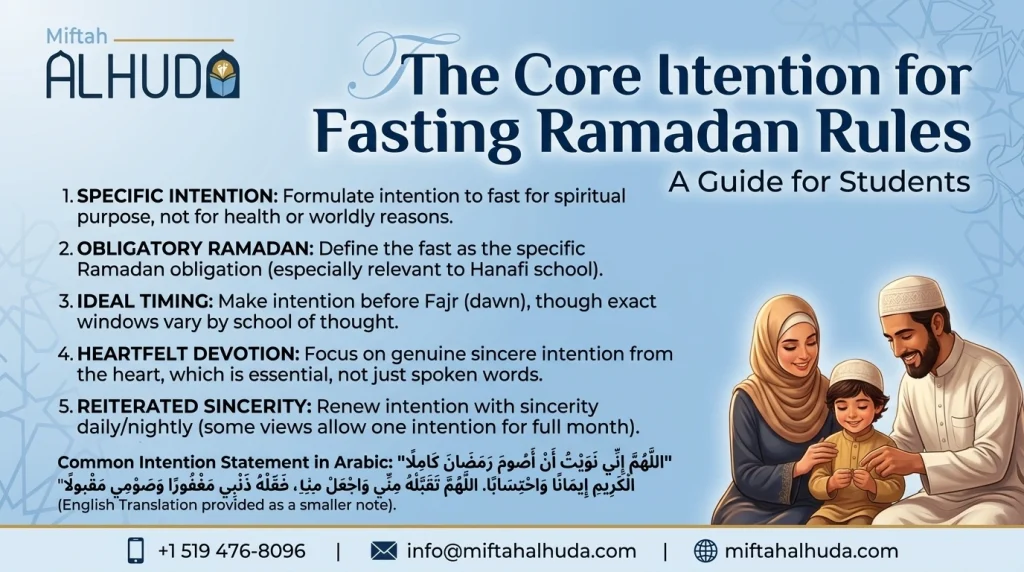
the essential elements of a correct Ramadan fasting intention can be summarized as follows:
- The intention must be to fast specifically, rather than simply refraining from food for health, nutritional, or other worldly reasons.
- The intention must state that the fast is for the obligatory Ramadan fast (as opposed to a voluntary fast, a make-up fast, or an expiation fast), especially when the Hanafi school is obligated to define the type of fast.
- The intention should ideally be declared before Fajr (dawn), but the exact acceptable window varies by school, as explained in the following section.
- The intention comes mostly from the heart. It does not have to be said aloud, although many Muslims find it spiritually beneficial to say it quietly as a manner of concentrating their determination.
- The intention should be reiterated with sincerity, preferably every night, however some schools allow a single intention to cover the full month under specific conditions.
A commonly recited intention statement in Arabic is: “Allahumma inni nawaytu an asooma Ramadan kamilan li wajhika al-kareem imanan wa ihtisaban. Allahumma taqabbalhu minni waj’al dhanbi maghfooran wa sawmi maqboolan.”
which translates roughly as ” O Allah, I intend to fast the entire month of Ramadan sincerely for Your Noble Countenance, with faith and seeking Your reward. O Allah, accept it from me, forgive my sins, and make my fasting accepted.”
It is crucial to clarify that uttering this precise sentence is not an Islamic obligation; what is necessary is genuine heartfelt intention, not a specific set of words.
When Should the Intention Be Made? Timing According to the Four Madhabs
The timing of the intention differs marginally among the four Sunni schools of Islamic jurisprudence.
- Hanafi: The intention is eligible to be declared from sunset until just before midday, as long as no actions that invalidate the fast have occurred after Fajr. This ruling applies to obligatory Ramadan fasts.
- Maliki: The intention should be made before Fajr. A single intention at the start of Ramadan is enough for the entire month, as long as fasting is not disrupted by a valid reason such as travel or illness. It is recommended that you renew your intention each night.
- Shafi’i and Hanbali: Every night before Fajr, a new intention must be set because each day’s fast is regarded as a separate act of worship.
Because scholarly perspectives differ, Muslims are recommended to accept the guidance of their trusted scholars or the madhab to which they adhere when applying the intention for fasting Ramadan rules.
How to Make the Correct Intention: A Step-by-Step Guide
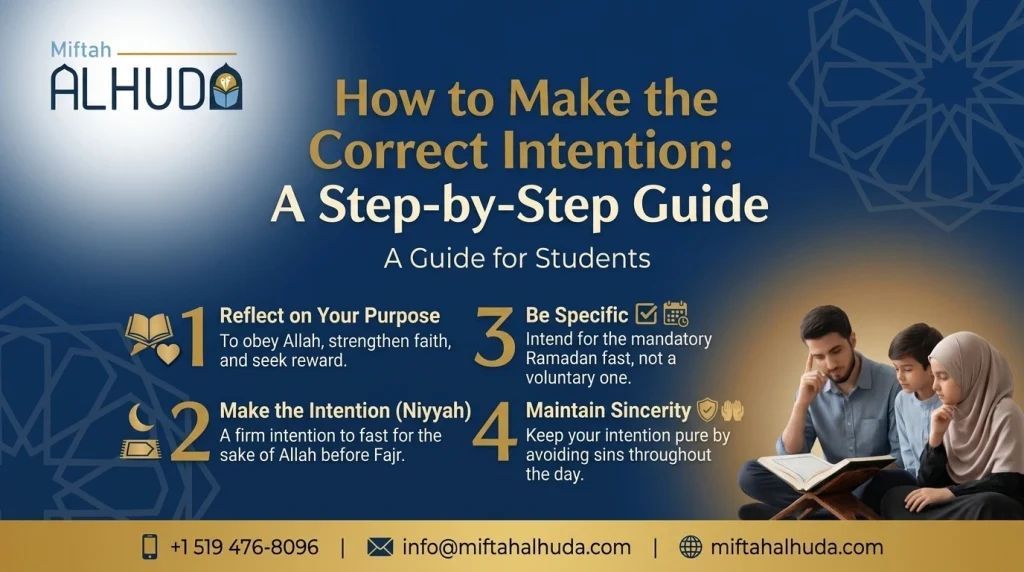
Follow these simple steps to observe the intention for fasting Ramadan rules correctly:
-
Reflect your purpose
Remember that you’re fasting to obey Allah, strengthen your faith, and seek His reward.
-
Make the intention in your heart
Before Fajr (or according to your madhab), make a firm intention to fast the following day for the sake of Allah.
-
Verbalize it if you wish
Saying the intent aloud is optional and can be done in Arabic or your native tongue, but it is not mandatory.
-
Be specific
Intend that your fast is a mandatory Ramadan fast, not a voluntary or makeup fast.
-
Maintain sincerity
Maintain your intention toward Allah throughout the day by avoiding sins and anything that reduces the reward of fasting.
-
Avoid unnecessary worry
There is no standard language for expressing the intention. A sincere intention in the heart is enough to fulfill the intention for fasting Ramadan rules.
The Spiritual Dimension: Beyond the Legal Requirement
Ramadan is a time to purify one’s heart, strengthen self-control, increase compassion, and draw closer to Allah. Fasting becomes a meaningful act of worship when there is a sincere intention behind it, inspiring believers to improve their character, worship, and daily lives.
Sample Intention Texts You Can Use
There is no required wording for intention, but the following examples might help:
- Ramadan fast (daily): “I intend to fast tomorrow to fulfill the obligation of Ramadan for the sake of Allah.”
- Entire month: “I intend to fast the entire month of Ramadan for the sake of Allah.”
- Make-up (Qada) fast: “I intend to fast today to make up for a missed Ramadan fast for the sake of Allah.”
- Voluntary fast: “I intend to fast today as a voluntary act of worship for the sake of Allah.”
The sincerity of the heart, rather than the wording, is what fulfills the intention for fasting Ramadan rules.
Conclusion
Understanding the intention for fasting Ramadan rules is essential for ensuring that your fast is both valid and spiritually rewarding. A sincere niyyah transforms fasting from a physical act into an act of worship dedicated to Allah. By learning the correct rulings and maintaining sincerity throughout Ramadan, you can observe each fast with confidence and devotion.
As you prepare for each day of Ramadan, take a moment to renew your intention and seek Allah’s pleasure in everything you do. May Allah accept your fasting, forgive your sins, and make this blessed month a time of spiritual growth, mercy, and countless rewards for you and your family.
Ready to Deepen Your Ramadan Practice?
Are you preparing for Ramadan and want to deepen your understanding of Islamic teachings, fiqh, and spiritual practice? Visit Miftah Al-Huda Academy for authentic Islamic courses, and resources to help you make the most of this blessed month. Explore our articles, connect with knowledgeable teachers, and take the next step in your spiritual journey today.
Contact Us
- WhatsApp: +1 519 476-8096
- E-Mail: in**@**********da.com
- Facebook: https://www.facebook.com/MiftahAlhudaOfficial
- Instagram: https://www.instagram.com/miftahalhudaa
- Youtube: https://www.youtube.com/@MiftahAl-huda
- Tiktok: https://www.tiktok.com/@miftahalhuda00
Frequently Asked Questions About The Intention For Fasting Ramadan Rules
1. Can I make my fasting intention while eating Suhoor?
Yes. If you are eating Suhoor with the genuine purpose of fasting that day for Allah’s sake, your intention is already there in your heart. There is no need to stop eating before setting the intention.
2. How can I help my family remember the importance of intention?
Create a simple nightly Ramadan routine by gathering for Suhoor, reminding one another of the intention, reciting a short dua, and encouraging sincerity in all acts of worship. This can strengthen both faith and family ties.
3. Can I change my intention from a voluntary fast to a Ramadan fast?
No, a mandatory Ramadan fast requires its own distinct intention. A voluntary fasting intention cannot be transformed into a Ramadan obligation after the fast has begun.
4. What happens if I accidentally doubt my intention during the day?
Having occasional doubts does not invalidate your fast. If you really wanted to fast before the required time, your fast remains valid, and you should disregard any unnecessary doubts.
5. Can children be taught to make the intention for fasting?
Yes. Although fasting is not required before puberty, encouraging youngsters to have a true intention helps them grasp the value of worship and prepares them for future commitments.
6. Why do scholars differ on the intention for fasting Ramadan rules?
The variations come from various interpretations of authentic Quranic verses and hadith. All four Sunni madhabs agree that intention is crucial, but they differ on specifics like timing and whether it should be renewed daily.
7. Does sleeping before Fajr without saying anything invalidate the intention?
No. If you went to bed intending to fast the next day, your intention is still valid even if you didn’t say anything before sleeping.