
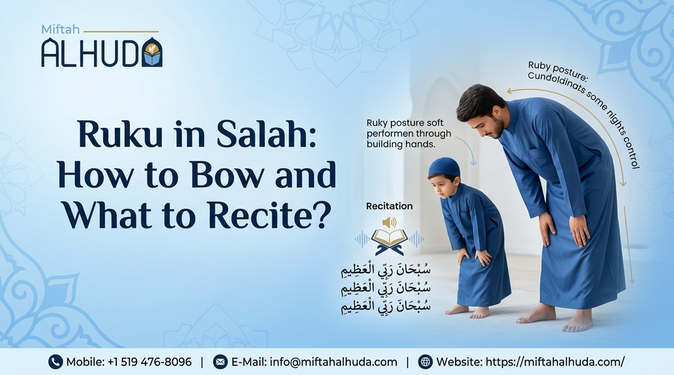
Ruku in Salah is an essential physical position in Muslim prayer. It is the time when we bow before Allah, stressing humility and surrender as the core of our worship. Although the movement is simple, practicing Ruku correctly requires many details, such as body posture, hand position, and the remembrance recited while bowing.
Learning how to properly perform a Ruku allows us to construct a prayer that is guided by the Quran and Sunnah. It also allows us to slow down during Salah rather than rushing through each movement.
This guide by Miftah Al-Huda Academy explains how to bow in Ruku, what to say, how long to remain in the position, common mistakes to avoid, and how Ruku fits into the Salah structure. It is supported by Quranic verses and authentic hadith from the Prophet ﷺ.
What Is Ruku in Salah?
Ruku is a bowing position performed after reciting Surah Al-Fatihah and another portion of the Quran while standing in Salah. We bend forward while keeping our backs reasonably straight, place our hands on our knees, and glorify Allah with the prescribed remembrance.
Ruku represents humility in front of Allah. The worshiper rises from the upright standing position and bows in submission, acknowledging the Creator’s greatness .
Quranic Evidence for Ruku
Allah commands bowing and prostration directly:
“O you who have believed, bow and prostrate and worship your Lord and do good – that you may succeed. “ ( surah Al-Hajj 22:77)
Ruku is a distinctive feature of true believers who follow the Prophet (ﷺ):
“Muhammad (SAW) is the Messenger of Allah, and those who are with him are severe against disbelievers, and merciful among themselves. You see them bowing and falling down prostrate (in prayer), seeking Bounty from Allah and (His) Good Pleasure. ” (Surah Al-Fath :29)
And Allah connects Ruku to the establishment of prayer itself, instructing believers to bow with the congregation.
“And establish prayer and give zakah and bow with those who bow [in worship and obedience]. ” (Surah Al-Baqarah 2:43)
Together, these verses demonstrate that Ruku is not a mere physical gesture; it is often mentioned in the Quran, alongside Sujud, as a distinguishing act of worship and a sign of believers.
When Do We Perform Ruku in Salah?
Ruku takes place following the Quranic recitation in the standing position.
The basic sequence is:
- We stand for Salah.
- We recite the opening supplication where applicable.
- We recite Surah Al-Fatihah.
- We recite another portion of the Quran in the relevant rak’ahs.
- We say Allahu Akbar and move into Ruku.
- We perform the prescribed remembrance while bowing.
- We rise from Ruku into the standing position, saying Sami’a Allahu liman hamidah (if leading or praying alone) and responding with Rabbana wa lakal-hamd.
- We proceed to Sujud.
The change should be carried out smoothly and without excessive hurry. Note that the Takbir “Allahu Akbar” signifies the descent into Ruku and later into Sujud, whereas the rising out of Ruku has its own distinct phrase “Sami’a Allahu liman hamidah”, which is discussed further below.
How to Perform Ruku Step by Step?
1. Say Takbir before bowing
As we move from standing to Ruku, we say:
Allahu Akbar: “Allah is the greatest.”
The Takbir signifies the transition from standing to bowing.
2. Bend Forward Properly
We then bend forward from our standing position. Instead of merely leaning forward, the idea is to achieve a balanced posture.
The back should be kept relatively straight, and the head should remain naturally aligned with the body.
3. Place the Hands on the Knees
We place our hands on our knees at Ruku. The Prophet Muhammad ﷺ established the practice of naturally spreading the fingers.
This position provides stability and helps establish Ruku’s recognized posture.
4. Keep the Body Calm
One of the most essential characteristics of Ruku in Salah is tranquility (tuma’niyah). The Prophet ﷺ specifically commands this action, not only as a recommendation.
In the well-known hadith of “the man who prayed badly” (agreed upon by Bukhari and Muslim), the Prophet ﷺ taught a man to pray correctly, saying:
“When you stand for the prayer, say Takbir and then recite from the Qur’an what you know and then bow with calmness till you feel at ease, then rise from bowing till you stand straight.
Afterwards prostrate calmly till you feel at ease and then raise (your head) and sit with Calmness till you feel at ease and then prostrate with calmness till you feel at ease in prostration and do the same in the whole of your prayer.” Sahih al-Bukhari
This hadith provides a direct foundation for the instruction not to quickly rise after attaining the bowing position. Prayer isn’t just a series of movements. Each position should be performed with khushu, attention, and composure.
What Do We Recite During Ruku?
The most widely uttered remembrance during Ruku is:
Subhana Rabbiyal-‘Azim: “Glory be to my Lord, the Magnificent.”
This remembrance highlights Allah’s majesty and perfection at a time when we are physically demonstrating our humility.
Additional Authentic Forms of Dhikr in Ruku
The Prophet ﷺ made multiple authentic supplications in Ruku:
Narrated `Aisha:
The Prophet (ﷺ) used to say in his bowing and prostrations, “Subhanaka l-lahumma Rabbana wa bihamdika; Allahumma ghfir li.’ (Exalted [from unbecoming attributes] Are you O Allah our Lord, and by Your praise [do I exalt you]. O Allah! Forgive me). Sahih al-Bukhari
How Many Times Should We Say It?
A common practice is to recite Subhana Rabbiyal-‘Azim three times. The important objective is to retain calm and true remembrance rather than hurrying through a certain number.
The Hadith on the Purpose of Ruku
Perhaps the most essential hadith absent from a simple explanation of Ruku is the one explaining why glorification, in particular, fits in this place.Ibn ‘Abbas (May Allah be pleased with them) reported:
The Messenger of Allah (ﷺ) said: “Glorify your Lord in Ruku’ (bowing posture) and exert yourself in supplication in prostration. Thus your supplications are liable to be accepted.” (Sahih Muslim)
This hadith illustrates the prayer’s internal logic: Ruku is the stance of ta’zim (exalting and glorifying Allah), whereas Sujud is the position of du’a (requesting and pleading). Understanding this distinction clarifies why we say “Subhana Rabbiyal-‘Azim” while bowing.
A related hadith explains what should not be done in Ruku.
‘Ali b. Abi Talib reported:
The Messenger of Allah (ﷺ) forbade to recite the Qur’an, while I am in the state of bowing and prostration. (Sahih Muslim)
This is why Ruku is kept for glorification rather than Quranic recital.
Why Do We Say Subhana Rabbiyal-‘Azim in Ruku?
The wording of the remembrance is strongly related to the position itself.
- Subhana represents Allah’s perfection and independence from all imperfections.
- Rabbiy translates to “my Lord.”Azim translates to “the Magnificent” or “the Great.”
As a result, while our bodies are humiliated, our mouth declares Allah’s magnificence. This establishes a strong link between the physical activity and the spiritual purpose of Salah, and it relates perfectly to the hadith stated above, which instructs us to “glorify the Lord” in Ruku.
How Long Should We Stay in Ruku?
We should stay in Ruku long enough to develop tranquility and proper composure, as commanded by the hadith of “the man who prayed badly” stated above.
Rushing through Ruku and quickly shifting to standing can degrade the quality of prayer. Ruku should consequently feel like a genuine pause in worship, rather than a transition between Ruku and Sujud.
How to Rise From Ruku?
After completing the remembrance, we rise from Ruku and return to an upright position. We should get settled before going on to the next position.
The Imam, while leading the prayer, says:
Sami’a Allahu liman hamidah: “Allah hears those who praise Him.”
The person praying behind the Imam responds:
Rabbana wa lakal-hamd: “Our Lord, and to You belongs all praise.”
This argument is itself based on a genuine hadith. Abu Hurairah (may Allah be pleased with him) reported that the Prophet ﷺ said:
“When the Imam says: (Sami Allahu liman hamidah) ‘Allah listens to those who praise Him. Then (all of you) say: (Rabbana wa lakal-hamd) ‘O our Lord! And to You is the praise for whoever’s saying concurs with the saying of the angels, then his past sins will be forgiven.” (Jami` at-Tirmidhi)
When praying individually, the worshiper uses both phrases, stating “Sami’a Allahu liman hamidah” and “Rabbana wa lakal-hamd.”
Common Mistakes During Ruku
1. Rushing Through Ruku
One of the most common mistakes is moving into Ruku and immediately standing again, clearly contradicting the Prophet’s ﷺ instruction to “bow until at ease.”” Allow adequate time to settle in and recite the remembrance with full attention.
2. Failing to Maintain a Balanced Posture
Some worshipers bow too lightly, while others exaggerate their movements. The goal is to have a bow that is stable and natural, as stated in the Sunnah.
3. Dropping the Head Excessively
The head should be naturally aligned rather than purposely dropped or elevated in an excessive manner.
4. Forgetting the Remembrance
Ruku is a perspective of glorification, as the hadith “glorify the Lord in it” states. We should remember the necessary dhikr rather than viewing the bow as merely a physical step.
5. Reciting Quran While Bowing
According to a hadith by Ali (may Allah be pleased with him), the Prophet ﷺ prohibited reciting the Quran during Ruku or Sujud. Some beginners wrongly continue Quranic recitation into the bow, which should be avoided.
6. Moving Before Achieving Tranquility
Salah’s transitions should be controlled. Before proceeding to the next position, we should first establish the current one.
Ruku and Khushu in Salah
Khushu means humility, attentiveness, and a heart that is consciously engaged in devotion.
Ruku provides an excellent opportunity to cultivate this quality. When we understand the significance of the words we recite, as well as their Quranic and Prophetic context, the movement becomes more than just physical exercise. We bow before Allah and declare His majesty, as ordered in Surah Al-Hajj (22:77) and detailed in the hadith on the purpose of Ruku.
Instead of thinking, “I need to finish this rak’ah,” we could focus on the significance of the moment: Allah is greater, and we are standing before Him in prayer.
The Difference Between Ruku and Sujud
| Ruku | Sujud |
| We bow forward | We prostrate |
| Hands are placed on the knees | The forehead and nose are placed on the ground |
| We glorify Allah as Al-‘Azim | We glorify Allah as Al-A’la |
| Position of ta’zim (glorification) : “glorify the Lord in it” | Position of du’a (supplication) : “strive hard in supplication” |
| It follows the standing recitation | It follows the standing after Ruku |
Ruku in the Five Daily Prayers
Ruku is performed during each of the five daily prayers. Whether we are praying Fajr, Dhuhr, Asr, Maghrib, or Isha, Ruku is a vital part of the prayer.
How Beginners Can Practice Ruku?
Beginners can learn Ruku gradually rather than attempting to memorize every aspect all at once.
- First, practice the physical movement until it comes naturally.
- Next, learn and understand Subhana Rabbiyal-‘Azim.
- Then, acquire at least one more authentic dhikr (such as “Subhanaka Allahumma Rabbana wa bihamdika, Allahumma-ghfir li”) to diversify the memory, as the Prophet ﷺ did.
- Finally, practice moving from standing to Ruku and back to standing, including the line, “Sami’a Allahu liman hamidah / Rabbana wa lakal-hamd.”
A useful practice sequence is:
Standing → Takbir → Ruku (tranquil, with dhikr) → Rise (Sami’a Allahu liman hamidah / Rabbana wa lakal-hamd) → Standing → Sujud
Repeating this sequence slowly can help you perform the movements correctly during the Salah.
Conclusion
Learning Ruku in Salah allows us to pray with increased accuracy, calm, and focus. Every aspect of Ruku, from saying Allahu Akbar as we bow to reciting Subhana Rabbiyal-‘Azim and its authentic variants to rising with “Sami’a Allahu liman hamidah,” carries a deeper meaning of humility before Allah, which is directly rooted in the Quran and authentic hadith from Sahih al-Bukhari and Sahih Muslim. By learning the proper posture, carefully practicing the transition, and focusing on the remembrance and its evidence, we can make Ruku a meaningful part of our daily worship rather than just another Salah part Miftah Al-Huda Academy is dedicated to helping students in learning Salah and its rulings using clear and accurate evidence; contact us to continue creating a prayer based on knowledge and khushu.
Want to perform Ruku in Salah correctly and with confidence? Join Miftah Al-Huda Academy and learn the essential steps, movements, and recitations of Salah with qualified instructors. Book your free trial today and start improving your prayer with guided, practical lessons.
Contact Us
- WhatsApp: +1 519 476-8096
- E-Mail: in**@**********da.com
- Facebook: https://www.facebook.com/MiftahAlhudaOfficial
- Instagram: https://www.instagram.com/miftahalhudaa
- Youtube: https://www.youtube.com/@MiftahAl-huda
- Tiktok: https://www.tiktok.com/@miftahalhuda00
Frequently Asked Questions About Ruku in Salah
1. Is Ruku required in every type of Salah?
Yes, Ruku is an important part of regular required and voluntary prayers.
2. Can we make personal Dua while in Ruku?
Yes, authentic supplications can be recited in Ruku, particularly in voluntary prayers, while adhering to the Sunnah.
3. Should we recite the Quran while in Ruku?
No, Ruku is primarily a position for dhikr and praise, not Quranic recitation.
4. What should we do if we forget the Ruku dhikr?
If the prescribed dhikr is forgotten, we should continue the prayer calmly and follow the applicable rulings according to our school of Islamic jurisprudence.
5. Can Ruku be performed while sitting?
A person who is unable to stand or bow normally due to a valid physical limitation may perform Salah to their abilities, in accordance with Islamic guidelines.