
Have you ever looked at a page of the Quran, observed the small circle positioned above a letter, and asked yourself, “Is that Sukoon?” Or Jazm? And honestly, does it even matter?”
If you answered yes, you are not alone. These two concepts confuse thousands of learners, including new Muslims and lifelong Arabic students. But here’s the beautiful truth: once you understand the Difference Between Sukoon and Jazm, your Quran recitation, and Arabic comprehension get a massive upgrade.
Let’s break it down in a simple, practical way, the way we teach it at Miftah Al-Huda Academy.
What is Sukoon (ْ)?
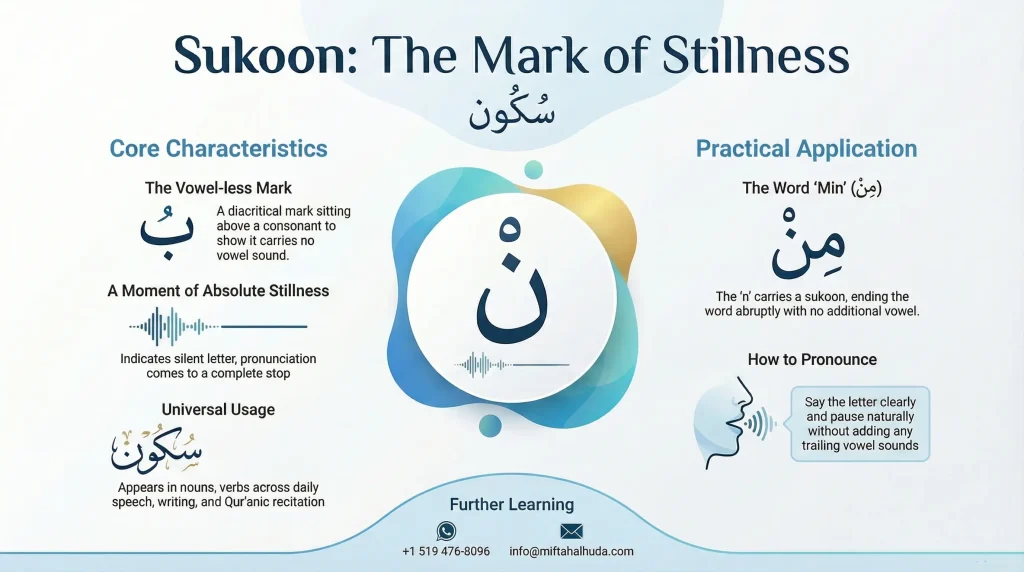
Sukoon (ْ) is an important Arabic diacritical mark that sits above a consonant to show it carries no vowel sound at all, making the letter completely still in pronunciation.
Key Features:
- It indicates that the letter is silent, with no vowels attached afterward.
- The pronunciation comes to a complete stop right at that letter.
- In Arabic, it appears in both nouns and verbs.
- It is frequently used in daily spoken and written Arabic, as well as the recitation of the Qur’an.
Example:
- مِنْ (min) → The letter “ن” has a sukoon, indicating that the word is pronounced distinctly and concludes abruptly without any additional vowel sound.
Sukoon can be conceptualized as a moment of absolute silence or stillness in speech; one says the letter clearly and then pauses naturally without adding any vowel thereafter.
What is Jazm (ْ)?
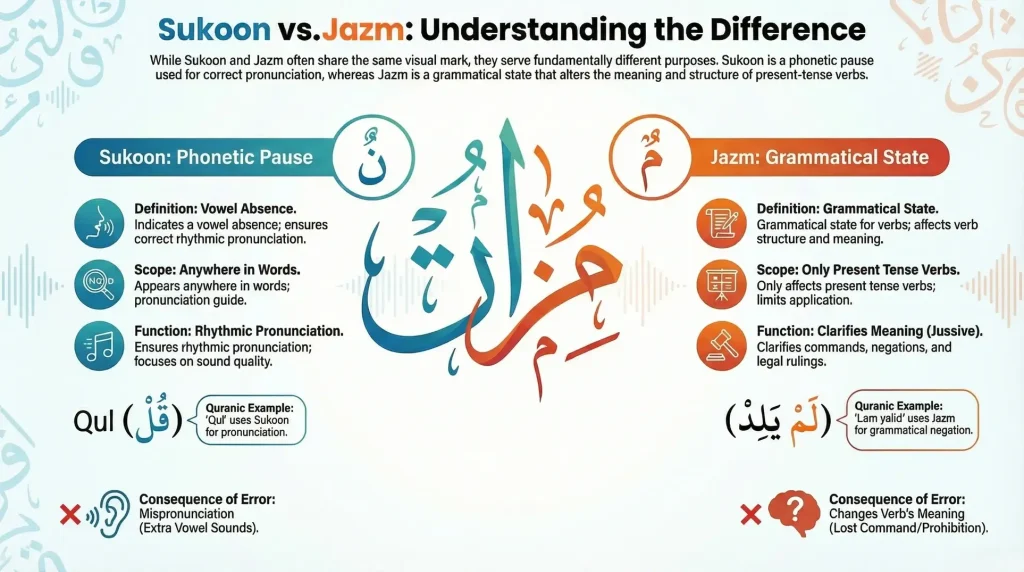
Although Jazm (ْ) appears to be similar to Sukoon, it has a distinct function in Arabic grammar. Unlike a simple pronunciation mark, Jazm serves as a grammatical indicator that only affects verbs.
Key Features:
- It indicates that a verb has transitioned into the jussive mood.
- It appears in specific grammatical contexts, such as after negative particles or within certain imperatives.
- It is used exclusively with present-tense (imperfect) verbs .
Example:
- لَمْ يَكْتُبْ (lam yaktub) → The final “ب” is a jazm, indicating the verb is in the jussive form as it follows the particle “لَمْ”.
Consider Jazm a grammatical switch; it changes not only how you pronounce the verb, but also its mood and entire meaning in the sentence.
Why This Difference Matters (The “Life Hack”) ?
Understanding the Difference Between Sukoon and Jazm is like discovering a hidden shortcut in Arabic study.
- Improves Tajweed precision
- Helps you prevent grammatical mistakes.
- Makes Qur’anic recitation more exact and profound.
- Improves your grasp of Arabic sentence structure.
Rather than guessing, you’ll understand why a letter is silent and how it influences meaning.
Real Examples: Seeing the Difference Between Sukoon and Jazm
Examples of Sukoon :
-
ذَهَبْتُ إِلَى السُّوقِ
- Word with Sukoon: ذَهَبْتُ
- Letter with Sukoon: بْ
- Meaning: I went to the market.
- Note: The sukoon is part of the natural word structure.
-
اِجْلِسْ هُنَا
- Word with Sukoon: اِجْلِسْ
- Letter with Sukoon: سْ
- Meaning: Sit here.
- Note: Ends with sukoon for correct pronunciation.
- وَاصْبِرْ عَلَى مَا أَصَابَكَ (Surah Luqman 31:17)
- Word with Sukoon: اصْبِرْ
- Letter with Sukoon: رْ
- Meaning: And be patient over what befalls you.
- Note: The sukoon is part of the natural pronunciation, not due to grammar.
Examples of Jazm:
- لَمْ يَذْهَبْ الطَّالِبُ إِلَى المَدْرَسَةِ
- Word with Jazm: يَذْهَبْ
- Trigger: لَمْ
- Meaning: The student did not go to school.
- Note: The sukoon on بْ is appears due to Jazm.
- لَا تَلْعَبْ بِالكُرَةِ
- Word with Jazm: تَلْعَبْ
- Trigger: لَا النَّاهِيَة (prohibition “do not”).
- Meaning: Do not play with the ball.
- Note: Jazm here gives a command/prohibition meaning.
لَا تَقْتُلُوا أَوْلَادَكُمْ .3 (Surah Al-An’am 6:151)
- Word with Jazm: تَقْتُلُوا
- Trigger: لَا النَّاهِيَة (prohibition “do not”)
- Meaning: Do not kill your children.
- Note: The sukoon is grammatical (Jazm) to indicate prohibition.
Struggling with light and heavy Raa rules?
Don’t practice alone! Join our personalized Online Tajweed Classes at Miftah Alhuda to apply the Raa Saakinah Rule in tajweed with 1-on-1 guidance from qualified native Arab teachers.
Explore Miftah Alhuda Tajweed Courses
Sukoon vs Jazm Comparison Table
| Aspect | Sukoon | Jazm |
| Definition | A mark indicating the absence of a vowel (pause on a letter) | A grammatical state that puts a verb in the jussive mood |
| Function | Pronunciation (how to read the letter) | Grammar (affects verb meaning and structure) |
| Where It Appears | – At the end of a word when pausing
– Inside words where a consonant has no vowel |
– Only in present tense verbs (المضارع)
– After particles like لَمْ and لِنَ |
| Types | – Original Sukoon (built into the word)
– Incidental Sukoon (when stopping in reading) |
No types (purely grammatical) |
| Example from the Qur’an | قُلْ هُوَ اللَّهُ أَحَدٌ → “قُلْ” has Sukoon on لْ | لَمْ يَلِدْ → “يَلِدْ” has Jazm due to لَمْ |
| Effect on Meaning | Does NOT change meaning; only affects pronunciation | Changes meaning and grammatical state of the verb |
| Role in Recitation | Ensures smooth, accurate pronunciation and rhythm | Ensures correct grammatical meaning during recitation |
| Impact if Ignored | Mispronunciation (e.g., adding extra vowel sounds) | Changes meaning (command, negation, or prohibition may be lost) |
| Use in Islamic Texts | Preserves proper recitation and Tajweed | Clarifies commands, prohibitions, and legal rulings (Fiqh & Hadith) |
Precision in Worship: A Form of Ihsan
The Prophet Muhammad ﷺ said, “Allah is beautiful and loves beauty.”Part of that beauty comes from carefully and accurately reciting His words. When you recognize the distinction between Sukoon and Jazm, you are demonstrating ihsan perfection in worship.
Why Choose to Learn the Difference Between Sukoon and Jazm with Miftah Al-Huda Online Academy ?

- Learn the Difference Between Sukoon and Jazm in a straightforward, clear, and organized way
- Get expert Tajweed support with real-life examples from the Quran.
- Improve pronunciation (Sukoon) and grammar understanding (Jazm) simultaneously.
- Avoid common mistakes that can alter meanings during recitation.
- Benefit from interactive classes and personal comments.
- Develop confidence and fluency in Qur’anic reading.
- Suitable for both beginners and expert learners.
Unlocking Arabic Proficiency Through Sukoon and Jazm
The Difference Between Sukoon and Jazm may appear minor, yet it has significant implications for both pronunciation and meaning. Sukoon will help you say Arabic correctly, while Jazm will help you comprehend it thoroughly.
Mastering both will strengthen your Qur’anic recitation and general Arabic proficiency. And with the appropriate instruction, the journey is made a lot easier and more effective. That’s where Miftah Al-Huda Academy comes in. We provide structured training, professional guidance, and hands-on experience to help you properly understand these core concepts.
Ready to master Tajweed and unlock the secrets of Arabic grammar? Stop guessing and start understanding the true Difference Between Sukoon and Jazm. Join Miftah Al-Huda Academy today and take the first step toward recitation excellence. Click here to claim your Free Trial and experience a transformational way to learn the language of the Qur’an!”
Mastering the Arabic alphabet doesn’t have to be intimidating or take months to figure out.
Ready to start reading Arabic today? Dive into our step-by-step guide to learn Alif, Ba, Ta, Tha in minutes, master their pronunciations effortlessly, and build a rock-solid foundation for your language journey!
Contact Us
- WhatsApp: +1 519 476-8096
- E-Mail: in**@**********da.com
- Facebook : https://surl.li/yqeyas
- Instagram:https://surl.li/smlfaq
- Youtube: https://surl.li/inbncd
- Tiktok:https://surl.li/ldzmww
Frequently Asked Questions About The Difference Between Sukoon and Jazm
1. Can Sukoon and Jazm occur on the same letter at the same time?
Technically, the symbol is the same, but depending on the context, it is translated as Sukoon or Jazm .
2. How does Sukoon affect Tajweed rules like Ikhfa or Idgham?
Sukoon is important in Tajweed rules, particularly when it appears on letters like نْ or مْ, which trigger rules like Ikhfa, Idgham, or Iqlab.
3. Does Jazm always make the last letter silent?
In most cases, yes; nevertheless, Jazm may also end in (letter deletion), particularly in weak verbs.
4. Can Sukoon appear in connected recitation (without stopping)?
Yes, Sukoon can emerge naturally within words even if you do not pause.
5. Why is Jazm important in understanding Qur’anic commands?
Because it clearly conveys negation, command, or prohibition, which has a direct impact on the intended meaning of the Qur’an.
6. How do teachers usually train students to recognize Jazm quickly?
By focusing on trigger particles such as لَمْ، لَا النَّاهِيَة، لِـ and performing repetitive pattern identification in sentences.
7. Can misunderstanding Jazm lead to incorrect tafsir (interpretation)?
Yes, because Jazm influences verb meaning, misunderstanding it might result in misinterpreting commands or negations.
8. Is learning Sukoon before Jazm better for beginners?
Yes, undoubtedly! Because Sukoon focuses on pronunciation, which is the foundation of accurate recitation, it is best mastered before going into grammatical principles like Jazm. This stepwise technique allows learners to comprehend the Difference Between Sukoon and Jazm without becoming overwhelmed. Start with the sound, then progress to the structure.