
Did you know that learning new Arabic words is similar to gathering unique treasures? Every word you discover allows you to read incredible stories, create new friends, share your great ideas with the world, and beautifully recite the Holy Quran with confidence and love!
Miftah Al-Huda Academy is honored to present this article as your comprehensive guide to discovering how we help your child master Kids Arabic Vocabulary using the best and latest online learning strategies.
Why Kids Arabic Vocabulary Matters for Early Development ?
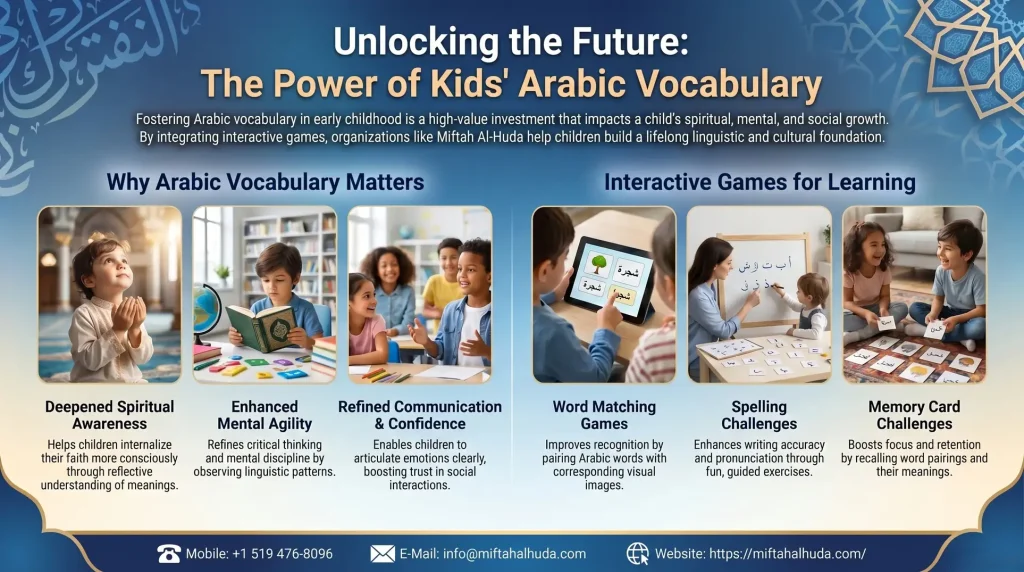
Fostering Kids Arabic Vocabulary during early childhood constitutes a valuable investment.
Deepened Spiritual Awareness
Enhancing Arabic vocabulary enables kids to internalize meanings and become familiar with their faith more consciously and reflectively.
Enhanced Mental Agility
Initial acquaintance with Arabic enhances critical thinking, observation of patterns, and mental discipline, thereby refining overall mental ability.
Refined Communication Skills
A varied vocabulary enables children to articulate thoughts and emotions with a greater level thereby enhancing their trust in both spoken communication and social interaction.
Lifelong Learning Advantage
Being fluent in Arabic establishes a strong linguistic buildup that facilitates future academic achievement and cross-cultural chances .
Interactive Games That Boost Arabic Vocabulary Skills
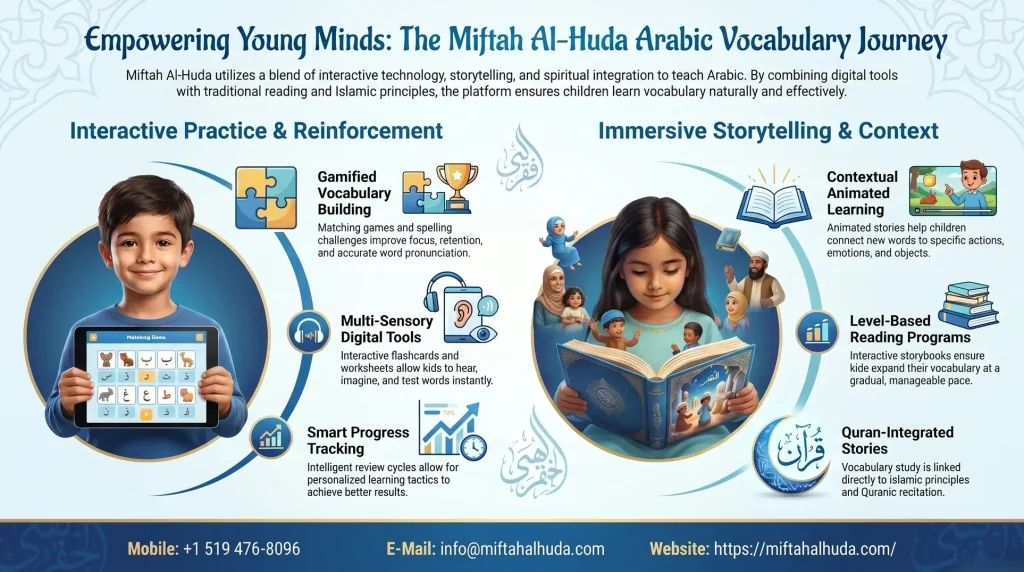
Games are one of the best methods for teaching Kids Arabic Vocabulary.
Word Matching Games
Pair Arabic words with images to improve acknowledgment.
Spelling Challenges
Fun spelling exercises help kids to accurately write Arabic words while practicing pronunciation.
Memory Card Games
Games like these improve kids’ focus and retention by challenging them to recall word pairings, images, and meanings.
Miftah Al-Huda maintains kids to be inspired by including these activities on a regular basis.
Animated Videos for Visual Vocabulary Learning
An effective method for helping Kids Arabic Vocabulary is animated content. Kids are assisted in making connections between words and actions, emotions, and objects by vivid images and captivating characters.
Story-Based Learning
Short animated stories offer new vocabulary in situations, making it easier for young kids to understand its use.
Character-Based Lessons
Kids follow familiar characters who lead them through vocabulary lessons while creating a sense of belonging and continuity.
Miftah Al-Huda transforms animated content into a great tool for natural, easily understood Kids Arabic Vocabulary training.
Flashcards and Digital Worksheets for Reinforcement
Digital tools make training Kids Arabic Vocabulary intriguing and much more useful..
- Interactive Flashcards
Hear, imagine, and test words instantly for greater remembering.
- Printable Worksheets
Printable worksheets replace word study into creative and entertainment.
- Progress Tracking Tools
Smart review cycles allow us to alter learning tactics for better results.
Storytelling and Reading Platforms
Reading plays a critical role in enriching Kids Arabic Vocabulary. Miftah Al-Huda storytelling sources offer access to a variety of age-appropriate content..
Interactive Storybooks
Select on any word to hear the pronunciation and what it means.
Level-Based Reading Programs
Gradual vocabulary ensures that kids learn at a manageable rate.
Comprehension Activities
After reading, kids answer questions or do assignments to enhance their vocabulary knowledge.
By integrating reading into daily routines, we help children naturally expand their vocabulary and improve language fluency.
Quran-Integrated Stories
Link the study of vocabulary to Islamic principles and recitation of the Quran.
Mobile Apps for Daily Kids Arabic Vocabulary Practice
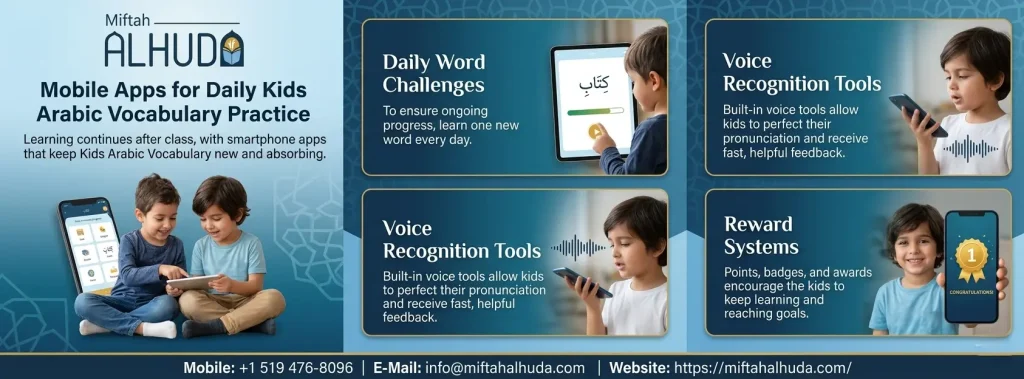
Learning continues after class, with smartphone apps that keep Kids Arabic Vocabulary new and absorbing.
Daily Word Challenges
To ensure ongoing progress, learn one new word every day.
Voice Recognition Tools
Built-in voice tools allow kids to perfect their pronunciation and receive fast, helpful feedback.
Reward Systems
Points, badges, and awards encourage the kids to keep learning and reaching goals.
Be Your Kid’s First Arabic Teacher: Partnering in Kids Arabic Vocabulary Success
Miftah Al-Huda believes that parents are an initial basis of the kid’s intellectual growth.
- Learn Together, Grow Together: Turn Kids Arabic Vocabulary practice into quality bonding time, read a short story, play a word game, or review flashcards together.
- Celebrate the Small Wins: Giving your kid a high five, a sticker, or a hearty “Masha’Allah!” after learning a new term boosts self-esteem and piques their interest.
- Weave Arabic into Daily Life: Make Kids Arabic Vocabulary a part of your home’s natural rhythm by naming items, describing meals, or reciting simple verses from the Quran .
- Stay Connected with Us: For smooth advancement, Miftah Al-Huda tutors provide regular updates that help you balance academic goals with at-home practice.
Building a Consistent Learning Routine
When kids acquire Arabic vocabulary consistently, it becomes a lifelong habit rather than just a duty.
Set Clear Goals
Define attainable vocabulary goals to keep motivation and focus high.
Mix Learning Methods
For a well-rounded approach, incorporate writing, reading, videos, and games.
Track Progress
Continually assess progress in order to modify strategies and guarantee consistent expansion.
Advanced Strategies for Faster Kids Arabic Vocabulary Growth
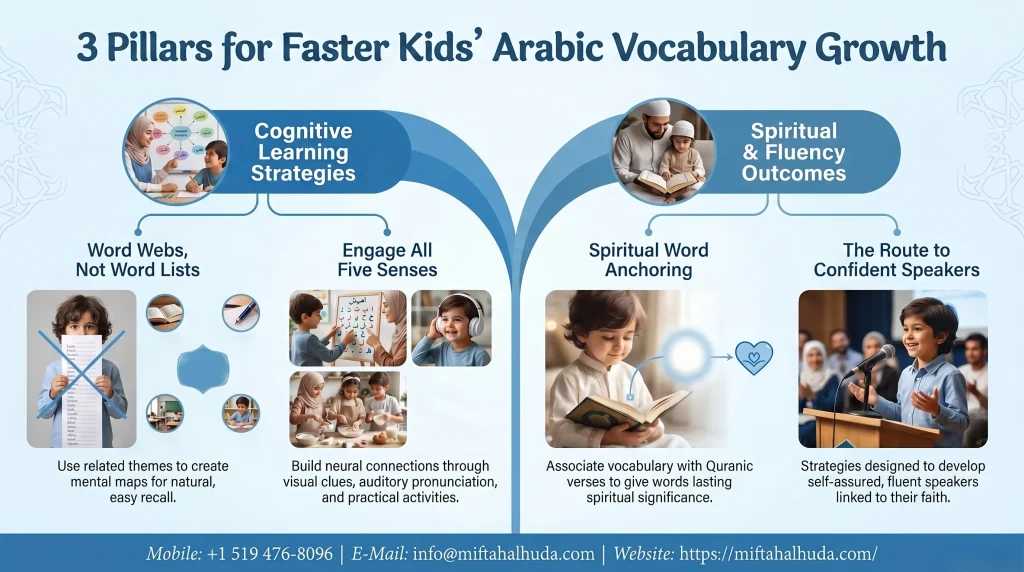
Use research-proven strategies for younger students to accelerate their growth.
- Word Webs, Not Word Lists: Through related themes, young learners acquire Kids Arabic Vocabulary, creating mental maps that facilitate easy and natural recall.
- Learn with All Senses: Deeper neural connections are created for young Kids Arabic Vocabulary recall through visual clues, auditory pronunciation, and practical activities.
- Spiritual Word Anchoring: By associating new vocabulary with verses from the Quran, words get spiritual significance that makes them more difficult to forget and more lovable.
The sophisticated strategies at Miftah Al-Huda are the everyday route to young speakers who are self-assured, fluent, and linked to their faith.
Kids Arabic Vocabulary Roadmap by Age
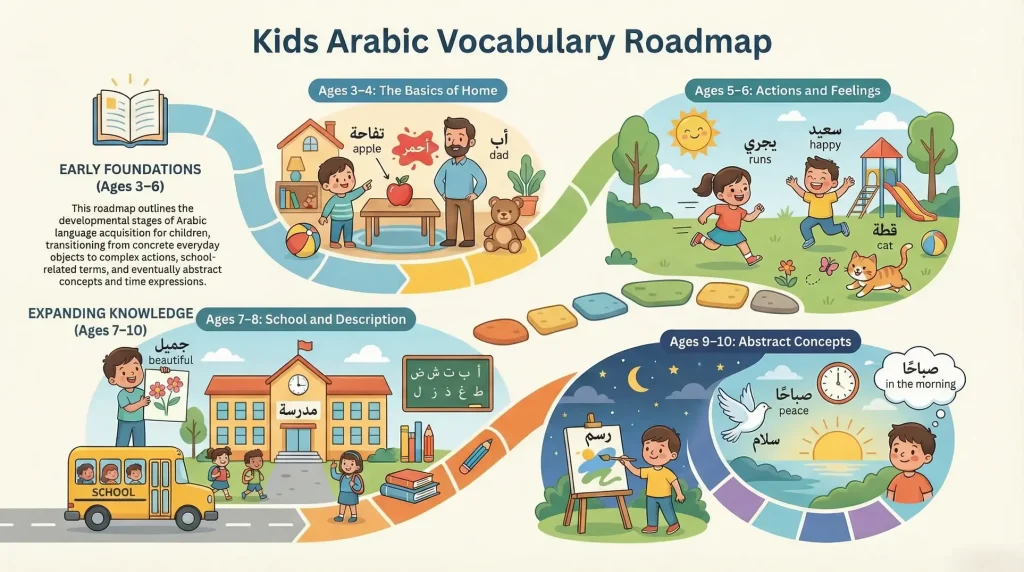
| Age Group | Focus Area for Kids Arabic Vocabulary | Sample Words (Arabic + English) | Recommended Interactive Activity |
| 3–4 years | Everyday objects, colors, family members | تفاحة (apple)
أحمر (red) أب (dad) |
Flashcard matching + coloring sheets |
| 5–6 years | Actions, emotions, numbers, animals | يجري (runs)
سعيد (happy) قطة (cat) |
Role-play games + sing-along vocabulary songs |
| 7–8 years | Descriptive words, school terms, places | جميل (beautiful)
مدرسة (school) حديقة (park) |
Interactive storybooks + word-tracing worksheets |
| 9–10 years | Abstract concepts, hobbies, time expressions | سلام (peace)
رسم (drawing) صباحًا (in the morning) |
Mini dialogues + vocabulary journaling + digital quizzes |
Empowering Young Minds Through Language Discovery
Establishing a solid base in Kids Arabic Vocabulary converts education into a mission of research, growth, and faith. Miftah Al-Huda Academy posits that when kids encounter rich, engaging, and purposeful language experiences, they commence thinking, analyzing, and interacting in Arabic with natural ease .
As young learners progress with us, Arabic emerges as a potent tool for expression, reasoning, and creativity.
Unlock Your Child’s Arabic Potential Today!
Join Miftah Al-Huda Academy for a FREE trial and discover how our engaging Kids Arabic Vocabulary program builds confidence, faith, and fluency one fun word at a time.
Contact Us
- WhatsApp: +1 519 476-8096
- E-Mail: in**@**********da.com
- Facebook : https://surl.li/yqeyas
- Instagram:https://surl.li/smlfaq
- Youtube: https://surl.li/inbncd
- Tiktok:https://surl.li/ldzmww
Frequently Asked Questions
1. Can learning Kids Arabic Vocabulary improve a kid’s performance in other subjects?
Yes, enhancing language skills improves overall cognitive capacities such as focus, and analytical thinking, which are beneficial in other academic fields.
-
What is the ideal balance between screen time and traditional learning for vocabulary building?
A balanced approach that includes both online tools and offline activities such as reading and writing results in more effective learning.
-
What are common mistakes kids make when learning Arabic vocabulary online?
Common difficulties include excessive reliance on passive learning, inconsistency in practice, and failure to use language in situations that require it.
-
How can mistakes in pronunciation be corrected without discouraging kids?
At Miftah Al-Huda, we believe that every mistake is a stepping stone to mastery, not a reason to stop. When it comes to Kids Arabic Vocabulary, gentle correction is key to building confidence while ensuring accuracy.
Here’s how we do it: Instead of saying “That’s wrong,” we simply repeat the word correctly with a warm smile.Yes! We say: كِتَاب (kitaab)!” so kids learn through positive reinforcement.
-
Do children need to understand grammar to build vocabulary effectively?
Vocabulary can be learnt independently in the early stages, but basic grammar can be gradually introduced to help with sentence creation.