
While perusing your phone, a sentence in Arabic captures your attention; you catch a word or two, although the complete meaning is not clear to you. That specific moment? That is your chance to make it happen. The truth is that cramming does not lead to fluency.
It is built on one basic habit: choosing to practice Arabic vocabulary online every day, even if only for 5 minutes. In this article, you’ll learn creative, practical tricks to practice Arabic vocabulary online that fit your busy schedule and transform studying from a chore to a fulfilling daily ritual.
We at Miftah Al-Huda Academy make this everyday practice simple, effective, and systematic by offering specialized online Arabic vocabulary courses.
Why Daily Vocabulary Practice Matters for Arabic Learners?

Language acquisition is similar to fitness in that you will not become skilled if you only study once per month. Consistent daily practice is crucial.
Consistently practice Arabic vocabulary online not only helps you recall words, but it also rewires your brain to think naturally in Arabic.
The Science Behind Spaced Repetition and Language Retention
- If you do not review fresh information, your brain will forget approximately 70% of it within the first 24 hours.
- Spaced Repetition Systems (SRS) address this problem by displaying words at the exact moment you are about to forget them.
- Using SRS-powered tools to practice Arabic vocabulary online enhances study efficiency and memory retention.
How Consistent Practice Beats Intensive Cramming Sessions?
- Cramming (such as all-nighters before a test) is ineffective for language learning because most knowledge is rapidly forgotten.
- Short daily sessions result in stronger brain circuits than extended, rare study marathons.
- Bite-sized, continuous practice reduces stress, keeps you motivated, and makes practice Arabic vocabulary online more pleasurable.
Getting Started with Online Arabic Vocabulary Practice
Start with modest, attainable goals to cultivate a sustainable habit.
Setting Realistic Daily Goals for Arabic Words
- Target 10 to 20 new words daily rather than 50. Quality is much more important than quantity.
- Prioritize high-frequency terms – those you’ll really use in daily life.
- If your aim is to comprehend the Quran, focus on the vocabulary that appears most frequently in its verses.
- Keep track of your progress with a simple notebook or app.
- Celebrate modest accomplishments, such as effectively incorporating a new word into a sentence.
Choosing the Right Tools and Platforms
- Although there are many free tools accessible, paid platforms typically offer more sophisticated features like live tutor help, individualized comments, and comprehensive progress analysis.
- The best strategy is to experiment with many options for a brief period of time until you choose the one that best suits your learning style and maintains your motivation.
Miftah Al-Huda has meticulously crafted our website to incorporate all these crucial components: high-quality audio, real-world examples, cleverly scheduled repetition, and professional instruction so you can begin learning Arabic vocabulary online and make significant progress.
Top Free Apps and Websites to Practice Arabic Vocabulary Online
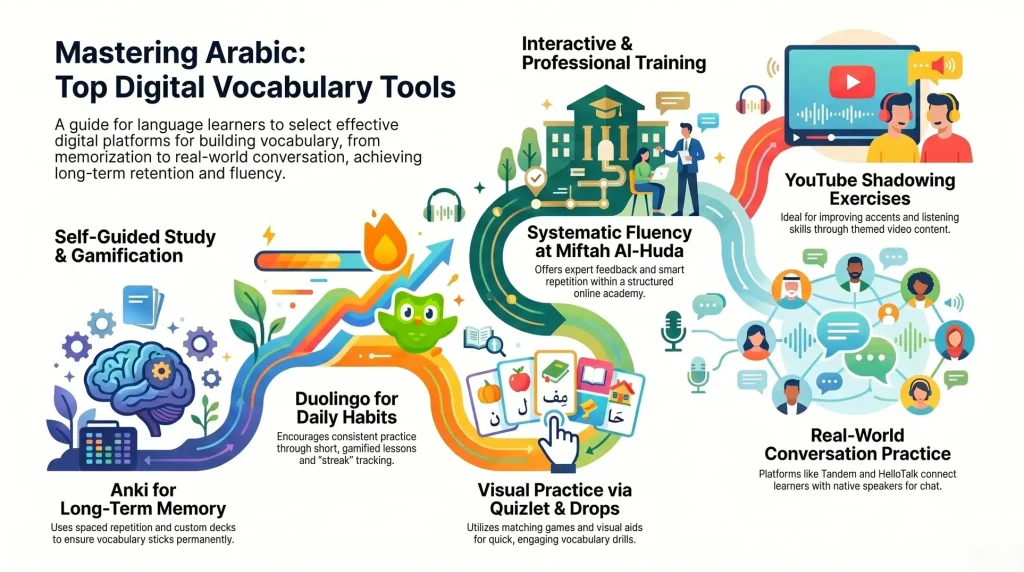
| Tool / Platform | Type | Main Features & Benefit | Best For |
| Anki | Flashcard App | Spaced repetition, custom decks, audio, Arabic script | Long-term memory retention |
| Duolingo | Gamified App | Short fun lessons, streaks, listening & speaking | Beginners & daily habit building |
| Memrise | Vocabulary App | Memes, native videos, mnemonics, real pronunciation | Fun memorization & pronunciation |
| Quizlet / Drops | Flashcard & Visual App | Visuals, audio, matching games, typing practice | Quick visual practice |
| Tandem / HelloTalk / italki Connect | Language Exchange | Chat with native speakers, voice messages, corrections | Real conversation practice |
| YouTube Channels | Video Platform | Short themed videos, shadowing exercises | Listening & accent improvement |
| Miftah Al-Huda Academy | Structured Online Academy | Professional audio, guided lessons, smart repetition, expert feedback, progress tracking | Systematic vocabulary building & fluency |
Thematic Vocabulary Example Table (Grouped Learning + Qur’anic Context)
| Category | Arabic Word | Transliteration | Meaning | General Example Sentence | Qur’anic Example | Qur’anic Meaning (Simple) |
| Food | خُبْز | Khubz | Bread | أَكَلْتُ خُبْزًا طَازَجًا | — | — |
| Food | أَرُزّ | Aruzz | Rice | الأَرُزُّ لَذِيذٌ | — | — |
| Travel | طَرِيق | Tariq | Road / Path | هَذَا الطَّرِيقُ طَوِيلٌ | اهْدِنَا الصِّرَاطَ المُسْتَقِيمَ | Guide us to the straight path |
| Travel | سَيَّارَة | Sayyara | Car | عِنْدِي سَيَّارَةٌ | — | — |
| Daily Life | عَمَل | Amal | Work / Deeds | أَذْهَبُ إِلَى العَمَلِ | وَقُلِ اعْمَلُوا فَسَيَرَى اللَّهُ عَمَلَكُمْ وَرَسُولُهُ وَالْمُؤْمِنُونَ | “And say, ‘Do (as you will), for Allah will see your deeds, and (so will) His Messenger and the believers.'” |
| Daily Life | وَقْت | Waqt | Time | الوَقْتُ مُهِمٌّ | وَالْعَصْرِ (1) إِنَّ الْإِنْسَانَ لَفِي خُسْرٍ (2) | By time, Indeed, mankind is in loss |
| Faith | اللَّه | Allah | God | اللَّهُ غَفُورٌ | بِسْمِ اللَّهِ الرَّحْمَٰنِ الرَّحِيمِ | In the name of Allah |
| Faith | رَحْمَة | Rahmah | Mercy | نَطْلُبُ رَحْمَةَ اللَّهِ | وَرَحْمَتِي وَسِعَتْ كُلَّ شَيْءٍ | My mercy encompasses all things |
| Faith | نُور | Nour | Light | النُّورُ جَمِيلٌ | اللَّهُ نُورُ السَّمَاوَاتِ وَالْأَرْضِ | Allah is the Light of the heavens and earth |
| Worship | صَلَاة | Salah | Prayer | أُحَافِظُ عَلَى الصَّلَاةِ | أَقِيمُوا الصَّلَاةَ | Establish prayer |
| Worship | صَبْر | Sabr | Patience | الصَّبْرُ جَمِيلٌ | إِنَّ اللَّهَ مَعَ الصَّابِرِينَ | Allah is with the patient |
| Knowledge | عِلْم | ‘Ilm | Knowledge | أُحِبُّ العِلْمَ | رَبِّ زِدْنِي عِلْمًا | My Lord, increase me in knowledge |
Advanced Techniques to Practice Arabic Vocabulary Online
Once you’ve mastered basics, try these advanced methods to expand your Arabic vocabulary.
Contextual Learning Through Arabic News and Articles
- Read simple articles (beginning with easy bits).
- Use browser extensions such as Language Reactor or Readlang to immediately translate and save new words.
- To practice active recall, summarize one brief article each day in your own words.
Writing Practice with Online Journals and Prompts
- Use platforms like Lang-8, which allows native speakers to correct your writing.
- Write every day, using prompts like “Describe what I ate today” or “My weekend plans”.
- To transition from recognition to actual output, every input should include at least 20 new words.
Listening and Shadowing Exercises
- Listen to informative podcasts such as Coffee Break Arabic or Arabic in a Minute.
- First, listen for general comprehension, then shadow (repeat) the speaker.
- This increases listening comprehension, pronunciation, and natural vocabulary usage.
Structured Advanced Learning
At Miftah Al-Huda , our specialist courses expand on these approaches with guided contextual lessons, instructor-written remarks, shadowing exercises, and personalized resources for Arabic learners.
How to Make Arabic Vocabulary a Daily Habit?
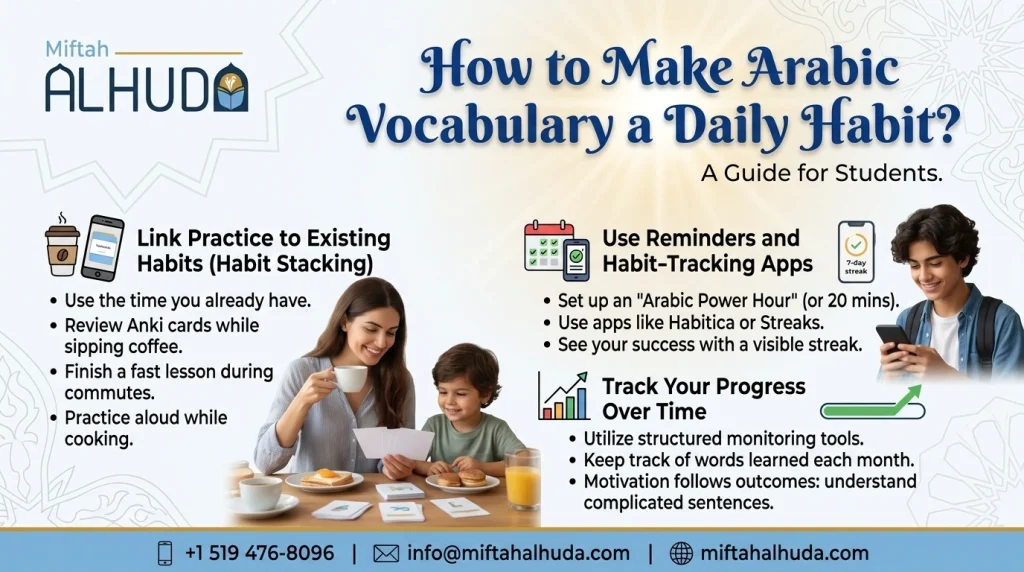
Link Practice to Existing Habits (Habit Stacking)
Stop looking for “extra” time; use the time you already have. At Miftah Al-Huda, we encourage learners to review Anki cards while sipping their morning coffee or to finish a fast lesson during their commute.
Practicing aloud while cooking or strolling makes Arabic feel more like a natural part of your day than a duty.
Use Reminders and Habit-Tracking Apps:
Use technology to stay disciplined. Set up an “Arabic Power Hour” (or 20 minutes) using applications such as Habitica or Streaks. Seeing a visible streak of your success gives you the motivation to keep turning up every day.
Track Your Progress Over Time
Motivation follows outcomes. Miftah Al-Huda recommends utilizing structured monitoring tools to keep track of how many words you learn each month.
Looking back on previous lessons and discovering you now can understand complicated sentences delivers an unparalleled mental boost.
Avoid Common Mistakes in Online Vocabulary Practice
To optimize outcomes, steer clear of these crucial mistakes:
- Acquiring too many words at once.
- Disregarding pronunciation exercises.
- Missing regular review sessions.
- Memorization without context.
From Small Habits to Fluency
Remember, to practice Arabic vocabulary online doesn’t have to be a grind; by combining smart tools with Miftah Al-Huda‘s interactive methodology, you can make the experience more pleasurable and consistent.
Mastering Arabic presents the way to a close connection with the Quranic language. Begin today with a simple step: learn 10 words and allow us at the Academy to guide you to the day when you can speak Arabic fluently .
Are you ready to claim your trophies of success?
Transform your Arabic vocabulary practice into an enjoyable daily habit with the experts at Miftah Al-Huda Academy. Start your Free Trial today and discover how we make a real difference in your language proficiency.
Contact Us
- WhatsApp: +1 519 476-8096
- E-Mail: in**@**********da.com
- Facebook : https://surl.li/yqeyas
- Instagram:https://surl.li/smlfaq
- Youtube: https://surl.li/inbncd
- Tiktok:https://surl.li/ldzmww
FAQs About How to Practice Arabic Vocabulary Online
1. How do I remember Arabic words that look similar?
Use mnemonics, visual correlations, or personal experiences. If you’re confused between “قلم” (pen) and “كلمة” (word), try writing “كلمة” with a “قلم”. Combine related words and rehearse them in contrasting sentences. This active participation allows you to more efficiently practice Arabic vocabulary online.
2. Can I practice Arabic vocabulary online with my children, and what age-appropriate tools exist?
Of course! Children acquire languages in different ways; they learn best via play, pictures, and repetition. Try gamified apps such as Arabic Pod 101’s children’s programming, Mondly Kids, or Gus on the Go.
Platforms like Miftah Al-Huda Academy provide kid-friendly vocabulary modules with audio, animation, and slow pacing for families who are interested in the Quran.
When practicing vocabulary online, it’s important to make sessions brief, enjoyable, and engaging.
3. What should I do when I hit a vocabulary plateau while trying to practice vocabulary online?
Plateaus are both normal and fixable!
- First, try different ways, such as swapping flashcards for listening exercises or crafting short stories using your known vocabulary.
- Second, review your objectives: are you learning terms that you will actually use?
- Third, provide output by speaking or writing with a partner to activate passive knowledge. Sometimes all you need is a new resource or a brief pause followed by renewed focus to break through and resume momentum.
4. How can I practice Arabic vocabulary for specific goals like travel, business, or Quranic study?
Customize your word list for your purpose! For travel, concentrate on greetings, directions, meals, and numbers. For business, emphasis professional terminology, email phrases, and industry-specific language.
For Quranic study, begin with high-frequency terms (e.g., رب, عبد, نور) and root-based patterns. Many apps allow you to create bespoke decks, or you may enroll in specialized courses (such as those offered by Miftah Al-Huda Academy) that align vocabulary with your specific goals.
5. What’s the role of writing by hand vs. typing when I practice vocabulary online?
Both are important, although in different ways. Writing by hand improves memory retention and allows you to grasp Arabic script flow and letter connections.
Typing improves speed and computer literacy, which is very useful in modern communication. Pro tip: combine both! To incorporate new words, write them by hand first, and then type them into sentences for practical application. Every time you practice online, this dual technique helps you learn more.