
Hello there! Have you ever wanted to order food, make friends, or converse with Arabic speakers with ease? You might be surprised at how quickly you can realize your desire by learning Arabic conversation vocabulary online.
But what if the Arabic you speak on a daily basis also made the Qur’an easier to you?
At Miftah Al-Huda Academy, we gently help you comprehend and relate to the lovely words of the Qur’an in their original language while introducing practical Arabic conversation in an useful, simple way.
Why Learning Arabic Conversation Vocabulary Matters More Than Ever?
- Arabic is spoken by more than 400 million people in 22 countries, making it extremely valuable for travel, business, and faith.
- Reading Arabic is not the same as speaking it naturally in real conversations.
- Learning Arabic provides Muslims with direct access to the Quran, eliminating the need for a regular translation.
- Many everyday terms coincide with Quranic vocabulary, so you develop both conversation and spiritual comprehension simultaneously.
- Online learning allows for convenient and flexible practice from anywhere.
Consider grammar as the motor and vocabulary as the fuel; robust Arabic conversation vocabulary online moves you forward in both everyday life and your connection to the Quran.
The Benefits of Learning Arabic Conversation Vocabulary Online
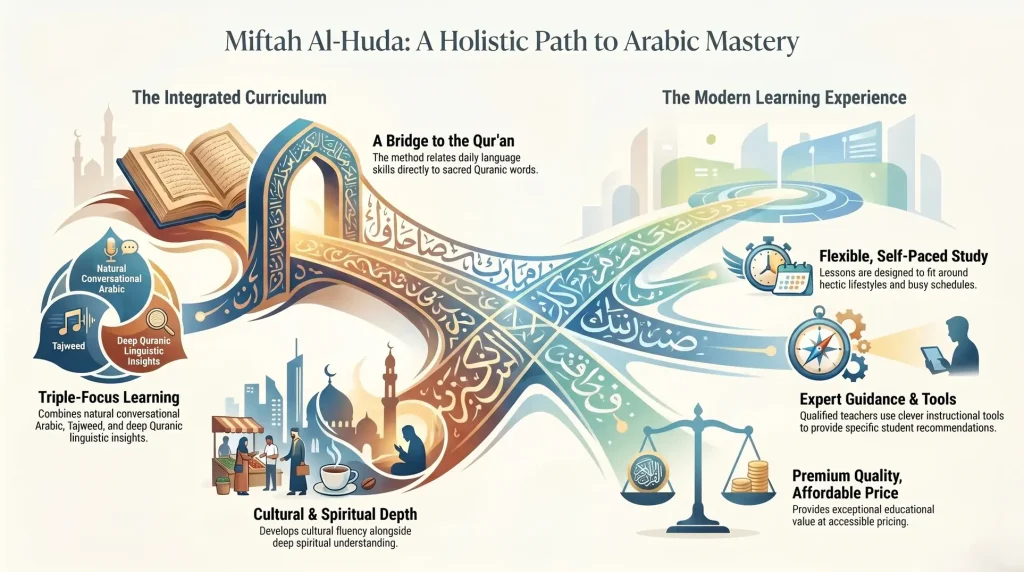
Words convey stories, traditions, and spiritual instruction. Miftah Al-Huda offers a structured online learning program that teaches practical Arabic conversation skills while also fostering a deep bond with the Holy Qur’an.
Through our academy, students experience the following:
- Flexible, self-paced study that fits around hectic lifestyles.
- Qualified teachers provide specific recommendations, as do clever instructional tools.
- Exceptional value, with premium quality at affordable pricing.
- A unique curriculum that combines natural conversational Arabic, Tajweed, and Quranic linguistic insights.
- Balanced development of cultural fluency and spiritual depth.
- An integrated method that relates daily language to the sacred words of the Qur’an.
10 Essential Arabic Conversation Vocabulary Categories with Practical Examples
| Category | Description | Examples & Quranic Connection |
| Everyday Greetings & First Impressions | Start conversations smoothly using common expressions. | Marhaba (Hello), Ahlan wa sahlan (Welcome), Assalamu alaikum (Peace be upon you).
Sabah al-khayr (Good morning), Masa’ al-khayr (Good evening), Ismi… (My name is…) . Greetings reflect politeness emphasized in Islamic culture. |
| Numbers, Scheduling & Time Expressions | Used for organizing schedules and daily planning. | Thalatha (three), khamsa (five), as-sa’ah kam? (What time is it?) .
Numbers appear in Quranic contexts like days and time references. |
| Food, Drinks & Dining Conversations | Helps in restaurants and social meals. | Lahm (meat), khubz (bread), hal turid qahwa? (Would you like coffee?) . Food is often described as a blessing and sustenance. |
| Travel, Directions & Transportation Talk | Essential for movement and navigation. | Ayna al-mahattah? (Where is the station?), sayyarah (car), rihlah (trip) .
Travel-related topics are mentioned in the Quran, emphasizing reflection. |
| Shopping, Prices & Market Language | Useful for everyday buying and selling. | Kam al-si’r? (How much is the price?), ghali (expensive), rakhis (cheap) .
Fairness in trade is a key Islamic value. |
| Career, Work & Business Communication | Supports communication in professional environments. | mudeer (manager), wazifah (job), ijtima‘ (meeting) .
Honesty and responsibility are emphasized in Quranic teachings. |
| Family, Relationships & Social Life | Enables meaningful social interactions. | akh (brother), ukht (sister), ziyara (visit) . Maintaining relationships is strongly encouraged in Islam. |
| Health, Safety & Emergency Situations | Helps in medical or urgent situations | tabib (doctor), alam (pain), sa‘idni (help me) . Concepts of healing and care are present in Quranic teachings. |
| Weather, Environment & Daily Activities | Used to describe everyday life and surroundings. | har (hot), barid (cold), astayqiz (I wake up) . Natural elements are frequently mentioned in the Quran. |
| Islamic & Quranic Vocabulary Essentials | Important for understanding religious and spiritual language. | du‘a (supplication), masjid (mosque), akhirah (afterlife), ibadah (worship) . Core concepts in Islamic belief and daily practice. |
10 Strategies to Learn Arabic Conversation Vocabulary Online Effectively
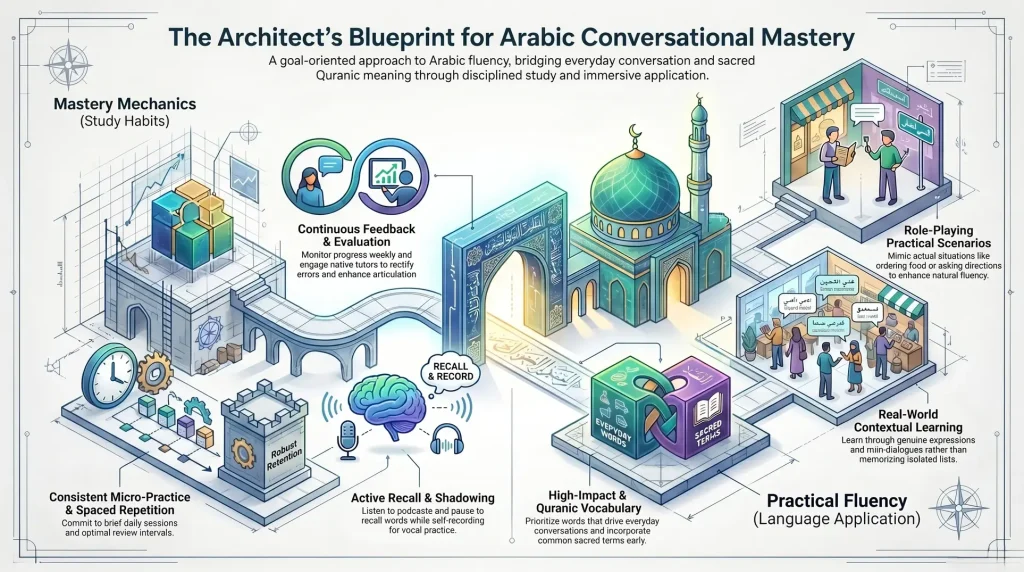
At Miftah Al-Huda, we provide our students with practical, goal-oriented ways for developing strong speaking abilities and increasing their understanding of the Qur’anic language. Here are the most effective ways that we teach:
- Dedicate yourself to daily micro-practice: Engage in brief, intensive sessions each day to foster consistent, consistent advancement.
- Utilize Spaced Repetition: Review vocabulary at ideal intervals with advanced methods to guarantee robust retention.
- Enhance Your Speaking Proficiency: Engage in vocal practice by shadowing and self-recording from the initial stages.
- Begin with High-Impact Vocabulary: Learn the key words and phrases that drive the majority of everyday conversations.
- Insert words into real-world contexts: Instead of memorizing isolated schedules, learn Arabic conversation vocabulary online through genuine expressions and mini-dialogues.
- Monitor Your Progress Weekly: Consistently evaluate your acquired knowledge and recalibrate your focus towards areas for enhancement.
- Incorporate Quranic Vocabulary Early: Introduce commonly used Qur’anic terms into your regular discussions to bridge the gap between practical Arabic and sacred meaning.
- Participate in Role-Playing Scenarios: Mimic actual situations such as ordering food, asking directions, or greeting individuals to enhance natural fluency.
- Get Feedback from Native Speakers or Tutors: Consistently engage with proficient educators who can rectify errors and enhance your articulation.
- Combine Listening and Active Recall: Listen to podcasts or conversations, then pause to recall and utilize the new words.
Understanding Arabic Dialects for Better Conversation
At Miftah Al-Huda Academy, we support learners to make informed decisions based on their individual needs. Modern Standard Arabic (MSA) provides a firm foundation for official and religious texts, but daily life takes place predominantly in spoken dialects.
Advanced Tips for Fluent Arabic Conversation Vocabulary
Once you’ve learned the basis, we’ll help you become a natural and confident speaker by filling your language with authentic expressions. Here’s how we’ll assist you advance:
- Master Slang, Idioms, and Cultural Humor: We cover common Arabic slang, proverbs, and light humor so that your conversations are vibrant and real.
- Engage in discussing and Storytelling: Our organized activities cover discussing significant themes and narrating stories in Arabic to enhance fluency and self-assurance.
- Learn from Native Speakers: Our advanced courses and carefully curated audio files will help you acquire true rhythm, intonation, and real-life expressions.
Overcoming Plateaus in Your Arabic Learning Journey
At Miftah Al-Huda , we realize that plateaus are common milestones on the way to mastery. Our academy offers clear, supporting techniques to help you progress smoothly:
- Refresh and Vary Your Routine: When growth slows, we recommend you to look into new materials and change your learning techniques.
- Practicing with a Language Partner or Tutor : Regular guided chats with skilled teachers or language partners may be very beneficial.
- Concentrate on One Skill At A Time: To break through the plateau, focus briefly on listening to, pronunciation, or vocabulary.
- Maintain Patience and Motivation: We remind our students that plateaus indicate that they are about to attain a greater level of proficiency.
Real Success Stories: How Others Mastered Arabic Conversation Vocabulary Online
At Miftah Al-Huda Academy, many students have changed their life by learning Arabic conversation vocabulary online. What’s their secret? Treating new words as live tools for genuine human connection and spiritual progress, rather than just memorization.
A real example:
Amina, a Malaysian teacher, joined our academy with the intention of relocating to Cairo for work and improving her Qur’an recitation skills. Within six months, she had mastered confident conversational Arabic, which helped her ace job interviews and settle in Egypt. She also acquired key Quranic language and Tajweed, allowing her to recite the Qur’an with beauty and understanding. Amina now works perfectly in Cairo and teaches basic Qur’an to young Muslim ladies in her area.
Time to Take Action
Whether you want to explore the Arab world, make foreign friends, or further your job, studying Arabic conversation vocabulary online will provide you with the practical skills you need to succeed.
At Miftah Al-Huda, we keep the learning process easy, effective, and balanced, encouraging you in gaining natural speaking confidence while gently empowering you with the original language of the Qur’an.
The path is rewarding, and the outcome is long-lasting.
Begin speaking Arabic with ease today. Your new adventure starts at Miftah Al-Huda Academy.
Unlock the secrets of fluent dialogue with our Arabic Conversation Vocabulary Course and experience our teaching firsthand.
[Sign up now for a Free Trial and start speaking with confidence!]
Contact Us
- WhatsApp: +1 519 476-8096
- E-Mail: in**@**********da.com
- Facebook : https://surl.li/yqeyas
- Instagram:https://surl.li/smlfaq
- Youtube: https://surl.li/inbncd
- Tiktok:https://surl.li/ldzmww
5 Unique FAQs About Learning Arabic Conversation Vocabulary Online
1. Can I really learn to speak Arabic fluently without living in an Arab country?
Yes, absolutely. With the appropriate approach, consistent speaking practice, and feedback from skilled teachers, many students can develop great conversational abilities exclusively online.
2. How can I practice Arabic conversation vocabulary online if I don’t have anyone to talk to?
Shadowing tactics, recording yourself, role-playing scenarios, and using AI tutors or language exchange applications can all help you improve.
3. How does learning conversational Arabic help with understanding the Qur’an?
Many common Arabic terms coincide with Quranic vocabulary. As your conversational abilities improve, you will automatically recognize and comprehend verses, making Qur’anic recitation and reflection more meaningful.
4. Can I learn Arabic conversation without mastering the Arabic script first?
Yes, you can begin learning the script gradually while utilizing transliteration (Roman letters). On the other hand, early alphabet acquisition helps in long-term pronunciation and memory.
5. How can I measure my progress in Arabic conversation vocabulary?
Try having short talks on well-known topics, record conversations with yourself, or keep track of how many new phrases you can use with ease.