

The heart of every believer inherently cultivates sentiments of love and veneration for Allah’s final Messenger, Muhammad sallallahu alaihi wasallam.
Sending blessings (salawat) upon him is one of the most meritorious forms of devotion; nonetheless, numerous Muslims recite it without comprehending the proper formulation or the genuine hadiths that support it. This guide, created with guidance from Miftah Al-Huda Academy, covers the significance of the phrase, the Qur’anic instruction behind it, the true formula of Salat al-Ibrahimiyyah, and the optimum times and practices for reciting it so that every reader can send blessings in the most acceptable manner to Allah.
What Does “Sallallahu Alaihi Wasallam” Mean?
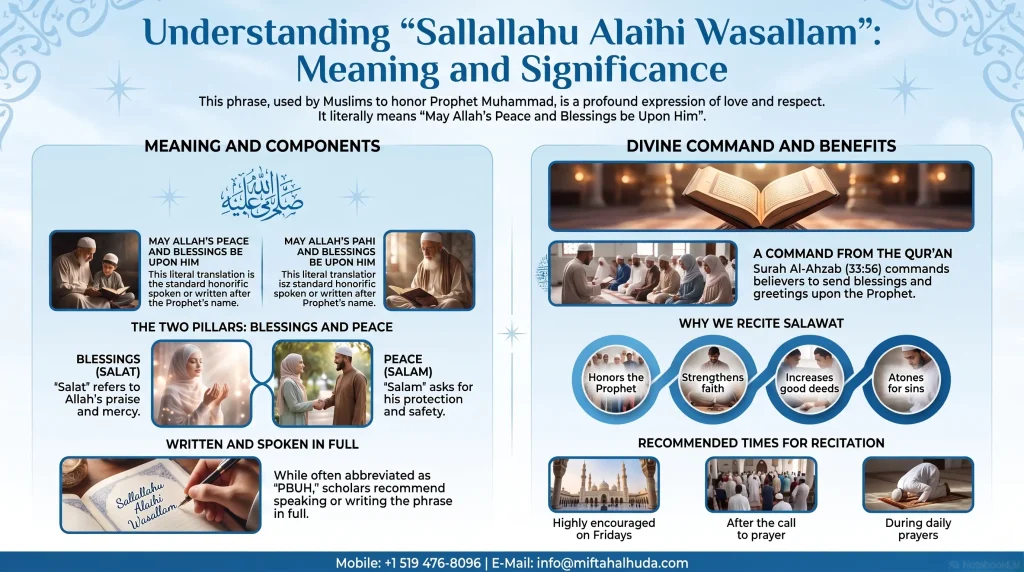
The expression “sallallahu alaihi wasallam” (صلى الله عليه وسلم) means “may Allah’s peace and blessings be upon him.” Muslims repeat it whenever the Prophet’s name is stated, spoken, written, or heard. In English, it is frequently abbreviated as “PBUH,” however scholars recommend writing or speaking it in full whenever possible.
The phrase “Peace and blessings of Allah be upon him” is a prayer and praise from the servant to Prophet Muhammad (ﷺ). It is separated into two parts:
- Blessings from Allah: Allah commended the Prophet in the highest assembly of angels (Al-Mala’ Al-A’la), bestowed mercy on him, and increased his reward.
- Blessings from the servants: Supplicating for him, asking Allah’s mercy, increasing his stature, honoring him, and ensuring the success of his message.
Salam (Peace): We are praying for his protection, as well as the safety and preservation of his call and message.
The Qur’anic Command to Send Blessings
The obligation to send salawat is specifically commanded in the Qur’an.
إِنَّ اللَّهَ وَمَلَائِكَتَهُ يُصَلُّونَ عَلَى النَّبِيِّ ۚ يَا أَيُّهَا الَّذِينَ آمَنُوا صَلُّوا عَلَيْهِ وَسَلِّمُوا تَسْلِيمًا
Allah sends His Salat (Graces, Honours, Blessings, Mercy, etc.) on the Prophet (Muhammad SAW) and also His angels too (ask Allah to bless and forgive him). O you who believe! Send your Salat on (ask Allah to bless) him (Muhammad SAW), and (you should) greet (salute) him with the Islamic way of greeting (salutation i.e. AsSalamu ‘Alaikum).(Surah Al-Ahzab, 33:56)
This indicates the perfection of Allah’s Messenger (peace and blessings of Allah be upon him), the loftiness of his rank, his exalted status with Allah and among His creation, and the exaltation of his mention.
We send salawat following the example of Allah and His angels, as a fulfillment of a fraction of his rights over us, to strengthen our faith, to honor and adore him (peace and blessings of Allah be upon him), out of love and respect for him, and to increase our good deeds and atone for our sins.
Many scholars believe that reciting salawat at least once in a lifetime is obligatory (wajib) based on this verse, although repeating it frequently, particularly on Fridays, after the adhan, and during the tashahhud, is a strongly emphasized Sunnah.
The Virtues of Salawat: Authentic Hadiths

sallallahu alaihi wasallam explained, in several authentic hadiths, the reward awaiting those who send blessings upon him.
1. Tenfold in return:
‘Abdullah b. Amr b. al-As reported Allah’s Messenger (ﷺ) as saying:
When you hear the Mu’adhdhin, repeat what he says, then invoke a blessing on me, for everyone who invokes a blessing on me will receive ten blessings from Allah; then beg from Allah al-Wasila for me, which is a rank in Paradise fitting for only one of Allah’s servants, and I hope that I may be that one. If anyone asks that I be given the Wasila, he will be assured of my intercession. Sahih Muslim 384
2. Closest to the Prophet on Judgment Day:
Ibn Mas’ud (RAA) narrated that the Messenger of Allah (ﷺ) said:
“Those who are nearest to me on the Day of Resurrection are those who invoke many blessings on me.” At-Tirmidhi and Ibn Hibban graded it as Sahih.
3. Forgiveness and elevated rank:
Ubayy bin Ka’b (May Allah be pleased with him) reported:
“O Messenger of Allah (ﷺ), I frequently invoke Allah to elevate your rank. How much of my supplications should I devote to you?” He said, “You may devote as much as you wish.” When I suggested a quarter, he said, “Do whatever you wish, but it will be better for you if you increase it.” I suggested half, and he said, “Do whatever you wish, but it will be better for you if you increase.” I suggested two- thirds, and he said, “Do whatever you wish but it will be better for you if you increase it.” I said, “Shall I devote all my supplications invoking Allah to elevate your rank?” He said, “Then you will be freed from your worries and your sins will be forgiven.” [At- Tirmidhi, who classified it as Hadith Hasan].
The Correct Formula: Salat al-Ibrahimiyyah
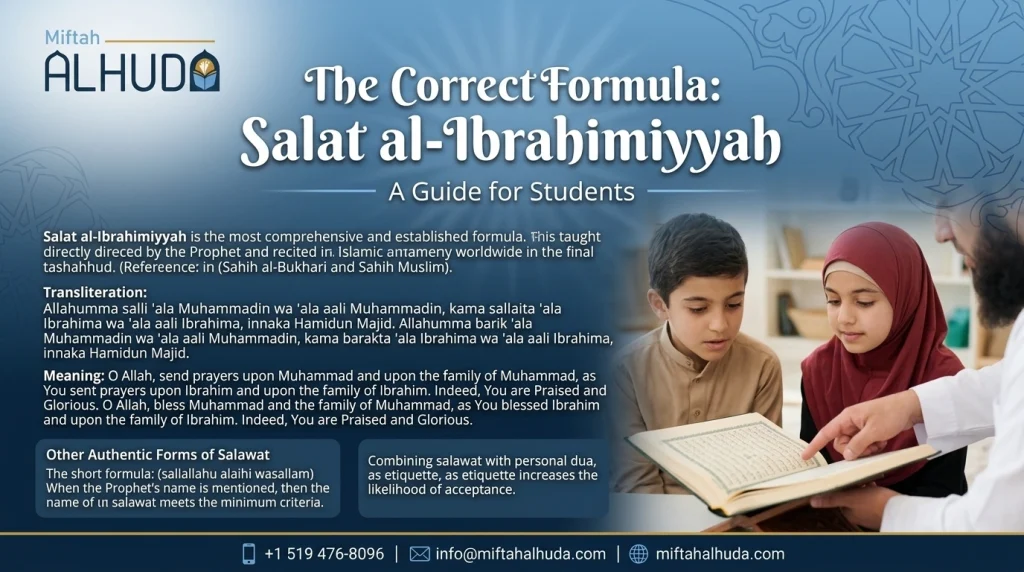
While uttering sallallahu alaihi wasallam following the Prophet’s name is the simplest way to offer blessings, Salat al-Ibrahimiyyah is the most comprehensive and officially established formula.
It was taught straight by the Prophet when the Companions asked him how to bestow blessings on him, and it is said by Muslims all around the world in the final sitting (tashahhud) of each prayer.
It is in both Sahih al-Bukhari and Sahih Muslim, the two most reliable hadith collections.
Transliteration: “Allahumma salli ‘ala Muhammadin wa ‘ala aali Muhammadin, kama sallaita ‘ala Ibrahima wa ‘ala aali Ibrahima, innaka Hamidun Majid. Allahumma barik ‘ala Muhammadin wa ‘ala aali Muhammadin, kama barakta ‘ala Ibrahima wa ‘ala aali Ibrahima, innaka Hamidun Majid.”
Meaning: “O Allah, send prayers upon Muhammad and upon the family of Muhammad, as You sent prayers upon Ibrahim and upon the family of Ibrahim. Indeed, You are Praised and Glorious. O Allah, bless Muhammad and the family of Muhammad, as You blessed Ibrahim and upon the family of Ibrahim. Indeed, You are Praised and Glorious. “
Other Authentic Forms of Salawat
The short formula: The most common form is to simply say “sallallahu alaihi wasallam,” which is recited whenever the Prophet’s name is mentioned. Though brief, it meets the minimum criteria and carries the full reward mentioned in the preceding hadiths.
The extended formula:Some scholars use “Allahumma salli ‘ala Muhammadin wa ‘ala aali Muhammadin wa ashabihi wa azwajihi wa dhurriyyatih” in supplication to include mention of the Prophet’s Companions, wives, and descendants.
Combining salawat with personal dua: The Prophet sallallahu alaihi wasallam once directed a man who began his supplication by asking Allah directly, without first praising Him or sending blessings, to first praise Allah, then send salawat, and only then ask for his need, demonstrating that salawat also serves as an etiquette that increases the likelihood of a dua being accepted.
When Should a Muslim Send Salawat?
While salawat can be performed at any moment, the Sunnah focuses on several specific times:
- Whenever the Prophet’s name is mentioned, it is spoken, heard, read, or written.
- On Fridays, the Prophet sallallahu alaihi wasallam instructed enhanced salawat during the day and night of Jumu’a.
- Salat al-Ibrahimiyyah is included in the tashahhud of every prayer, making it one of the most frequently used supplications in a Muslim’s life.
- After the adhan, recite the dua for al-wasilah, a specific station in Paradise reserved for the Prophet.
- To improve the likelihood of acceptance, place at the beginning and conclusion of the dua.
- When entering or leaving the mosque, the relevant dua is frequently said.
- In meetings of knowledge, keep your heart committed to the Prophet’s example.
Common Mistakes to Avoid
- Neglecting it out of habit: hearing the Prophet’s name often but not saying sallallahu alaihi wasallam, which the Prophet warned against.
- Treating it as if it were exclusively for exceptional occasions: it should be spoken in everyday situations, not only formal ones.
- Inventing formulas that contradict Islamic teachings: scholars warn against using wording that ascribes to the Prophet characteristics that belong only to Allah. The actual formulas presented above are sufficient and safe.
- Reciting it without reflection: Salawat is a prayer that should not be rushed through.
- Using abbreviations without understanding them:”PBUH” is an acceptable shorthand, however scholars recommend writing or saying sallallahu alaihi wa sallam in full whenever possible.
Spiritual Benefits of a Daily Salawat Habit
Beyond the specific hadith rewards, consistent salawat is associated with several benefits:
- Increasing love for the Prophet (ﷺ).
- Relief from anxiety and hardship.
- Purification of speech and intent.
- A light (nur) for the Day of Judgment.
- Fulfilling a part of the Ummah’s communal obligation of gratitude.
Historical Context
Classical scholars point out that Surah Al-Ahzab, verse 56, was revealed in Madinah at a time when the Prophet sallallahu alaihi wasallam‘s status as the final Messenger was becoming increasingly established among believers. Some sources state that the Companions, astounded that Allah and the angels themselves bestowed blessings on the Prophet, inquired as to how they could participate, prompting the Prophet to teach them Salat al-Ibrahimiyyah.
This framework raises salawat from a simple phrase of respect to a mechanism by which ordinary believers might participate in something that angels themselves are doing.
Salawat and Intercession on Judgment Day
One of a believer’s deepest desires is the Prophet’s intercession (shafa’ah) on a day when even close family members are preoccupied with their own affairs. While intercession is ultimately Allah’s gift, hadiths link plentiful salawat in this world with greater closeness to the Prophet sallallahu alaihi wasallam in the Hereafter.
Scholars explain that the more one’s heart and tongue participate in honoring him in this life, the stronger the link becomes, which many hope will carry over into the next.
Is Salawat the Same as Dua?
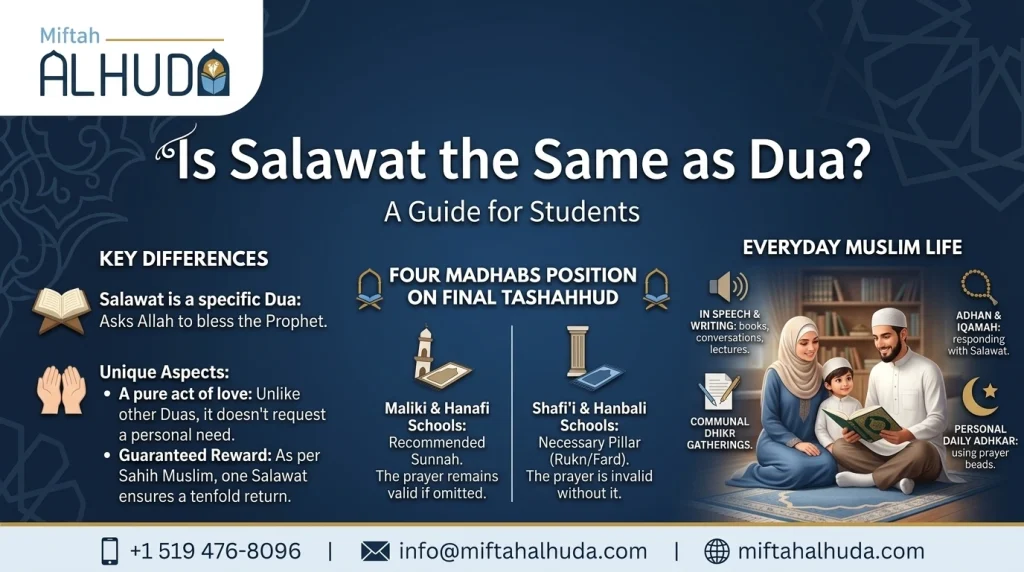
Salawat is a type of dua in which the believer asks Allah to bless the Prophet. However, it differs in two important aspects.
First, unlike other duas, it does not request something the reciter needs; instead, it requests that Allah bless someone else who is already the most honored of creation, making it a pure act of love rather than necessity. Second, while regular dua may or may not be answered, the reward for salawat is guaranteed: as stated in Sahih Muslim, bestowing blessings upon the Prophet sallallahu alaihi wasallam once ensures a tenfold return regardless of external circumstances.
The Position of the Four Madhabs
- Maliki and Hanafi schools: Sending blessings to the Prophet ﷺ during the final tashahhud is a Sunnah. The omission of the prayer, whether intentional or unintentional, does not invalidate it; however, if it is left out unintentionally, the prostration of forgetfulness (sujud al-sahw) is recommended.
- Shafi’i and Hanbali schools: Sending blessings upon the Prophet ﷺ during the final tashahhud is a pillar (rukn) or necessary element (fard), and the prayer is invalid without it.
Salawat in Everyday Muslim Life
The practice is woven into daily life around the world: in speech, when the Prophet’s name appears in a sermon, lecture, or casual conversation; in writing, where books and articles include sallallahu alaihi wasallam or its abbreviation after his name; in communal dhikr gatherings; in the adhan and iqamah, where it is Sunnah to respond with salawat; and in personal daily adhkar, where many Muslims set a fixed count using prayer beads.
6 Practical Tips to Increase Daily Salawat
- Attach it to an existing habit: recite it after each of the five daily prayers.
- Use a counter or tasbih: set a daily target, such as 100 salawat.
- Recite while commuting or waiting : turning idle time into worship.
- Teach it to children: instilling the habit early secures ongoing reward for the parent.
- Increase it on Fridays: in line with the explicit Sunnah recommendation.
- Reflect on its meaning: rather than reciting mechanically.
Salawat as a Source of Ummah Unity
Regardless of nationality, language, or school of thought, repeating sallallahu alaihi wasallam after the Prophet’s name is generally recognized throughout the Muslim world, linking Muslims through the identical Arabic words. This shared practice also connects today’s Ummah to previous generations, all the way back to the Companions who first asked the Prophet how to send blessings upon him.
Conclusion
Sending blessings to Prophet Muhammad sallallahu alaihi wasallam is more than just a linguistic habit. It is a direct Qur’anic command, a practice that Allah and His angels engage in, and an action described by the Prophet as bringing tenfold reward, forgiveness, and closeness to him on Judgment Day. Salat al-Ibrahimiyyah is recited during all prayers, and the shorter phrase sallallahu alaihi wasallam can be said whenever his blessed name is mentioned. Every believer strengthens their connection to the Prophet and earns enormous reward in this life and the next by learning the correct formula and practicing salawat on a daily basis.
If this guide moved your heart, let it be a starting point rather than a stopping point. Step into the classrooms of Miftah Al-Huda Academy, where authentic knowledge of the Qur’an and Sunnah is taught with clarity and heart and turn what you’ve read today into a lifelong habit of love for the Prophet sallallahu alaihi wasallam.
Contact Us
- WhatsApp: +1 519 476-8096
- E-Mail: in**@**********da.com
- Facebook: https://www.facebook.com/MiftahAlhudaOfficial
- Instagram: https://www.instagram.com/miftahalhudaa
- Youtube: https://www.youtube.com/@MiftahAl-huda
- Tiktok: https://www.tiktok.com/@miftahalhuda00
Frequently Asked Questions
What is the correct formula for sending blessings upon the Prophet?
The most complete formula is Salat al-Ibrahimiyyah, taught by the Prophet and recorded in Sahih al-Bukhari and Sahih Muslim. The shorter form, simply saying sallallahu alaihi wasallam, is also authentic and rewarded.
Why do Muslims say “sallallahu alaihi wasallam” after the Prophet’s name?
In obedience to the Qur’anic command in Surah Al-Ahzab (33:56), and because the Prophet said whoever sends blessings upon him once receives it back tenfold from Allah.
How many times should a Muslim recite salawat each day?
There is no fixed maximum. At minimum it should be said whenever the Prophet’s name is mentioned and in every tashahhud, with extra emphasis on Fridays.
Is it enough to write “PBUH” instead of the full phrase?
Abbreviations are permissible for convenience, but scholars recommend writing and saying sallallahu alaihi wasallam in full whenever possible.