

The month of Muharram comes discreetly every year, and before Muslims realize, Ashura is just a few days away. Some remember their fast only on the last day.
Some are confused which day to observe while others wonder if keeping the fast on the tenth day is sufficient. Most know for sure that Ashura pardons sins but they don’t know what this pledge means.
The common mistakes to avoid when fasting Ashura are as follows: fasting on the wrong day; having the notion that all sins will be forgiven by fasting; thinking that the tenth day only is the Sunnah day; and failing to realize the spiritual significance of the day.
Fortunately, however, these errors can easily be avoided when you have an understanding of what the teachings of the Prophet (s) were. The following guide provides you with all you need to know about the common myths, and how to practice Ashura with certainty and faith.
Common Mistakes To Avoid When Fasting Ashura
If you’re looking for a quick answer, these are the most common mistakes Muslims make when fasting Ashura:
- Fasting the wrong date because of incorrect moon sighting information
- Thinking Ashura forgives every sin without sincere repentance
- Assuming fasting only the tenth is always the preferred Sunnah
- Following cultural customs or rituals that have no authentic basis
- Forgetting that Ashura is a day of gratitude as well as fasting
- Neglecting intention, suhoor, and practical preparation
- Focusing only on avoiding food while neglecting good character and self-control
All of them have the potential to decrease the spiritual value of the day. An insight into the teachings of the Quran and Sunnah about Ashura is necessary for you to worship according to the practices of the Prophet ﷺ and not on the basis of misunderstanding.
1. The Date Confusion That Costs the Reward

A surprising number of Muslims miss Ashura entirely, not because they forgot to fast, but because they fasted the wrong day.
Moon sighting can shift Muharram’s start by a full day between countries, and sometimes between mosques in the same city. A post from an Instagram page in another time zone is not a fatwa.
Confirm the date with your local masjid or a trusted regional Islamic authority
Do not rely on a single social media post, especially one shared internationally
Set a reminder as soon as Muharram is announced locally, not when you happen to remember
Ibn Abbas (may Allah be pleased with him) said he never saw the Prophet ﷺ so keen to seek the reward of any day above all others except this day and the day of Ashura (Sahih al-Bukhari 2006, Sahih Muslim 1132). That eagerness only means something if the date is right.
2. Fasting the Tenth Alone and Calling It Complete
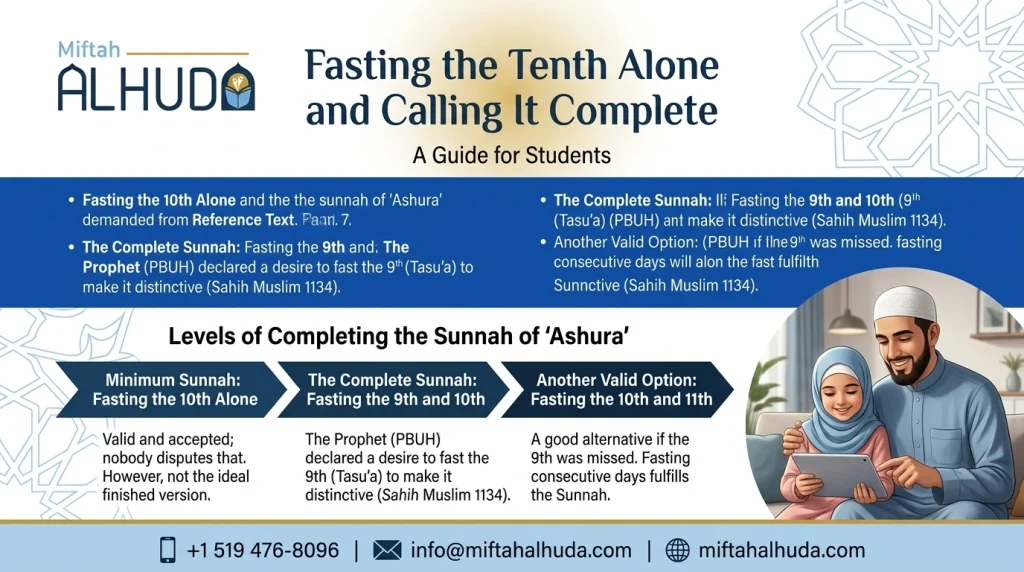
The tenth of Muharram alone is valid. Nobody disputes that. But treating it as the finished, ideal version of the Sunnah is where many people stop short.
This ninth day was called Tasu’a and the Prophet wanted to make it distinctive in relation to how the Jewish people performed it by declaring that if he were to live for another year and see the next month of Muharram he would definitely fast on the ninth day (Sahih Muslim 1134). The Prophet died before this next year could come about, hence why it was said that fasting both the ninth and tenth days is a more complete Sunnah.
If the ninth has already passed by the time you remember, fasting the tenth and eleventh together is also accepted. The mistake is not choosing one valid option over another. The mistake is assuming there was only one option to begin with.
3. Believing One Day Erases Everything
This is probably the most common misunderstanding, and it shows up every single Muharram.
Fasting Ashura carries a real promise. The Prophet ﷺ was asked about it directly, and he said it expiates the sins of the preceding year (Sahih Muslim 1162). That is an enormous mercy from Allah for a single day of effort.
But this promise has a condition attached that people quietly skip past.
Allah informs the believers that tawbah is the only way back to Him while deeds of worship are there to help in that process.
The reward for fasting on the day of Ashura is another manifestation of the endless mercy of Allah, but it must motivate the believer to keep asking Allah’s forgiveness all through the year and not take it as an alternative to it.
4. Expiation relates to the small sins only
Big sins like breaking pledges, continuous harm to others, or deliberately stopping praying are not expiated by fasting on Ashura
Someone who sees Ashura as a means to escape sinning the whole year around has completely misunderstood the spirit of fasting
Scholars have long warned against this exact trap. Someone who neglects daily prayers, backbites, lies, or commits major sins cannot expect one day of fasting to quietly wipe the slate clean. The fast is a mercy for the sincere, not an escape hatch for the careless.
5. Turning a Day of Gratitude Into a Day of Ritual
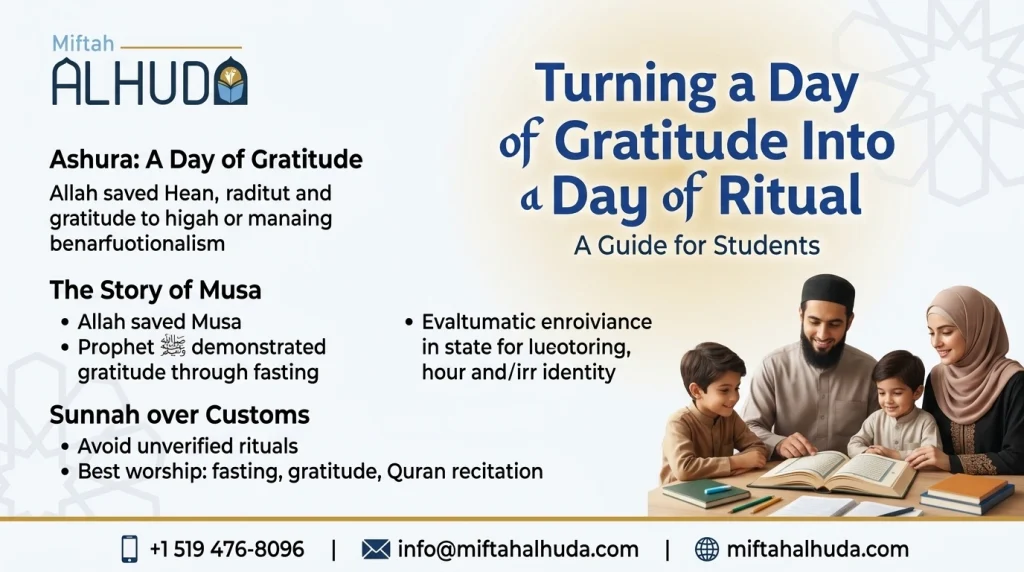
At its heart, Ashura is a day of gratitude. Allah says:
“And [remember] when your Lord proclaimed, ‘If you are grateful, I will surely increase you [in favor].'” (Quran 14:7)
The Prophet ﷺ demonstrated this gratitude through fasting after learning that Allah had saved Musa (peace be upon him) and the Children of Israel from Pharaoh. Rather than introducing new rituals, he taught Muslims to remember Allah’s blessings through sincere worship and thankfulness.
Ashura carries genuine weight in Islamic history. It marks the day Allah rescued Musa (peace be upon him) and the Children of Israel from Pharaoh, a story confirmed directly by the Prophet ﷺ himself when he explained why he fasted it and instructed the Muslims to do the same (Sahih al-Bukhari 2004, Sahih Muslim 1130).
Yet somewhere along the way, some communities attached customs to this day that were never part of that original teaching. Special dishes, particular clothing, or claims about a single guaranteed dua that must be recited word for word have no basis in authentic Sunnah.
The day is meant for fasting, gratitude, Quran recitation, and honest self-reckoning. It is not meant for invented rituals or unverified promises passed around a family group chat. When in doubt, the safest measure is simple. If the Prophet ﷺ did not teach it, do not attach it to Ashura as if he did.
6. Walking Into the Fast Without a Plan
Voluntary fasts fail more often from poor preparation than from lack of will. Ashura is no exception, especially for people juggling work schedules where the fasting hours can stretch long into a summer evening.
- Set the niyyah before Fajr, or better, the night before while you are already thinking clearly
- Eat suhoor even if it is light, since skipping it entirely leaves you running on empty by midday
- Hydrate well the night before if the fast falls during longer daylight hours
- Keep your schedule realistic so the fast does not collide with a day full of physical demands you did not plan around
None of this needs to be complicated. A five-minute plan the night before prevents most of the exhaustion people blame on the fast itself.
7. Undoing the Fast at Iftar
The purpose of fasting extends far beyond abstaining from food and drink. Allah says:
“O you who believe, fasting has been prescribed for you as it was prescribed for those before you so that you may become righteous.” (Quran 2:183)
Ashura is no exception. The fast is meant to cultivate self-restraint, gratitude, and awareness of Allah throughout the day.
The final stretch is where a lot of the day’s discipline quietly unravels.
Breaking the fast with a date, following the Prophetic example, is a beautiful and simple Sunnah. What often follows it is not. A single day of restraint gets undone by a plate piled with fried food, followed by a food coma that erases any reflection the fast was supposed to create.
There is also the matter of temper. Fasting is not only about food and drink. Arguments, harsh words, or impatience during a fasting day chip away at the very reward the fast was meant to secure. The goal of Ashura was never an empty stomach. It was a disciplined heart that carries into how you speak and act until Maghrib.
Ready to understand fasting, Sunnah practices, and the sciences behind them with a qualified teacher? Explore the Islamic courses at Miftah Alhuda, or book a free trial session to get started today, InshaAllah.
Contact Us
WhatsApp: +1 519 476-8096
E-Mail: in**@**********da.com
Facebook: https://www.facebook.com/MiftahAlhudaOfficial
Instagram: https://www.instagram.com/miftahalhudaa
Youtube: https://www.youtube.com/@MiftahAl-huda
Tiktok: https://www.tiktok.com/@miftahalhuda00“.
Frequently Asked Questions
Is fasting on Ashura obligatory?
No. It was obligatory before Ramadan fasting was prescribed. It is now a strongly recommended Sunnah fast, not a mandatory one.
What is the best way to fast Ashura?
Fasting the ninth and tenth of Muharram together is the fuller Sunnah. Fasting the tenth alone, or the tenth with the eleventh, is also valid.
Does fasting Ashura forgive all sins?
No. It expiates minor sins of the past year. Major sins require sincere repentance and cannot be erased by this fast alone.
Can I make the intention for Ashura in the morning?
Yes, for a voluntary fast the intention can be made anytime before midday if you have not eaten or drunk anything since Fajr. Making it the night before is still preferred.
What if I do not know the exact date this year?
Check with your local masjid or a recognized regional Islamic authority instead of relying on a single social media post, since moon sighting can vary by location.
Are special Ashura foods or rituals part of the Sunnah?
No. The authentic Sunnah for this day is fasting, dua, Quran recitation, and charity. Customs like special meals or fixed rituals were not taught by the Prophet ﷺ.
What the Tenth of Muharram Actually Asks of You
Ashura was never meant to be complicated. It asks for a sincere intention, an accurate date, a fast observed with patience, and an honest understanding of what one day of worship can and cannot undo. Everything else people have layered onto it over the centuries is optional at best.
Maybe the real question is not whether you will fast this Ashura. It is whether you will use the day the way it was intended, as a moment of gratitude and correction rather than a shortcut you can forget about until next Muharram.
Learn the Sunnah behind Ashura and every other act of worship with guided Islamic courses at Miftah Alhuda.