

It is now 9:40 PM on a weekday evening; you have put your children to sleep and are now looking at an app on your phone that teaches you how to read the Quran. Perhaps you pray every day, and you may have even learned a few of the short chapters just by hearing them recited.
There may be a certain amount of humiliation that you feel because all of this is common knowledge to everyone but you, and that is precisely the reason that Noorani Qaida Online for adults is what most adults search for.
But the conventional wisdom doesn’t do much good either. Free PDF files and YouTube tutorials require knowledge of the script letters. Weekend classes in your area follow the timetable of the children’s school, not the timetable of the working parent with a nine-to-five or night shift job.
The group online Zoom classes will be based on the learning speed of the quickest learner in class, which may not be an adult newbie practicing his or her Alif, Ba, Ta in middle age.
The article provides a very straightforward and candid insight into what Noorani Qaida Online for adults learning is like. Here you will find out what Noorani Qaida really entails, why speed is crucial for adults, but not children, what structure an actual course should have and from where to begin if you want to look for a teacher accustomed to Western learners.
Why Adults delay Learning Noorani Qaida?
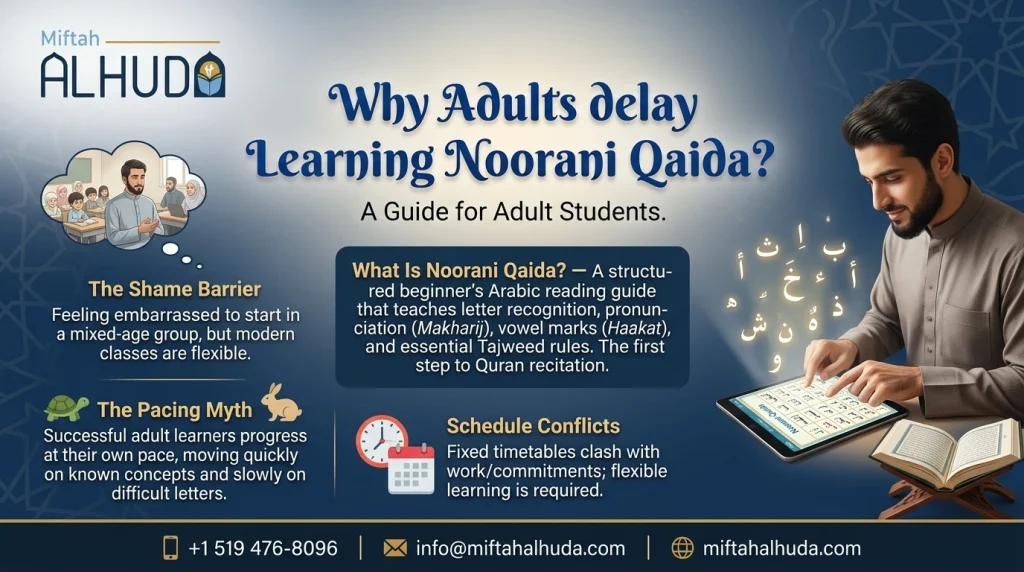
Shame is the elephant in the room no one wants to talk about. There is nothing embarrassing about sitting in a room full of children at age 30, except the fact that this might be your only choice.
Timing is another issue. Most weeknights are dominated by work and other commitments. A fixed timetable that doesn’t take into account the realities of someone’s life is abandoned in a matter of weeks, not because the learner lacked determination, but because the schedule wasn’t designed with their needs in mind.
Those who complete Noorani Qaida have one thing in common: they discovered a way to learn the letters which caused them problems at a slower pace, and to master the ones they already knew more quickly.
What Is Noorani Qaida?
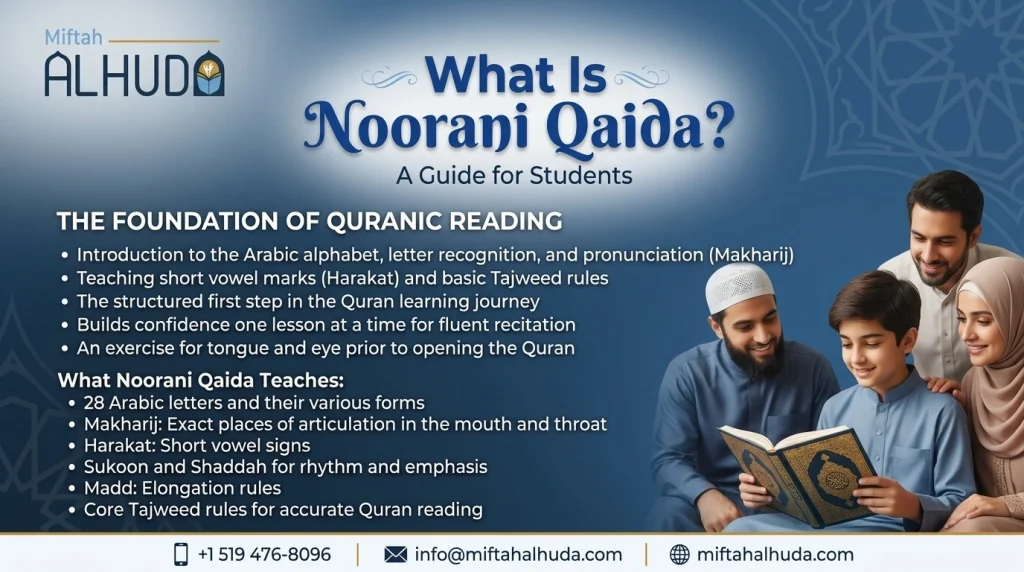
Noorani Qaida is a beginner’s Arabic reading guide that teaches students how to read the Quran correctly before moving on to full Quran recitation. It introduces the Arabic alphabet, letter recognition, vowel marks (Harakat), pronunciation (Makharij), and the basic Tajweed rules needed for accurate Quran reading.
For millions of Muslims around the world, Noorani Qaida is the first step in their Quran learning journey. Rather than asking students to memorize words by sight, it gradually teaches them how Arabic letters sound, how they connect, and how they should be pronounced according to the rules of Tajweed.
Learning Noorani Qaida Online for adults is the structured approach and it’s especially valuable. Instead of feeling overwhelmed by opening the Quran immediately, students build confidence one lesson at a time while developing the skills needed for fluent and correct Quran recitation.
What Noorani Qaida Actually Teaches?
Noorani Qaida is not a class in Islam nor a memorization class. This book is an exercise for both tongue and eye, prior to a student opening up the Quran.
A Noorani Qaida class is expected to have the following content covered:
- 28 letters of the Arabic language and their various forms according to the place in the word.
- Makharij: the exact place from which the letters come in the mouth or throat.
- Harakat: short vowel signs.
- Sukoon and Shaddah, which control rhythm and emphasis
- Madd, the elongation rules that stretch certain sounds
- Some basic rules of Tajweed which will make a student ready to read the Quran
When people try learning to read the Quran on their own, they miss this vital stage and skip directly to reading the Quran. These people recognize words through their memories but cannot figure out words they have never seen before and even have slight mistakes in pronunciations which no one has ever pointed out to them.
Who should learn Noorani Qaida?
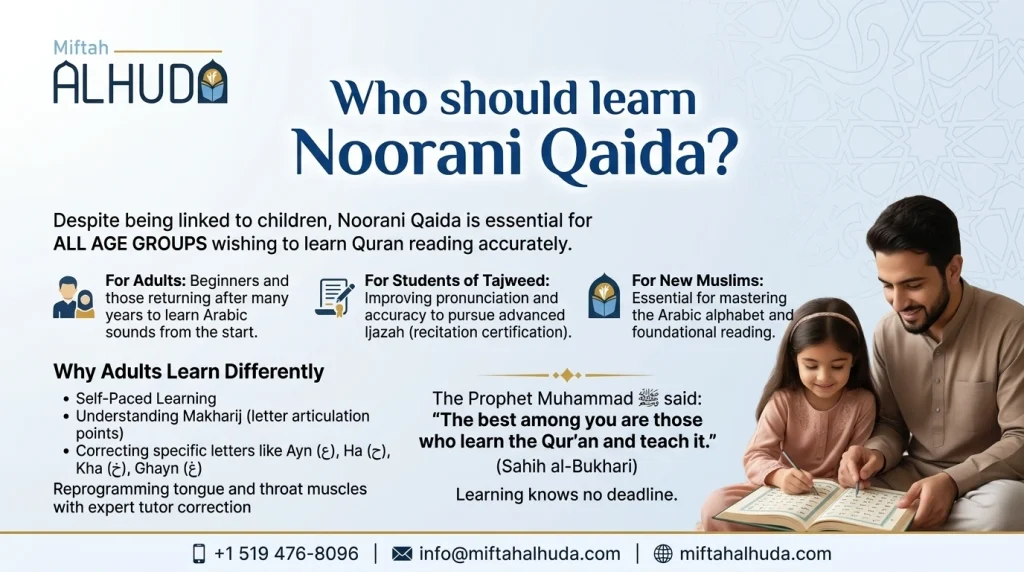
Despite being linked to children, Noorani Qaida can be taught to any person who wants to learn Quran reading well. It is particularly useful for:
- Adults learning to read the Quran for the first time
- Muslims returning to Quran study after many years
- New Muslims who want to learn the Arabic alphabet from the beginning
- Non-Arabic speakers looking to improve their Arabic pronunciation
- Students preparing to study Tajweed in greater depth
- Anyone hoping to pursue an Ijazah or improve the accuracy of their Quran recitation
Whether you are thirty, fifty, or older, learning Noorani Qaida is simply the beginning of learning to read the Quran correctly, not something reserved for children.
Why Adults Learn Noorani Qaida Differently?
It is quite possible to master Noorani Qaida in adulthood, though, generally, people do not learn like children. Whereas repetition may be enough to help the child learn new sounds, an adult needs to know the reason behind such a sound and receive correction right away.
Many letters in the Arabic language are not present in the English language or any other language of Europe. Such sounds like ع (Ayn), ح (Ha), خ (Kha), and غ (Ghayn) need special tongue and throat movements unfamiliar to adults.
This is the reason why many adults studying the Quran make faster progress in Noorani Qaida Online for adults than in groups. The experienced tutor may explain the concept of Makharij in English, and give corrections needed.
Learning at your own pace is not a disadvantage, it is often the key to building confidence and lasting accuracy.
Why Self-Paced Learning Changes Everything After Age Twenty-Five?
The acquisition of new sounds by a kid is quite effortless. This does not hold true in the case of an adult. For an adult’s mind, repetition and correction are needed to reprogram the muscles in the mouth and throat that have been used for decades to pronounce English, French, or some other language.
This is the exact reason why pacing becomes crucial in the case of adult students. Certain letters such as Ayn, Ha, Kha, and Ghayn are not found in any Western language at all. At times, it may be necessary for the student to take three classes just for learning one letter whereas he will be able to learn five other letters during the same period.
A one-size-fits-all type of curriculum penalizes this fact whereas a self-paced program compensates for it.
Islam itself frames the pursuit of this knowledge as something worth the effort at any age. The Prophet Muhammad ﷺ said, “The best among you are those who learn the Qur’an and teach it,” a hadith recorded in Sahih al-Bukhari, number 5027, narrated by Uthman ibn Affan. Nothing in that statement mentions age or a deadline. It simply describes the value of starting.
Common Mistakes Adults Make When Learning Noorani Qaida
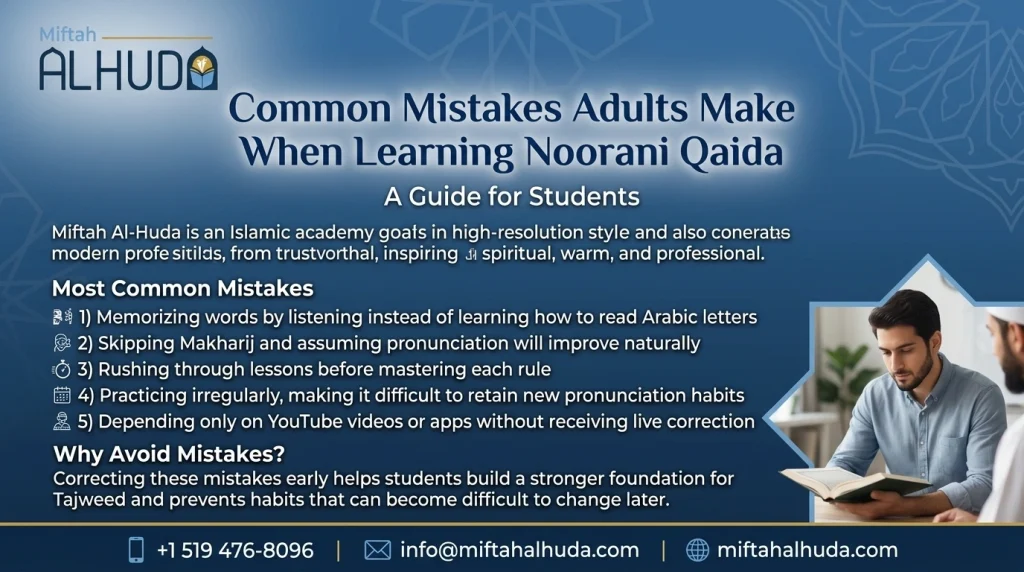
Many adult learners face similar challenges, especially when studying on their own. Fortunately, these mistakes are easy to avoid with proper guidance.
Some of the most common include:
- Memorizing words by listening instead of learning how to read Arabic letters
- Skipping Makharij and assuming pronunciation will improve naturally
- Depending only on YouTube videos or apps without receiving live correction
- Rushing through lessons before mastering each rule
- Practicing irregularly, making it difficult to retain new pronunciation habits
Correcting these mistakes early helps students build a stronger foundation for Tajweed and prevents habits that can become difficult to change later.
Can Adults Really Learn Arabic Pronunciation?
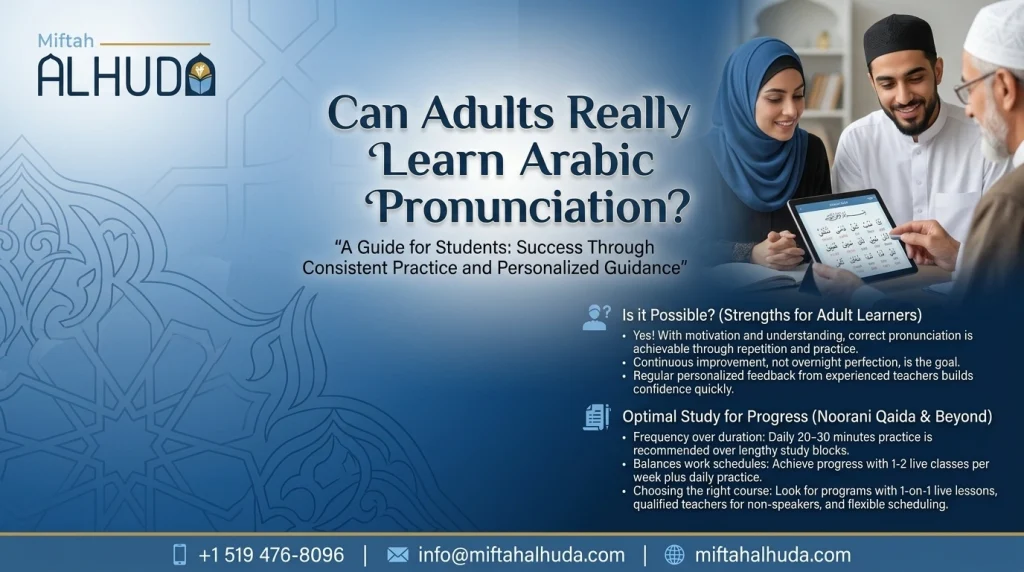
Yes. It is possible for adults to successfully learn correct Arabic pronunciation through consistent practice and good guidance.
Though it might take more repetitions for adults to pronounce certain unfamiliar Arabic sounds, there are other strengths adults possess which are helpful in this case. Motivation and understanding how to produce a particular sound are some of the strengths that adults have over kids.
Through regular personalized feedback from an experienced teacher on the internet, the adult learner will start gaining confidence in pronouncing words in a matter of weeks.
The aim is not perfection in one day but continuous improvement.
How Frequently Should Adults Recite Noorani Qaida?
Regular practice is far more important than lengthy periods of study.
In fact, for many adult students, the recommended amount of practice per day should range from 20 to 30 minutes as compared to several hours of study per week.
This way of learning helps with memorization of letters and pronunciation of words, as well as makes rules of Tajweed easy to understand.
Despite a heavy schedule at work, many adult students show good progress in reading the Quran due to the combination of one or two live classes per week plus daily practice at home.
How to Choose the Right Noorani Qaida Online for Adults?
Not every beginner Quran course is designed with adult learners in mind.
When comparing online Quran classes for adults, look for a program that offers:
- One-on-one live lessons with individualized feedback
- Qualified Quran teachers experienced with non-Arabic speakers
- Clear instruction in Arabic pronunciation and Makharij
- Flexible scheduling for different time zones
- Regular revision and progress assessments
- A learning pathway from Noorani Qaida to Tajweed and Quran recitation
The right course should help you understand your mistakes, not simply move through lessons as quickly as possible.
What Does a Quality Noorani Qaida Course Include?
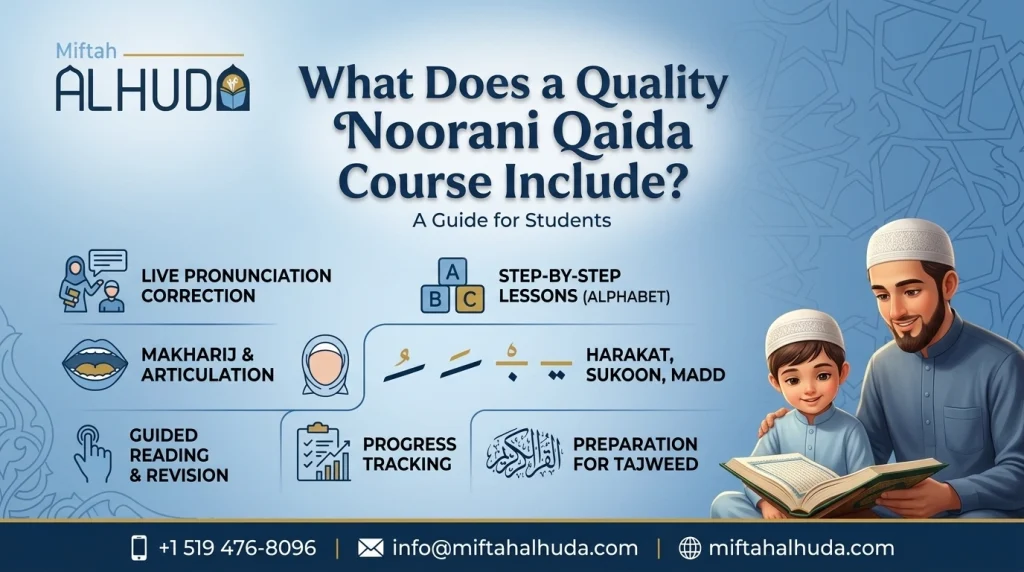
A well-designed Noorani Qaida course should do more than teach the Arabic alphabet. It should prepare students to read the Quran accurately and confidently by combining structured lessons with continuous feedback.
Most quality programs include:
- Live pronunciation correction from an experienced teacher
- Step-by-step lessons covering the Arabic alphabet and letter connections
- Makharij training for correct articulation
- Harakat, Sukoon, Shaddah, and Madd practice
- Guided reading exercises with revision
- Homework that reinforces each lesson
- Progress tracking to ensure every concept is mastered before moving forward
- Preparation for Tajweed study and fluent Quran recitation
This type of structured learning helps adult students develop lasting reading skills rather than simply memorizing exercises.
Why Many Adult Students Choose Miftah Alhuda?
Finding the right teacher often matters more than finding the shortest course.
Many adult students choose Miftah Alhuda because the learning experience is designed specifically for non-Arabic speakers balancing work, family, and other responsibilities.
The program offers:
- Individual online classes customized for the pace of each student
- Teachers fluent in both Arabic and English
- Flexibility with respect to scheduling that works best for learners in the USA, Canada, UK, and Europe
- A step-by-step curriculum that starts with the Noorani Qaida and ends with the Quranic recitation
- Option to proceed towards obtaining an Ijazah through experienced teachers who have the authenticated chain of transmission
Instead of imposing a strict time schedule on the students, the program emphasizes helping each student read the Quran accurately by providing ongoing support and guidance.
The Course Worth Your Time: Noorania Qaida Ijazah Program at Miftah Alhuda
Miftah Alhuda built its Noorania Qaida Ijazah program specifically around the struggles of non-native speakers. The course walks a student from the very first letter through to an Ijazah, a certified, unbroken chain of transmission connecting the student’s recitation back to the Prophet ﷺ.
Classes are one-on-one and run around the clock, so a student in New York and a student in Berlin can both find a slot that fits their week. Teachers are native Arabic speakers who are also fluent in English, which matters most when explaining a sound like Ghayn to someone who has never had to make it before.
The program covers Makharij mastery, Harakat and Madd rules, phonetic fluency built specifically for Western tongues, and the Tajweed foundation needed before real Quran recitation begins. Students who complete it walk away with a recognized Sanad, not just a certificate of attendance.
Ready to stop guessing and start correcting your recitation with a teacher who understands exactly where Western learners struggle? Explore the Noorani Qaida and Quran courses at Miftah Alhuda.
Not sure this is the right fit yet? Book a free trial session and meet your teacher before committing to anything.
Contact Us
WhatsApp: +1 519 476-8096
E-Mail: in**@**********da.com
Facebook: https://www.facebook.com/MiftahAlhudaOfficial
Instagram: https://www.instagram.com/miftahalhudaa
Youtube: https://www.youtube.com/@MiftahAl-huda
Tiktok: https://www.tiktok.com/@miftahalhuda00“.
Frequently Asked Questions
Is it too late to learn Noorani Qaida as an adult?
No. There is no age limit on learning Tajweed or correct Arabic pronunciation, and many adult students finish the Qaida within a few months of consistent practice.
How long does it take an adult to complete Noorani Qaida?
Most adult learners finish in two to four months with regular one-on-one sessions, though the exact timeline depends on how many letters need extra practice.
Do I need to already know Arabic before starting?
No prior Arabic knowledge is required. The entire course is designed to start from the alphabet itself.
Is Noorani Qaida the same thing as Tajweed?
Not exactly. Noorani Qaida lays the foundation, including letter recognition and basic pronunciation, while Tajweed builds on that foundation with more advanced recitation rules.
Are online Noorani Qaida classes one-on-one or group sessions?
At Miftah Alhuda, classes are one-on-one, so the teacher can focus entirely on one student’s pronunciation and pace.
Can I earn an Ijazah after finishing Noorani Qaida?
Yes. Completing the Noorani Qaida with sustained accuracy is typically the first step toward an Ijazah, which certifies a student’s recitation through a verified chain of transmission.
The Letter You Are Avoiding Is Usually the One You Need Most
Every adult learner has one sound that trips them up more than the rest. For some it is the throat-based letters. For others it is simply reading right to left without losing their place. Whichever one it is for you, it is worth naming honestly to a teacher rather than mumbling past it the way so many self-taught readers do for years.
Starting later than you would have liked is not the same as starting wrong. What matters now is whether the next class you take actually corrects what needs correcting, or lets you keep reciting the way you always have.
Book your free trial and start correcting your Noorani Qaida recitation today.