
It’s 9 p.m. somewhere in Ohio or Manchester, the kids are finally asleep, and you’re staring at a Noorani Qaida book you bought months ago but never opened past page three. You know the Quran is meant to be recited, not just read silently in translation. You also know your Arabic pronunciation has never been corrected by anyone qualified to correct it.
Most people in this position try YouTube first. A free trial Noorani Qaida online class sounds almost too simple compared to the stacks of PDFs and half-finished apps already sitting on your phone. The videos are decent for recognizing letters, but nobody on the other side of the screen can hear whether your Ain sounds like an Ain or whether you’re quietly mispronouncing it every single time.
This article walks through what a real free trial actually involves, what to expect from your first live session, and how a short trial class can tell you more about a Quran academy than a week of research ever will.
The Letters That Don’t Exist in English
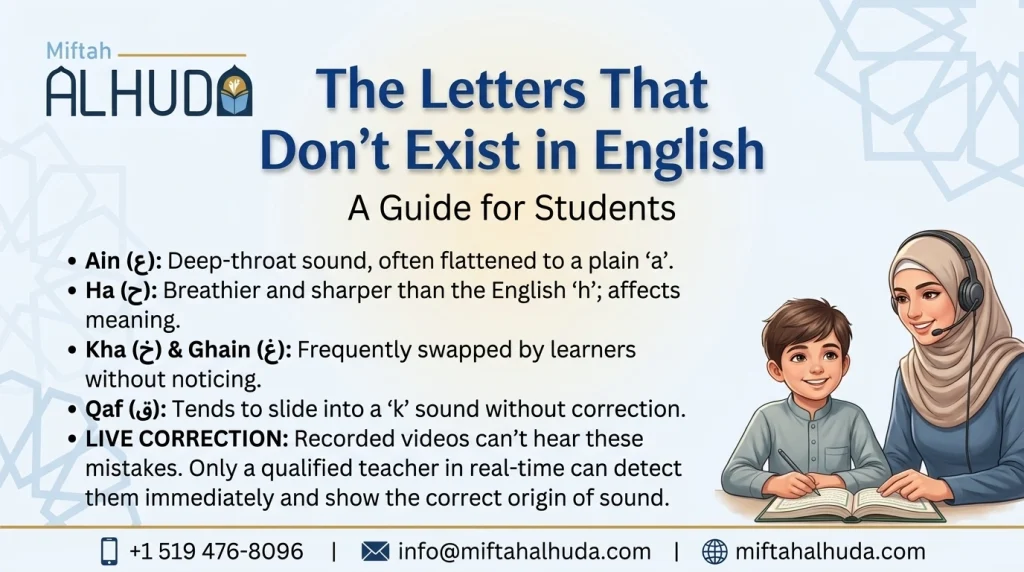
Adult learners run into a specific wall that beginner-focused apps rarely address. Arabic contains sounds that simply have no equivalent in English, French, or German.
- Ain (ع) comes from deep in the throat and gets flattened into a plain “a” by most self-taught readers
- Ha (ح) is breathier and sharper than the English “h,” and the difference changes word meanings
- Kha (خ) and Ghain (غ) are frequently swapped for each other without the speaker ever noticing
- Qaf (ق) tends to slide into a “k” sound when there’s no live correction happening
A recorded video cannot hear these mistakes. A qualified teacher, listening in real time during a free trial Noorani Qaida online class, catches them in the first few minutes and shows you exactly where the sound should originate.
What Actually Happens During the Free trial Noorani Qaida Online class?
The phrase “free trial” gets used loosely across the industry, and some academies attach conditions that only appear after you’ve already given your card details. A trial worth booking should look roughly like this.
- You register with basic details and pick a time that suits your schedule, day or night
- A teacher joins a live video session, usually thirty minutes, and starts by assessing where you currently stand
- You read a few lines directly from the Noorani Qaida while the teacher listens for Makharij, the precise articulation point of each letter
- The teacher corrects you on the spot rather than waiting until the end
- You leave with a clear sense of what your first month of lessons would actually cover
None of this requires payment information upfront. If a site asks for a card before the free trial Noorani Qaida class even begins, that’s worth treating as a warning sign rather than a formality.
Why the First Session Tells You More Than a Sales Page
A polished website says very little about how a teacher handles a nervous adult beginner mispronouncing basic letters in front of a stranger.
The trial session is where that actually gets tested. You notice whether the teacher is patient when you repeat the same word four times, whether they explain the reasoning behind a correction instead of just repeating it, and whether the pace matches your comfort rather than a fixed curriculum script.
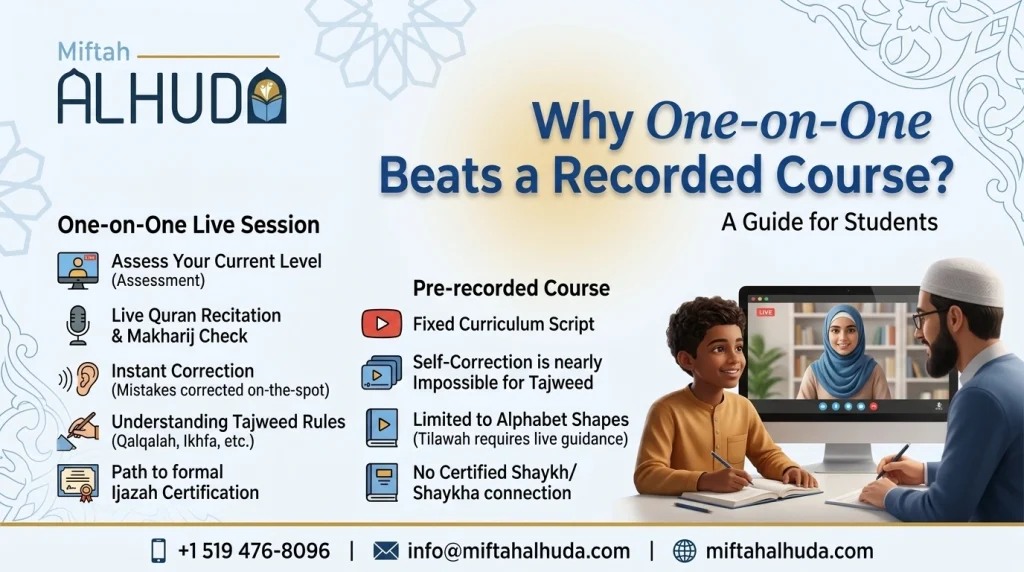
Why One-on-One Beats a Recorded Course?
Group videos and pre-recorded courses have their place for memorizing the alphabet shapes. But Tilawah, the actual art of correct Quranic recitation, is built on Tajweed rules like Qalqalah, Ikhfa, Idgham, Iqlab, and Madd, and these are nearly impossible to self-correct.
Miftah Alhuda‘s Noorania Qaida Ijazah program is built around exactly this gap. The program was developed specifically to address non-native speakers, working through certified Shaykhs and Shaykhas who teach one-on-one rather than in a crowded group call. Students move from Bismillah to a formal Ijazah, a certified chain of transmission connecting the student’s recitation back to the Prophet ﷺ, something a recorded video course cannot offer at any price.
The Courses Worth Your Time
Once the trial confirms the teaching style is a fit, most students move into one of a few structured paths depending on their goal.
Noorania Qaida Ijazah Program: This is the full route from first letter to certification. It covers Noorania Qaida rules mastery, advanced Tajweed application, and phonetic training built specifically for English and European speakers struggling with sounds like Ain, Ha, Kha, and Ghain. Students who complete it receive a Sanad-linked Ijazah, authorizing them to recite, and eventually teach, on an authenticated chain of transmission.
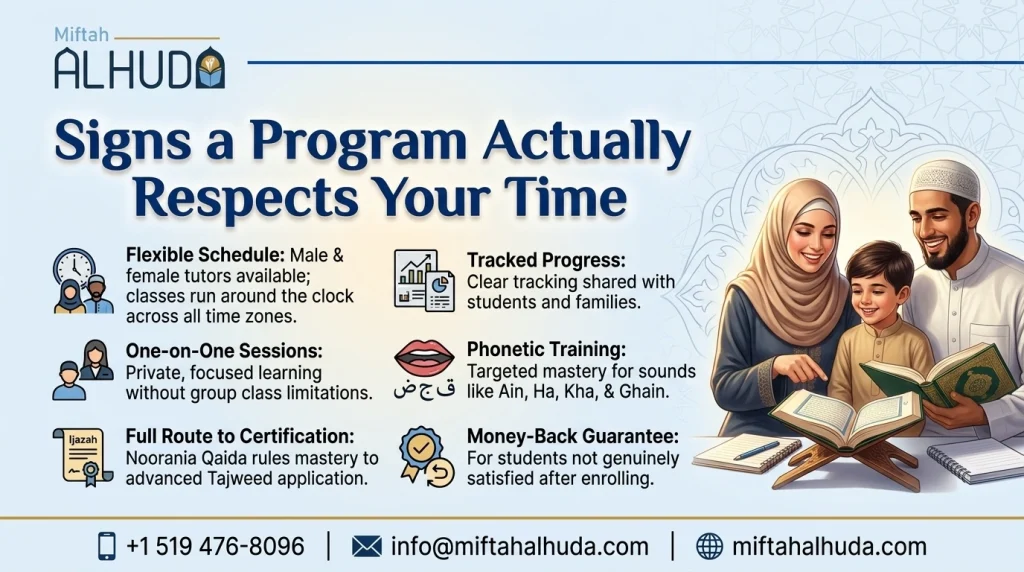
Signs a Program Actually Respects Your Time
Not every academy offering a free trial Noorani Qaida online class delivers the same experience once you’re enrolled. A few things separate the programs worth staying with.
- Male and female tutors are both available, so students can choose based on comfort
- Classes run around the clock, which matters when you’re in New York and your teacher is several time zones away
- Sessions stay one-on-one rather than shifting you into a group once the trial ends
- Progress gets tracked and shared with you, not just logged internally
- A money-back guarantee exists for students who genuinely aren’t satisfied after enrolling
None of these guarantee results on their own. But a program missing most of them is unlikely to hold your attention past the second week, which is usually when motivation naturally dips.
Ready to commit to the full journey? Explore the Noorani Qaida Online Class and start your learning journey.
Prefer to start smaller first? Book your free trial session and meet a teacher before deciding anything else.
Contact Us
WhatsApp: +1 519 476-8096
E-Mail: in**@**********da.com
Facebook: https://www.facebook.com/MiftahAlhudaOfficial
Instagram: https://www.instagram.com/miftahalhudaa
Youtube: https://www.youtube.com/@MiftahAl-huda
Tiktok: https://www.tiktok.com/@miftahalhuda00“.
Frequently Asked Questions
Is the free trial Noorani Qaida online class actually free?
Yes. A genuine trial session requires no card details and no payment before the class takes place.
How long does a trial class usually last?
Most sessions run around thirty minutes, enough time for a teacher to assess your level and correct a few key sounds.
Can adults join, or is Noorani Qaida only for children?
Adults make up a large share of students. Programs built for non-native speakers specifically address pronunciation habits that developed over years, not just childhood learning.
Does the trial include Tajweed, or only letter recognition?
A proper trial usually touches on basic Tajweed alongside letter pronunciation, since the two are taught together from the start.
What do I need for the class besides internet access?
A copy of the Noorani Qaida, either physical or PDF, a quiet space, and a device with video and audio.
How soon can I start after booking?
Most academies offer trial slots within the same week, and some offer same-day sessions depending on time zone availability.
The Page You Never Open Again
Somewhere between the third abandoned app and the YouTube playlist you stopped watching, most people quietly decide correct recitation just isn’t going to happen for them as an adult.
That assumption tends to survive right up until the first live correction, when a teacher points out in thirty seconds what months of solo practice never caught.
Whether that first session leads to a full Ijazah journey or just a clearer sense of where your pronunciation actually stands, the only way to know is to sit through one.
Book your free trial Noorani Qaida online class today and find out what a live correction actually sounds like.