

The suhoor dua begins the fasting day before it even starts. In the quiet darkness before dawn, Muslims around the world rise for a small meal that the Prophet (ﷺ) filled with blessing, and for a few unhurried minutes of supplication before the day’s worship begins.
This guide covers what to say at suhoor, what the Sunnah actually establishes about the meal, and the duas that fit this blessed time, with Arabic text, transliteration, translation, and sources. At Miftah Al-Huda Academy, we help Muslims build worship on authentic knowledge, understood word by word.
The Blessing of Suhoor
Suhoor is not just breakfast early. The Prophet (ﷺ) made it a mark of this ummah and a source of barakah:
“تَسَحَّرُوا فَإِنَّ فِي السَّحُورِ بَرَكَةً”
Learn your deen with a qualified teacher — Explore Fiqh Classes →“Tasahharu fa inna fis-suhuri barakah.”
(Take suhoor, for indeed in suhoor there is blessing.) – Agreed upon, recorded by al-Bukhari and Muslim.
He ﷺ also said that the difference between our fasting and the fasting of the People of the Book is the suhoor meal (recorded by Muslim), and another narration tells us that “Allah and His angels send blessings upon those who take suhoor” (recorded by Ahmad, graded hasan). Even a sip of water counts, because the blessing is in the act itself.
Is There a Specific Suhoor Dua?
Many Muslims search for the exact words to say at suhoor, and the honest answer frees the heart: no specific suhoor dua is established from the Prophet (ﷺ). What is established is the meal itself, its timing, and the virtue of the hour in which it is eaten.
Begin your meal with Bismillah, eat with gratitude, and then use the time for personal supplication. The intention to fast is made in the heart and needs no spoken formula; our guide on the intention for fasting in Ramadan explains this in detail.
The Best Duas for the Suhoor Hour
Suhoor falls in the last part of the night, the time Allah described the righteous with:
“وَبِالْأَسْحَارِ هُمْ يَسْتَغْفِرُونَ”
“Wa bil-ashari hum yastaghfirun.”
(And in the hours before dawn they would seek forgiveness.) – Surah Adh-Dhariyat, 51:18.
This is the hour when Allah descends to the lowest heaven and asks: “Who is calling upon Me, that I may answer him? Who is asking of Me, that I may give him? Who is seeking My forgiveness, that I may forgive him?” (agreed upon, recorded by al-Bukhari and Muslim). So the best suhoor duas are istighfar and your own deepest requests:
“أَسْتَغْفِرُ اللَّهَ الَّذِي لَا إِلَهَ إِلَّا هُوَ الْحَيُّ الْقَيُّومُ وَأَتُوبُ إِلَيْهِ”
“Astaghfirullahal-ladhi la ilaha illa Huwal-Hayyul-Qayyumu wa atubu ilayh.”
(I seek the forgiveness of Allah, there is no god but He, the Ever-Living, the Sustainer, and I turn to Him in repentance.) – Recorded by Abu Dawud and al-Tirmidhi.
Follow it with your own words: ask for a day of accepted fasting, strength for taraweeh, and forgiveness for yourself and your family.
Sunnah Practices Around Suhoor
The Sunnah encourages delaying suhoor toward the end of its time, just before dawn: “My ummah will remain in goodness as long as they hasten iftar and delay suhoor” (recorded by Ahmad, graded sahih). Pair the late suhoor with the opposite habit at sunset, a prompt iftar, and you have followed the Prophet’s (ﷺ) rhythm for the whole day.
If you accidentally sleep through suhoor, your fast is still valid; the intention was in your heart, and you can still say your morning remembrances and begin the day with dua.
A Simple Suhoor Routine
The blessed hour rewards a little order. Wake with enough time to eat without rushing. Begin with Bismillah and eat whatever is available, remembering that the Prophet (ﷺ) loved dates, and that even water carries the blessing. Pray two rak’ahs of voluntary prayer if you can, then spend the minutes before dawn in istighfar and your own supplication. Make the intention to fast in your heart, and close with the certainty that you started your day exactly where the righteous were described: seeking forgiveness in the hours before dawn.
Suhoor in the Quran and Sunnah
Suhoor is not a cultural habit that grew around Ramadan; it is a practice the Prophet (ﷺ) commanded and praised directly. He said: “Take suhoor, for in suhoor there is blessing (barakah).” (Al-Bukhari and Muslim) The command is gentle but clear, and the reason given is barakah: divine increase placed inside an otherwise ordinary pre-dawn meal.
He (ﷺ) also gave suhoor a special rank among the practices of this ummah: “The difference between our fasting and the fasting of the People of the Book is the meal of suhoor.” (Muslim) Eating before dawn is a mark of the Muslim fast itself, a small act that carries identity as well as strength.
And he described the suhoor hour as a moment of divine attention: “Our Lord, Blessed and Exalted, descends every night to the lowest heaven when the last third of the night remains, saying: Who calls upon Me so that I answer him? Who asks of Me so that I give him? Who seeks My forgiveness so that I forgive him?” (Al-Bukhari and Muslim) Suhoor sits inside that last third. The person at the suhoor table is awake in the very hours when the King invites His servants to ask.

The Best Time for Suhoor
The Sunnah is to delay suhoor toward the end of its time. Zayd ibn Thabit (may Allah be pleased with him) said: “We took suhoor with the Prophet (ﷺ), then he stood for prayer.” He was asked how long was between them, and said: “Fifty verses.” (Al-Bukhari and Muslim) That is the measure of a short, calm gap: enough to sit, make dua, and prepare for Fajr.
Practically, this means you do not need to eat at midnight and you should not stop eating too early out of caution. The time for suhoor runs until true dawn (al-fajr al-sadiq), which is what your local prayer timetable marks as the start of Fajr. Eat a little before that time, keep drinking until shortly before it, and use the remaining minutes for istighfar and dua. The common habit of stopping thirty or forty minutes early “to be safe” has no basis; it only makes the fast harder than Allah made it.
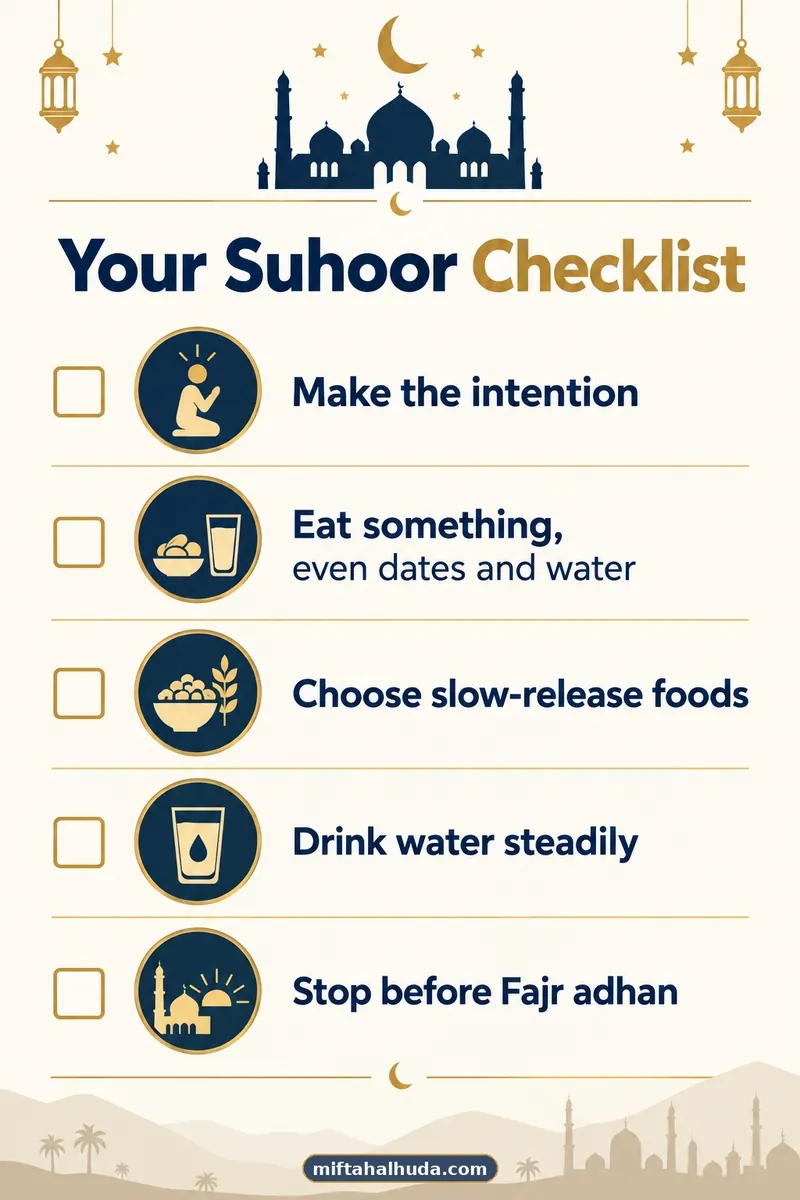
What to Eat at Suhoor
The Prophet (ﷺ) said: “The best suhoor of the believer is dates.” (Abu Dawud, hasan) Dates give steady, slow-releasing energy, and following the Sunnah in the food itself is worship.
Beyond dates, the principle is simple: choose food that sustains and water that hydrates. Slow-digesting foods such as oats, eggs, yogurt, beans and whole grains carry you further into the day than fried or very salty food, which returns as thirst by noon. Drink water steadily rather than in one large amount. And keep the meal moderate; a heavy suhoor followed by sleep brings discomfort, not strength. The goal of suhoor is to help you worship through the day, not to store up against hunger as if the day ahead were a famine.
Live 1-to-1 classesLearn it properly, with a real teacherCertified teachers · Flexible times · Free trial classExplore Fiqh Classes →Duas for the Suhoor Hour
As covered earlier, no single fixed “suhoor dua” is established from the Prophet (ﷺ). But the suhoor hour is the last third of the night, and that time carries its own treasures. Fill it with what is established:
- Istighfar. Allah praises “those who seek forgiveness in the hours before dawn” (Surah Adh-Dhariyat 51:18). Say: أَسْتَغْفِرُ اللهَ (Astaghfirullah – I seek Allah’s forgiveness), and the master supplication of forgiveness if you know it.
- The dua of the one who wakes at night. The Prophet (ﷺ) taught that whoever wakes should say: “La ilaha illallah, wahdahu la sharika lah, lahul-mulku wa lahul-hamd, wa Huwa ‘ala kulli shay’in Qadir. Alhamdulillah, wa subhanallah, wa la ilaha illallah, wallahu akbar, wa la hawla wa la quwwata illa billah,” and then ask, for it will be answered. (Al-Bukhari)
- Your personal needs. This is the hour of “Who asks of Me so that I give him?” Ask for your Ramadan, your children, your health, your provision, and your akhirah.
- The intention of fasting, settled quietly in the heart. If you ate and drank with the purpose of fasting tomorrow, the intention is present.
You will find these and more, in Arabic with translation, in our Ramadan duas collection, and the suhoor dua guide pairs them with the meal itself.

Suhoor With Family and Children
A shared suhoor is one of Ramadan’s sweetest memories for a child. It also quietly teaches them the Sunnah without a lecture. A few ideas that work:
- Wake the children gently and with good cheer. The tone of the waking becomes their memory of Ramadan.
- Let everyone say one thing they are asking Allah for this Ramadan while eating.
- Keep the table simple so the meal ends with time for dua and Fajr, not a rush.
- For younger children who are not yet fasting, let them join the meal anyway. They are absorbing the atmosphere of the month, which is how love of worship is formed.
If you want help building a child-friendly Ramadan routine, our article on teaching Quran to kids at home has practical daily structures, and the Ramadan preparation checklist includes a family section.
Common Suhoor Mistakes
- Skipping suhoor to keep sleeping. The Prophet (ﷺ) tied barakah to this meal; a few dates and a glass of water take two minutes and carry the blessing.
- Stopping food and drink long before Fajr. Imsak before true dawn is a later caution, not a Sunnah. Follow the timetable’s Fajr time.
- Salty and fried food at suhoor. It guarantees a thirsty, difficult day and makes fasting feel like punishment.
- Sleeping through Fajr after suhoor. The meal is meant to lead you into prayer. Set your plan for the few minutes after eating: wudu, dua, then Fajr.
- Treating suhoor as the main meal of the day. Moderation keeps the fast light and the heart awake.
The Intention at Suhoor: What the Scholars Say
Because suhoor is the last moment before the fast begins, Muslims naturally connect the intention (niyyah) to it. The scholars explain three things clearly.
First, the intention is an act of the heart, not the tongue. No authentic report gives a specific sentence to pronounce. Whoever eats suhoor intending to fast has intended; the meal itself is proof of the purpose. If you want to know how this applies to the obligatory Ramadan fast in detail, our guide on the intention for fasting Ramadan covers the rulings.
Second, for Ramadan, the majority of scholars hold that one intention at the start of the month covers all its days, as long as nothing breaks the fast in between, because each day’s fast follows the one before it by habit and knowledge. The Maliki school states this explicitly, and it relieves anyone who forgets to “renew” the intention one night.
Third, the safest practice, followed by many, is simply to resolve each night that tomorrow you will fast. If you ate suhoor planning to fast, you have already done it. Do not turn the niyyah into anxiety; Allah made this deed easy.
Suhoor for People Who Find Mornings Hard
Not everyone wakes easily before dawn, and Ramadan should not be lost to a heavy sleeper. These are practical steps that experienced fasters rely on:
- Set two alarms across the room. One phone beside the bed is a snooze button; an alarm across the room gets you standing.
- Prepare suhoor before you sleep. Dates, yogurt, oats and a filled water bottle on the table remove the “too tired to cook” excuse.
- Agree on a wake-up chain. Family members or roommates call each other; the one who wakes first becomes the alarm for the rest.
- Sleep earlier in Ramadan. The real fix for a hard suhoor is bedtime, not willpower. Move sleep thirty minutes earlier each week from Rajab onward, as the Ramadan preparation checklist advises.
- If you miss suhoor entirely, fast anyway. Suhoor is a blessed sunnah, not a condition of the fast. Your fast is valid; just plan the next night better.
Water, Coffee and Suhoor
Hydration questions fill every Ramadan, and the answers are simpler than the anxiety around them. Drink water steadily between iftar and suhoor rather than flooding your body at one meal; a body absorbs water over hours, not minutes. Two or three glasses at suhoor, after an evening of regular drinking, serve most people well.
Coffee and tea drinkers should know that caffeine at suhoor can increase thirst and bring a headache by afternoon, and heavy daily caffeine makes the first Ramadan mornings rough. Many people ease off caffeine gradually in the two weeks before Ramadan so that the month begins without withdrawal. Suhoor with dates, water and a calm stomach beats suhoor with three cups of tea every single time.
Suhoor on Work and School Days
The blessed meal does not need a dining table. A student with an early commute, a nurse on shift, or a builder leaving before dawn can all keep this sunnah with ten minutes of preparation. Pack a small suhoor box the night before: dates, a banana, a sandwich, a bottle of water. Eat it wherever Fajr finds you, at the kitchen counter or on the train platform, and let the barakah of the Sunnah follow you into the day.
What matters is that the meal happens inside its time and carries its purpose. Some of the busiest companions were travelers and workers, and the Prophet’s (ﷺ) command to take suhoor was addressed to the whole ummah, not only to those with quiet mornings.
A Word for Mothers at Suhoor
In many homes, the mother feeds everyone at suhoor and eats last, standing. Remember that your suhoor is worship too, and that the family can share the preparation. Prepare together the night before, sit with your children at the meal, and make your own dua in that blessed hour, not only theirs. Ramadan trains the whole household, and a mother who guards her own suhoor and her own Fajr teaches more than any reminder.
From Suhoor to Fajr: The Blessed Half Hour
What you do between suhoor and Fajr sets the tone of the whole fasting day. The Prophet (ﷺ) and his companions treated these minutes as part of the night prayer’s time, filled with Quran and istighfar, not as a gap to doze through. Even fifteen minutes of recitation or quiet dua in that window changes how the day unfolds.
Try this small routine: finish eating ten minutes before the end of suhoor time, make wudu, sit with a short portion of Quran or the morning adhkar until the adhan, pray the sunnah of Fajr at home, then the fard. If Fajr is prayed in the masjid, walk with the intention that every step is recorded. And if you must sleep after Fajr, sleep having already banked the hour’s worship. The Ramadan duas collection has the morning adhkar ready to print for exactly this slot.
Frequently Asked Questions About Suhoor
1. Is there a specific dua to say at suhoor?
No specific verbal dua is established from the Prophet (ﷺ) for suhoor. Begin with Bismillah, eat with gratitude, and fill the last part of the night with istighfar and personal supplication, which is exactly what that blessed hour is for.
2. Do I have to say the intention out loud at suhoor?
No. The intention (niyyah) is an act of the heart, made before dawn. Waking up to eat suhoor is itself one of the clearest signs that you intended to fast, and no spoken formula is required.
3. What if I sleep through suhoor completely?
Your fast is valid. Suhoor is a beloved Sunnah full of blessing, not a condition of the fast. Make your intention in your heart, begin your day with your morning remembrances, and try to set an extra alarm the next night.
4. Can I keep drinking water until the adhan ends?
The fast begins at true dawn. Eating and drinking must stop when dawn actually enters, and since the adhan of Fajr announces its arrival, the safe habit is to finish eating and drinking by the adhan rather than stretching into it.
5. Is suhoor only for Ramadan?
Suhoor is the pre-dawn meal of any fast, including voluntary fasts like Mondays, Thursdays, and the six days of Shawwal. Its blessing applies whenever you fast, and Ramadan simply gives it its largest stage.
For everything else the month needs, from the iftar duas to the Laylat al-Qadr supplication, see our complete guide to authentic Ramadan duas, our Ramadan fasting rules guide, and our collection of duas for forgiveness.
6. Do I have to eat a full meal for suhoor to count?
No. Even a sip of water or a single date taken with the intention of suhoor carries its barakah. The scholars mention that the blessing is in taking something before dawn, however small, following the Prophet’s (ﷺ) command to take suhoor.
7. Is it better to delay suhoor or eat it early?
The Sunnah is to delay it toward the end of the suhoor time, close to Fajr, as the companions described eating with the Prophet (ﷺ) about fifty verses’ length before the prayer. Eating too early loses both the blessing of the timing and the energy for the day.
8. Can I intend a voluntary fast at suhoor time?
Yes. For voluntary fasts, the intention may be formed any time before the fast begins, and even during the morning for one who has not eaten, according to the sounder view. For the obligatory Ramadan fast, the intention must be settled before Fajr, which suhoor naturally accomplishes.
9. What if I wake up after Fajr without eating suhoor?
Your fast is still valid; suhoor is a blessed sunnah, not a pillar of fasting. Make your intention, begin your fast, and set better alarms for the next night. Many people fast without suhoor on some days, but making it a habit means leaving the Prophet’s (ﷺ) gift of barakah unopened.
Keep reading
Learn your deen with a qualified teacher
Live one-to-one Fiqh classes that explain the rulings clearly and practically.
2 Responses