

Seeking forgiveness is one of Islam’s most prominent forms of worship. Every believer makes mistakes, falls short, and sins, whether intentionally or unintentionally. Islam calls for a direct way to Allah through true repentance and sincere supplication. In Islam, a forgiveness dua in islam is more than just a prayer; it represents humility, faith, and trust in Allah’s limitless mercy.
In this guide, Miftah Al-Huda Academy will explain the meaning of forgiveness dua (Dua Al-Istighfar), its significance in Islam, and how to recite it genuinely as part of your regular devotion.
Forgiveness in Islam
Forgiveness in Islam is based on two key concepts: Istighfar and Tawbah.
Istighfar implies begging Allah for forgiveness, which is frequently said as follows:
“Astaghfirullah”
“I seek forgiveness from Allah.”
Tawbah refers to genuine repentance, which includes expressing regret, abandoning the sin, and promising not to return to it.
Together, these acts assist believers in purifying their souls and earning Allah’s mercy.
The Best Forgiveness Dua in Islam
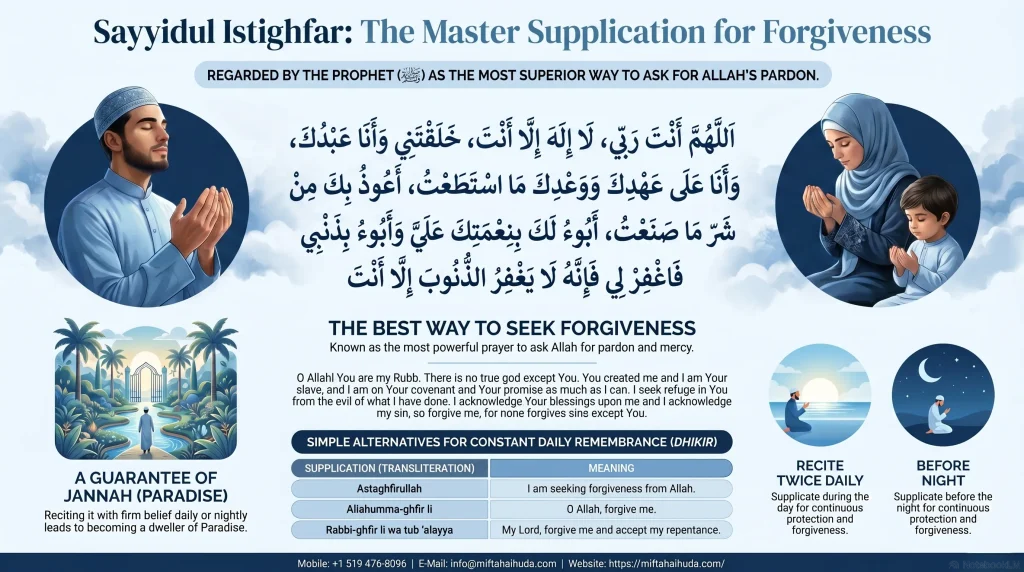
Sayyidul Istighfar is often regarded as the most powerful dua for seeking forgiveness.
Shaddad bin Aus (May Allah be pleased with him) said:
The Prophet (ﷺ) said, “The best supplication for seeking forgiveness (Syed-ul- Istighfar) is to say: ‘Allahumma Anta Rabbi, la ilaha illa Anta, khalaqtani wa ana ‘abduka, wa ana ‘ala ‘ahdika wa wa’dika mastata’tu, a’udhu bika min sharri ma sana’tu, abu’u laka bini’matika ‘alayya, wa abu’u bidhanbi faghfir li, fa innahu la yaghfirudh-dhunuba illa Anta.
(O Allah! You are my Rubb. There is no true god except You. You have created me, and I am Your slave, and I hold to Your Covenant as far as I can. I seek refuge in You from the evil of what I have done. I acknowledge the favours that You have bestowed upon me, and I confess my sins. Pardon me, for none but You have the power to pardon).’
He who supplicates in these terms during the day with firm belief in it and dies on the same day (before the evening), he will be one of the dwellers of Jannah; and if anyone supplicates in these terms during the night with firm belief in it and dies before the morning, he will be one of the dwellers of Jannah.” [Al-Bukhari].
Simple Forgiveness Duas for Daily Recitation
- Astaghfirullah: I am seeking forgiveness from Allah (God).
- Allahumma-ghfir li: “O Allah, forgive me.”
- Rabbi-ghfir li wa tub ‘alayya innaka anta At-Tawwabur-Raheem:
It was narrated that Ibn `Umar said:
“We used to count that the Messenger of Allah (ﷺ) said one hundred times in a gathering: ‘Rabbighfirli wa tub `alayya innaka Antat-Tawwabur-Rahim (O Allah forgive me and accept my repentance, for You are the Accepter of repentance, the Most Merciful).'”
Quranic Duas for Forgiveness
The Dua of Prophet Adam (AS)
After making a mistake, Prophet Adam and Hawwa prayed:
“Our Lord! We have wronged ourselves. If You forgive us not, and bestow not upon us Your Mercy, we shall certainly be of the losers.” (Surah Al-Araf)
This is still one of the most powerful repentance prayers in Islam.
The Dua of Prophet Musa (AS)
Prophet Musa supplicated:
“My Lord, indeed I have wronged myself, so forgive me,” and He forgave him. Indeed, He is the Forgiving, the Merciful. (surah Al-Qasas)
His heartfelt regret was accepted immediately.
Forgiveness Dua from the Sunnah
Despite his sinlessness, Prophet Muhammad asked for forgiveness around 70 times per day.
One of his frequent supplications was:
“Astaghfirullaha wa atubu ilayh.”
Meaning:
“I seek Allah’s forgiveness and turn to Him in repentance.”
Narrated Abu Huraira:
I heard Allah’s Messenger (ﷺ) saying.” By Allah! I ask for forgiveness from Allah and turn to Him in repentance more than seventy times a day.”
This demonstrates the importance of continuous repentance regardless of one’s spiritual level.
Best Times to Recite Forgiveness Dua

-
Before Dawn
The period before Fajr is one of the most blessed times for requesting forgiveness.
-
During Sujood
When believers prostrate, they are closest to Allah.
-
After Obligatory Prayers
Reciting Istighfar after salah is very recommended.
-
During Tahajjud
The last third of the night is one of the most potent moments for supplication.
-
On Fridays
Friday provides unique chances for worship, remembering, and repentance.
How to Make Sincere Tawbah?
True repentance lies in:
1. Recognize the Sin
A believer must admit wrongdoing openly and honestly.
2. Feeling genuine regret
Genuine remorse is at the heart of repentance.
3. Stopping the sin
One must immediately stop the sinful act.
4. Resolving Not to Return
To avoid repeating the sin, make a true commitment.
5. Restoring rights
If other people were harmed, their rights should be restored wherever possible.
5 Benefits of Constant Istighfar
1. Increased Blessings
Seeking forgiveness brings Allah’s blessings in all aspects of life.
2. Relief from Difficulties
Many scholars suggest that consistent Istighfar can help alleviate troubles.
3. Peace of heart
Repentance alleviates guilt and spiritual heaviness.
4. Spiritual Growth
Frequent forgiveness strengthens faith and develops character.
5. Closer connection to Allah
Every act of real repentance moves the believer closer to Allah’s mercy.
Building a Daily Istighfar Routine
To develop forgiveness as a constant habit:
- Recite Astaghfirullah after each prayer.
- Set aside a few minutes before Fajr to repent.
- Include forgiveness duas in the morning and evening adhkar.
- Prior to going to bed, seek forgiveness.
- Every day, reflect on your actions and intentions.
Consistency is more valuable than occasional, intense attempts. Even modest amounts of Istighfar can have a significant influence over time.
Discover Travelling Dua in Islam how invoking Allah’s protection and blessings can transform your journey into a peaceful, faith-filled experience.
Whether you are setting off on a long flight, heading out on a road trip, or commuting every day, learning the Travelling Dua connects you to a timeless Sunnah that brings safety, barakah, and peace of mind.
Read the full guide to discover:
-
The Authentic Meaning: Understand the powerful words and spiritual significance behind the supplication.
-
Key Spiritual Benefits: Learn how reciting the dua shields you from hardship and elevates your travel into an act of worship.
-
Exact Times to Recite: Master the ideal moments from stepping into your vehicle to returning home to earn continuous rewards.
 [Read the Full Article Now] to equip yourself with the blessings and protection of the Sunnah for your next journey!
Conclusion
Reciting a forgiveness dua is one of the most effective ways to come closer to Allah. Believers can cleanse their minds, obtain Allah’s mercy, and deepen their faith by repenting sincerely, reciting Istighfar on a regular basis, and praying heartily.
Regardless of how serious a person’s mistakes are, the door of repentance remains open.
If you want to learn more about forgiveness dua in Islam, Miftah Al-Huda Academy provides expert guidance to help you understand authentic duas, their meanings, and their spiritual benefits.
Open the door to a stronger connection with Allah by learning the most powerful duas of repentance and forgiveness. At Miftah Al-Huda Academy, our experienced teachers will guide you through their meanings and spiritual benefits. Start with a FREE Trial and begin your journey today.
Contact Us
- WhatsApp: +1 519 476-8096
- E-Mail: in**@**********da.com
- Facebook : https://surl.li/yqeyas
- Instagram:https://surl.li/smlfaq
- Youtube: https://surl.li/inbncd
- Tiktok:https://surl.li/ldzmww
Frequently Asked Questions
1. How many times should I say Astaghfirullah daily?
There is no fixed number, although regular daily recitation is highly recommended.
2. Can Allah forgive major sins?
Yes, real repentance may end in forgiveness for even serious sins.
3. What is the difference between Istighfar and Tawbah?
Istighfar is a request for forgiveness, whereas Tawbah is full repentance with regret and a new beginning.
4. Does repeated repentance still count?
Yes, as long as the repentance is honest.
5. Can I make forgiveness dua for my parents?
Yes, prayer for parents is strongly encouraged in Islam.
6. Why is forgiveness dua in Islam considered a key to spiritual renewal?
Forgiveness dua in Islam enables Muslims renew their faith, seek Allah’s mercy, and continue with a pure heart and a deeper dedication to devotion.