
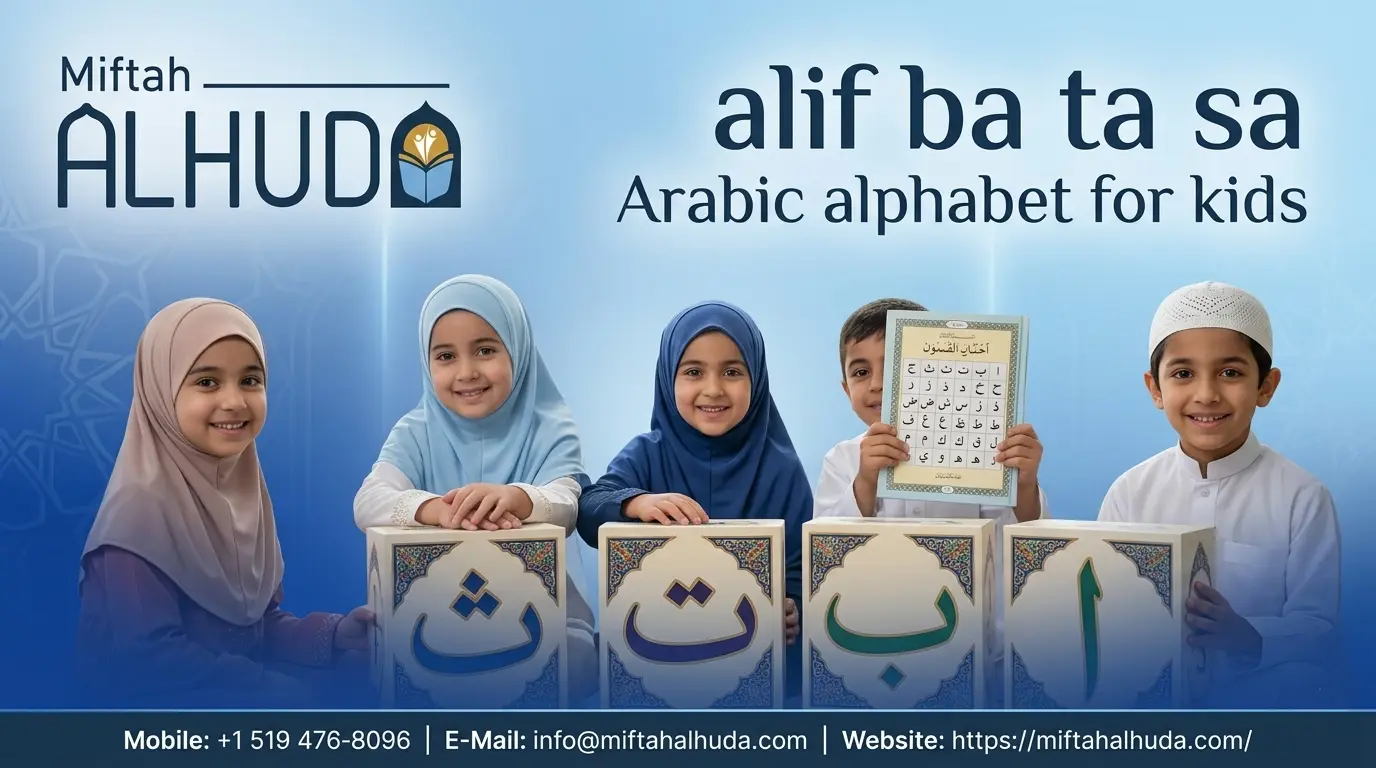
Your child knows how to say “dinosaur” without faltering. Every lyric from the TV show they watched two years ago still rings true in their head. Yet as soon as you pull out the Arabic alphabet, there’s that confused look in their eyes, maybe even an attempt at moving to the couch. It isn’t your imagination. Learning the alif ba ta sa Arabic alphabet for kids is indeed a unique experience, one which doesn’t yield much success by simply looking at flashcards and saying letters.
Most parents try to introduce Arabic the way they’d introduce any other subject: structured, patient, maybe with a workbook. That works for math. For a second language, especially one with a completely different script, it works for about three sessions before the resistance kicks in. Not because the child isn’t capable, but because the method doesn’t match how young brains actually absorb language.
This article walks through what actually helps Arabic letter recognition take root in kids who are growing up in English-speaking households, the activities, the sequencing, and the daily habits that make alif ba ta sa feel like theirs, not like something they’re doing to please you.
Why the Arabic Alphabet Feels Harder Than It Actually Is?
There’s a gap between how difficult Arabic looks to a Western child and how difficult it actually is once the right foundation is built. The script runs right to left, letters change their shape depending on where they appear in a word, and there are 28 letters, compared to English’s 26. From the outside, that’s a lot.
What doesn’t get said often enough is that Arabic is phonetically consistent. Every letter has one sound that does not shift based on context. Once a child knows the sound of ب (ba), it will always be that sound, everywhere, without exception. English doesn’t give children that reliability. Compare “c” in “cat,” “city,” and “chord.” Arabic, once learned at the letter level, is actually more predictable.
The tough part about being brought up on English is that they have never seen Arabic in their surroundings. They do not see it in signs on the streets, on products in stores, nor in classrooms at school. It is the lack of exposure that makes them seem foreign to them.
The Order of Teaching Alif Ba Ta Sa Arabic Alphabet For Kids That Most Parents Get Backwards
Many concerned parents begin by instructing the child to trace letters that he or she cannot identify. Tracing before identification is akin to teaching a child how to write the word “elephant” without seeing an elephant first. The physical act is second to the mental image.
A sequence that works considerably better runs through these stages:
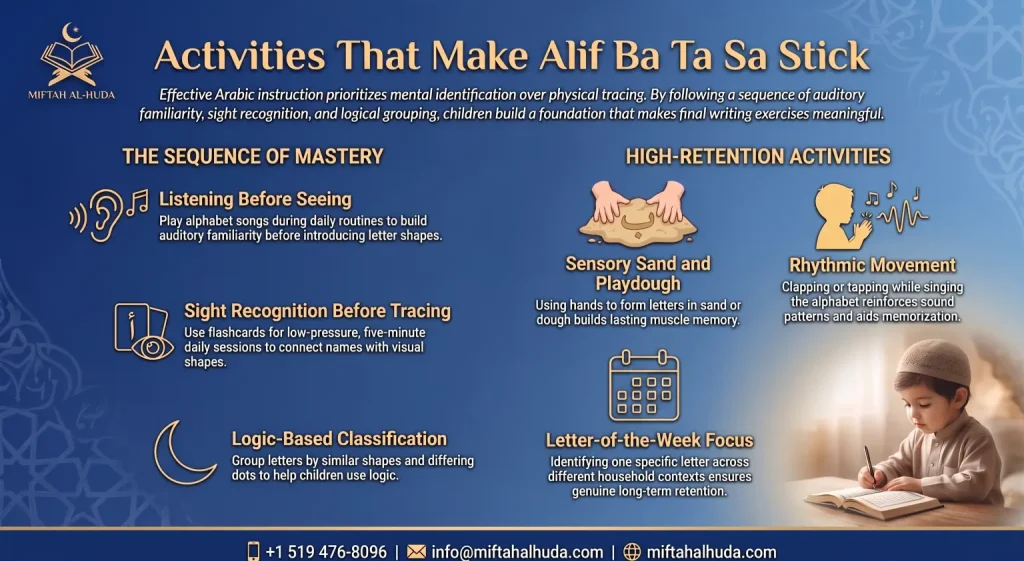
Listening before seeing.
Play Arabic alphabet songs in the background of daily routines for a week or two before formally introducing the letters. Car rides, breakfast, quiet time. The child builds an auditory familiarity with the letter sounds before they’re ever asked to recognize a shape.
Sight recognition before tracing.
To teach alif ba ta sa Arabic alphabet for kids Use large, colorful flashcards with one letter and one matching image per card. Hold up the card, say the letter name and sound, move on. Short sessions, five minutes, no drilling. Do this daily. The repetition works because it’s low-pressure.
Classification based on similarities in shape.
There are quite a few letters in the Arabic language that have similar shapes but differ in their number and location of the dots they have. It will be much more productive to teach these letters as part of one group than follow the strict alphabetical order. If children see that the shape is similar but the number and location of dots differ, they use logic.
Tracing last, after recognition is solid. Once a child can identify a letter in isolation, writing it becomes meaningful. Before that, it’s just copying shapes they don’t yet know.
Activities That Make Alif Ba Ta Sa Stick
Sand Trays and Playdough
There’s a reason educators return to sensory play for to teach alif ba ta sa Arabic alphabet for kids. When a child physically forms the shape of ا (alif) in a tray of sand, they use their hands, eyes, and muscle memory simultaneously.
This builds a kind of retention that looking at a printed letter doesn’t. Playdough works the same way. Roll out the shape of ب (ba) and press the dots in with a finger. It sounds basic. It is basic. That’s why it works.
Alphabet Songs with Movement
The Arabic alphabet song, sometimes called the alif ba ta nasheed, exists in several versions for children and most are genuinely catchy. The best approach is not to treat it as background noise but to sing along.
Clapping or tapping a rhythm while reciting reinforces the sound patterns. A parent I know used a simple rule: the alphabet song plays once every morning in the car, and both parent and child sing it. Within a month, the child had the full sequence memorized without a single formal lesson having been taught.
Letter-of-the-Week Games
Pick one letter and spend an entire week on it. Name things around the house that start with that letter in Arabic. Draw it. Find it in a book. Stick a small label on something.
The narrower focus means the child encounters the letter repeatedly across different contexts, which is exactly how retention forms. By the time you move to the next letter, the previous one is genuinely theirs.
The Letter Forms Problem An How To Fix It
This is where parents fail to realize how much their children learn from them. Arabic alphabets do not have just one form each.
Based on where in a word the letter occurs, i.e., the first, middle, last position, or standing alone, it can assume a different appearance.
This is known as the positional forms, and this particular aspect of the alphabet tends to give even adults a lot of trouble.
For young children, the most practical approach is not to introduce all four forms at once. Start with the isolated form. Get that solid.
Once a child is reading simple words with harakat (the short vowel marks placed above and below letters), the connected forms start to make sense naturally because they’re seeing them in context, not as abstract variants to memorize.
Six letters, including ا (alif), د (dal), ذ (thal), ر (ra), ز (zayn), and و (waw), don’t connect to the letter following them, which means they only have two forms instead of four.
Many teachers recommend beginning connected-form practice with words that include only these non-connecting letters. It gives children visible progress early, which matters more than most curricula acknowledge.
What Online Arabic Lessons for Kids Actually Offer That Home Practice Doesn’t?
There is a limit on how much parents can achieve at home since not all families use Arabic as their primary language. While consistency is important, there is also an issue of proper pronunciation as well as the progression in learning, and being able to recognize bad habits formed while making sounds/letters.
A qualified teacher sees things a parent can’t, not because the parent isn’t paying attention, but because they’re not trained to spot the specific errors that compound over time.
A child who consistently mispronounces ع (ain) in early stages will carry that mispronunciation into Quran reading if it isn’t corrected early. A teacher catches it in lesson two.
What good online Arabic lessons provide is a sequence that builds deliberately: letter recognition, letter sounds, positional forms, short vowels (harakat), then simple word reading.
Each stage depends on the previous one being solid before advancing. That structure is genuinely difficult to replicate through weekend worksheets and flashcard sessions alone.
Ready to Go Further? Here’s What Miftah Alhuda Offers
If your child is ready for structured Arabic learning with a qualified teacher, Miftah Alhuda’s Arabic for Kids Course takes children through the full Arabic alphabet with dedicated focus on letter recognition, pronunciation, and writing, in sessions designed specifically for young learners in Western households.
The course is built around making Arabic feel accessible, not overwhelming, and moves at a pace that respects how kids actually learn.
Not sure if it’s the right fit? Book a Free Trial Session first. One session with a teacher will give you a clearer picture of where your child is and what they need next.
Contact Us
WhatsApp: +1 519 476-8096
E-Mail: in**@**********da.com
Facebook: https://www.facebook.com/MiftahAlhudaOfficial
Instagram: https://www.instagram.com/miftahalhudaa
Youtube: https://www.youtube.com/@MiftahAl-huda
Tiktok: https://www.tiktok.com/@miftahalhuda00
Frequently Asked Questions
1. What is the right time to teach the Arabic letters (alif ba ta sa) to my child?
The recommended time to start informal learning would be from ages 3 to 5. The brain can easily pick up sounds and patterns from play and repetition at this young age, whereas the age for learning letters formally would range between ages 4 and 6.
2. Are there more Arabic letters than English? If yes, how many?
Yes, there are 28 Arabic letters, while English has only 26. This difference may not mean much, except for the change in writing direction from right to left.
3. Should my child learn to write Arabic letters before they can read them?
No. Letter recognition and sound association should come before any writing practice. A child who can identify and name a letter before tracing it will write it more correctly and retain it longer.
4. My child keeps confusing ب (ba), ت (ta), and ث (sa) — is that normal?
Very normal, and it actually reflects good pattern recognition. The child has noticed that the base shape is identical. The solution is to focus on dot count and placement as the distinguishing feature, using games where the child has to count dots to name the correct letter.
5. Can a child learn Arabic effectively through online classes if they have no Arabic at home?
Yes, and many children do. The key is choosing a teacher experienced with non-native-speaking children, maintaining consistency between sessions with simple home activities, and keeping expectations realistic for the early months.
6. How long does it usually take to learn the full Arabic alphabet?
With regular, structured sessions two to three times per week, most children can recognize all 28 letters in isolated form within three to four months. Reading simple vowelled words typically follows within another two to three months after that.
Conclusion
There will be weeks when none of this feels like it’s working. Your child will recognize a letter confidently on Tuesday and act like they’ve never seen it on Thursday. That regression is real, it’s documented in language acquisition research, and it doesn’t mean you’re doing it wrong.
What actually erodes progress isn’t a bad lesson or a forgetful week. It’s the decision to stop after a bad lesson or a forgetful week. The children who arrive at word-level reading in Arabic are almost never the ones who found it easy. They’re the ones whose families kept showing up, kept the sessions short enough to feel manageable, and didn’t wait for the child to be “ready” before beginning.
The alif ba ta sa letters are not a destination. They’re the beginning of something much longer, an ability to read, understand, and eventually connect with a language that carries a considerable amount of meaning for many of the families trying to pass it on.
Getting through that first stage, honestly and without rushing, is the part that matters most right now.
If you’re looking for structured online Arabic lessons that take young learners from letter recognition to confident reading, Miftah Alhuda‘s Arabic for Kids Course offers qualified teachers, a clear progression, and a free trial session to get started.