

Although mastering Tajweed requires careful attention to detail, Common Mistakes in Idgham Shafawi can still occur , affecting the clarity and rhythm of Quran recitation. Idgham Shafawi is one of those Tajweed rules that appears simple at first, yet many learners fail to apply it correctly.
Small pronunciation errors with the lips or ghunnah may rapidly progress to repeated mistakes without the reciter’s awareness. Understanding where these mistakes happen is the first step toward improving Tajweed, and at Miftah Al-Huda Academy, students receive the guidance and support needed to recognize these errors, correct them properly, and recite the Quran with confidence.
What Is Idgham Shafawi?
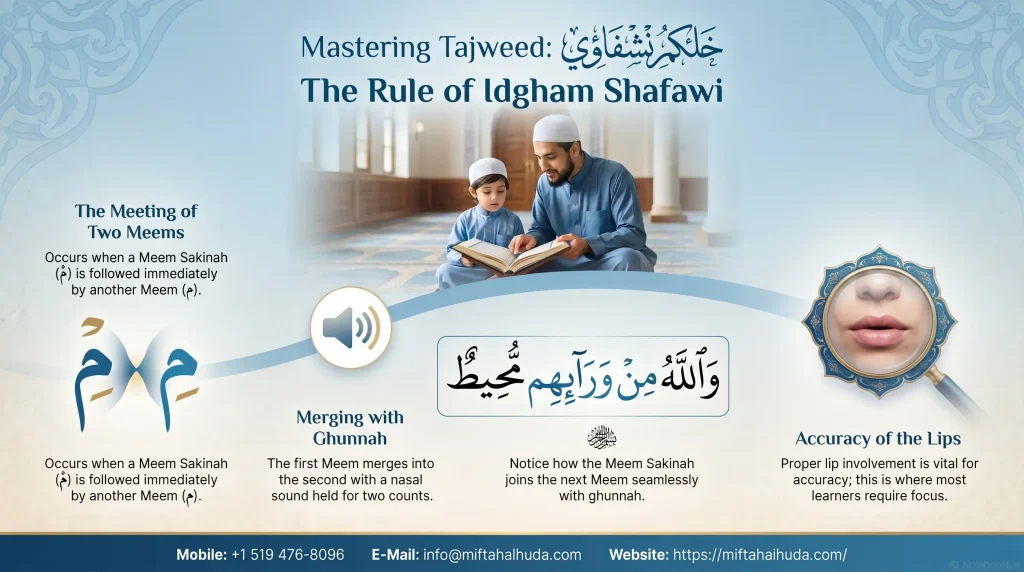
Idgham Shafawi occurs when the letter Meem Sakinah (مْ) is followed by another Meem (م). In this particular case, the first Meem merges into the second via ghunnah (a nasal sound held for two counts).
A simple example is:
وَاللَّهُ مِن وَرَائِهِم مُّحِيطٌ
Here, the Meem Sakinah joins the next Meem, and the reciter obviously applies ghunnah.
Because the lips are involved in saying Meem, accuracy is important. This is where many learners make mistakes.
Struggling with Idgham Shafawi? Watch Out for These Common Mistakes in Idgham Shafawi
1.Why Skipping Ghunnah Can Weaken Your Recitation?
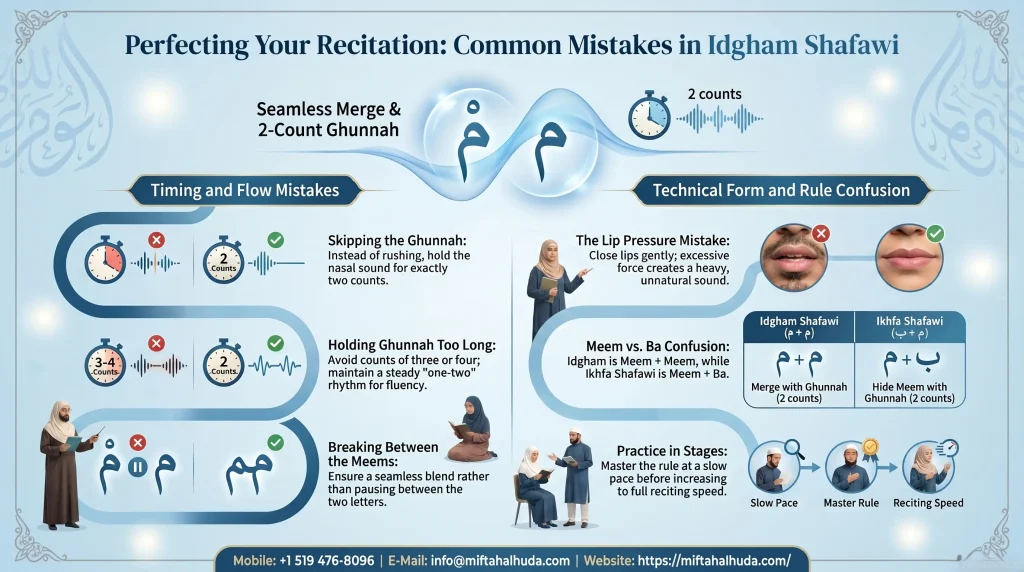
One of the most frequent mistakes in Idgham Shafawi is reading both letters rapidly and without ghunnah.
Instead of holding the nasal sound for two counts, the reciter moves directly into the second Meem. This removes an important part of the Tajweed rules.
How to Fix It?
Slow down.
When you see Meem Sakinah, then Meem:
- Close the lips slightly.
- Allow the sound to resonate through the nose.
- Hold for two counts.
Listening to competent Quran reciters might also help you improve hearing skills.
2. When the Ghunnah Lasts Too Long in Recitation?
Among other Common Mistakes in Idgham Shafawi is extending the ghunnah for longer than required.
Some students hold it for three or four counts, disrupting the natural flow of recitation.
How to Fix It?
Use a steady count:
- One
- Two
Then continue.
Maintaining proper time enhances fluency and accuracy in recitation.
3. Breaking Between the Meems
Pronouncing both Meems separately is an obvious mistake.
Instead of blending seamlessly, the learner pauses between them.
Example:
- Incorrect: لَهُم… مَّا
- Correct: لَهُمَّا
How to Fix It
Keep your focus on a smooth connection.
Practice by reciting brief Quranic examples multiple times until the merge feels natural.
4. The Lip Pressure Mistake That Affects Your Sound
Because the Meem relies on the lips, some students close them with excessive force. This tension impacts sound quality and is one of the Common Mistakes in Idgham Shafawi that can make recitation feel heavy. To ensure a correct sound, the lips should meet gently without being pressed too tightly.
How to Fix It?
- Keep a relaxed lip position.
- The closing should be forceful enough to pronounce Meem clearly while remaining gentle enough to allow for a seamless flow.
- A Common Tajweed Mix-Up Between Meem and Ba
Students sometimes mix these two rules:
Idgham Shafawi = Meem + Meem, while Ikhfa Shafawi = Meem + Ba.
This is one of the most technical Common Mistakes.
How to Fix It?
Memorize the pattern:
- Meem + Meem = merge with ghunnah.
- Meem + Ba = hide the Meem with ghunnah.
Regular review of examples helps to reinforce the difference.
| Rule | Definition | Example |
| Idgham Shafawi | Happens when Meem Sakinah (مْ) is followed by Meem (م). The two Meems merge with ghunnah (2 counts). | إِنَّهَا عَلَيْهِم مُّؤْصَدَةٌ |
| Ikhfa Shafawi | Happens when Meem Sakinah (مْ) is followed by Ba (ب). The Meem is hidden with ghunnah (2 counts). | فَبَشِّرْهُم بـِعَذَابٍ أَلِيمٍ |
6. Ignoring the Rule While Reciting Quickly
During fast recitation, students may forget the rule totally.
This becomes a common mistake when learners focus solely on fluency.
How to Fix It?
Practice in stages:
- Slow recitation
- Medium pace.
- Full reciting speed.
This promotes correct habits.
The 4-Step Blueprint to Perfect Idgham Shafawi

Miftah Al-Huda Academy will help you improve your recitation from basic reading to soulful mastery.
- Step 1:The Sonic Blueprint (Listen): Before you recite, you must absorb. At Miftah Al-Huda Academy, we begin by training your hearing; by listening to our qualified Qaris, you will learn the exact resonance of Ghunnah the book cannot.
- Step 2: Self-Mirror (Record): Recording yourself is a personal quality check. It fills the gap between what you believe you sound like and your actual recital. Drop your audio samples into the Miftah Al-Huda student site for exact tracking.
- Step 3: The 5-Minute Habit (Practice): Tajweed is more than just mental knowledge; it also involves muscle memory. Our academy breaks down complex rules into daily 5-minute micro-habits, allowing you to achieve consistency without feeling overwhelmed.
- Step 4:The Master’s Touch (Live Feedback): The ultimate shortcut to perfection is a live guide. Miftah Al-Huda Academy‘s interactive sessions include expert teachers who listen to you in real time and correct minor errors before they become permanent habits.
The Path to Error-Free Recitation
Once you understand the basics of Idgham Shafawi, you’ll find it easy to master. However, avoiding Common Mistakes in Idgham Shafawi (such as dropping the Ghunnah or confusing rules) necessitates dedicated practice and competent support. While individual study produces slow improvement, Miftah Al-Huda Academy speeds up your transformation. Our live, interactive sessions allow skilled teachers to immediately correct tiny mistakes, transforming your daily practice into perfect, soulful recitation.
Unlock Perfect Recitation Today! Book your Tajweed course with Miftah Al-Huda Academy now and get an exclusive Free Trial to start your journey risk-free.
Contact Us
- WhatsApp: +1 519 476-8096
- E-Mail: in**@**********da.com
- Facebook: https://www.facebook.com/MiftahAlhudaOfficial
- Instagram: https://www.instagram.com/miftahalhudaa
- Youtube: https://www.youtube.com/@MiftahAl-huda
- Tiktok: https://www.tiktok.com/@miftahalhuda00
Frequently Asked Questions (FAQs)
1. 1. What is the easiest way to recognize Idgham Shafawi and avoid Common Mistakes in Idgham Shafawi?
Look for a Meem Sakinah followed by another Meem, then perform a clear two-count ghunnah (nasal sound).
2. What is the difference between Idgham Shafawi and Idgham with Noon Sakinah?
Idgham Shafawi applies to Meem, whereas the other rule applies to Noon Sakinah or Tanween.
3. Why do students confuse lip-based Tajweed rules?
Because the pronunciation points are similar and require repeated practice.
4. Can I improve Idgham Shafawi through listening only?
Listening is beneficial, but it is even more effective when combined with recitation practice.
5. Should I stop and repeat the verse when I miss Idgham Shafawi?
Yes, repeating the verse reinforces right pronunciation.
6. Why is teacher feedback important in Idgham Shafawi?
Because an instructor can identify minor pronunciation problems that are easy to overlook on your own.