

You picked up a set of alif ba ta sa flashcards arabic learners have been using for years, ran through the first few letters, and felt genuinely hopeful. Then week two arrived. The cards started blurring together, the dot patterns stopped making sense, and you hit the same wall that stops most beginners before they ever reach ث (tha).
The problem is not motivation. Most people who quit early were not being lazy. The issue is that a lot of flashcard sets do not teach how Arabic actually works, they just display letters without the context a beginner’s brain needs to hold them. You memorize ب (ba) on its own, then meet it inside a word and fail to recognize it. That gap is not a you-problem; it is a design problem.
This article walks through what separates a genuinely useful Arabic alphabet flashcard set from one that wastes your time, which types perform best for English-speaking adult beginners, and what to do after the flashcards so the letters you’ve learned stay connected to actual reading ability.
What the Alif Ba Ta Sa Flashcards Arabic Actually Asks of You?
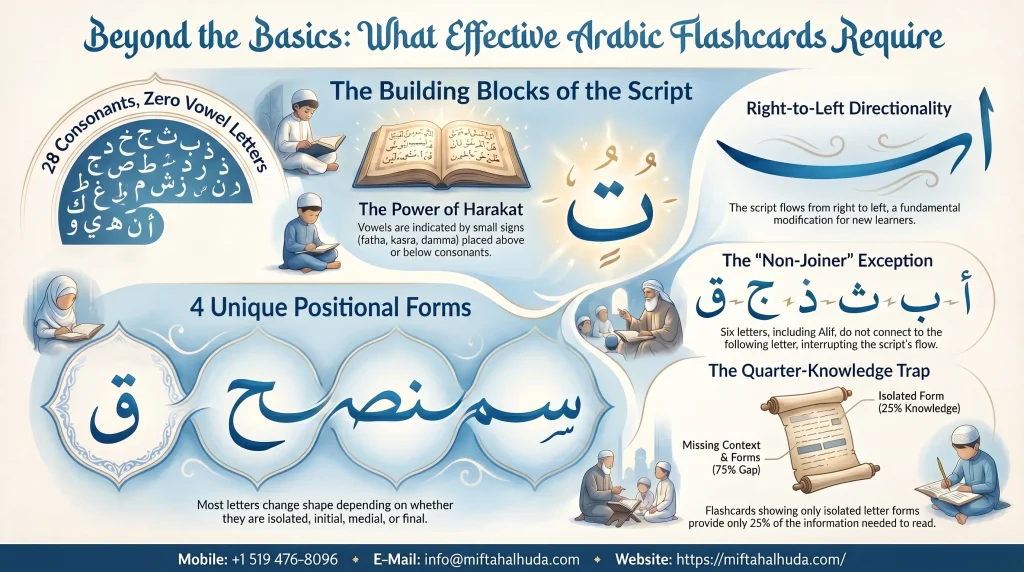
However, before making any assessment about the alif ba ta sa flashcards Arabic, one should first decide what they are to learn. In total, there are 28 letters in Arabic, all of which are consonants.
In Arabic, there is no separate letter for the vowel sound because it is marked with small signs over and under the consonants called harakat (fatha, kasra, and damma).
Another surprise for many students is the fact that most of the letters in Arabic have four forms depending on their position in a word, isolated, initial, medial, and final forms. Thus, ب (ba) may change slightly depending on its place in a word. A flashcard that only shows the isolated form of each letter is giving you roughly a quarter of what you need to read actual Arabic text.
The alphabet runs from right to left, as another independent modification. Then there are also six letters, among them the ا (alif), which do not join with the following letter, thus interrupting the flow. This is not meant to dissuade but merely to stress that the only truly useful flashcards are those that incorporate these modifications into their system, whereas the bad ones ignore them altogether.
What Good Alif Ba Ta Sa Flashcards Actually Include?
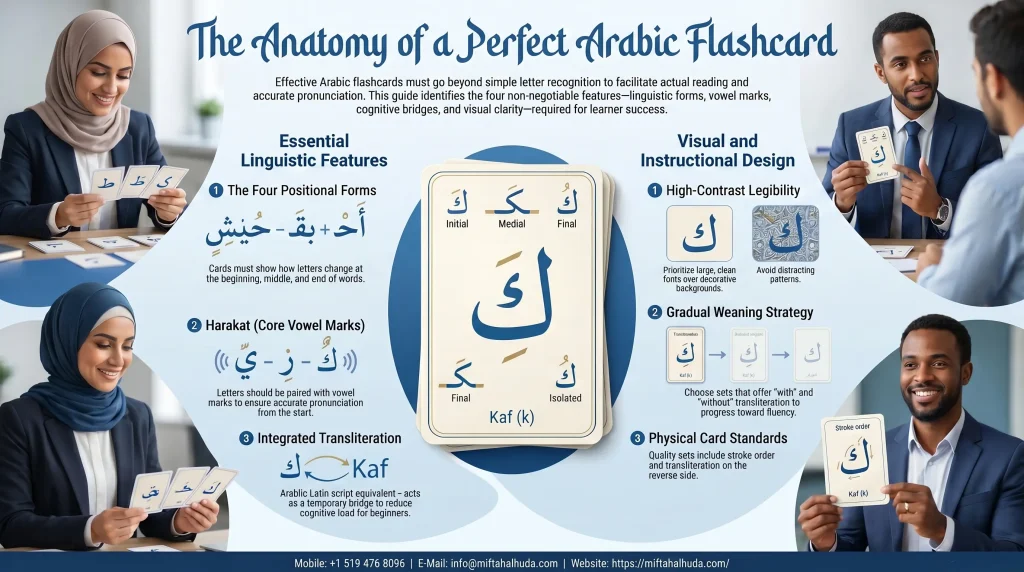
The Four Positional Forms, Not Just One
This is what is most crucial about the cards. Flashcards showing just the individual shapes of Arabic letters will facilitate recognition but not reading.
An aspiring reader must learn how the appearance of the letter ت (ta) changes when it is used at the beginning of a word as opposed to its use within a word. The difference can be very pronounced, and learning about this difference by experiencing it within a word is disorienting.
Physical sets from publishers include all four positional forms on the reverse side of each card, alongside stroke order and English transliteration. That kind of card is worth the extra cost for adults.
Harakat (Vowel Marks) Alongside Each Letter
Good alif ba ta sa flashcards Arabic sets for beginners show each letter paired with its three core harakat, so you learn to hear the letter as bA, bI, and bU right from the start, not just as an abstract shape.
This matters enormously for pronunciation accuracy. Picking up mispronunciation habits in the first month is genuinely hard to correct later, and it happens regularly when learners skip vowel-mark practice.
Transliteration in Latin Script
Transliteration is a bridge, not a destination. For adult English-speaking beginners, having the sound of each letter written out in familiar letters (for example, “ba,” “ta,” “tha”) removes one layer of cognitive load during the early weeks.
Over time, you rely on it less. Sets that offer a “with transliteration” and “without transliteration” option give you the flexibility to wean yourself off it gradually, which is a more realistic learning progression than removing it immediately.
Clear Visual Design and High Contrast
Arabic script is elegant but compact. Cards with small font sizes, low-contrast color choices, or decorative backgrounds that compete with the letter shape create unnecessary reading difficulty.
The letter should be immediately visible, large, high-contrast, with clean lines. This sounds obvious, but a significant number of printable and physical sets prioritize aesthetics over legibility.
How to Actually Use Flashcards So the Letters Stay?
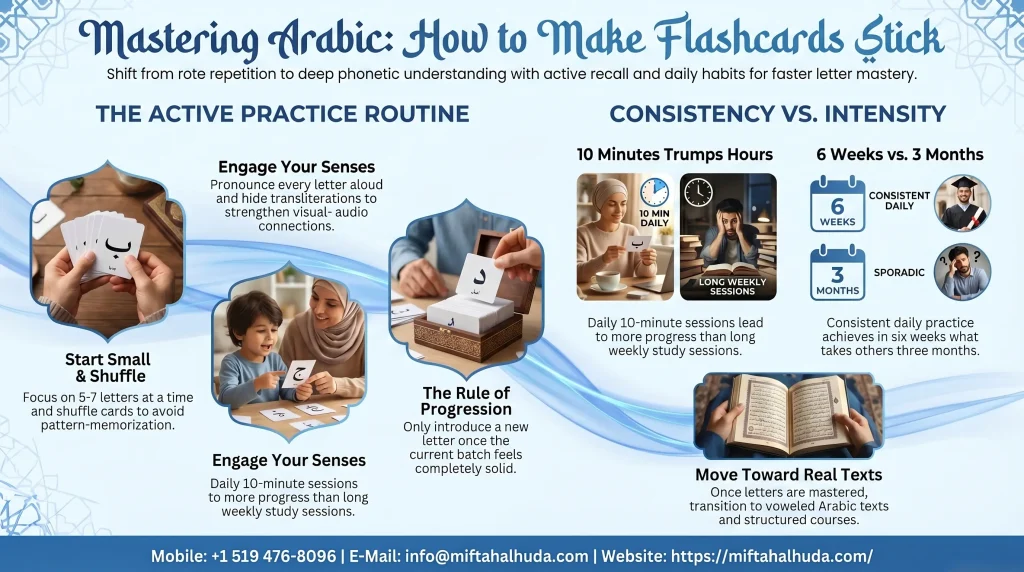
Most people who use Arabic flashcards without seeing results are using them the same way every session: front to back, same order, same context. The letter recognition that builds from this kind of practice is shallower than it feels. You start to recognize the card rather than the letter.
A few adjustments make a significant difference. Start sessions with a small group, five to seven letters rather than all twenty-eight. Add a new letter only when the existing ones feel solid. Shuffle frequently. Cover the transliteration part right away, regardless of how hard it is for you to do. Also, pronounce every letter you flip over since Arabic is a phonetic language and you are essentially training the relation between the way it looks and sounds.
Many people discovered that short but frequent practice sessions (ten to fifteen minutes) work better than longer ones done only once a week. The family I know, including grown-ups who were learning Arabic together, progressed more in six weeks of using daily ten-minute card sessions than in three months of learning at weekends only. It all boils down to consistency, the factor underestimated by many.
There comes a time when the flashcards will serve their purpose and it will be time for the real thing: learning short texts in voweled form and gradually progressing to Arabic. This is where a teacher or structured course becomes valuable in a way that no flashcard set can replicate.
After the Flashcards, Where Most Beginners Stall?
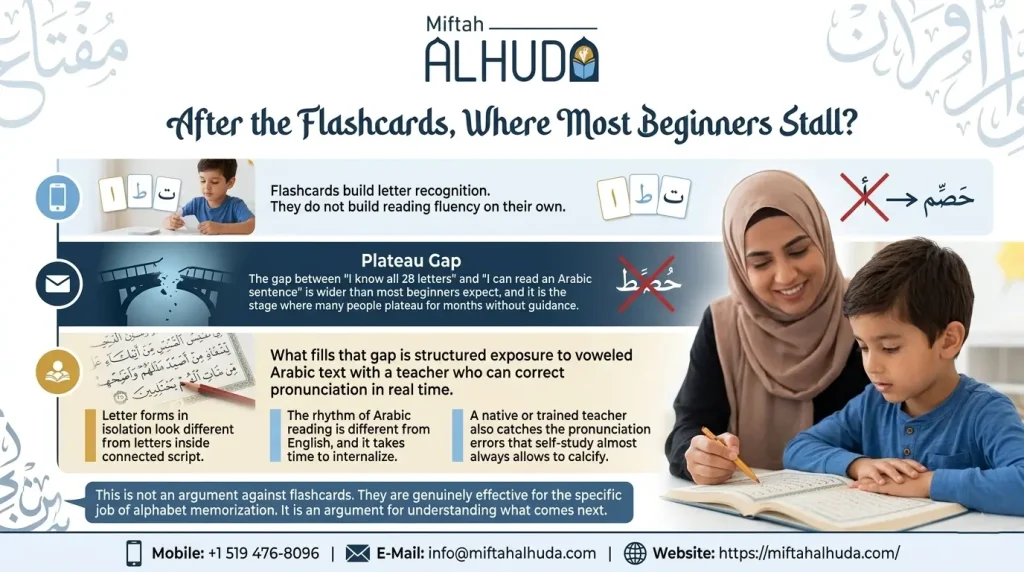
Flashcards build letter recognition. They do not build reading fluency on their own. The gap between “I know all 28 letters” and “I can read an Arabic sentence” is wider than most beginners expect, and it is the stage where many people plateau for months without guidance.
What fills that gap is structured exposure to voweled Arabic text with a teacher who can correct pronunciation in real time. Letter forms in isolation look different from letters inside connected script. The rhythm of Arabic reading is different from English, and it takes time to internalize.
A native or trained teacher also catches the pronunciation errors that self-study almost always allows to calcify.
This is not an argument against flashcards. They are genuinely effective for the specific job of alphabet memorization. It is an argument for understanding what comes next.
Ready to Go Beyond the Alphabet?
If you’ve got the letters down and want to move into real Arabic reading and speaking with a teacher, Miftah Alhuda’s Intensive Arabic Course is built for beginners who are serious about making fast, structured progress. Enroll today.
Not sure if it’s the right fit? Book a free trial session and see for yourself before committing.
Contact Us
WhatsApp: +1 519 476-8096
E-Mail: in**@**********da.com
Facebook: https://www.facebook.com/MiftahAlhudaOfficial
Instagram: https://www.instagram.com/miftahalhudaa
Youtube: https://www.youtube.com/@MiftahAl-huda
Tiktok: https://www.tiktok.com/@miftahalhuda00
Frequently Asked Questions
1. How many letters are there in the Arabic alphabet?
There are 28 letters in the Arabic alphabet, and all of them are represented by consonants only. The vowel sounds are not letters but rather marks placed above or under letters.
2. Are alif ba ta sa flashcards useful for adults learning Arabic, or only for children?
Adults can use alif ba ta sa flashcards as long as the set consists of all four forms of every letter along with vowel marks (harakat). Children’s sets usually lack these characteristics, so adult learners need to choose appropriate Flashcard decks that would facilitate their Arabic learning process.
3. What is the best flashcard deck of the Arabic alphabet?
It is recommended that each letter in the set have four forms (isolated, initial, medial, and final); it should contain the vowel marks as well. Besides, font size should be clearly visible. It is better if the cards have transliterations on the back or at least allow transliterations to be included.
4. Can I learn Arabic with flashcards alone?
Flashcards are effective for alphabet memorization, but reading connected Arabic script requires additional practice with voweled texts and ideally some feedback on pronunciation. Most learners find they need a course or teacher after the alphabet stage to avoid stalling.
5. What is the difference between alif ba ta and the full Arabic alphabet?
Alif (ا), ba (ب), ta (ت), and sa/tha (ث) are simply the first four letters of the Arabic alphabet in sequence. “Alif ba ta” is the Arabic equivalent of “ABC” in English, a shorthand way of referring to the alphabet from its opening letters.
6. How long does it take to memorize the Arabic alphabet with flashcards?
Most consistent beginners can recognize all 28 letters within two to four weeks using daily 10-15 minute sessions. Learning all four positional forms and reading connected words typically takes longer, closer to two to three months of regular practice.
Conclusion
There is a version of learning Arabic that stops with the flashcards. Letters memorized, transliteration committed to memory, a kind of comfortable surface-level familiarity that never quite turns into reading. A lot of people stay there for years without realizing it.
The alphabet is the foundation, not the goal. What it unlocks, reading the Quran in its original script, understanding spoken Arabic, building vocabulary that actually sticks, requires crossing from letter recognition into real language use. That transition is harder to make alone than most learning resources admit.
Flashcards are worth the investment of time. They are genuinely the right tool for the first stage. But they are a beginning, not a solution.