

You’ve been staring at those four letters for a while now. Alif. Ba. Ta. Sa. You can name them. You can probably write them from memory. But when you sit down to read an actual line of Arabic text (even a short one) something slows you down in a way that feels harder to explain than you expected. Therefore you start searching for an alif ba ta sa reading practice Arabic videos.
Most beginner resources sorta stop at recognition, they give you the shape, the tone, and then kind of leave this gap where the real reading practice should be. Like, you get stuck there, because they do not properly prepare you for the moment where recognition and reading have to click together, at speed, across a connected script you are still not fully comfortable with.
This guide is basically about closing that gap, kind of, and then moving on. It goes over the first letters of the Arabic alphabet, alif ba ta sa, but not in a super formal way, rather it stays with practical reading exercises. Like, you learn how to practice syllables, how to train your eye to glide through the text, and how to build the kind of reading fluency that doesn’t hiccup each time you meet an unfamiliar word form. It’s more about steady rhythm than memorizing everything at once.
Why alif ba ta sa Four Letters Trip Up Beginners More Than Expected?
Alif, ba, ta, and sa seem straightforward at first because they come early, they’re taught together, and they feel like a manageable starting point. That familiarity can actually work against you.
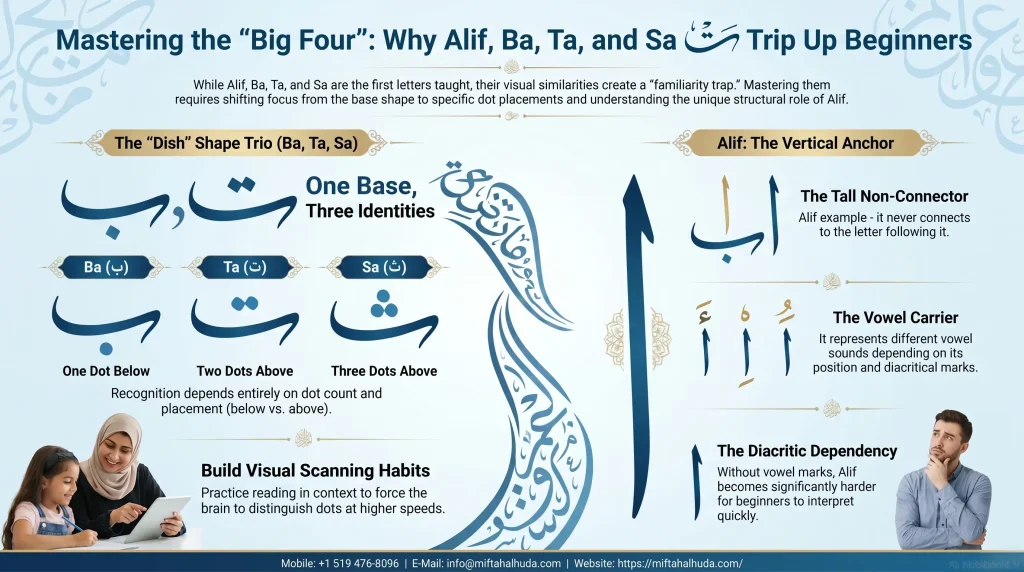
Ba, ta, and sa all share the same base shape: a shallow, horizontal dish. What changes is only the number and placement of dots.
- Ba has one dot below
- Ta has two dots above
- Sa has three dots above
For a new reader, this distinction demands attention at the dot level, not just the letter level. When reading moves faster, dots get missed. That’s not a reading problem exactly, it’s a visual scanning habit that takes time to build. The fix isn’t reviewing the letters again; it’s more reading time with texts that force you to distinguish the three forms in context.
Alif sits in a different category. It’s one of the tallest letters in the Arabic script and doesn’t connect to the letter that follows it. Depending on its position and the diacritics around it, it can represent different vowel sounds or act as a long vowel carrier. In beginner texts with full diacritical marking, alif is actually the easiest of the four to read correctly. Without those marks, it becomes one of the harder letters to interpret quickly.
The First alif ba ta sa reading practice Arabic Skill: Moving from Letters to Syllables
Letter recognition is the starting gate. Syllable reading is the first real track.
Arabic syllable practice means pairing a consonant with a short vowel diacritic (harakat) to produce a simple sound unit. For beginners practicing alif ba ta sa reading, the most useful early combinations look like this:
- Ba + fatha (short “a” above) = بَ (ba)
- Ba + kasra (short “i” below) = بِ (bi)
- Ba + damma (short “u” above) = بُ (bu)
- The same pattern applied to ta and sa
This sounds almost too simple to bother with, and a lot of adult beginners skip it because it feels like a children’s exercise. That skip tends to cost them later. Syllable reading is where the connection between shape and sound gets automated, and that automation is exactly what fluent reading depends on. A reader who has to consciously decode each letter will always read slowly. Someone who has drilled syllables until the combinations are instant will read at a fundamentally different pace.
The Noorani Qaida is the most well-known resource for this kind of practice. It was built specifically for this stage: moving from isolated letters to syllable combinations to short words, with the kind of repetition that actually trains the reading reflex rather than just informing it.
What Good Alif Ba Ta Sa Reading Practice Actually Looks Like?
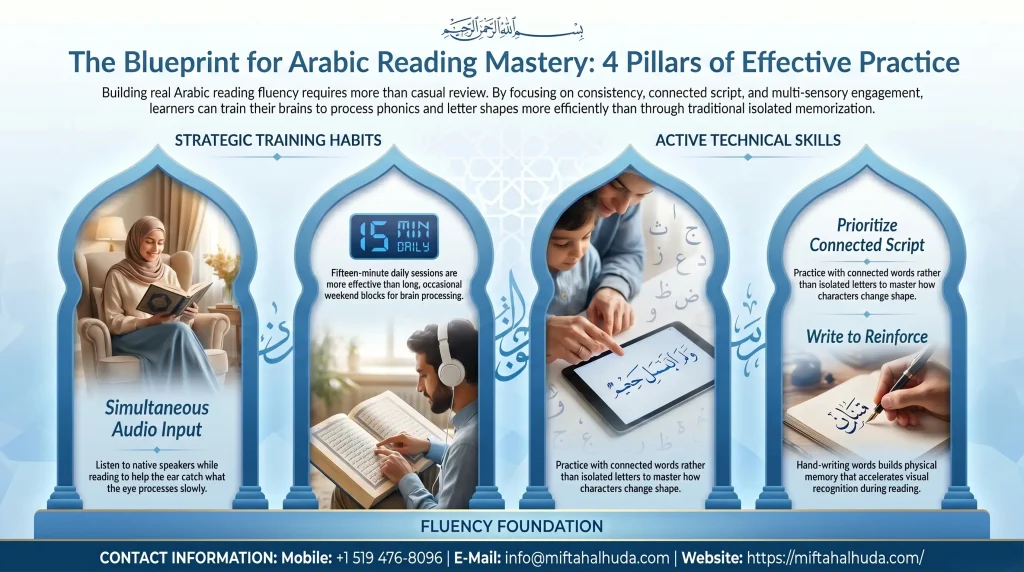
Practice that builds real reading ability has a few specific features that casual review doesn’t.
Short daily sessions beat long occasional ones
A fifteen-minute period of concentration practicing reading six days a week is far better than a two-hour period of practice during the weekend. This is because the brain processes phonics in sleep, and the timing of practice is more important than the amount practiced at one time. Most beginners do the opposite; they do heavy reviews before forgetting what they have learned.
The text has to be harder than the letters you already know
Reading through lists of isolated letters doesn’t build reading fluency because isolated letters aren’t what you encounter when reading actual Arabic. The challenge of reading comes from connected script, from letters changing shape based on their position, and from your eye needing to process a full word rather than a single character. Good reading practice uses short connected words (even very simple ones) from the earliest stage possible.
Listening while reading accelerates everything
Playing audio of a native speaker reading the same text you’re practicing with gives your brain two inputs simultaneously. The ear catches what the eye is still processing too slowly. Most beginners treat listening and reading as separate activities. Combining them, especially at the syllable and short-word stage, is one of the more efficient methods available. It also helps with sa specifically, which is a sound that English speakers tend to flatten or approximate until they’ve heard it enough times to hold the correct tongue position.
Write what you’re reading, not just what you’re copying
Handwriting practice that follows alif ba ta sa reading practice Arabic (rather than replacing it) reinforces letter recognition in a way that looking at text doesn’t. The movement of writing alif, ba, ta, and sa in their connected forms builds a physical memory of how the letters sit in relation to each other, which feeds back into how quickly you recognize them when reading.
How Diacritics Change the Reading Task?
One of the bigger differences between beginner Arabic texts and more advanced ones is the presence or absence of diacritical marks. These are the small symbols placed above and below letters to indicate the short vowel sounds.
Fully vowelized text (where every short vowel is marked) is what most beginner learning materials use, and for good reason. It tells the reader exactly what sound to produce for each letter. No guessing. No ambiguity.
Unvowelized text is what most real Arabic writing looks like, and it requires the reader to infer missing vowels from context, grammar, and familiarity with common words. That’s a different and considerably harder skill.
For alif ba ta sa practice specifically, beginners should stay in fully vowelized text long enough to make the basic sound-letter mappings automatic. Moving to unvowelized text before that stage is solid tends to reinforce guessing habits rather than actual reading skills.
A lot of self-study learners push past vowelized text too quickly because it feels like a beginner stage they want to graduate from. It is a beginner stage, but the skills built there matter more than they look like they do from the outside.
Common Mistakes That Slow Down Arabic Reading Progress
Even with consistent practice, certain patterns tend to hold beginners back longer than necessary.
- Reviewing letters instead of reading words, going back to isolated letter study after forgetting feels productive but often delays the shift to actual reading.
- Skipping unfamiliar words rather than slowing down to decode them, speed is built through difficulty, not around it.
- Treating reading and memorization as the same thing, knowing the name of a letter and being able to read it in connected text are genuinely different abilities.
- Practicing the same familiar text repeatedly instead of introducing new material, fluency develops through volume and variety, not through perfecting a single page.
One thing worth knowing is that, around the four or five week mark of steady practice, a lot of beginners kind of hit a wall, and it feels like regression even if they’re doing everything right. The letters look familiar but the reading is still kind of slow, and that slowness can be frustrating enough that some folks take it as a sign they’re not really progressing.
It’s real and it’s a natural part of the development of the reflex to read. Just because it’s happening doesn’t mean that you have to regress back to zero. Instead, it means that another level of automatic response is being established, and this can take several additional weeks of regular exposure to text until that happens.
Ready to graduate from learning on your own and develop full fluency in reading Arabic in a structured manner? The Intensive Arabic Course at Miftah Alhuda provides a step-by-step Arabic training program for beginners, with professional teachers helping you learn to read starting from scratch. Try it now.
Still hesitant? Take a free trial class and decide after.
Contact Us
WhatsApp: +1 519 476-8096
E-Mail: in**@**********da.com
Facebook: https://www.facebook.com/MiftahAlhudaOfficial
Instagram: https://www.instagram.com/miftahalhudaa
Youtube: https://www.youtube.com/@MiftahAl-huda
Tiktok: https://www.tiktok.com/@miftahalhuda00
Frequently Asked Questions
Q: How much time would I need to learn alif ba ta sa for reading in Arabic?
It shouldn’t take you more than a couple of days to recognize alif, ba, ta, and sa. Learning to read them fluently in texts may take a while, probably a few weeks. It is worth noting that recognition and reading are two separate processes and the latter will definitely require more time than many sources claim.
Q: Is it possible to learn to read in Arabic alone using only online sources?
There are no problems in making real progress in learning to read by yourself if you use proper teaching aids for letters recognition and simple syllables. Where you will face difficulties is in pronunciation, which requires native speakers’ feedback. Pronunciation of sounds such as sa is something to pay extra attention to.
Q: Why do ba, ta, and sa look so similar to me?
Because they share the same base shape and are distinguished only by dots. This is one of the more disorienting features of Arabic script for new learners, and it’s normal to confuse them initially. The fix is more reading time with connected text, not more review of isolated letters. The distinction becomes automatic once your eye has seen the three forms enough times in real words.
Q: Should I learn to write the letters at the same time as reading them?
Writing supports reading, particularly for the connected forms of letters that change shape depending on their position in a word. It’s worth doing both together, but writing practice should follow reading sessions rather than replace them. Spending an entire study session writing without any reading slows the development of fluency.
Q: Is it normal to still read slowly after learning all the letters?
Very normal. Knowing the letters and reading fluently are separated by weeks or months of text exposure, not just letter review. Reading speed in any script develops through volume, and the early stage of connected Arabic reading is slow for almost everyone, including people who are progressing well.
Q: Which is the most effective way to begin reading alif ba ta sa?
The Noorani Qaida is the most systematic method to start with when it comes to practicing reading in Arabic, as it involves syllables and short sentences, complete with accurate pronunciations. With constant practice and exposure, you will be able to develop your reflexes to read naturally.
What Fluent Reading Actually Requires
There’s a version of this process that people imagine when they start: learn the letters, practice them, and then reading Arabic is just a matter of going letter by letter until it speeds up. That version is partially right. The letter stage matters, and it has to be done carefully. But reading fluency is something that happens after the letter stage, not during it.
What the reading reflex actually depends on is pattern recognition at the word level, not the letter level. The fluent Arabic reader is no more analyzing individual letters than a fluent English reader does. Instead, they recognize whole-word forms, complete familiar patterns rapidly, and read slowly only when encountering new information.
To move from reading individual letters to this level of fluency requires patience and volume, much more than most beginner courses actually train you in. The positive news is that this progression has a clear recipe: daily practice with texts that are completely vowelled, beginning simply and building slowly to greater complexity.
The tricky part is knowing how long it will take until the process begins moving faster on its own. The average person working through their material every day will hit some sort of threshold at somewhere between the eight and twelve-week mark of reading. Not necessarily fluent reading yet, just the beginning of an important transformation.