

You are reading a surah you have recited dozens of times, and something still feels off. The words are correct. The vowels are right. But there is a particular letter that keeps landing wrong, the Raa Saakinah Rule in tajweed, it’s heavier than it should be in some places, lighter in others.
And because no one told you this distinction existed, you have been making the same mistake quietly for years without knowing it.
That letter is ر, the Raa. And the particular difficulty that all non-native Arabic speakers face is not simply the letter Ra’a but the Ra’a saakinah, the silent Raa without any vowel of its own, so that the way it sounds becomes entirely dependent on the letters around it. It is no superficial change, this understanding of the Ra’a saakinah rule, for this is one of the cornerstones of Tajweed.
Most learners encounter one half of the rule (usually the heavy version, Tafkheem) and assume the work is done. This article focuses on the other half: Tarqeeq, the light Raa, when it applies, why it applies, and how to train yourself to hear and produce the difference.
What Raa Saakinah Rule in tajweed Actually Means?
Before getting into conditions, it helps to understand what “Saakinah” means in this context.
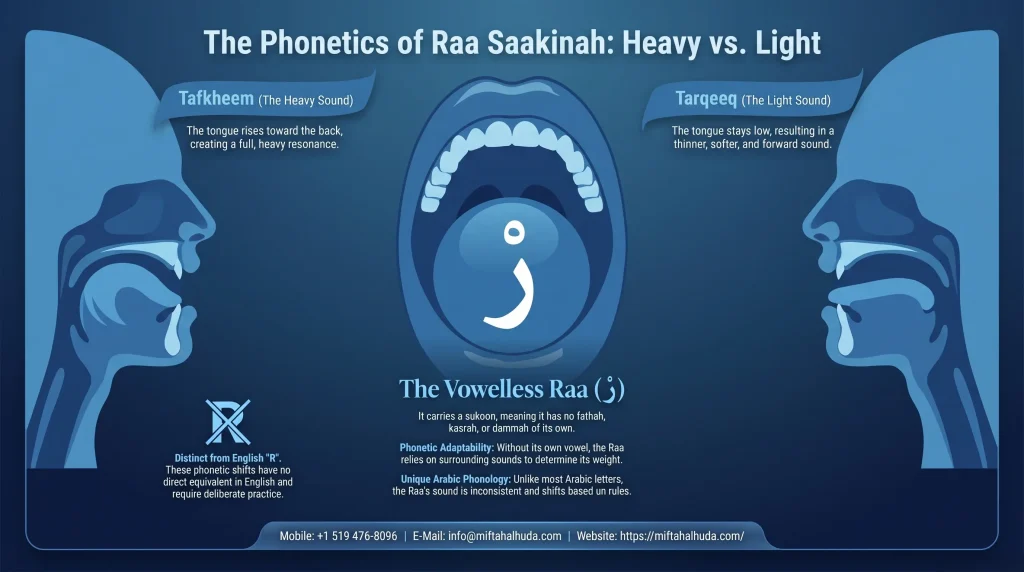
The Raa Saakinah (رْ) is the letter ر when it carries a sukoon, meaning it has no vowel (no fathah, no kasrah, no dammah) of its own. When a letter has no vowel, it does not produce its own phonetic weight. That means the surrounding vowels take over and determine how the Raa sounds.
In Arabic phonology, the Raa is categorized as a letter that can be either heavy (Tafkheem) or light (Tarqeeq) depending on its environment. This is different from most Arabic letters, which stay consistent. The Raa shifts, and Tajweed science maps exactly when and why.
Tarqeeq produces a thinner, softer sound. The back of the tongue stays low, the resonance stays forward, and the Raa comes out clear and light. Tafkheem does the opposite: the tongue rises toward the back of the mouth, and the Raa fills with a heavier, fuller resonance.
For non-Arabic speakers, this distinction takes deliberate practice because English has no equivalent phoneme. The English “R” sits in its own category entirely.
The Three Conditions That Make Raa Saakinah Light
This is the core of the Raa Saakinah Rule in tajweed. There are three main situations where the Raa Saakinah must be pronounced with Tarqeeq:
When the Letter Before It Has an Original Kasrah
If the Raa is Saakinah and the letter directly before it carries a kasrah (ِ), the Raa is recited lightly. The kasrah must be original, meaning it is genuinely part of the word, not a temporary kasrah added to break a cluster.
This can be illustrated by taking the case of the word وَاسْتَغْفِرْهُ (wastaghfirhu), where the letter preceding the letter Raa is given kasrah. This means the letter Raa is light in this case. Another example, which is commonly used for the teaching of Tajweed, is the word فِرْعَوْن (Fir’awn) the kasrah on the Fa makes the Raa that follows it light.
The key word here is “original.” This matters because there are cases in the Quran where a kasrah appears on a Hamzat al-Wasl only when starting recitation. In that specific situation, that kasrah is considered non-original, and the Raa is actually pronounced heavy, not light.
This is one of the exceptions students often find confusing, and it is worth working through slowly with a teacher rather than trying to self-correct from a chart alone.
When the Raa Is Preceded by a Ya’ Saakinah (يْ)
If the Raa Saakinah comes after a Ya’ Saakinah, meaning the letter before the Raa is a yaa carrying a sukoon (يْ), the Raa is recited with Tarqeeq.
In this case, the most common example that scholars of Tajweed mention is the word خَيْر (khayr) which means “good.” The reason for this is that when stopping on this word (waqf), the letter ر (Ra’a) is pronounced in its soft form because it comes after the letter ي (Ya’), which is also Saakin. Another example used widely is the word قَدِيرٌ (qadeer).
This condition particularly applies in waqf situations, which is worth noting. When you stop at the end of an ayah, words that end in a voweled Raa become Saakinah momentarily, and if a Ya’ Saakinah precedes them, the light rule applies at that pause.
When the Raa Itself Carries a Kasrah
This condition is actually about the Raa Mutaharrikah (a Raa with its own vowel), but it connects directly to understanding the Saakinah rule. If the Raa carries a kasrah on itself, it is always light, without exception. An example is the word شَرِّ (sharri) from Surah Al-Nas: the kasrah on the Raa makes it soft and clear.
Exceptions That Require Extra Attention
The Raa Saakinah Rule in tajweed has a small number of exceptions that override the Tarqeeq conditions above. Knowing these protects you from overcorrecting.
If the Raa Saakinah follows a kasrah but is directly followed by one of the Isti’la letters (خص ضغط قظ) within the same word, the Raa becomes heavy. The presence of an Isti’la letter overrides the kasrah effect.
There are five specific words in the Quran that fall into this category. Most Tajweed teachers introduce these words early (before the general rule) because knowing the exceptions first helps the general rule stick better afterward.
The word مِصْر (Misr, meaning Egypt) is a case where both Tafkheem and Tarqeeq are permitted, depending on whether you are pausing or continuing. When pausing on the word, both readings are acceptable. Scholars differ slightly here, and both positions are grounded in transmission.
Watch the Rule in Action
Before moving further into practice, it helps to hear the distinction being modeled. Watch this short video where the Raa Saakinah Tarqeeq rule is demonstrated with Quranic examples:
Why Tarqeeq Matters More Than You Think?
There is a verse in Surah Al-Muzzammil (73:4) where Allah commands: “and recite the Quran in measured, rhythmic tones” (Saheeh International). The Arabic word used, tarteel, refers to recitation that is both careful and beautiful, giving each letter its full due.
The Raa is one of the letters where this precision shows most clearly. A heavy Raa in a place that calls for lightness does not just sound off to trained ears, it actually changes the phonetic texture of the ayah.
Arabic is a language where the weight of a single letter carries meaning and rhythm, and the Raa is among the most dynamic in this respect.
For non-Arabic speakers learning Tajweed, the Tarqeeq of the Raa is also one of the rules where real improvement is audible quite quickly. Once the ear is trained to hear the difference, incorrect pronunciation of the Raa becomes immediately noticeable, in your own recitation and in others.
A note worth making for beginners: the goal at this stage is not perfection, but awareness. Many students I know who were reciting for fifteen years without ever having been taught this rule improved noticeably within weeks once they understood the conditions. The rule is not complicated, the application takes time.
Practical Tips for Training the Light Raa

Getting Tarqeeq right is partly a phonetic task and partly a listening task. Here are approaches that tend to work well for non-Arabic speakers:
- Listen before you practice. Find a recording of a proficient reciter, Sheikh Mahmoud Khalil Al-Husary is commonly recommended for clear Tajweed modeling, and specifically listen for the Raa in words you know meet the Tarqeeq conditions. Train the ear first.
- Work from Surah Al-Fatiha. This short surah contains examples of the Raa in different phonetic environments. Identifying the Raa in Al-Fatiha and practicing the correct weight for each is a focused starting point.
- Isolate the kasrah-Raa combination. Take a word like وَاسْتَغْفِرْهُ and practice saying the Raa very softly, almost without resonance. Then contrast it with a heavy Raa word like رَبّ. The difference in tongue position is what you are trying to internalize.
- Record yourself. This is uncomfortable, but it works. Many students cannot hear their own mispronunciation in real time. Playback makes the heavy/light distinction audible in a way that self-monitoring during recitation rarely does.
- Work through exceptions separately. The five Isti’la-letter exceptions are best memorized as a list, not derived from the general rule. Treat them as vocabulary, not logic.
There is only one thing that will actually speed this up for you, rather than all the techniques mentioned above, and it is practicing with a trained tutor who will correct you instantly.
For those who wish to learn how to properly implement the principle of “Raa Saakinah” in tajweed and get individualized training, Miftah Alhuda’s Tajweed For Adults Course provides instant live tutoring sessions with trained tutors.
For a no-commitment first step, book a free trial session and see how a live teacher can accelerate your recitation in ways no article can fully replace.
Contact Us
WhatsApp: +1 519 476-8096
E-Mail: in**@**********da.com
Facebook: https://www.facebook.com/MiftahAlhudaOfficial
Instagram: https://www.instagram.com/miftahalhudaa
YouTube: https://www.youtube.com/@MiftahAl-huda
TikTok: https://www.tiktok.com/@miftahalhuda00
Frequently Asked Questions
Q: What is the Raa Saakinah rule in tajweed?
The Raa Saakinah (رْ) is the letter Raa when it carries a sukoon, no vowel of its own. In Tajweed, it is pronounced either heavy (Tafkheem) or light (Tarqeeq) based on the vowels of the letters around it. The light rule, Tarqeeq, applies in three main situations: when the preceding letter has an original kasrah, when the preceding letter is a Ya’ Saakinah, or when the Raa itself carries a kasrah.
Q: How do I know if the kasrah before the Raa is “original” or not?
An original kasrah is one that belongs permanently to the word, it does not change depending on how you begin your recitation. A non-original kasrah is one added only to break a consonant cluster at the start, such as the kasrah sometimes heard on a Hamzat al-Wasl.
If the kasrah you see is on a Hamzat al-Wasl, the Raa that follows it is heavy, not light. This distinction is genuinely one of the trickier parts of the rule, and it comes up most clearly when practicing with specific Quranic examples rather than general definitions.
Q: Does Tarqeeq only apply when I pause on a word?
No, though waqf (pausing) does create additional Tarqeeq situations. The kasrah condition applies whether you are pausing or continuing.
The Ya’ Saakinah condition, however, is more commonly encountered at waqf, words like خَيْر and قَدِير show this rule most visibly when you stop on them. When continuing, the letters reconnect and the situation may change.
Q: What happens if the Raa Saakinah is followed by an Isti’la letter?
The Isti’la letters (the seven letters associated with elevation in Arabic pronunciation) override the kasrah effect. So even if the letter before the Raa has a kasrah, if the Raa is followed by one of the Isti’la letters within the same word, the Raa is pronounced heavy.
There are five such words in the entire Quran. Most Tajweed teachers advise memorizing these words directly as exceptions.
Q: Is it a major mistake if I accidentally pronounce a light Raa as heavy?
A consistent, uncorrected error in Tajweed is called Lahn, and it can affect the validity of recitation depending on severity. Pronouncing a light Raa as heavy is considered a Lahn Khafi, a subtle error, rather than a Lahn Jali (clear error that changes meaning).
It does not invalidate prayer, but it is worth correcting. The goal of Tajweed is to honor the language as it was revealed and recited by the Prophet (peace be upon him), and the Raa is one of the letters where that care shows.
Q: Can I learn the Raa Saakinah rule without a teacher?
You can learn the conditions from a written explanation, and this article gives you the framework. But applying the rule correctly in live recitation requires feedback.
The ear needs calibration that written descriptions cannot fully provide. A teacher who can model the sounds, correct your pronunciation in real time, and point you to specific Quranic examples will move you through this rule far faster than self-study alone.
The Letter That Teaches You to Slow Down
There is something worth sitting with about the Raa and why it behaves this way. Arabic is a language of roots and environments, a single consonant can carry different meanings and weights depending entirely on what is beside it. The Raa Saakinah is not the only letter that shifts based on context, but it is one of the most sensitive to it.
For non-Arabic speakers who are used to letters having fixed sounds, this takes adjustment. The English “R” sounds like one thing regardless of what surrounds it.
Learning to let the Raa be shaped by its context is, in a quiet way, also learning something about how the Quran is structured, it is not a static text to be decoded once and then read on autopilot. Every recitation asks for attention to the specific word, the specific vowel, the specific position.
Whether that attention eventually becomes second nature depends on time, practice, and honest correction. Most students find that it does. But the point at which the rules stop feeling like rules and start feeling like hearing, that transition does not come from reading about it.
Ready to unlock the deeper layers of Arabic grammar and Tajweed?
Understanding the Difference Between Sukoon and Jazm is a game-changer for fluently reading and understanding the Qur’an. Take your learning further with 1-on-1 personalized guidance from certified native teachers at Miftah Alhuda.