

You learned Arabic, got past the alphabet, and suddenly some person gives you the price tag, phone number, or the time, and you see that the numbers appear to be an entirely different subject.
This occurs with nearly all beginners who study Arabic. Learning the Arabic numbers constitutes one of the earliest useful steps in learning the language, and for most students it comes sooner than anticipated.
The difficult part isn’t even about the numbers. Most learners learn numbers 1 through 10 rather easily. What causes the real slowdown is the discovery that Arabic numbers have rules the textbook didn’t preview: gender agreement, a reversal pattern for 3 through 10, and two completely different numeral systems depending on the country. That’s a lot to land on someone who just wanted to count to twenty.
Trace the Number
٠
This guide will take you through the workings of the Arabic numbers system, beginning with the most important concepts and expanding on them until you have acquired knowledge of the recognition of Arabic numerals, how to count using Arabic numbers and the few grammar rules that confuse beginners.
The Two Number Systems You Need to Know
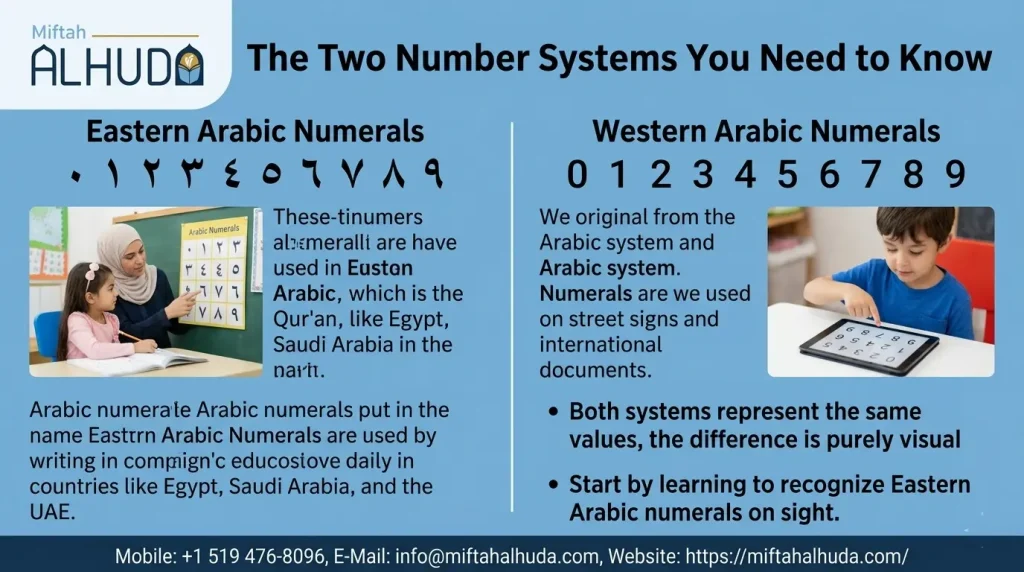
Prior to anything else, just take one thing into account about Arabic: Arabic employs two different numeral systems, both of which can be observed in practice.
One of these is the Eastern Arabic Numerals (or Arabic-Indic numbers), used in Arabic-speaking nations, in the Qur'an, and in virtually any piece of Arabic writing – ٠ ١ ٢ ٣ ٤ ٥ ٦ ٧ ٨ ٩. And these numbers will look completely foreign to you.
Another system of digits is the system that is already familiar to most people from Western cultures – 0, 1, 2, 3, 4, 5, 6, 7, 8, 9. And it's known as Western Arabic numbers. The ironic thing is, however, they originated from the Arabic numeral system itself. So in a quiet way, you already know Arabic numbers. You just didn't know where they came from.
For practical learning, here is what matters:
- Countries like Egypt, Saudi Arabia, and the UAE use Eastern Arabic numerals in everyday writing
- Street signs, digital displays, and international documents often use Western (0–9) numerals
- Both systems represent the same values, the difference is purely visual
Start by learning to recognize Eastern Arabic numerals on sight. You do not need to master writing them before you start speaking or listening. Recognition comes first.
Arabic Numbers 1 to 10 (The Real Starting Point)
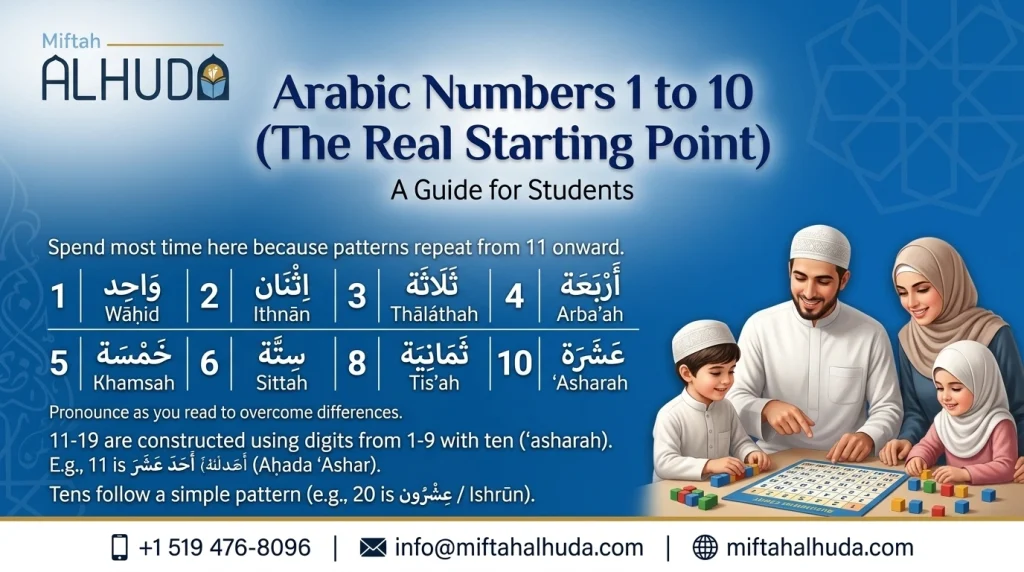
The first ten numbers in Arabic carry almost everything you need to build higher numbers. Spend the most time of learning the Arabic numbers here, because from 11 onward, patterns repeat.
Here are the cardinal numbers 1 through 10 in Modern Standard Arabic, with transliteration:
| Number | Arabic | Transliteration |
| 1 | وَاحِد | Wāḥid |
| 2 | اثْنَان | Ithnān |
| 3 | ثَلَاثَة | Thalāthah |
| 4 | أَرْبَعَة | Arba'ah |
| 5 | خَمْسَة | Khamsah |
| 6 | سِتَّة | Sittah |
| 7 | سَبْعَة | Sab'ah |
| 8 | ثَمَانِيَة | Thamāniyah |
| 9 | تِسْعَة | Tis'ah |
| 10 | عَشَرَة | 'Asharah |
Pronounce them as you read them through. There will not be any problem at all in overcoming the difference between reading and pronunciation after this step.
Learning The Arabic Numbers 11 to 20
The numbers 11-19 are constructed using the digits from one to nine with ten ('asharah). The number 11 is أَحَدَ عَشَرَ (Aḥada 'Ashar), 12 is اثْنَا عَشَرَ (Ithnā 'Ashar), and so on. This means you will only have to memorize the numbers from 1 to 10 and then combine them for the rest until 19.
Twenty is عِشْرُون (Ishrūn). Thirty is ثَلَاثُون (Thalāthūn). There is a pattern followed by the tens which makes it very easy to count till 100.
The Gender Rule That Confuses Almost Everyone
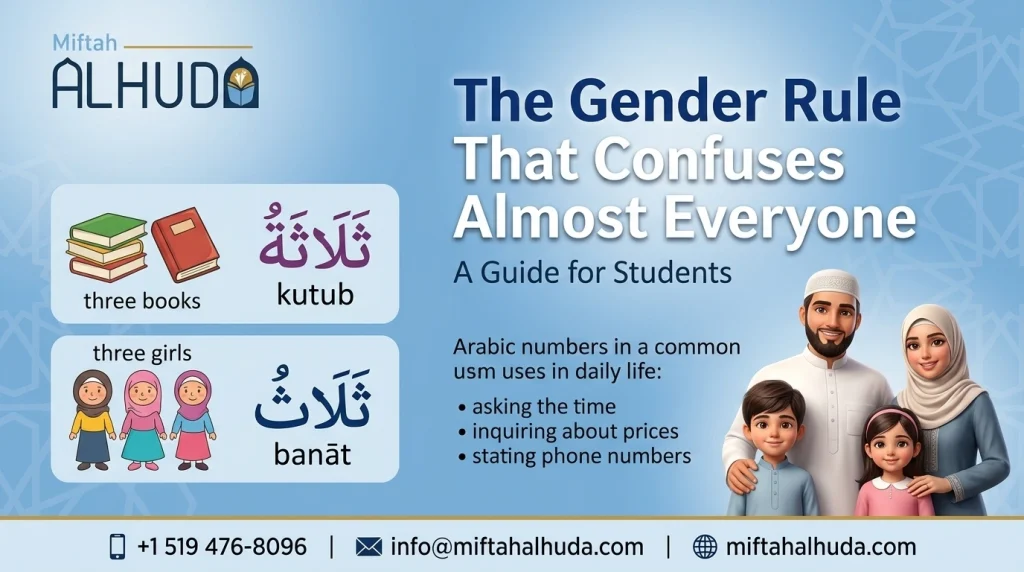
This is the section which most beginners' guides briefly touch upon and then proceed to ignore. And it definitely deserves more consideration.
- In the case of Arabic numbers 1 and 2, they match the gender of the nouns they modify. Numbers 1 and 2 will be in their masculine forms if the noun is masculine; they will be feminine if the noun is feminine. This seems reasonable enough.
- But from 3 up to 10, numbers behave differently. Gender polarity states that you use the opposite gender for numbers. When counting three masculine items, you will use the feminine gender for your number; counting three feminine items requires using the masculine gender.
- Thus, "three books" (kutub are masculine plural) would be ثَلَاثَةُ كُتُب (thalāthatu kutub), the number is feminine; while "three girls" (banāt are feminine plural) will become ثَلَاثُ بَنَات (thalāthu banāt), the number is masculine.
This sounds strange coming from English, and that is completely normal. The important thing to know early on is that this rule exists. Do not try to memorize every combination before you can count smoothly, just notice the pattern when it appears and come back to it once your number foundations are solid.
What "Counting in Arabic" Actually Looks Like in Daily Life?
Learning numbers by themselves is one thing, but learning where you see them used in daily language use is another.
- These are the typical circumstances a novice will encounter:
- Asking for the time: "What is the time?" translates to كَمِ السَّاعَة؟ (Kami al-sā'ah?). The response involves the use of ordinal numbers and fractions to state minutes.
- Inquiring about prices: كَمْ هَذَا؟ (Kam hāthā?) asks, "How much is this?" The merchant will respond with the price stated with a number and currency name.
- Stating your phone number: In Arabic, the number is read just like it would be read in English; each number separately.
- Announcing your age: عُمْرِيَ ثَلاَثُون سَنَة (Umrī thalāthūn sanah) means "My age is thirty years."
- Counting objects: The gender polarity rule applies here, though in casual speech, many Arabic speakers simplify it.
A student I know spent three weeks drilling the number list before trying any real-world application. She said that learning through the Arabic cooking video was achieved much quicker in two classes than by spending three weeks just memorizing tables. Learning in context is much more efficient than learning through practice alone.
How to Build a Practice Habit That Actually Sticks

Daily fifteen minutes is better than three hours at once on Sunday. This statement is not an attempt to motivate people; rather, it is an insight into how memory works while learning new vocabulary.
Here are the methods that work when learning the Arabic numbers:
Flashcards:
Both Anki and Quizlet give users the ability to make flashcards with Eastern Arabic numeral on one side and its pronunciation on the other.
Real objects at home:
Label items with their quantities in Arabic. Three books on your shelf. Two cups in the cupboard. This connects numbers to physical context.
Price practice:
When you see a price tag or receipt, convert the number to Arabic in your head. It takes just a few seconds to help ingrain the 1-100 scale into your memory.
Verbal counting:
Try counting your footsteps when walking and counting items when cooking. Counting in Arabic will become second nature through practice.
Listening to spoken Arabic:
Watch Youtube video channels, Arabic news segments, and even some child-oriented counting videos on Youtube will train your ears on the sound of numbers being said naturally, as opposed to their written form in tables.
The secret lies in keeping the time invested brief enough to ensure you don’t find the process burdensome. It is better to review twenty words per day with active memorization than two hundred words passively.
Ready to Learn Arabic the Right Way?
For anyone who is truly interested in acquiring an authentic understanding of Arabic language through a well-planned program, complete with teachers who are patient and lessons taught at times convenient to you, then the Intensive Arabic Course at Miftah Alhuda will suit your needs.
Still not convinced? Why don’t you sign up for a free trial lesson?
Contact Us
WhatsApp: +1 519 476-8096
E-Mail: in**@**********da.com
Facebook: https://www.facebook.com/MiftahAlhudaOfficial
Instagram: https://www.instagram.com/miftahalhudaa
Youtube: https://www.youtube.com/@MiftahAl-huda
Tiktok: https://www.tiktok.com/@miftahalhuda00
Frequently Asked Questions
Q: Are Arabic numbers hard to learn for English speakers?
The numbers themselves are manageable, most beginners get 1 through 10 within a few days. What makes it harder is the gender agreement system and the polarity rule for 3 through 10. Those take more time to internalize, but they are learnable with consistent practice.
Q: What is the difference between Eastern and Western Arabic numerals?
Western Arabic numerals are 0–9, which most of the world uses today. Eastern Arabic numerals (٠–٩) are used in Arabic-speaking countries and in Quran text. They represent the same values but look completely different. Beginners should learn to recognize both.
Q: Do Arabic numbers go right to left like Arabic text?
No. Although Arabic text is written right to left, Arabic numbers are read left to right, just like in English. So 25 is still read as "twenty-five," not "five-twenty."
Q: How long would it take me to master Arabic numbers from 1 to 100?
By allocating about 15 minutes per day for practicing Arabic numbers, it usually takes beginners between two and three weeks to be able to identify and write numbers from 1 to 100. However, using them correctly in a sentence in relation to gender will take you at least one to two months.
Q: Should I learn Modern Standard Arabic numbers or just those of a certain Arabic dialect?
It is advisable to start learning numbers in Modern Standard Arabic first. This is the basis that all Arabic dialects are based upon, and you would be able to understand them easily once you learn MSA numbers.
Q: Can I learn Arabic numbers through applications only?
While there is nothing wrong with learning the Arabic numbers via applications, they cannot help you with learning how to use grammar such as gender polarity. You should learn them using applications along with other resources for optimal results.
Numbers Are the Beginning, Not the Goal
It is satisfying when, after a while of drilling, you suddenly see that number show up in an actual conversation, whether it’s on a price tag, in a comment on YouTube, or even when someone is talking. The experience comes much sooner than many beginners think it will, and once it does, the whole language seems different.
The Arabic numbers are not just about learning another bit of vocabulary. They represent the very first time that you recognize that the language is actually making its way into your head. The rules that seem abstract now, the gender polarity, the tens patterns, the two numeral systems, start to feel like a system once real exposure begins, and systems eventually become intuition.
Getting there takes time. It also takes the right structure around you. Without some guidance on the grammar, a lot of learners plateau in the "I can count but I cannot use numbers in a sentence" stage for longer than necessary.