

Everyone has moments when making the proper decision becomes tough. Whether we choose a spouse, accept a new job, start a business, pursue more education, or relocate to a new place, our decisions can have long-term consequences. Islam provides a lovely solution through Dua e Istikhara, a specific supplication in which believers seek Allah’s direction and place their trust in His infinite wisdom.
Rather than relying exclusively on our own understanding, we ask the One who knows what is best for us in this life and the next. In this guide, Miftah Al-Huda Academy will explain the meaning, importance, and proper way to perform Dua e Istikhara, helping you make decisions with greater peace, confidence, and faith.
What Is Dua e Istikhara?
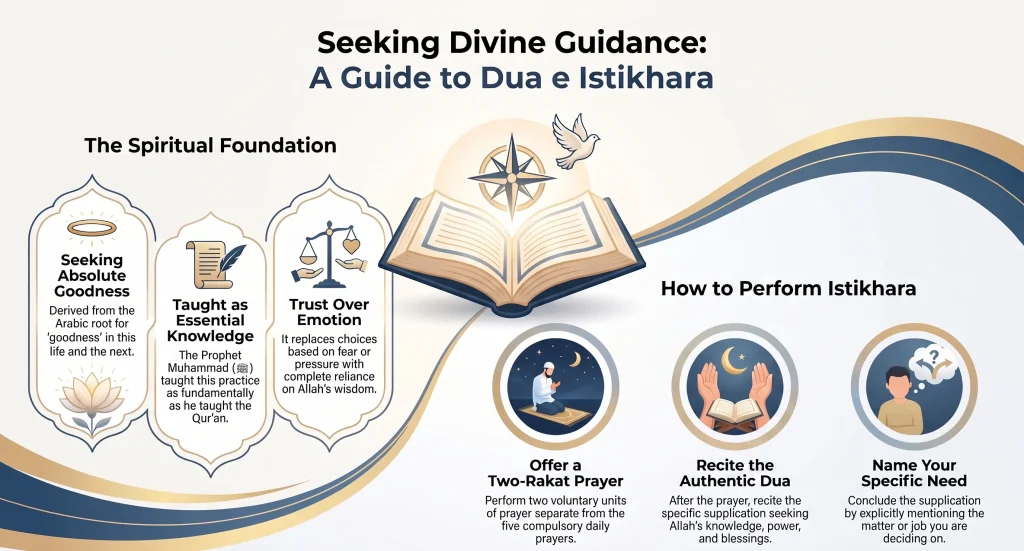
The Arabic word Istikhara is derived from the root meaning to seek goodness. In Islamic practice, it means asking Allah to guide us to what is best in both this life and the Hereafter.
The Prophet Muhammad (ﷺ) instructed his companions to practice Istikhara for important matters, just as he taught them Qur’anic chapters. This indicates how important it is in a Muslim’s daily life.
Rather than making choices based entirely on emotions, pressure, or fear, Muslims put their trust in Allah and use the means He has given them.
The Authentic Dua e Istikhara
Narrated Jabir bin `Abdullah:
The Prophet (p.b.u.h) used to teach us the way of doing Istikhara in all matters as he taught us the Suras of the Qur’an. He said, “If anyone of you thinks of doing any job he should offer a two rak`at prayer other than the compulsory ones and say (after the prayer): ‘Allahumma inni astakhiruka bi’ilmika, Wa astaqdiruka bi-qudratika, Wa as’alaka min fadlika Al-`azlm Fa-innaka taqdiru Wala aqdiru, Wa ta’lamu Wala a’lamu, Wa anta ‘allamu l-ghuyub. Allahumma, in kunta ta’lam anna hadha-lamra Khairun li fi dini wa ma’ashi wa’aqibati `Amri (or ‘ajili `Amri wa’ajilihi) Faqdirhu wa yas-sirhu li thumma barik li Fihi, Wa in kunta ta’lamu anna hadha-lamra shar-run li fi dini wa ma’ashi wa’aqibati `Amri (or fi’ajili `Amri wa ajilihi) Fasrifhu anni was-rifni anhu. Waqdir li al-khaira haithu kana Thumma ardini bihi.’
(O Allah! I ask guidance from Your knowledge, And Power from Your Might and I ask for Your great blessings. You are capable and I am not. You know and I do not and You know the unseen. O Allah! If You know that this job is good for my religion and my subsistence and in my Hereafter (or said: If it is better for my present and later needs) Then You ordain it for me and make it easy for me to get, And then bless me in it, and if You know that this job is harmful to me In my religion and subsistence and in the Hereafter (or said: If it is worse for my present and later needs) Then keep it away from me and let me be away from it. And ordain for me whatever is good for me, And make me satisfied with it). The Prophet (ﷺ) added that then the person should name (mention) his need. (Sahih al-Bukhari 1166)
Why Is Istikhara So Important?

One of the most significant benefits of Islam is that we never have to face life’s uncertainties alone.
Allah knows:
- What we can’t see.
- What will happen tomorrow?
- The unintended effects of each decision.
- What eventually benefits our religion and lives.
When we really perform the Dua e Istikhara, we accept that our knowledge is limited and Allah’s wisdom is faultless.
When Should We Perform Istikhara?
Istikhara is recommended whenever we are faced with a permissible decision with an uncertain outcome.
Typical situations include:
- Proposals for marriage.
- Career shifts.
- Collaboration between companies.
- Admission to university.
- Travel arrangements.
- Purchase of property.
- Relocating.
- Large financial investments.
- Accepting employment offers.
- Decisions made by the family.
Every significant halal decision can be a chance to seek Allah’s guidance.
How to Perform Dua e Istikhara?
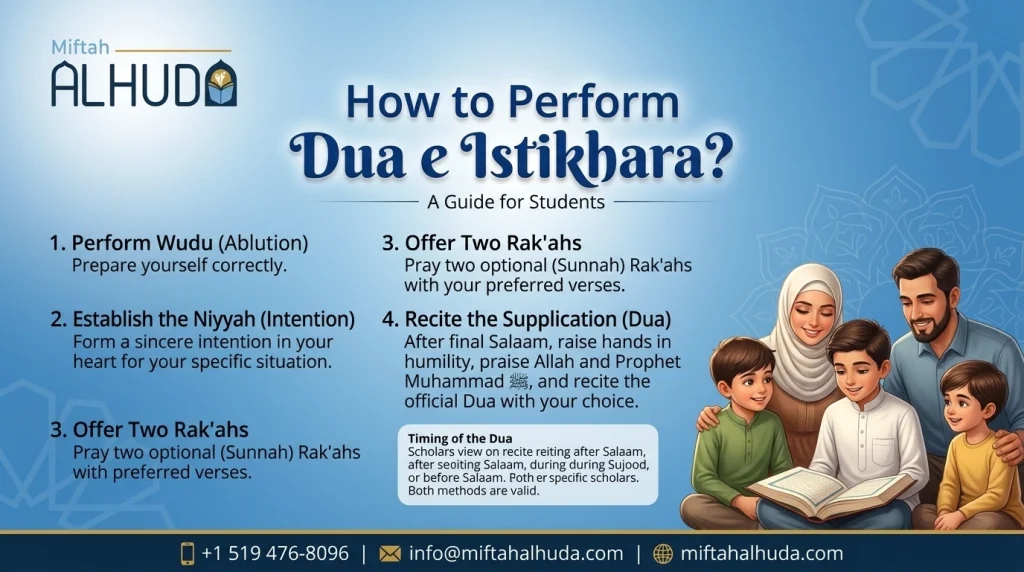
1. Perform Wudu (Ablation)
Prepare yourself by performing Wudu correctly, just as you would for any other prayer.
2. Establish the Niyyah (Intention)
Form a sincere intention in your heart to pray the Istikhara prayer for your specific situation. It is not mandatory to say it aloud.
3. Offer Two Rak’ahs
Pray two optional (Sunnah) Rak’ahs at any permissible time of the day or night (avoiding the disliked times of prayer). In each Rak’ah, recite Surah Al-Fatiha followed by any verses of the Quran you prefer.
4. Recite the Supplication (Dua)
After making the final Salaam to end the prayer, raise your hands in humility. Begin by praising Allah (SWT) and blessing the Prophet Muhammad ﷺ. Then, recite the official Dua of Istikhara with your specific choice.
The Timing of the Dua
The majority of Islamic scholars believe that the Istikhara supplication should be recited after the final Salaam of the prayer. Other scholars, however, believe that it is permissible to make the Dua during prostration (Sujood) or immediately before Salaam. Both methods are valid.

Do You Have to See a Dream?
One of the most common misconceptions is that Istikhara always results in dreams.
This is not supported by reliable Islamic evidence.
Some people have dreams after Istikhara, but many don’t. Neither situation affects whether Allah answered the prayer.
Alternatively, Allah may respond by:
- Making the decision easy.
- Closing specific opportunities.
- Creating unexpected challenges.
- Opening better alternatives.
- Bringing calm to the heart.
His guidance takes numerous different forms.
Signs That Allah Has Guided You
Many scholars indicate that guidance following Istikhara may manifest as:
- Increased ease
- Removal of barriers
- Inner tranquility.
- Positive circumstances
- Protection from bad choices.
Sometimes what looks to be a disappointment today turns out to be a tremendous blessing later.
Combine Istikhara with Consultation
Islam supports both Istikhara and Shura (consultation).
Before making major decisions:
- Seek advice from knowledgeable individuals.
- Study the matter thoroughly.
- Consider the practical impacts.
- pray Istikhara.
- Trust Allah wholeheartedly.
Faith and wisdom work together.
The Spiritual Benefits of Istikhara
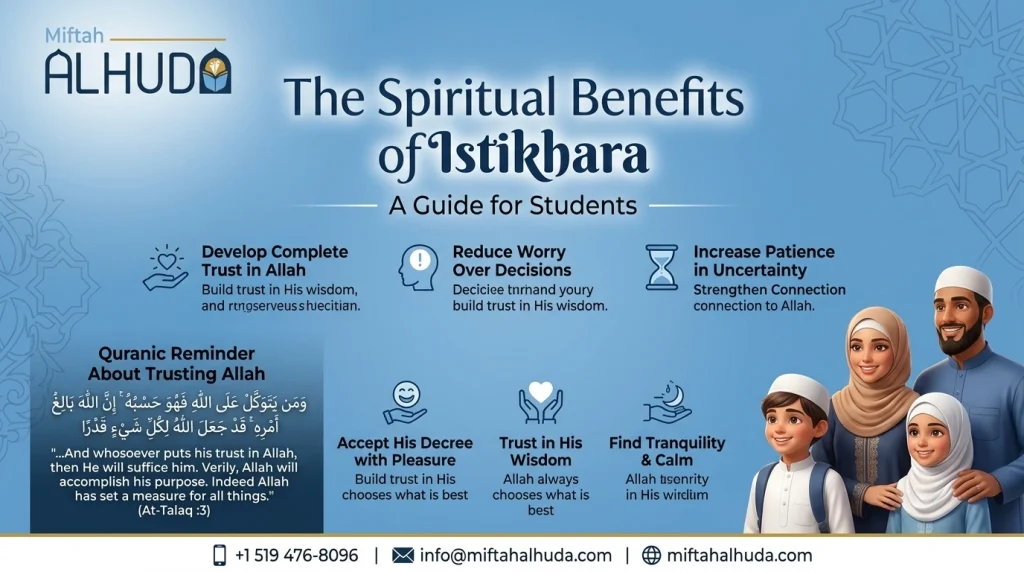
Regularly performing Istikhara improves a believer in a variety of ways.
It helps us:
- Develop complete trust in Allah.
- Reduce worry over challenging decisions.
- Increase your patience during uncertainty.
- Strengthen our connection with Allah.
- Accept His decree in pleasure.
- Build trust in His wisdom.
- Find tranquility, regardless of the outcome.
Every true Istikhara serves as a reminder that Allah always chooses what is best for His people.
Quranic Reminder About Trusting Allah
Allah says:
وَمَن يَتَوَكَّلْ عَلَى اللَّهِ فَهُوَ حَسْبُهُ ۚ إِنَّ اللَّهَ بَالِغُ أَمْرِهِ ۚ قَدْ جَعَلَ اللَّهُ لِكُلِّ شَيْءٍ قَدْرًا
“…And whosoever puts his trust in Allah, then He will suffice him. Verily, Allah will accomplish his purpose. Indeed Allah has set a measure for all things.“ (At-Talaq :3)
This verse beautifully expresses the essence of Istikhara. When we leave our issues to Allah after taking the necessary steps, we can move forward with confidence, knowing that His wisdom is superior to ours.
Discover Travelling Dua in Islam how invoking Allah’s protection and blessings can transform your journey into a peaceful, faith-filled experience.
Whether you are setting off on a long flight, heading out on a road trip, or commuting every day, learning the Travelling Dua connects you to a timeless Sunnah that brings safety, barakah, and peace of mind.
Read the full guide to discover:
-
The Authentic Meaning: Understand the powerful words and spiritual significance behind the supplication.
-
Key Spiritual Benefits: Learn how reciting the dua shields you from hardship and elevates your travel into an act of worship.
-
Exact Times to Recite: Master the ideal moments from stepping into your vehicle to returning home to earn continuous rewards.
👉 [Read the Full Article Now] to equip yourself with the blessings and protection of the Sunnah for your next journey!
Conclusion
Dua e Istikhara is more than a supplication; it is a lifelong practice that fosters trust, patience, and dependence on Allah. Every time we seek His guidance, we recognize that His knowledge is infinite and ours is limited.
By incorporating Istikhara into our decision-making, we learn to confront life’s uncertainties with confidence, knowing that whatever Allah chooses is ultimately the best outcome for us.
Equip yourself with the knowledge to make faith-driven choices. Learn the correct prophetic practices of prayer and supplication. Start your journey today with a Free Trial at Miftah Al-Huda Academy.
Contact Us
- WhatsApp: +1 519 476-8096
- E-Mail: in**@**********da.com
- Facebook: https://www.facebook.com/MiftahAlhudaOfficial
- Instagram: https://www.instagram.com/miftahalhudaa
- Youtube: https://www.youtube.com/@MiftahAl-huda
- Tiktok: https://www.tiktok.com/@miftahalhuda00
Frequently Asked Questions
1. Can I repeat Istikhara?
Yes, if uncertainty remains, many scholars agree to repeat it.
2. Can women perform Dua e Istikhara during menstruation?
They may recite the supplication and seek Allah’s guidance, but the two Rak’ahs of prayer are postponed until they are able to pray.
3. What if the outcome is different from what I hoped for?
Trust that Allah’s decision is ultimately best, even if its wisdom is shown only later.
4. Can I read the Dua from a paper or phone?
Yes, especially while you are learning it.
5. Is Istikhara only for major life decisions?
It is most usually used for major decisions, but it can also be utilized for other permissible situations when there is genuine uncertainty.