

Every year, Ramadan arrives and two kinds of Muslims meet it. The first stumbles in exhausted from an ordinary year, spends the first week adjusting, finds his rhythm around the middle of the month, and reaches the last ten nights just as his energy gives out. The second walks in ready: body trained, Quran habit running, dua list written, house prepared, and the whole month stretches before him like a field already plowed.
The difference between them is not piety or willpower. It is preparation, and preparation is a skill anyone can learn. The righteous generations called Rajab the month of planting, Sha’ban the month of watering, and Ramadan the month of harvest. This checklist is the planting and watering plan, drawn from the Sunnah and the practice of those who took the month seriously.
Ramadan 1448 is expected to begin around February 8, 2027. Working back eight weeks, the season of preparation opens in mid-December 2026. Here is everything to do, in order, before the crescent appears.
Why Preparation Is Half of Ramadan
The Prophet (ﷺ) taught us that deeds are judged by their endings, and every craftsman knows the ending depends on the setup. Ramadan is thirty days of intense worship dropped into a life that does not pause: work continues, children need school runs, bodies still need sleep. Whoever enters the month without rearranging that life spends Ramadan fighting it instead of living it.
Learn to read the Quran correctly — Start Learning Quran →Preparation also multiplies the worship itself. A dua made from a written list reaches further than a mind groping for words at iftar. A reader who built up to a juz a day in Sha’ban finishes the Quran; one who starts cold on the first night usually stalls by the second week. And a heart that spent two months repenting arrives at the month of mercy already soft.
Think of it the way athletes think of training camp. Nobody expects to win the race with the fitness of the sofa. Ramadan is the race; Rajab and Sha’ban are the camp.
Spiritual Preparation: Starting With the Heart
Everything on this checklist serves one goal: a heart that meets Ramadan clean and hungry for Allah. Start there.
Repent first. The months before Ramadan are the season of closing accounts. Take an honest inventory: the prayer you have been neglecting, the habit you would be ashamed to carry into the month, the money matter left unresolved, the person you have not spoken to. Fix what can be fixed now, and carry the rest to Allah in istighfar every night. The believer does not bring a clogged heart to the month of mercy.
Set your Ramadan intention early. Not the technical niyyah of fasting, which is settled each night of the month, but the direction of your Ramadan: what do you want this one to change in you? Write it down in one sentence. “This Ramadan, I become someone who prays Fajr on time forever.” A written intention survives the tired middle of the month; a vague feeling does not.
Write your dua list now. Three columns: your needs, your people, your akhirah. The fasting person’s dua is answered, the last third of the night is open, and the last ten nights are coming. Do not meet those moments empty-handed. The authentic supplications for every Ramadan moment are gathered in our Ramadan duas collection; learn the core five before the month begins.

Quran Preparation
Ramadan is the month of the Quran: “The month of Ramadan in which the Quran was revealed” (Surah Al-Baqarah 2:185). Jibril would review the Quran with the Prophet (ﷺ) every Ramadan, and in his final year they reviewed it twice (Al-Bukhari). The month without a Quran plan is a body without a spine.
Build the pace gradually. If you are starting from little, begin with ten pages a day in Rajab, raise to fifteen in early Sha’ban, and reach a juz (twenty pages) by the last week of Sha’ban. Entering the month already reading at Ramadan pace is the single strongest predictor of finishing a khatmah. Our Quran reading schedule for Ramadan gives the day-by-day plan, including catch-up rules for the days life interrupts.
Decide also what kind of reading Ramadan gets: fast completion, slow understanding with translation, or memorization. Each is noble; mixing them without a plan produces none. Beginners who struggle with recitation should use the month to fix the foundations with a teacher rather than forcing speed, and our online Qirat courses exist for exactly that.
Fasting Preparation
The body needs the month as much as the soul does.
Fast Sha’ban. The Prophet (ﷺ) fasted Sha’ban more than any other month, calling it a neglected month in which deeds are raised (An-Nasa’i). Mondays, Thursdays and the white days are the minimum structure; the details and the rules about the last two days are in our Sha’ban fasting guide.
Finish your make-up fasts. If you owe days from last Ramadan, they are due before the new one arrives. Aisha (may Allah be pleased with her) made hers up in Sha’ban (Al-Bukhari and Muslim). Count your days and schedule them early in the month.
Train the body’s clock. Shift bedtime earlier in half-hour steps starting in Rajab, and practice waking for suhoor at least once a week in Sha’ban. Ramadan’s first days hit hardest those whose sleep is still on winter time.
Ease off caffeine gradually. The first-morning headache of Ramadan is usually withdrawal, not hunger. Two weeks of tapering in late Sha’ban removes it entirely.
Check your health early. Anyone with diabetes, pregnancy, illness or regular medication should consult a doctor well before the month about whether and how to fast, and review the fiqh of who may delay or be excused in our Ramadan fasting rules guide.
Worship Routines to Build Before the Month
Ramadan worship stands on daily pillars, and each is easier to establish in a quiet month than inside the storm:
- The five prayers on time, every day, starting now. This is the foundation; nothing in Ramadan compensates for its absence.
- Two rak’ahs of night prayer after Isha or before sleep, so taraweeh and qiyam meet a body already used to standing.
- The morning and evening adhkar, memorized and daily. They take ten minutes and guard the whole day.
- A charity habit, small and weekly, so giving in Ramadan continues a rhythm instead of starting one.
- Friday sunnahs: Surah Al-Kahf, salawat on the Prophet (ﷺ), and the hour of dua before Maghrib.
None of these is large. Together, by Ramadan, they are the difference between a month you live and a month that happens to you.
Knowledge Preparation
Worship built on ignorance leaks reward. Every year, Muslims break fasts they could have kept, skip fasts they could have made, and argue over settled rulings, all for want of one evening of study. Before the month, review:
- What breaks the fast and what does not, in the fasting rules guide.
- The rulings of intention, especially for make-up and voluntary fasts, in the intention guide.
- The special cases: travel, illness, breastfeeding, which have their own detailed guides on the site.
- The fiqh of taraweeh, i’tikaf and zakat al-fitr, which arrive quickly once the month begins.
One hour a week of reading from Rajab onward finishes this list with time to spare.
Preparing Your Home and Family
Ramadan is a household project. The home that feels the month produces children who love it.
- Talk about it early. Tell the children what is coming and why it matters, with excitement in your voice. A countdown calendar on the wall works on hearts before it works on dates.
- Shift the family schedule together: dinner becomes iftar, evenings tilt toward prayer and Quran, and screens shrink by agreement, not by policing.
- Plan simple meals. Decide the weekly suhoor and iftar pattern in Sha’ban, stock the staples, and free the month’s hours from daily cooking marathons. The Ramadan for kids guide has a full family section, and the suhoor guide and iftar guide cover the sunnahs of both meals.
- Prepare a worship corner. Prayer mats laid out, mushafs on a shelf within reach, a speaker for Quran, and the dua list posted where the family breaks its fast.
Practical and Financial Preparation
Shop in Sha’ban, not in Ramadan. Every hour in a supermarket queue is an hour out of the month’s worship. Stock rice, dates, flour, oil, frozen items and household goods before the crescent.
Arrange work early. Request schedule flexibility, shift swaps or leave days for the last ten nights now, while calendars are open. The one who asks in December gets the days; the one who asks in Ramadan gets regrets.
Live 1-to-1 classesLearn it properly, with a real teacherCertified teachers · Flexible times · Free trial classStart Learning Quran →Plan your charity budget. Decide now what you will give, where, and on which nights, so the last ten nights find your zakat and sadaqah already allocated rather than researched in a panic.
Prepare the masjid question. Know your taraweeh mosque, its pace, and your backup plan for nights you pray at home.
The Week-by-Week Checklist
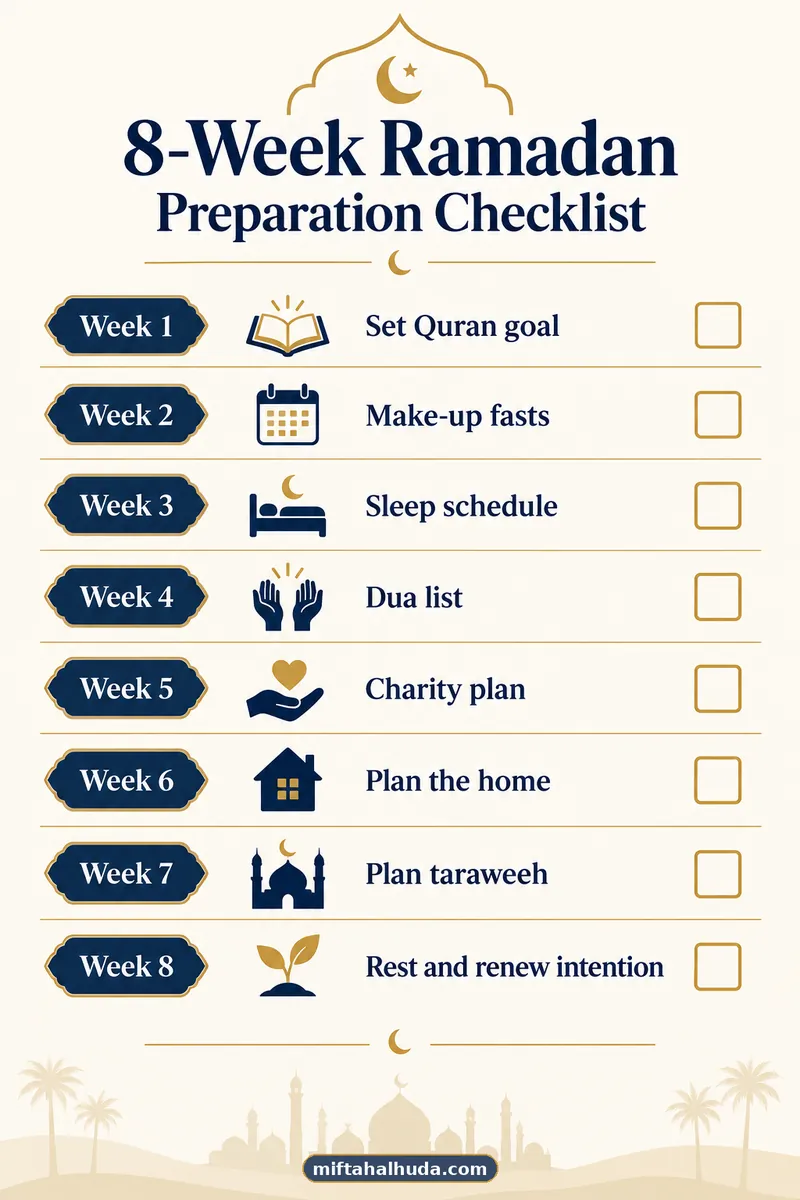
Weeks 8-6 before Ramadan (mid-December to early January): Repentance and the written intention. Start the dua list. Begin ten pages of Quran daily. First weekly suhoor practice. Review the fasting rules.
Weeks 5-4 (mid-January, Sha’ban begins): Mondays and Thursdays fasting begins. Make-up fasts scheduled and started. Quran pace to fifteen pages. Bedtime shift starts. Children briefed and excited.
Weeks 3-2 (late January): White days fasted (~January 21-23). Quran at a full juz daily. Caffeine taper. Big shopping done. Work arrangements confirmed. Charity budget decided.
Final week (early February): Make-up fasts finished. House stocked and worship corner ready. Dua list printed. Sleep schedule on Ramadan time. Last two days: rest, as the Sunnah pauses voluntary fasting before the month.
The night of the crescent: Greet the month with the dua of sighting the new moon, a grateful heart, and the intention you wrote eight weeks ago. You are ready.
Common Preparation Mistakes
- Starting everything on the first night. The person who plans to begin Quran, fasting practice, sleep shifting and charity all on 1 Ramadan has planned to fail by the fifth.
- Over-planning. Twenty resolutions die together. Choose a few foundations and build the rest in the month.
- Preparing the body and forgetting the heart. Stocked freezers with unrepented sins make a strange Ramadan. The heart’s preparation comes first on this checklist for a reason.
- Leaving make-up fasts to the last week of Sha’ban. Illness, travel and exhaustion punish the procrastinator. Aisha’s (may Allah be pleased with her) Sha’ban was a month-long window, not a final day.
- Preparing alone. A family or a friend circle that prepares together arrives together. Share the checklist.

Preparing for the Last Ten Nights Before Ramadan Starts
The last ten nights are the crown of the month, and they punish the unprepared. They begin around February 26, 2027, and Laylat al-Qadr hides among them. Everything about them is easier if it was arranged in Sha’ban:
- Work leave for the last ten is requested months ahead, not days. Put the request in writing now.
- I’tikaf, if you intend it, needs a masjid, family agreement and a packed bag. Ask your masjid in early Sha’ban what arrangements exist, and plan the home alternative if not, as the Laylat al-Qadr guide describes.
- The dua list must be finished by then, because those nights are for asking, not for composing. Learn the taught dua “Allahumma innaka ‘afuwwun tuhibbul-‘afwa fa’fu ‘anni” by heart before the month begins; it takes one evening.
- Charity for the ten nights scheduled in advance: some families split their Ramadan sadaqah into ten parts so that no night passes without giving, guaranteeing that the Night of Decree carries their charity.
The believer who reaches the 20th of Ramadan with these four things already arranged spends the ten nights in worship. The one who did not spends them in logistics.
The Two Months Before: Rajab and Sha’ban in Focus
Allah, in His wisdom, placed two full months between the busy year and Ramadan, and the Sunnah fills both with meaning. Understanding their roles turns “preparation” from a slogan into a calendar.
Rajab (begins ~December 10, 2026) is the month of awakening. A sacred month, one of the four named in Surah At-Tawbah, it is the season of repentance, of restarting the Quran habit gently, and of planting the intention. No special fasts or rituals are legislated for it, as our Rajab guide details, which makes it the perfect quiet workshop: all the preparation, none of the noise.
Sha’ban (begins ~January 9, 2027) is the month of training. The Prophet (ﷺ) fasted it more than any other month because deeds are raised in it, and the early generations called it the month of the reciters because they began their Quran drives in it. Its middle brings the white days and, two weeks before Ramadan, the final checkpoint, as the mid-Sha’ban guide explains.
Plant in Rajab, water in Sha’ban, harvest in Ramadan. The checklist above is simply that ancient rhythm written out in modern weeks.
Preparing Your Eid in Advance
Strange as it sounds in December, the best Ramadan preparation reaches past Ramadan to Eid. Zakat al-Fitr is due before the Eid prayer, and the one who plans it now will never scramble on the last night. Eid clothes bought in the quiet of Sha’ban cost less and distract no one. And the six fasts of Shawwal, which carry the reward of fasting the year, begin two days after Eid; the person who knows this in advance catches them while the fasting habit is still warm.
Hold the whole season in view: Ramadan is the center, but the road runs from Rajab to Shawwal, and every stage of it rewards the one who saw it coming.
Picture Your Prepared Ramadan Day
It is worth seeing clearly what all this preparation buys. The alarm sounds before dawn, but your body has been waking at this hour for weeks. Suhoor is already on the table because it was prepared the night before, and the family eats while someone reads a page of Quran aloud. Fajr is prayed in its time, the morning adhkar are said from memory, and the day begins.
The workday passes on familiar fuel, because Sha’ban taught your body fasting. At four in the afternoon the kitchen is calm: the meal was planned in a week of simple menus, and no one has stood at a stove since noon. Fifteen minutes before Maghrib, the family gathers, the printed dua list comes out, and the last minutes of the fast are spent asking, not stirring. Iftar follows the Sunnah: dates, water, the reported words, Maghrib, then a moderate meal.
Isha and taraweeh are unhurried. Before sleep, ten pages of the day’s juz remain; you read them in twenty minutes because the pace was built two months ago. The dua list gets one more pass. And you sleep early, because bedtime was moved in December, knowing tomorrow runs the same gentle track, all the way to the last ten nights, whose leave was approved in January.
None of this is fantasy or exceptional piety. It is simply what happens when the farmer plants in Rajab and waters in Sha’ban. The checklist above is the whole method. Start this week, and the Ramadan you just read about is yours, by Allah’s permission.
Frequently Asked Questions About Preparing for Ramadan
1. When should I start preparing for Ramadan 2027?
Ramadan 1448 begins around February 8, 2027, and audience research shows planning starts up to eight weeks before, which means mid-December 2026. Spiritually, the Sunnah’s own season opens with Rajab (December 10, 2026) and intensifies through Sha’ban, so the earlier the heart starts, the deeper the month goes.
2. What is the most important part of Ramadan preparation?
Repentance and the five daily prayers on time. Every other item on the checklist builds on those two, and no amount of meal planning or Quran scheduling compensates for a heart that has not turned back to Allah.
3. How do I prepare my body for fasting?
Fast Mondays, Thursdays and the white days through Sha’ban, shift your sleep earlier gradually from Rajab, taper caffeine in the two weeks before the month, practice a weekly suhoor wake-up, and consult your doctor early if you have any medical condition.
4. How many pages of Quran should I read daily to finish in Ramadan?
A full khatmah needs about twenty pages (one juz) a day, roughly four pages after each prayer. Build to that pace gradually across Rajab and Sha’ban rather than starting cold, and use the day-by-day plan in our Ramadan Quran reading schedule.
5. What duas should I learn before Ramadan?
Start with five: the dua of breaking the fast, the dua of Laylat al-Qadr, a Quranic dua such as Rabbana atina, a dua for your parents, and Sayyid al-Istighfar. All five, with Arabic text and translation, are in our Ramadan duas collection.
6. How do I prepare my children for their first Ramadan?
Start weeks early with excitement, not pressure: a countdown calendar, age-appropriate fasting practice, small daily Quran and dua habits, and involvement in suhoor and iftar. The Ramadan for kids guide on this site walks through every age group.
7. Is it wrong to prepare food and decorations before Ramadan?
Preparing the home is wise and needed; the caution is about scale and belief. Simple decorations and good food as family customs are fine, as long as they are not treated as religious rituals of the month and do not consume the time and money that worship deserves.
8. What if Ramadan starts and I have prepared nothing?
Start where you stand. Ramadan’s doors of mercy do not check your preparation at the entrance. Begin the checklist on day one, at half pace, and the month will still carry you further than you expect, by Allah’s permission.
Learn to read the Quran correctly
Start or improve your Quran reading with a certified teacher, one-to-one online.
One Response